How Can Restaurant Booths Be Repaired Without Closing the Dining Room?
A restaurant loses more to a booth being out of service than to the repair itself. Almost all of that is schedulable.
Quick answer
By working in sections outside service hours and putting the cure period into hours the room is closed anyway. Booth repair is mobile, so nothing leaves the building. A section is repaired between closing and opening, or during a slow daypart with that area roped off, and it is back in service by the next service. The constraint is not the repair — it is the window before the surface takes friction, which is why overnight work suits restaurants better than anything else.
At a glance
| Nothing leaves | Booths are fixed to the floor; the work comes to them |
|---|---|
| Work in sections | One area at a time keeps the rest of the room selling |
| Best window | Overnight — the cure period costs nothing |
| Real cost | Covers out of service, not the invoice |
| Batch it | Several booths in one visit shares setup and color mixing |
The number that actually matters
For a restaurant, the cost of a booth repair is the invoice plus the covers that booth did not turn while it was out of service.
A four-top booth out for a Friday and Saturday is a meaningful number in most rooms, and it is usually larger than the repair itself.
That reframes the whole question. It is not how cheaply the vinyl can be fixed — it is how few service hours the fix consumes.
And once you look at it that way, nearly all of the available saving is in scheduling rather than in the work.
The same logic applies to the appearance problem. A booth with a taped seat or a visible split is costing you something every service it is seen, whether or not it is occupied.
So the two questions worth asking a specialist are when they can work and how long before the section is back in service — before asking what it costs.
Why booth work is mobile by nature
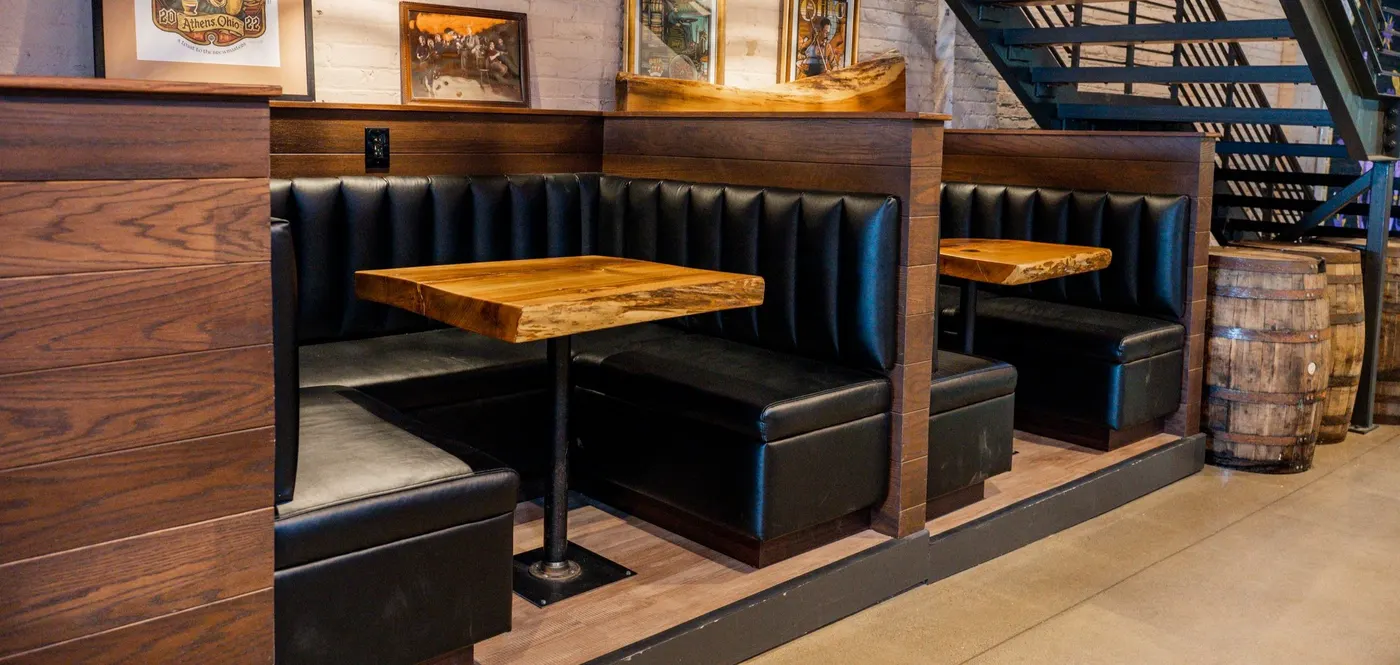
Restaurant booths are built into the room, which turns out to be an advantage rather than a problem.
They are fixed to the floor and often to the wall, and the backs are frequently shared between two booths.
Removing them would mean dismantling part of the dining room, so nobody does it for cosmetic work.
That means the work comes to the building as a matter of course. There is no transport, no shop slot, and no period where a booth is absent.
The specialist arrives with everything needed, works on the seating in place, and leaves.
For seat and back panels — which is where nearly all booth damage is — access is straightforward because the damaged surfaces are the ones facing into the room.
Only full reupholstery of a removable seat pad involves anything leaving, and many booth seats are fixed rather than removable.
Working in sections
This is how a dining room stays open, and it is a planning decision more than a technical one.
The room is divided into working areas, and one is taken out of service at a time while the rest keeps selling.
A section is roped off or simply not seated, the work happens, and it comes back before the next service.
How large a section can be depends on the room. A restaurant with a hundred covers can lose ten for a lunch service; one with thirty cannot.
It is worth mapping this before booking rather than deciding on the day, because the sequence determines how many visits are needed.
The other consideration is appearance. A section under repair in the middle of a service is visible, so most operators prefer to keep the work out of the room entirely by using closed hours.
Which brings us to the part that actually decides the schedule.
The cure period is the real constraint
This is the part that gets underestimated and it is where poor planning costs a service.
A filled and refinished repair needs a period before the surface takes friction and load. How long depends on the products and on the day's temperature and humidity, so a specialist confirms it at the end rather than promising a figure in advance.
On a booth seat, friction means people sliding across it — which is exactly how a booth is used.
So a repair finished at four in the afternoon on a humid day, with the room opening at five, is either not opening that section or getting the repair marked and paying twice.
The fix is not a faster cure. It is putting the cure period where it costs nothing.
For a restaurant that is unusually easy, because the building is closed for a predictable block every day.
Overnight work with the section back in service at opening is the standard arrangement and it removes the problem entirely.
The windows that work
In rough order of how well they suit a restaurant.
Overnight, after close and before open. The cleanest option — a full cure window in hours the room was empty anyway.
The gap between lunch and dinner service, for smaller jobs where the cure time fits.
A scheduled closed day, which many restaurants have and which suits a larger batch.
Early morning before prep, for work in areas away from the kitchen.
A planned closure for other maintenance, where interior work in the same window is effectively free downtime.
What does not work is squeezing a repair into the hour before a service, which is how repairs get marked in their first hours and end up being redone at your cost in goodwill if not in money.
Where booths actually fail
The pattern is consistent across rooms and it helps to know what to walk the room looking for.
The front edge of the seat, from people sliding in and out, which is the most common failure by a wide margin.
The outer corner of the seat nearest the aisle, which takes the same sliding plus bags and passing traffic.
The top edge of the seat back, where hands rest and where people grip when standing.
The seams along the front edge and around the corners.
The back panel at head height, which takes hair products and skin oils and goes dark before it wears.
The base and kick panel, which takes shoes, cleaning equipment and mop contact.
And any point where the booth meets a table edge, which is a repeated contact point that most people never look at.
Batching across the room
This is where the cost per booth is decided, and it favors planning over reacting.
Travel, setup, cleaning products and color mixing are largely fixed per visit rather than per booth.
Restaurant seating is usually one or two colors across the whole room, so a single color mix serves every booth in the building.
So a room where six booths are repaired in one overnight session costs substantially less per booth than six separate call-outs across a year.
The practical approach is a standing arrangement rather than reactive calls: a scheduled visit that clears whatever has accumulated, with anything urgent handled between.
It also produces a consistent standard across the room, which matters because guests see the whole space rather than one booth.
And it lets an operator budget the work rather than being surprised by it.
What can and cannot be done in place
Being clear avoids a wasted overnight visit.
Done in place: tears, punctures, burns, worn seat fronts, cracked areas, split seams that can be hand-stitched, recoloring faded or discolored panels, and rebuilding worn edges and piping.
Also in place: cleaning and degreasing panels that have gone dark with accumulated soil, which on a booth back can be most of the visible problem.
Taken away or done separately: full reupholstery of a removable seat pad, machine restitching of a long seam, and panel replacement where the material has to be remade.
Not upholstery work: loose or broken frames, damaged bases, and anything structural in the booth carcass.
Where a seat pad does have to leave, it usually goes during one visit and returns in another, so the booth is only missing a pad rather than being unusable — and a spare pad can bridge the gap in some rooms.
Working around a commercial kitchen
A few practicalities specific to food service that are worth agreeing in advance.
Ventilation. Refinishing products need airflow, and a closed dining room overnight with the extraction off is not ideal. Running the ventilation during the work solves it.
Food safety. Work should be scheduled so that surfaces are fully cured and the area cleaned before any food preparation or service resumes, and prep areas should be protected or clear.
Access and security. Overnight work means somebody's keys and alarm codes, which usually needs a manager present or a defined arrangement.
Cleaning schedules. Overnight cleaners and repair work in the same room at the same time do not mix well — grease and cleaning chemicals in the air prevent bonding.
So the sequence that works is cleaners first, then repair, then the room is left to cure.
It is worth having the specialist and the cleaning contractor aware of each other rather than discovering the conflict at two in the morning.
Telling the team what is happening
A small amount of communication prevents most of the friction around overnight work.
The closing shift needs to know somebody is coming, what time, and that the section should be cleared and cleaned before they leave.
The opening shift needs to know which section was worked on and whether anything should not be sat on yet, since a repair that needs another hour is easy to protect and easy to ruin.
A simple sign or a couple of chairs across the section handles it better than a verbal handover that gets missed.
Front of house should know so they can seat around it without improvising during a service.
And whoever holds the cleaning schedule should know not to have contractors in the same room at the same time.
None of this takes long, and it is the difference between an overnight repair that nobody notices and one that generates three separate problems the following morning.
What to send when arranging a visit
A room walk and a list beat a photo album.
The number of booths affected and what is wrong with each, in one line per booth.
One representative photograph per damage type rather than a full set for every booth.
The material — whether it is genuine leather, a commercial vinyl, or a coated synthetic — and the color, since matching is where time goes.
The access window, including whether overnight work is possible and who can provide access.
When each section needs to be back in service, which is what determines the sequencing.
Whether the seat pads are fixed or removable.
And whether there is a remodel, a rebrand or a color change planned, since that changes whether repair or recoloring is the right answer.
Questions we get asked next
- Do we have to close the restaurant?
- No. Work happens in sections outside service hours, most often overnight, and the section is back in service at opening. The building is closed for a predictable block every day, which makes restaurants easier to schedule around than almost any other commercial space.
- How long before a repaired booth can be used?
- It depends on the work and the day's temperature and humidity, so the specialist confirms it at the end rather than promising a figure up front. The practical planning rule is to put the cure period into closed hours rather than trying to fit it between services.
- Can several booths be done in one visit?
- Yes, and it is substantially cheaper per booth. Travel, setup and color mixing are shared, and restaurant seating is usually one or two colors across the whole room. A scheduled visit that clears accumulated work beats reactive single call-outs.
- Do booths need to be removed?
- Almost never. They are fixed to the floor and often to the wall, and the damaged surfaces are the ones facing into the room, so access is straightforward. Only full reupholstery of a removable seat pad involves anything leaving the building.
- restaurant booths
- downtime
- commercial