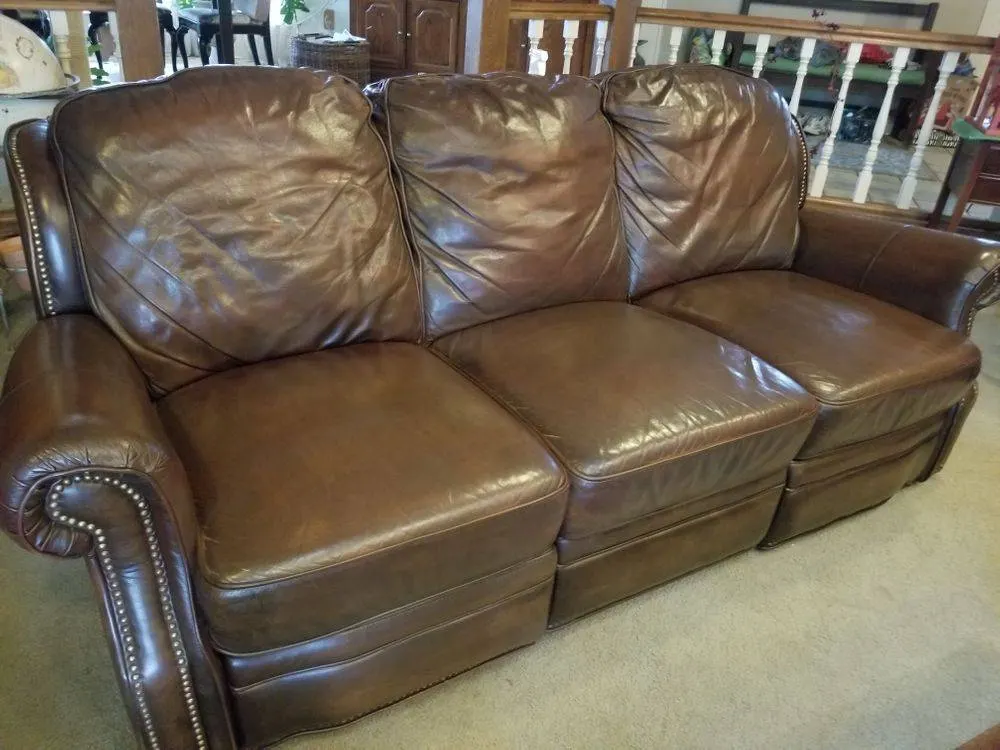
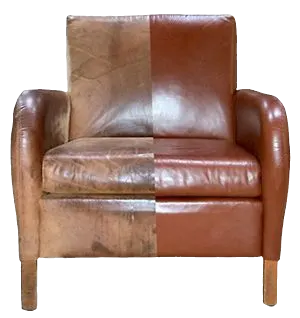
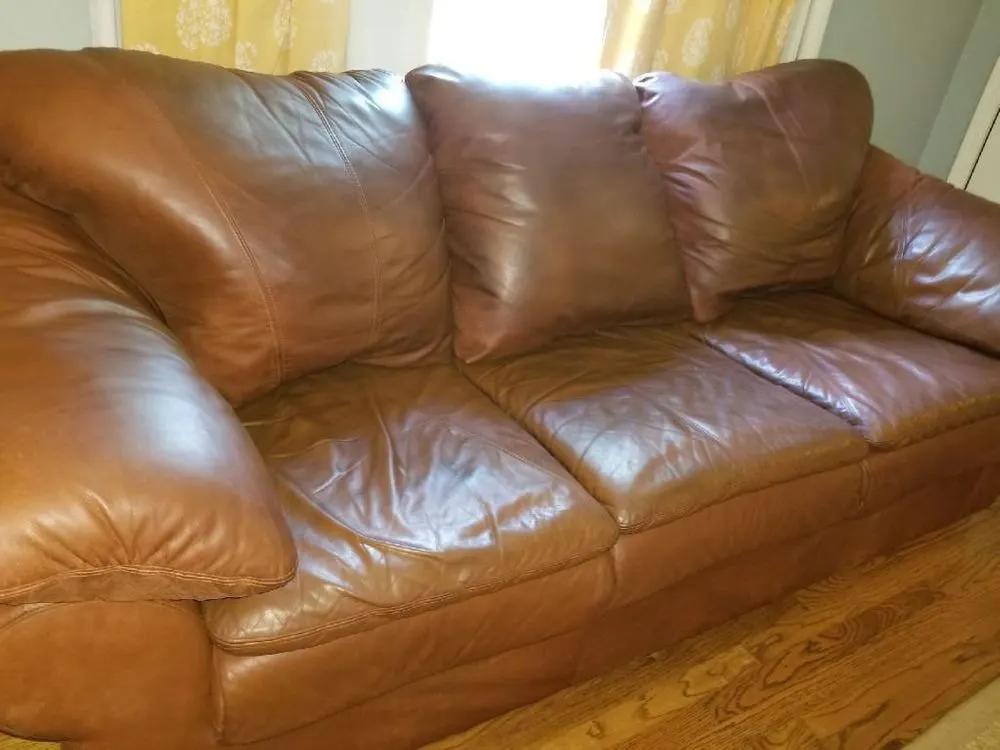
Full-Grain vs. Top-Grain vs. Corrected-Grain Leather: Does Repairability Differ?
Counter-intuitively, the most expensive leather is the hardest to repair invisibly — and the cheapest-sounding grade is the most forgiving.
Quick answer
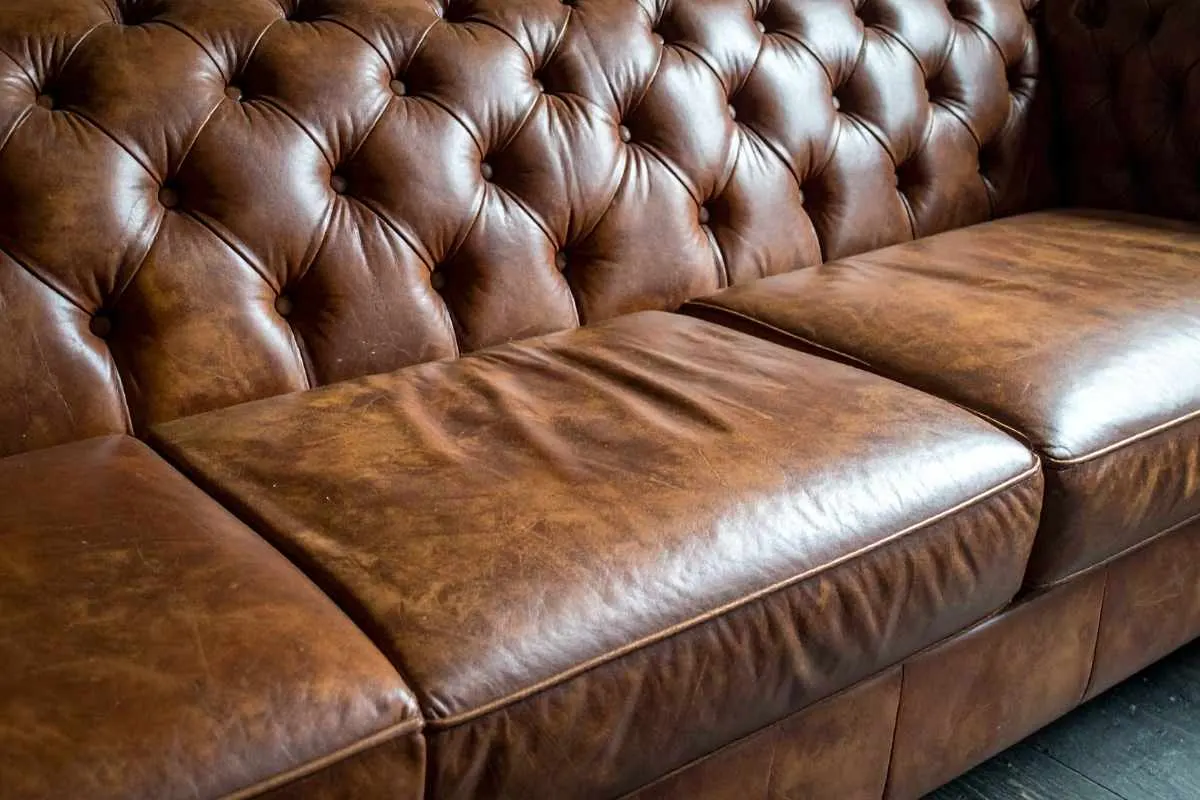
Yes, and not in the direction people expect. Corrected-grain leather repairs most invisibly because it carries a thick pigment layer and an embossed texture, both of which can be rebuilt exactly. Top-grain sits in the middle. Full-grain is structurally the toughest and the longest-lived, but it is the hardest to repair invisibly, because its value comes from a natural surface that cannot be reproduced by pressing a pattern into filler.
At a glance
| Full-grain | Natural surface intact. Strongest and longest-lived. Hardest to repair invisibly |
|---|---|
| Top-grain | Surface lightly sanded and finished. Durable, repairs well, most common on quality furniture |
| Corrected-grain | Sanded, embossed and heavily pigmented. Repairs most invisibly of the three |
| Split / genuine leather | Lower layer of the hide with an applied surface. Repairs, but wears faster |
| Best repair outcome | Corrected-grain, because texture and color are both reproducible |
What the grades actually describe
These terms describe how much of the hide's natural outer surface survives into the finished material, and they are widely misused in furniture marketing.
A hide has a natural outer layer — the grain — which is the densest and strongest part, formed of tightly packed fibers. Below it sits the corium, a looser fibrous layer, and hides are often split horizontally into layers to yield more material.
Full-grain means the natural outer surface is intact, unsanded and unaltered. Every mark the animal acquired is still there: scars, insect marks, brand marks, variation in pore density.
Top-grain means that outer surface has been lightly sanded to remove the worst imperfections, then finished. It is still the strong outer layer, just smoothed.
Corrected-grain means the surface has been sanded more heavily, then embossed with an artificial grain pattern and coated with a substantial pigment layer to produce a uniform appearance.
'Genuine leather' as a marketing term is the confusing one — it usually indicates a split layer from below the grain with an applied surface, which is real leather but the weakest of these options.
Why full-grain is the hardest to repair invisibly
This surprises people who assume more expensive means more repairable.
The value of full-grain lies in a surface that is natural and irregular. Pore density varies, there are healed scars and growth marks, and the way it reflects light changes across a panel. That irregularity is what makes it beautiful and what makes it impossible to reproduce.
A leather repair rebuilds texture by pressing a grain pattern into filler. Grain papers reproduce a repeating pattern very convincingly — which works perfectly on an embossed surface that was itself made by pressing a repeating pattern. On a natural surface, a pressed pattern is a regular texture sitting inside an irregular one, and the eye picks that up under raking light.
Color is the second difficulty. Full-grain furniture is frequently finished aniline or semi-aniline, meaning the color is in the hide rather than in an opaque coating on top. There is no pigment layer to blend a repair into.
What this means in practice: a tear in full-grain leather can be made structurally sound and much less noticeable, and a good repair is genuinely good. But 'invisible from a foot away' is a fair expectation on corrected-grain and an optimistic one here.
Why corrected-grain repairs so well
Corrected-grain gets a poor reputation among leather enthusiasts and is the best news a repair customer can have.
Its surface texture is an embossed pattern, applied mechanically and repeating. That is exactly what a grain paper reproduces, so the texture of a repair can be matched genuinely rather than approximately.
Its color sits in an opaque pigment layer on top of the hide. Rebuilding that layer is standard work, and because it is opaque, a rebuilt area is fully covered rather than partially translucent.
And because the finish is comparatively thick, it tolerates the cleaning, degreasing and light abrasion that surface preparation involves without the underlying hide being affected.
The combined result is that most repairs on corrected-grain furniture are invisible in normal light and normal use. If you have a mid-range family sofa in a uniform color, this is very likely what you have, and the outlook is good.
Top-grain: the middle ground, and the most common
Top-grain is where most quality furniture and virtually all automotive leather sits, and it behaves well.
The surface has been lightly sanded, so it is more uniform than full-grain but retains more character than corrected-grain. The finish applied over it is usually pigmented, though more lightly than on corrected-grain.
For repairs this is a comfortable middle: there is a pigment layer to work with, the texture is regular enough to match convincingly, and the hide underneath is the strong outer layer, so it takes a backing and filler well.
The one caution is that lighter pigmentation means color matching has to be more precise. On a heavily pigmented corrected surface, small mismatches disappear under the opacity; on a lightly pigmented top-grain, they show.
Split leather and 'genuine leather'
This grade is worth understanding because the label sounds reassuring and the material is the weakest of the four.
When a hide is split into layers, the lower layers lack the dense fiber structure of the grain. To make them usable as upholstery, a surface is applied — often a polyurethane coating, embossed to look like grain.
It is genuine leather in the literal sense, and it is not the same thing as bonded leather, which is a coating containing ground leather fiber. But the wear characteristics are much closer to a coated synthetic than to top-grain.
For repair, the applied surface behaves reasonably like corrected-grain and matches well. The limitation is durability: the substrate is weaker, so tears propagate more readily, and a repair sits in material that is itself less robust than the repair.
If a label says only 'genuine leather' with no grade qualifier, this is usually what it means.
How to tell which one you have
Look closely at the surface under a strong raking light, ideally with a phone camera zoomed in.
Corrected-grain shows a pattern that repeats. Once you find the repeat — the same cluster of pores appearing at regular intervals — it is definitive.
Full-grain shows no repeat at all, plus visible natural marks: healed scars, wrinkle lines from the animal's neck, variation in pore size across the panel.
Top-grain sits between: no obvious repeat, but more uniformity and fewer visible natural marks than full-grain.
The cut edge helps too. Look under a cushion or at a seam. Full-grain and top-grain show a dense outer layer with looser fiber beneath; split leather shows a more uniform loose structure with a distinct applied coating on the face.
And check how the surface responds to a drop of water on a hidden area. Full-grain and aniline finishes usually darken as they absorb; heavily pigmented corrected surfaces bead.
Which grade lasts longest in this climate
Durability and repairability are different questions, and full-grain wins the first one decisively.
The intact grain layer is the strongest part of the hide, which is why full-grain is used where leather has to survive decades of hard use. It also develops patina rather than simply wearing out, so an aged full-grain piece often looks better than a new one.
In North Texas the relevant stress is drying rather than abrasion. Strong UV and year-round air conditioning pull plasticizers out of any leather, and the result is stiffness and eventually cracking at fold lines.
Full-grain and top-grain tolerate that better than corrected-grain or split leather, because there is more sound fiber structure to work with. But no grade is immune, and conditioning matters more here than the grade does. A neglected full-grain sofa in a sunroom will fail before a well-maintained corrected-grain sofa in a shaded room.
Setting realistic expectations before a repair
This is where knowing the grade actually pays, because it lets a specialist set expectations honestly rather than promising the same outcome for every piece.
On corrected-grain, the reasonable expectation is that the repair will not be findable without being told where it is.
On top-grain, the same is usually true, with slightly more attention needed to color.
On full-grain and aniline finishes, the honest expectation is a repair that is structurally sound, considerably less noticeable, and possibly still detectable to someone looking closely under good light. Anyone promising invisibility on a full-grain aniline hide is over-promising.
That conversation should happen before the work, not after. A customer who was told what to expect is satisfied by a good result; a customer who was promised invisibility is disappointed by the same result.
Why the same grade behaves differently on furniture and in cars
Automotive leather is nearly always top-grain or corrected-grain, and it is finished to a specification furniture leather rarely meets — which is worth knowing when comparing a car seat repair to a sofa repair.
Vehicle interiors face surface temperatures far above anything in a house, constant UV through glass, and abrasion levels no living-room sofa approaches. So automotive finishes are built thicker, harder and more heat-resistant, and the hides are usually selected for consistency rather than character.
For repair this is helpful. A harder, thicker finish gives more to work with, and consistent hide means color matching is more predictable across a panel.
It also explains a common confusion. Owners sometimes ask why their car's leather feels less luxurious than their sofa's despite costing more. It is not lower quality — it is a finish engineered for a far harsher environment, and it is a large part of why automotive interiors survive Texas summers at all.
The reverse holds too: furniture-grade finishes applied to a vehicle will not last, which is why the products used differ even when the technique is identical.
What to send for an assessment
Grade is one of the things a photograph reads well, provided the light is right.
Take a close-up of an undamaged area of the leather from about six inches away, lit from the side rather than straight on, so the grain texture stands out. That single image usually identifies the grade.
Add the standard set: a wide shot of the whole piece, the damage square-on, the damage at a raking angle, and the label under the seat deck if there is one.
If you know what the piece cost and roughly when it was bought, say so. Price bracket correlates strongly with grade, and it helps confirm what the photographs suggest.
Questions we get asked next
- Is full-grain leather worth the extra cost?
- For longevity, yes — it is the strongest part of the hide and it ages into a patina rather than simply wearing out. Just be aware that its repair outlook is different: damage can be made sound and much less visible, but perfectly invisible repair is a fair expectation on corrected-grain rather than on full-grain.
- Can corrected-grain leather be made to look like full-grain?
- No. The natural surface was removed during manufacture and cannot be restored. A refinish can change color, sheen and texture within what embossing allows, but the irregular character of a natural grain is not recoverable.
- Does 'genuine leather' on a label mean it is good quality?
- It means the material contains real leather, nothing more. In practice it usually indicates a split layer from below the grain with an applied surface, which is the weakest of the real-leather grades. A quality piece will usually specify top-grain or full-grain.
- Which grade should I buy if I have pets?
- Top-grain or corrected-grain, both for durability and for repairability. Claw damage on those repairs invisibly, whereas the same damage on full-grain aniline can be stabilized but may stay faintly visible.
- full-grain
- top-grain
- leather grades