Is My Car Seat Leather or Vinyl, and Why Does It Matter for Repair?
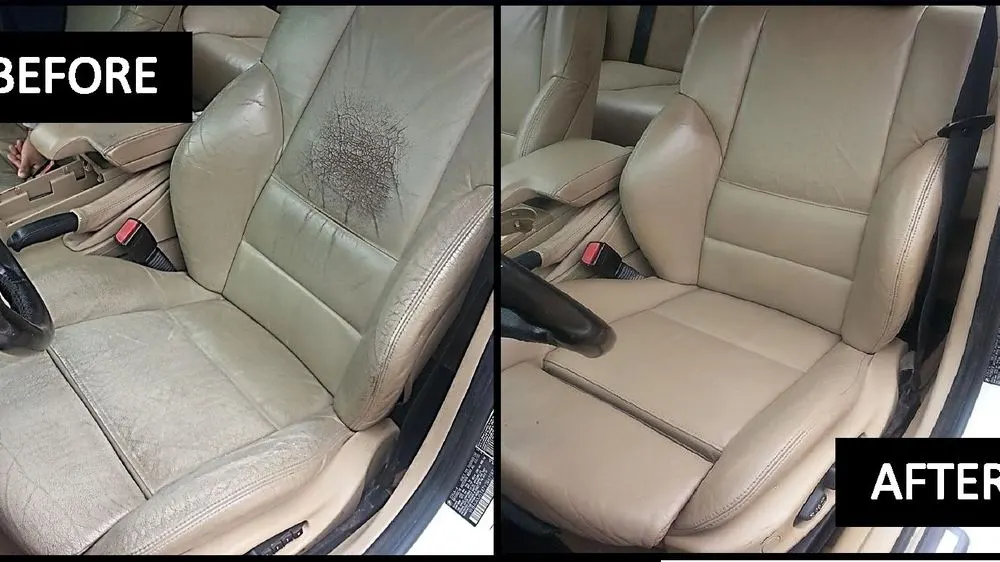
Manufacturers routinely put hide where you sit and vinyl where you do not. That is why one part of a seat can fail while the rest looks new.
Quick answer
Most vehicles use both. Genuine leather typically covers the center seating surfaces, while vinyl covers the bolsters, seat backs and sides — a construction sometimes marketed as leather-appointed or leather-trimmed. Check by feel and warmth, look for a repeating grain pattern under raking light, and compare the seating surface with the side. Both materials repair well, but they take different fillers, different colors and different topcoats, so identifying each surface correctly matters.
At a glance
| Common construction | Hide on center seating panels, vinyl on bolsters, backs and sides |
|---|---|
| Leather signs | Warms under the hand, irregular grain, softer, smells organic at seams |
| Vinyl signs | Repeating embossed pattern, cooler and more uniform, slight plastic smell |
| Repair outlook | Both repair reliably; vinyl is often the more predictable of the two |
| Why it matters | Different fillers, color systems and topcoats for each |
Why one seat contains two materials
This is not a shortcut manufacturers hide — it is standard practice, and it makes reasonable engineering sense.
Hide is expensive, and its advantages are felt where a body touches it: breathability, the way it warms, the way it gives. Those advantages matter on the center of a seat cushion and the center of a backrest. They matter far less on the outer side of a bolster or on the back of a seat, where nobody's skin makes contact.
So manufacturers commonly specify genuine leather for the seating surfaces and a coordinated vinyl for the bolsters, the seat backs, the sides and sometimes the headrest sides. The color and grain are matched closely enough that most owners never notice.
The marketing language reflects this: 'leather-appointed', 'leather-trimmed' and 'leather seating surfaces' all describe mixed construction. 'Full leather' or 'all leather' is a genuinely different specification, usually on higher trim levels.
Understanding this explains a pattern owners find baffling — that the bolster is peeling while the seating surface looks almost new. Those are two different materials with two different lifespans, both behaving normally.
How to tell them apart in your own car
Four checks take about a minute and do not damage anything.
Put your palm flat on the center of the seat cushion for thirty seconds, then do the same on the outer bolster. Leather warms to skin temperature and stays warm. Vinyl warms more slowly and often feels slightly clammy afterward.
Look closely at both surfaces under strong light, ideally with a phone camera zoomed right in. Vinyl carries an embossed pattern from a roller, so it repeats. Find the same cluster of pores appearing at regular intervals and you have vinyl. Leather does not repeat, even when it is corrected-grain, and it usually shows small natural variations.
Press a thumb into each surface. Leather deforms with fine wrinkling around the contact point and recovers slowly. Vinyl deforms and springs back more uniformly, with less fine wrinkling.
Smell at a seam where the finish is thinnest. Leather has an organic smell; vinyl smells faintly of plastic or of nothing at all.
If your findings differ between the center panel and the bolster, that is the mixed construction described above rather than a mistake in your testing.
Why the distinction changes the repair
The technique looks the same from the outside — clean, fill, texture, color, seal — but the materials at each stage differ.
Fillers formulated for leather are designed to bond to a fibrous hide surface and to flex the way a hide flexes. Vinyl fillers bond to a plastic surface and match vinyl's different flex characteristics. Using the wrong one produces a repair that releases at its edges within months.
Color systems differ too. Vinyl takes a different carrier from leather, and a leather color applied to vinyl can sit on the surface rather than keying into it.
Topcoats differ in hardness and flexibility, matched to what the substrate does under load and heat.
So a repair spanning both materials — a tear that crosses from the seating surface onto the bolster, for instance — is genuinely two repairs meeting in the middle, and it needs to be approached that way rather than treated as one.
Which one lasts better in a Texas vehicle
This surprises people who assume leather is automatically superior.
Automotive vinyl is engineered for heat, UV and abrasion, manufactured to a consistent thickness, and it is genuinely durable. It is used in commercial fleets, work trucks and marine seating precisely because it takes punishment.
Leather is more comfortable — it breathes, it warms rather than sticking, and it feels better on skin in both extremes of temperature. But it needs conditioning to stay supple, and in a car parked outside through Dallas summers it loses plasticizers faster than almost any other environment will do to it.
Neglected leather in this climate will fail before well-specified vinyl. Maintained leather outlasts most vinyl and stays far more pleasant to sit on.
The practical implication for owners here: if your seating surfaces are hide, conditioning them three or four times a year is not optional maintenance in the way it might be in a mild climate. It is the difference between a seat that lasts the life of the vehicle and one that cracks at the bolster in year six.
The wear pattern each material shows
Knowing which material is where lets you read the damage correctly.
Leather seating surfaces fail by drying, stiffening and then cracking along the fold lines — usually across the center of a seat cushion where it flexes. Before that, the finish goes matte and the color dulls.
Vinyl bolsters fail by abrasion first, because that is the surface the driver slides across on every entry. The embossed grain wears smooth, then the color goes, then the surface splits.
Vinyl also fails by shrinkage and hardening in extreme heat, which shows up as a seam pulling tight or a panel that no longer sits smoothly over its foam.
If you can identify which material is showing which symptom, you can usually predict what the rest of the interior will do — and time the repair before a worn bolster becomes a torn one.
Perforated panels are a third case
Many vehicles use perforated material on the seating surfaces for heating and ventilation, and it is worth identifying separately because it changes how a repair is done.
Perforated leather and perforated vinyl both exist, and both require the holes to stay open. Filler that closes them blocks the airflow ventilation depends on, and a solid patch inside a perforated panel is visible from across the cabin.
Liquids are the other consideration. Cleaning products and finishes that run into perforations reach the foam and, on ventilated seats, the ducting and fan below. Work near perforation uses minimal liquid and careful masking.
If your seats are heated or ventilated, say so when asking for an estimate. It is not an obstacle — perforated panels are repaired routinely — but it is slower and more careful work than the same damage on a solid panel.
Looking after a seat that is both
Mixed construction means the two surfaces want slightly different care, and treating the whole seat identically shortens the life of one of them.
Clean both with a product intended for automotive interiors, applied to a cloth rather than sprayed directly, so nothing runs into seams or perforations. That part is common to both.
Condition the leather seating surfaces three or four times a year in this climate. That is the panel that dries, stiffens and eventually cracks, and it is the one that repays the effort. Concentrate on the center of the cushion and the center of the backrest.
Treat the vinyl bolsters with a dressing made for vinyl rather than a leather conditioner. Heavy leather products on vinyl leave a slick residue, which on a bolster you slide across every day is genuinely unpleasant and slightly hazardous.
Avoid high-gloss silicone dressings on any interior surface. They look impressive for a week, they attract dust, they migrate onto clothing, and they contaminate the surface so that any future repair needs extra preparation before a finish will bond.
And park in shade wherever possible. Nothing else you can do has a comparable effect on how long either material lasts here.
What this means when you get a quote
A specialist should identify the materials before quoting, and it is reasonable to ask which surfaces they think are which.
If a quote treats the whole seat as one material without comment, that is worth a question. It may be a full-leather vehicle, in which case fine — but on a mixed-construction seat it suggests the assessment was quick.
Ask specifically what will be used on each surface. The answer does not need to be a product list, but someone who works with both materials will describe them as different jobs.
And ask what happens at the boundary between them, if your damage crosses one. That transition is where an inattentive repair shows itself first, because the two materials take color slightly differently and the join is exactly where the eye goes.
Photographing it for an assessment
Open the door and shoot in daylight with no flash — car interiors are dim, and flash removes exactly the surface texture that identifies the material.
Take one close-up of the center seating surface from about six inches, lit from the side so the grain stands out. Take a second of the bolster at the same distance and angle. Comparing those two images usually settles the construction question immediately.
Add a wide shot of the whole seat, a square-on shot of the damage, and one from a low raking angle so depth shows.
Say what the vehicle is and roughly its age, whether the seats are heated or ventilated, and whether there is an airbag tag on the outboard edge of the seat back. Those three details shape both the method and what can legitimately be quoted.
Mention how the vehicle is parked, too. A car that lives outside in full sun has a different finish requirement from one that lives in a garage, and in this climate that difference is large enough to change which topcoat is appropriate. It also explains a lot of damage before anyone has to ask about it.
Questions we get asked next
- My car was advertised with leather seats but the bolsters feel like vinyl. Was I misled?
- Almost certainly not. 'Leather-appointed' and 'leather seating surfaces' are standard descriptions for mixed construction, and it is used across most manufacturers at mid trim levels. It is worth knowing about, but it is normal specification rather than a defect.
- Does vinyl repair as well as leather?
- Usually better, in the sense of being more predictable. Vinyl is manufactured to a uniform thickness and takes filler and color consistently, whereas hide varies across a panel. The reason vinyl repairs are so common in commercial and marine work is exactly that reliability.
- Can vinyl bolsters be replaced with leather?
- Technically yes, through a trim shop making new panels. In practice it is rarely worth it — the cost approaches reupholstering the seat, and the vinyl was specified for a surface that takes heavy abrasion, where hide would wear faster.
- Should I use the same conditioner on both?
- Check the product. Leather conditioners feed a fibrous hide; vinyl needs a dressing formulated for a plastic surface, and heavy leather conditioners on vinyl can leave a slick residue. Some automotive products are made for both, and those state it clearly on the label.
- car seats
- vinyl
- identification