Can Restaurant Booths Be Recolored During a Remodel Without Full Replacement?
A rebrand does not require new seating. If the vinyl is sound, changing its color costs a fraction of replacing it.
Quick answer
Yes, provided the vinyl is still flexible. Commercial vinyl recolors well because it is manufactured to a consistent thickness with a repeating embossed grain, so color rebuilds evenly and texture matches accurately — including substantial color changes. The limit is material condition rather than the size of the change: vinyl that has stiffened and crazes under thumb pressure will crack through any new finish, and there reupholstery is the honest answer.
At a glance
| Works when | The vinyl still flexes without crazing or powdering |
|---|---|
| Color change | Substantial changes are achievable, lighter more easily than darker |
| Cost | A fraction of reupholstery, with far less lead time |
| Timing | Fits into a remodel schedule; no material lead time |
| The limit | Stiffened vinyl cracks through any new finish |
Why this comes up in every remodel
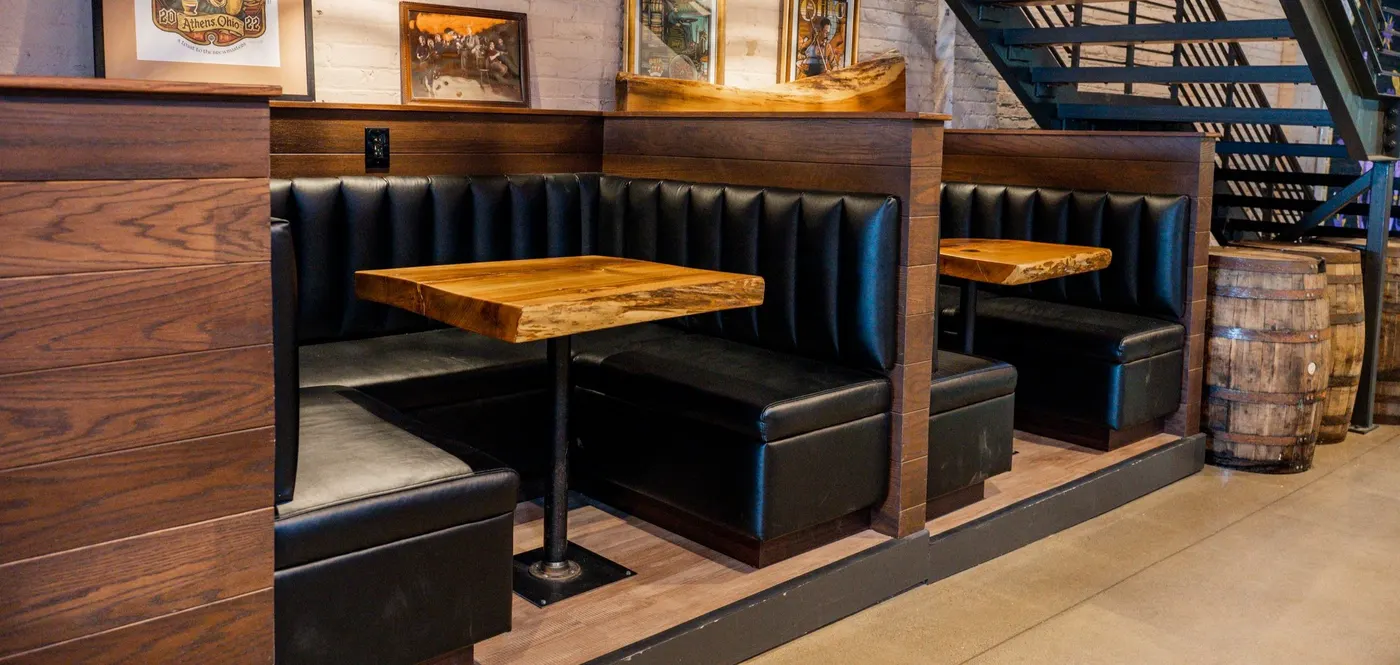
Seating is one of the largest visual elements in a dining room and one of the most expensive to replace.
So a rebrand, a refresh or a change of concept regularly runs into the same question: the booths are structurally fine and physically sound, and they are the wrong color for the new scheme.
Replacing them means capital cost, lead times on material, installation, and a dining room out of use.
Recoloring means the existing seating stays exactly where it is and changes color.
Operators are often unaware this is an option at all, or assume it means a light freshening of the existing color rather than a genuine change.
It is worth knowing the real scope of what is possible before pricing replacement, because the difference is substantial.
Why vinyl recolors so well
This is a genuine advantage of the material and it is worth understanding.
Commercial vinyl is manufactured to a uniform thickness and density, so it accepts color evenly across a whole panel. Leather varies across a hide, which is why leather recoloring needs more blending.
The grain is embossed and repeats exactly, so any texture that needs restoring is matched precisely rather than approximated.
The base color is uniform to start with.
And the surface is non-porous, so color sits in a controlled layer rather than being absorbed at different rates.
The result is that a whole dining room can be brought to one consistent new color, including booths that have faded at different rates because of where they sit relative to windows.
That consistency across a room is exactly what a remodel needs and what is hardest to achieve any other way.
How far the color can change
Further than most people expect, with a couple of practical asymmetries.
Going lighter is easier than going darker in terms of coverage, because a light color over a dark base needs more coats to achieve opacity.
Going darker is straightforward and often takes fewer coats.
Very large changes — a deep red room to a pale gray one — are achievable and simply need more material and more time, which shows in the quote.
Matching a specific brand color is possible, and it is worth supplying the actual reference rather than a description, since brand palettes are specific.
The finish sheen is chosen deliberately too, and it matters in a dining room: a satin or low-sheen finish reads as upholstery, while a high gloss reads as plastic under downlighting.
It is worth doing a sample panel on one booth and viewing it under the room's actual lighting before committing the whole space, because restaurant lighting is rarely neutral.
The test that decides whether to recolor at all
Before any of the above matters, the material has to be capable of holding a finish.
Press a thumb firmly into the vinyl and flex it.
If it yields and springs back, the material is sound and recoloring will hold.
If fine crazing appears under the pressure, the vinyl has lost plasticizers and is rigid. A new finish over it will crack along with the material, usually within months.
Run a finger across the surface. Powder that keeps coming after repeated cleaning means the coating is disintegrating and there is nothing sound to bond to.
Do this on several booths across the room, including ones that are rarely used, since chemical stiffening affects those equally.
Where the room fails this test, recoloring is not the answer regardless of how good it would look on day one — and a specialist who says so is saving you from paying twice.
Preparation is most of the job
Nearly every failed commercial recoloring failed here rather than at the color stage.
Years of grease, food residue and cleaning-product film have to come off completely. In a restaurant this is a bigger job than in almost any other setting.
Airborne kitchen grease settles on everything, including booths across the room from the kitchen, and it forms a film that nothing bonds to.
Old protectants and dressings have to be removed.
The surface is then cleaned with a preparation solution and given a key for the coating.
On heavily used restaurant seating this stage regularly takes longer than the coloring.
A quote that involves cleaning and coloring a dining room quickly is quoting something that will peel, and the preparation is the part worth asking about specifically.
Doing it inside a remodel schedule
This is where recoloring has a practical advantage that is easy to overlook.
Replacement seating has material lead times, which on a specific color or a custom specification can be substantial and are outside your control.
Recoloring has no material lead time in the same sense — the product is mixed to your color.
It also happens in place, so there is no removal, no installation and no coordination with a delivery.
In a remodel that is already juggling trades, that matters. Booth recoloring can be slotted into the schedule around other work rather than driving it.
The sequencing point: do it after any dusty work — demolition, sanding, drilling — and before final cleaning, because settling dust on curing finish is a real problem.
And build in the cure period before the room opens, which for a full dining room means finishing with time in hand rather than the night before.
What else to address at the same time
A recoloring visit is the efficient moment to deal with everything else, since preparation and setup are already done.
Cracks, tears and burns, which should be repaired before color rather than covered by it — color over damage highlights it.
Split seams, which are hand-stitched.
Worn edges and piping, which are rebuilt to restore the profile.
Foam that has compressed, which no surface work addresses and which is the reason a booth feels tired even when it looks fine.
Loose or damaged bases and kick panels.
And any booth where the material has failed the flex test, which should be separated out and handled differently rather than included in the recoloring.
Doing all of this in one program is substantially cheaper than a recoloring now and repairs later.
How long it lasts in commercial service
A fair question, and the answer depends mostly on what happens afterward.
A properly prepared and applied finish on sound vinyl wears like a factory finish. It is not a coating that peels off under normal use.
In heavy restaurant service it will wear at the contact points over time, exactly as the original did, and those points can be touched in.
What shortens it dramatically is cleaning chemistry. Kitchen degreasers, solvents and high-concentration disinfectants strip the topcoat and then work on the vinyl beneath.
So a recoloring program should come with a change in cleaning practice, or it is a temporary result.
Abrasive pads cut straight through the color layer.
And a protectant appropriate to commercial vinyl, applied periodically, extends it meaningfully.
Rooms that get this right see years of service from a recoloring; rooms that go back to the degreaser do not.
Comparing it against replacement honestly
Recoloring is not always the right answer and it is worth setting out when replacement is.
Where the vinyl has stiffened across the room, replacement is the honest recommendation.
Where the foam has broken down throughout, the seating is uncomfortable regardless of its color, and recovering with new foam addresses both.
Where the booth layout is changing as part of the remodel, new seating built to the new plan makes sense.
Where the frames or bases are failing.
And where the operator wants a material change — a different texture, a different grade, a genuinely different look that a color change cannot deliver.
Where none of those apply and the vinyl is sound, recoloring delivers most of the visual result for a fraction of the cost and disruption, which is why it is worth pricing both.
Sampling before you commit the room
For a color change across a whole dining room, a sample stage is worth the extra day and it is routinely skipped.
Have one booth, or one panel, done in the target color before the rest is scheduled.
View it in the room's actual lighting, at the times of day the restaurant trades. Restaurant lighting is rarely neutral, and a color chosen under daylight can read very differently under warm downlights in the evening.
View it against the other finishes going into the remodel — the flooring, the tabletops, the wall color — rather than against a swatch.
Check the sheen at the same time, since that is what makes upholstery read as upholstery rather than as plastic under a spotlight.
Sit on it, so the finish is assessed the way a guest will experience it.
Adjusting a color at the sample stage costs almost nothing. Adjusting it after a dining room has been done costs the whole job again.
What to send for an assessment
Photograph the dining room as a whole and several booths individually, in the room's normal lighting.
Photograph any damage close up.
Do the thumb-flex test on at least three booths including a rarely used one, and report what happened on each.
Run a finger across the surface and say whether residue comes off.
Say the target color, with an actual brand reference or sample rather than a description.
Say the remodel timeline and when the room must be open.
List what the seating is currently cleaned with.
And say whether the layout is changing, since that determines whether recoloring the existing seating is even the right question.
Questions we get asked next
- Can booths be changed to a completely different color?
- Yes. Substantial changes are achievable — commercial vinyl takes color evenly and the embossed grain matches precisely. Going lighter over a dark base needs more coats for opacity; going darker is usually quicker. Matching a specific brand color is straightforward with a real reference.
- How does the cost compare with replacement?
- A fraction of it, and without the material lead time or the installation. The comparison changes if the vinyl has stiffened, the foam has broken down, or the layout is changing — in those cases replacement is the honest answer and it is worth pricing both.
- Will a recolored booth hold up to restaurant use?
- Yes, when properly prepared and applied to sound vinyl — it wears like the original finish. What shortens it dramatically is cleaning chemistry, so a recoloring program should come with a switch to a neutral upholstery cleaner or the result is temporary.
- How do we know if our vinyl is suitable?
- Press a thumb firmly into it and flex it, on several booths including rarely used ones. Yielding and springing back means sound. Fine crazing appearing under the pressure means the vinyl has gone rigid, and any new finish will crack along with it.
- remodel
- recoloring
- restaurant booths