Cigarette Burns and Holes in Leather Car Seats and Headrests: What Can Be Repaired?
Most cigarette burns, vape and lighter burns, punctures and headrest holes in leather car seats can be repaired in place, in your Dallas–Fort Worth driveway or office lot. The hard melted edge is removed, the hole backed, filled, grain-stamped and color-blended, and on pigmented leather the spot is invisible at normal viewing distance. Don't pick at it or glue it first; damage on an airbag seam goes to a trim shop.
Quick answer
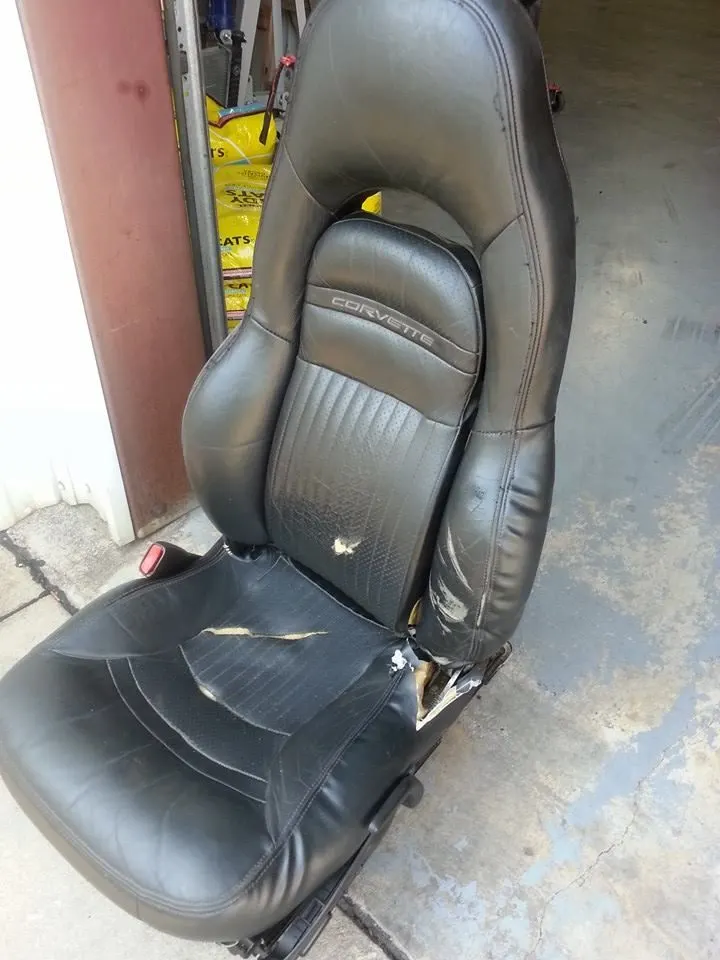
Most cigarette burns, vape and lighter burns, punctures and small holes in leather car seats and headrests can be repaired in place, in your driveway or office lot. The hard, melted edge is cut away first, the hole is backed from beneath, filled in layers, grain-stamped to match and color-blended into the panel; on pigmented leather the finished spot is invisible at normal viewing distance. Do not pick at it or glue it first. The exceptions are damage on an airbag seam and leather that is brittle across the whole panel.
At a glance
| Usually repairable | Cigarette, vape and lighter burns, punctures, small holes, headrest holes |
|---|---|
| Before the visit | Don't pick, glue or use a DIY kit; keep the hole from snagging |
| Where | In place, in your driveway or office lot |
| Drive it | The same evening, after a few hours of light-touch caution |
| Not a spot repair | Airbag-seam damage; leather brittle across the panel |
Why Dallas Drivers Choose Leather Repair Dallas
Leather Repair Dallas, legally Dallas Leather Reconditioning Specialist, is owned by technician Francisco Avila. Our service is fully mobile across Dallas–Fort Worth. Your vehicle stays at home or work while we repair it; there is no shop to haul anything to.
We begin with a free photo estimate. Send a picture of the whole seat and close-ups of the damaged area. We reply with a firm price and an honest recommendation without requiring an inspection visit. The photo quote is the price unless the damage is materially different in person. That is rare, and we discuss any difference before work starts.
Color matching happens beside your vehicle. We mix color on-site against the actual leather in its own lighting, using factory color references to help confirm the mix. We then blend the repaired area into the panel so the seat reads uniformly.
That matters when a small burn sits in an otherwise presentable interior. A patch that closes the hole but leaves an obvious color boundary has not solved the appearance problem. Our leather burn and hole repair process addresses the damaged edges, missing material, surface texture, and surrounding color together.
Why a Car-Seat Burn Needs a Car-Specific Repair
A car seat has different working conditions from a couch. In Dallas, a vehicle parked in the sun has a hot cabin. Its upholstery also flexes as people enter, exit, turn, and settle into position. The repair must be considered in that setting, especially where the seat bends or receives regular contact.
Location changes the assessment. A burn in the middle of a cushion, a puncture on a raised bolster, and a hole in a headrest may look similar in a close-up. They sit in different shapes and receive different contact. We need the whole-seat photo to understand that context.
Bolsters deserve particular attention because occupants pass over them when getting into the vehicle. A loose edge there can catch during normal use. If a puncture has already begun extending into a tear, repairing it sooner keeps the job smaller.
Seats may also combine leather and vinyl. A nearby panel is not necessarily the same material as the damaged one. Include the surrounding upholstery in your photos, and tell us if you are unsure what the seat is made from. Our assessment should reflect the actual surface rather than an assumption based on the vehicle's trim description.
Perforations add another requirement. A repair cannot simply cover the surface and disregard the existing openings. On perforated and ventilated seats, we keep the holes open through the fill and finish so heating and cooling continue working.
These details explain why a generic furniture patch is a poor starting point for an automotive problem. The seat's shape, flex, material, openings, and seam locations all belong in the repair decision.
What Burns, Punctures, and Headrest Holes Can Be Repaired?
We handle cigarette and cigar burns, vape and lighter burns, melted spots from heat contact, punctures from sharp objects, and small holes caused by wear-through. The cause helps explain the damage, but the condition of the remaining material determines the recommendation.
A cigarette burn often leaves more than a visible opening. Its hard, heat-damaged perimeter must be removed before rebuilding the missing area. Filling directly over that edge skips the preparation that allows the repair to bond to clean material.
A puncture is approached like a small tear: we support it from beneath, fill it, restore texture, and color the surface. If the opening has started to run, include the full length of that developing tear in your photographs.
We work on driver and passenger seats, rear benches, captain's chairs, bolsters, side panels, headrests, and armrests. Heated and perforated seats are routine work. Our leather car seat repair service considers both the damaged spot and the seat around it.
Headrest holes need their own assessment.
Yes, a hole in a leather headrest can be repairable. Tell us whether it came from dog teeth, a child catching or picking the surface, a tool, or a buckle puncture. Then show us the entire headrest and a close view of the opening.
Those descriptions help us understand what to inspect. With dog damage, photograph every affected spot rather than only the most obvious hole. With a tool or buckle puncture, show any split extending beyond the entry point. If a child has pulled at an existing opening, include the surrounding lifted material.
A perforated headrest also needs its openings preserved during the repair. Include enough undamaged surface in the photograph to show the perforation pattern and grain.
Do not assume the headrest needs replacement simply because the hole is conspicuous at eye level. Equally, we will not promise that every headrest hole can be restored. The remaining material, texture, color, and extent of damage must support the proposed result.
What to Do During the First Days After Finding Damage
Your immediate goal is to leave the damage assessable and keep the opening from becoming a larger tear. You do not need to prepare it for us.
Leave the edges alone. Do not pick out the burned center, pull loose fibers, or trim the perimeter. We remove damaged material as part of the repair, with the surrounding surface in view. Picking can change a contained hole into an irregular opening.
Skip superglue and the DIY kit before getting an estimate. Our process requires clean material at the repair boundary. Adding an adhesive, filler, or colored patch first changes what we must assess and prepare. Send photographs before applying anything.
Keep the hole from catching. Be deliberate about clothing, bags, pet contact, buckles, and tools near the affected area. On a bolster, avoid dragging items across the loose edge. On a headrest, keep straps and other objects from hooking into the opening.
Do not test whether the material will tear farther. Pulling the edges apart to show the hole can extend a puncture. Take a close photograph without stretching the upholstery.
Photograph all the damage together. Multiple small burns on the same seat can be repaired in one visit and priced together. We need images of every spot to give you a combined estimate.
If you have already applied a product, tell us what it was and send photos of the current condition. That information belongs in the estimate discussion. Do not keep adding material in an attempt to improve the appearance before we see it.
For a clear next step, text your photos to (972) 522-9763 or send photos for a free estimate. Include the whole seat, close-ups, and any other affected areas.
What Happens During a Mobile Repair Visit?
Most appointments are scheduled within days of estimate approval. Our hours are Monday–Friday, 9–5, and Saturday, 10–4. We repair the vehicle in your driveway or office lot, with the seat almost always left in place.
The work follows a preparation-and-rebuilding process. Closing the visible opening is only part of it.
We confirm the damage and access. We compare the seat with the photographs and check the surrounding material, perforations, and nearby seams. If the condition is materially different from the photo estimate, we discuss it before beginning.
We clean out the damaged material. Hard, melted burn edges come out first. The fill needs to bond to clean material. This preparation is why professional repairs last where DIY patch kits leave a scar: covering a damaged perimeter does not remove it.
We back the void. Missing material needs support beneath the opening. Punctures and small tears are also backed from below so the repair has a supported base.
We fill in layers. We rebuild the void rather than leaving a surface patch over an unsupported opening. The aim is to restore the area in relation to the surrounding panel.
We stamp the grain. Texture is matched to the adjacent surface. A smooth spot on a grained seat can remain noticeable even when the color is close, so the surface pattern is part of the work.
We mix and blend the color. We match the actual leather on-site, then airbrush color outward into the panel. Factory references help confirm the mix, while the seat itself guides the final match.
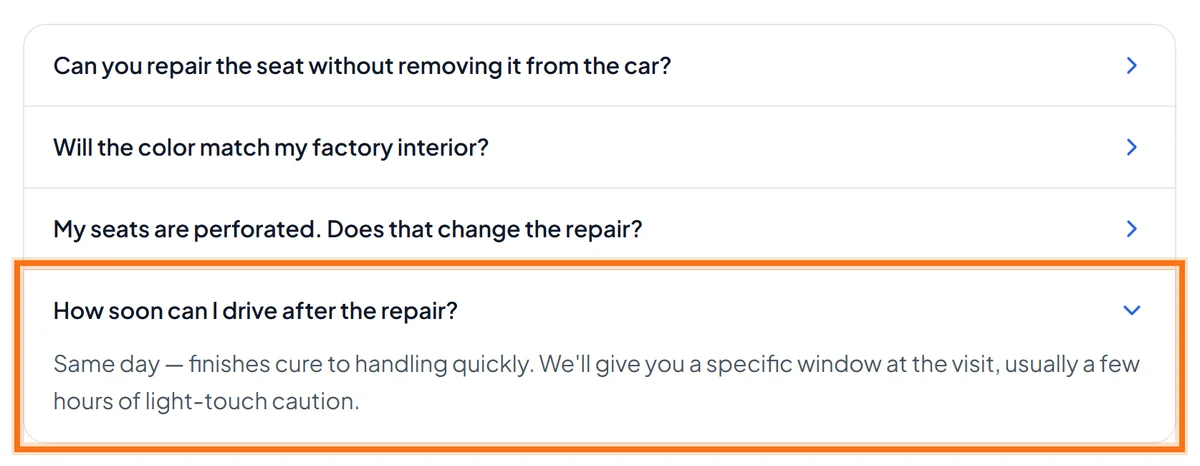
We explain the initial care window. The vehicle is usable the same day. You can drive that evening after a few hours of light-touch caution; we give you the exact window at the visit.
Seat removal is almost never needed. If access genuinely requires it, removal and reinstallation happen during the same visit. A close-up alone cannot always show access, which is another reason the wider photograph matters.
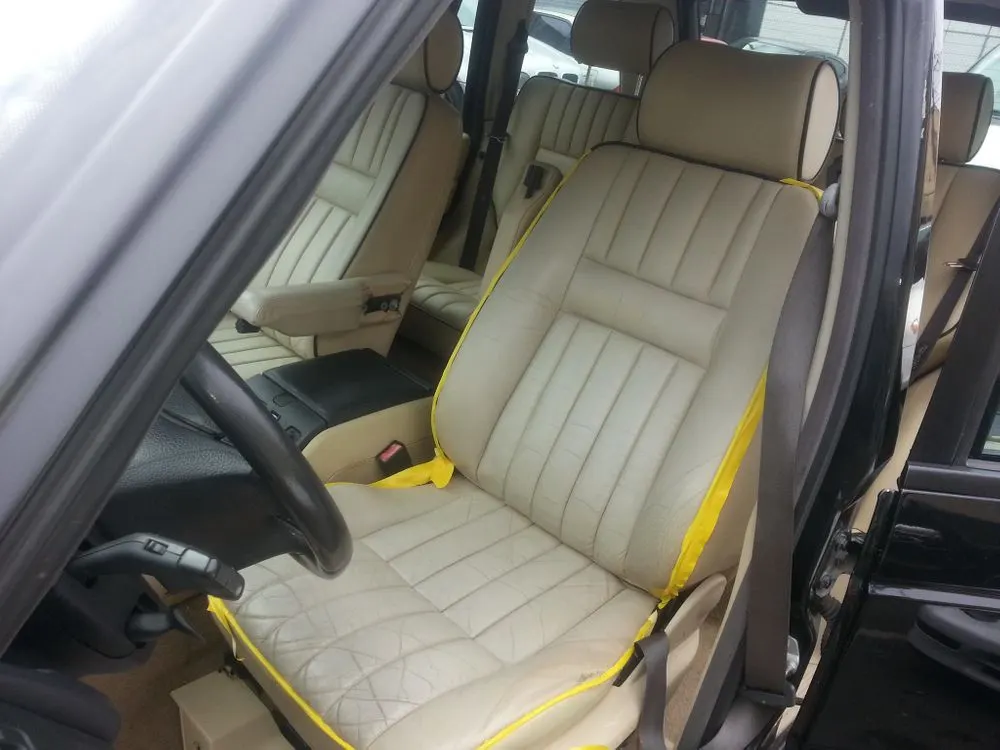
Car seat burns and holes in Dallas: what you have and the usual answer
Most burns and holes we see on Dallas–Fort Worth car seats fall into a handful of cases. The table shows the usual answer for each, including the three where a spot repair is not the right call.
Our leather car seat repair page covers seats repaired in your driveway or office lot, leather burn and hole repair explains the burn process, and car seat repair covers leather, vinyl and cloth seats. Before anything near an airbag, read airbag seam repair safety; for perforated seats, perforated leather seat repair; for burns elsewhere in the car, automotive carpet burns and holes; and for furniture, what to do after a leather burn.
| Damage | Where | Usual answer |
|---|---|---|
| A single cigarette, vape or lighter burn | Seat cushion or backrest | Hard edge removed, backed, filled, grain-stamped and color blended |
| Several small burns | One seat | Repaired in one visit and priced as one job |
| A puncture starting to run into a tear | Bolster or seat | Backed from beneath and repaired soon, before it grows |
| A hole in a headrest | Headrest, perforated or plain | Repaired when the surrounding material supports it, perforations kept open |
| A burn on a perforated or ventilated seat | Perforated panel | Repaired with the holes kept open so heating and cooling still work |
| A large melted area across a panel | Any panel | The photos decide: a local repair or a replaced panel |
| Leather brittle across the whole panel | Any panel | Assessed as a whole before any spot repair |
| Damage on or next to a side airbag seam | Outer edge of the seat back | A trim shop working to the manufacturer's specification |
How to read this table: find your damage in the first column. The first five rows are routine repairs in your driveway, and the car is usable the same day. The last three rows are where we say at the estimate that a spot repair is not the right answer.
What Result Can You Expect—and When Is Repair the Wrong Choice?
Protected, or pigmented, leather repairs most invisibly. On pigmented leather, a finished burn repair is genuinely invisible at normal viewing distance. That is a specific expectation for a suitable surface, not a promise that every material and every damaged panel will finish identically.
Aniline leather blends slightly less perfectly. We set expectations before work begins so you understand the likely appearance rather than discovering a limitation after the repair.
Perforated and ventilated upholstery also needs the right treatment. We preserve the holes through the fill and finish so heating and cooling keep working. Our guidance on perforated seats explains why maintaining those openings belongs in the repair plan.
Some damage calls for a different recommendation:
A single burn or puncture in otherwise sound leather is the classic repair: backed, filled, textured and color-blended into the panel.
Several small burns on the same seat are assessed together, repaired in one visit and priced as one job.
A large melted area that runs across a panel needs a closer look; the photos decide whether a local repair still makes sense or the panel should be replaced.
Leather that is brittle across the whole panel is assessed as a whole before anyone recommends a spot repair, because a patch cannot hold in leather that is failing around it.
Damage on or right next to a side airbag seam goes to a trim shop that works to the manufacturer's specification. We say so at the estimate.
A large melted area and widespread brittleness deserve a broader assessment because the problem extends beyond an isolated hole. We will give an honest recommendation from the photographs instead of assuming every damaged panel should receive a spot repair.
The airbag-seam exception is definite. If damage is on or immediately beside that seam, we say so at the estimate and direct you to the appropriate trim shop. Read more about airbag seams before attempting to glue, fill, or patch damage in that location.
Smoke odor is a separate issue. Restoring the burned upholstery does not mean the odor problem has been addressed. Mention both concerns when requesting an estimate so the visible repair is not mistaken for an odor treatment.
DIY Kit, Professional Repair, or Seat-Cover Replacement?
The decision should reflect the extent of the damage, the condition of the panel, and the appearance you want. A small hole in sound upholstery presents a different choice from a broad melted section.
A DIY kit only works if you can remove the damaged material, support the opening from behind, match the grain and match the color. Most kits do none of that well, and the result is often a visible scar that has to be removed before a professional repair.
A professional repair removes the burned edges, backs the opening, fills it, restores the texture and blends the color into the panel. The seat stays in the car and the car is usable the same day.
Replacing the seat cover swaps the whole panel instead of rebuilding one small opening. It is the right call only when the damage or the leather around it rules out a spot repair.
Every repair is quoted from photos, with a firm price before anyone books a visit. Send the whole seat and every damaged spot, so the quote covers the actual job rather than part of it.
Multiple small burns on a seat are priced together and repaired during the same visit. That work is far cheaper than seat-cover replacement. Send photos of each burn so the estimate covers the actual job rather than an incomplete view of it.
For resale or trade-in preparation, start with an assessment before deciding to replace a cover. A conspicuous hole may be a localized repair opportunity. We cannot promise a particular sale price or trade-in increase, but we can quote the upholstery work so you can decide whether its appearance benefit fits your plans.
Also check whether the damage extends beyond the seat. A dropped burning item may leave another affected area in the vehicle. Photograph those areas separately; burns and holes in automotive carpet need their own assessment.
How to Get a Useful Estimate Without an Inspection Visit
Good photos let us evaluate the repair in context. Start with the whole seat, including the backrest and cushion. For headrest damage, show the headrest in relation to the seat as well as on its own.
Follow with close-ups that clearly show the opening, its edges, and the surrounding texture. Include a nearby seam if there is one. Photograph perforations clearly, and send a separate image of every damaged spot.
Tell us whether the opening has grown, whether anything has been applied, and whether the concern includes odor. If you are uncertain whether a panel is leather or vinyl, say so rather than guessing.
We use that information to return a firm price and recommendation. Once you approve the estimate, most appointments are scheduled within days. The quoted price remains the price unless the damage is materially different in person, with any difference discussed before work begins.
Text photos to (972) 522-9763 or use the free photo estimate form. We will help you determine whether the burn, seat hole, or headrest puncture is a suitable repair and explain the expected result. For Carrollton drivers, read leather car seat repair in Carrollton.
Questions we get asked next
- Who fixes cigarette burns in leather car seats in Dallas?
- Leather Repair Dallas provides fully mobile cigarette-burn repair across Dallas–Fort Worth. We repair vehicles in driveways and office lots. Text whole-seat photos and damage close-ups to (972) 522-9763 for a free estimate.
- Can you repair a hole in my car's leather headrest?
- Yes, headrest holes can be repaired when the surrounding material supports the work. We assess punctures, burns, and other holes from photographs. Include the entire headrest and close-ups of every damaged area, including any perforations.
- Will a cigarette-burn repair be invisible?
- On pigmented leather, a finished burn repair is genuinely invisible at normal viewing distance. Aniline leather blends slightly less perfectly. We assess the material and explain expectations before starting; we do not promise identical results on every surface.
- Can you repair perforated or heated leather seats?
- Yes. Perforated and heated seats are routine work. On perforated and ventilated upholstery, we keep the holes open through the fill and finish so heating and cooling continue working.
- How much does a leather car-seat burn repair cost?
- It is quoted from your photos rather than from a price list: send the whole seat and close-ups of every burn and we reply with a firm price. Multiple small burns on the same seat receive a combined estimate. The photo quote remains the price unless the damage is materially different in person, which we discuss before work starts.
- Can I drive after the repair, and will it remove smoke odor?
- The vehicle is usable the same day. You can drive that evening after a few hours of light-touch caution, with the exact window given at the visit. Smoke odor is a separate problem from the burn repair.
- car seats
- burn repair
- headrest repair
- auto leather repair
- dallas