What Should You Do After a Hot Ember or Cigarette Burns Leather?
Small burns repair almost invisibly. What determines the result is mostly what happens in the first hour, and the instinct is to do the wrong thing.
Quick answer
Let it cool completely, then leave it alone. Do not pick at the charred rim, do not cut anything away, and do not apply any product. A burn is repaired by rebuilding from behind, and the intact edge around the char is what the repair keys into — removing it makes the void larger. Check whether the foam beneath is damaged, cover the area so nothing catches it, and photograph it before anything changes.
At a glance
| First step | Let it cool. Then do nothing |
|---|---|
| Do not | Pick at the char, cut the edges, or apply cleaner or conditioner |
| Check | Whether the foam beneath is scorched or melted |
| Repairs invisibly | Small burns on finished leather — cigarette, ember, spark |
| Harder | Aniline leather, or burns where the foam has to be rebuilt too |
What a burn actually does to leather
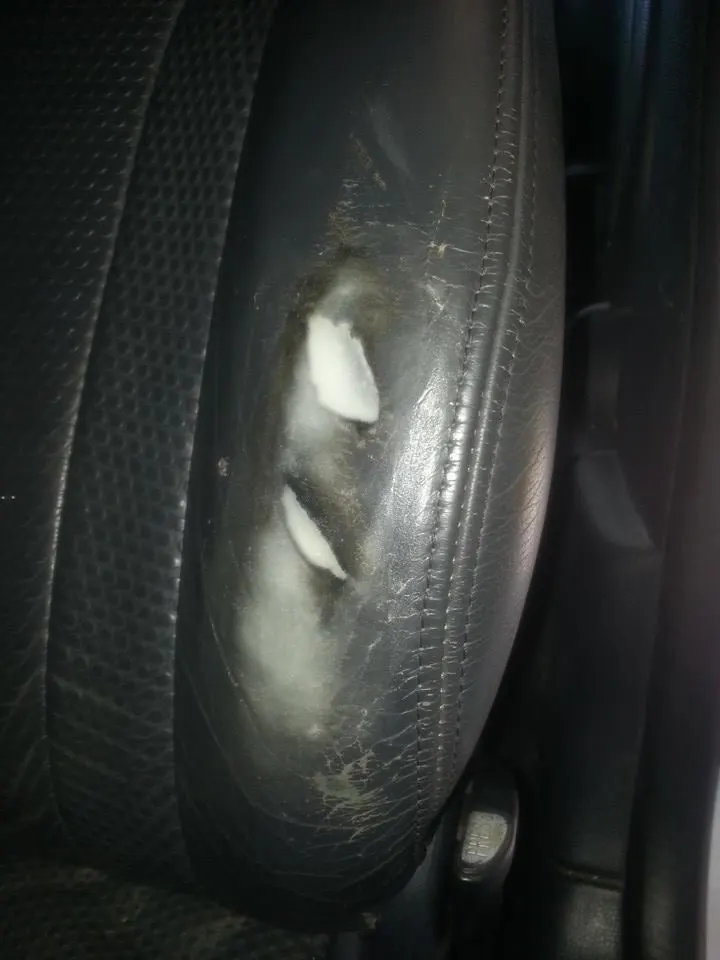
Heat destroys leather in a small, well-defined area and leaves a distinctive structure: a hole or crater in the middle, a ring of charred, hardened material around it, and beyond that, leather that looks normal but has been heat-affected.
The char is carbonized hide. It is brittle and it will not take filler or color, so it has to come out during the repair.
The heat-affected ring beyond it is the part people miss. It looks fine but its finish has been altered and its fibers stiffened, which is why a repair that stops exactly at the visible damage sometimes shows a faint halo later.
Underneath, the foam may also be affected. Polyurethane foam melts and shrinks rather than charring, so a burn that went through the leather often leaves a small crater in the cushion below.
All of that is repairable. The point of understanding the structure is knowing why the first-hour instinct — cleaning it up — makes the job worse.
Why not to pick at it
The urge to tidy a burn is strong. It looks messy, the char flakes, and removing it feels like progress.
It is not. A repair works by bonding a backing behind the void, then building flexible filler up from that backing to the level of the surrounding surface. What the filler keys into at the edges is intact leather.
Every millimeter of edge you remove makes the void wider, which means a larger rebuilt area, a wider color blend, and a more visible result on close inspection.
Picking also frequently enlarges the hole beyond the burn itself, because heat-affected leather next to the char is weakened and tears when pulled.
The correct handling is to leave the char in place. A specialist removes it precisely, under control, as the first step of the repair — and removes only what has to go.
What to do in the first hour
Let it cool completely before touching anything. On a car seat in summer this can take longer than you would expect.
Remove whatever caused it and check for other burns. Sparks and embers rarely land alone, and a second smaller mark a few inches away is common and easily missed.
Look at the foam. Press gently beside the burn — if there is a soft depression under the hole, or you can see melted foam through it, note that. It changes the repair and it is worth knowing early.
Do not apply anything. Not cleaner, not conditioner, not water. The area is compromised and any liquid soaks into exposed hide and foam.
Cover the area so nothing catches the edges. A smooth cloth or a throw is enough. Charred edges snag on clothing and each snag widens the opening.
Photograph it now, before anything flakes or gets brushed away. A photograph of a fresh burn is far more useful than one taken a week later.
How burns are repaired
The sequence is the same as any hole repair with one extra stage at the start.
The char is removed precisely, back to sound leather and no further. This is the step that determines the final size of the repair.
The area is cleaned and degreased, because filler will not bond through body oil or residue.
If the foam beneath is damaged, it is addressed first — a burn crater in the cushion is filled or a plug of matching foam is fitted, so the repair has a stable, level foundation. Skipping this leaves the finished surface sitting over a hollow, and it dents under pressure.
A backing material is bonded behind the opening to give the filler a floor.
Flexible filler is built up in thin layers, each allowed to cure, until it is level with the surrounding surface.
Grain is pressed into the final layer to match the surrounding texture, then color is sprayed in light coats and feathered well past the repair, and a flexible topcoat seals it.
How invisible the result is
Honest expectations by material and size.
A cigarette-sized burn on finished, pigmented leather in a mid or dark tone: normally undetectable in ordinary light and ordinary use. This is the best case and it is also the most common one.
The same burn on light-colored leather: very good, with a wider color blend needed because the eye picks up small tonal differences more readily on pale surfaces.
The same burn on aniline leather: structurally sound and much less noticeable, but potentially visible on close inspection, because there is no pigment layer to blend into and no reproducible grain to press.
A larger burn — a hand-sized area from a dropped candle or a heat source left in contact — is still repairable, but the rebuilt area is large enough that panel replacement is sometimes the better result.
Multiple burns across a panel, which is common on older smoked-in furniture, are usually best handled as a panel refinish rather than as separate spot repairs.
Vinyl behaves differently
Burns on vinyl and PU upholstery are common in vehicles, restaurants and commercial settings, and the material responds differently.
Vinyl melts rather than charring. A burn leaves a hardened, shiny rim of resolidified plastic and often a raised lip around the hole.
That rim has to be leveled rather than just removed, because a raised edge under filler produces a bump in the finished surface.
The repair outlook on vinyl is very good, often better than on leather, because the material is manufactured to a consistent thickness and its embossed texture repeats — so a grain plate reproduces it accurately.
This is why restaurant booths, work-truck seats and marine seating with burn damage are almost always worth repairing rather than replacing.
The safety part worth mentioning
Upholstery burns are also an ignition question, and it is worth being straight about it.
Polyurethane foam is combustible, and a smoldering source that reaches it can continue to burn slowly inside a cushion for a long period without visible flame. Smoldering-ignition fires involving upholstered furniture are a recognized fire-safety concern, which is why furniture flammability standards exist in the first place.
So if a cigarette or ember went into a cushion rather than just marking the surface, do not simply cover it and forget it. Check the cushion thoroughly, and if there is any doubt, get the core out of the house.
A burn that continues to smell of smoke hours later, or a cushion that feels warm in one spot, should be treated as an active problem rather than a cosmetic one.
This is a small risk and it is not a reason for alarm about a surface scorch. It is a reason to check the foam rather than assume.
Burns in Texas vehicles
Vehicle interiors here take a specific kind of burn damage that is worth naming.
Cabin temperatures in a car parked outside through a Dallas summer are high enough that objects left on a seat can reach temperatures that mark leather without any flame involved. Metal buckles, phone cases, and anything dark left in direct sun through glass are the usual culprits.
This produces a different mark from an ember: a hardened, discolored, sometimes glossy area rather than a hole. It is heat damage to the finish rather than combustion.
It repairs as a refinishing job — leveling the affected area, matching grain, recoloring and sealing — rather than as a hole repair.
The prevention is straightforward: nothing metal or dark left on a seat in summer, and park in shade where possible.
Smoke odor is a separate problem
Where a burn came with smoke — a fire, or long-term smoking indoors — the odor question is independent of the repair.
Smoke residue lands on every surface, and on leather it sits in the finish and in the seams. Cleaning removes most of it from the cover.
What holds odor is the cushion foam, which absorbs smoke particulate and releases it slowly for years. A perfectly cleaned cover on a smoke-affected cushion smells of smoke within days.
As with pet urine and mold, the answer for foam is replacement rather than treatment. Cores are the cheapest component in upholstery and replacing them is what actually resolves the smell.
Mention smoke exposure when you ask for an assessment, because it changes the scope from a repair to a repair plus a cleaning and possibly a core replacement.
What to send for an assessment
Photograph the burn square-on from about six inches, close enough that the char rim and the edge of the hole are clearly visible.
Take a second shot from a low raking angle across the surface, which shows depth and whether there is a raised lip.
Put something for scale beside it — a coin or a card — because burn size determines the approach more than anything else.
Photograph the area around it too, in case there are additional smaller marks you have not registered.
Say whether the foam beneath feels damaged, whether the piece is leather or vinyl, and whether there is any smoke smell. And say what the heat source was, because a cigarette, a candle and a hot object left in the sun produce different damage and different repairs.
If the burn is on a vehicle seat, add whether it sits on a perforated area and whether there is an airbag tag on the outboard edge of the seat back. Perforated panels need the holes kept open through the repair, and anything on an airbag seam belongs to a trim shop rather than a cosmetic repair.
Questions we get asked next
- Can a cigarette burn really be made invisible?
- On finished, pigmented leather in a mid or dark tone, yes — a cigarette-sized burn normally disappears into the panel in ordinary light and use. Light colors need a wider blend, and aniline leather can be made sound and much less noticeable but may stay faintly visible up close.
- The burn went through into the foam. Is that a bigger job?
- Somewhat. The foam has to be addressed first so the repair sits on a level, stable base — otherwise the finished surface dents under pressure. It adds a stage rather than changing the nature of the work, and it is well within a normal single visit.
- I already trimmed the burnt edges. Have I made it worse?
- Slightly larger, not ruined. The repair now has a bigger void to rebuild and a wider blend, which means a little more work and a marginally larger finished area. Tell whoever assesses it what you removed, so they are not guessing about the original size.
- There are several old burns on a secondhand sofa. Worth repairing?
- Often yes, but usually as a panel refinish rather than as separate spot repairs. Multiple rebuilt spots in one panel look like multiple rebuilt spots; refinishing the panel brings the whole surface back uniformly and generally costs less than chasing each one.
Sources
- Standard for the Flammability of Residential Upholstered Furniture — U.S. Consumer Product Safety Commission, checked 2026-08-21
- burns
- holes
- emergency