Why Does Dark Leather Fade, and Can Its Original Depth Be Restored?
Black turns gray, brown turns orange, and the panel by the window goes first. All of it comes back, because fading is pigment loss rather than damage.
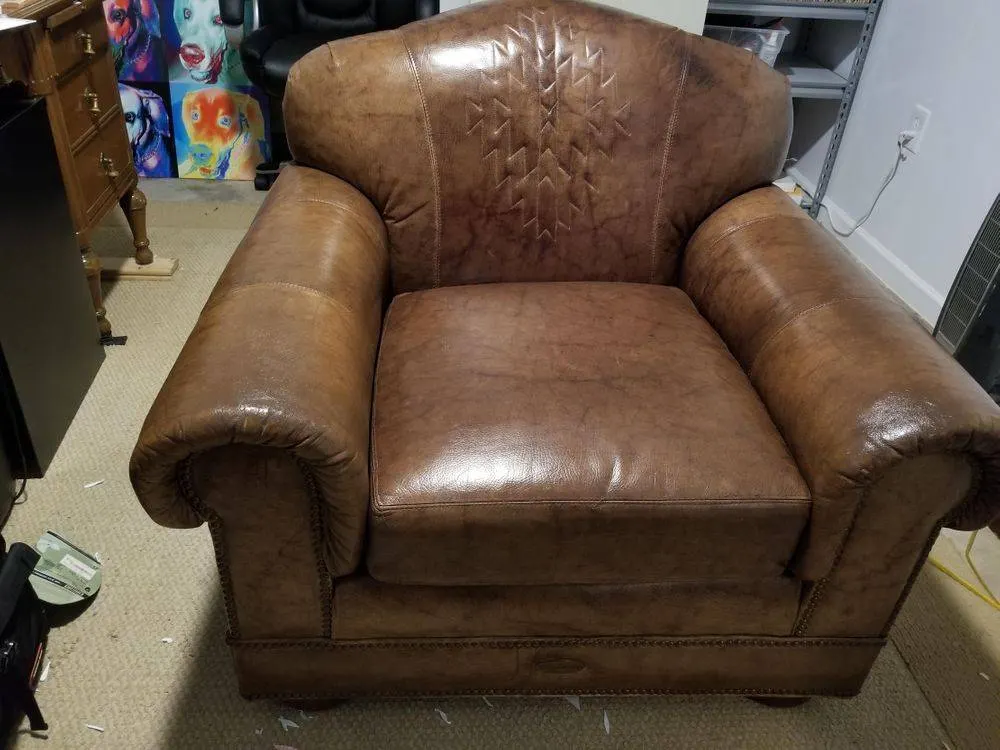
Quick answer
Dark leather fades because ultraviolet light breaks down pigment, and dark finishes contain more pigment to lose — so the change is larger and more visible. Black shifts toward gray or brown; dark brown shifts toward orange or red. It restores fully, because fading is pigment loss rather than damage to the hide. The work is cleaning, stabilizing and recoloring, and the main question is how far the blend must extend to leave no visible boundary.
At a glance
| Cause | UV breaks down pigment and the binder holding it |
|---|---|
| Black fades to | Gray, or a brownish cast where the underlying tone shows through |
| Dark brown fades to | Orange or red, as the cooler pigments break down first |
| Restorable | Fully, on sound leather — this is pigment replacement, not damage repair |
| The real question | Whether one panel or the whole piece needs blending |
What fading actually is
It helps to be precise, because fading is often confused with dirt, drying or general wear, and the three need different responses.
On finished leather, color lives in a pigment layer applied over the hide and sealed with a clear topcoat. Ultraviolet light degrades both: it breaks down the pigment molecules so they reflect less color, and it breaks down the binder holding the pigment in place.
The visible result is a panel that has lost depth. It is not dirty — cleaning it changes nothing. It is not dry — conditioning it changes nothing either, beyond a temporary darkening as the surface takes up product.
The hide underneath is usually completely sound. That is why fading is one of the more satisfying problems to fix: nothing needs rebuilding, only recoloring.
The complication is the binder loss. A finish that has lost flexibility along with color is also the finish most likely to start cracking, which is why a badly faded panel often has fine cracking beginning at its fold lines.
Why dark colors show it more
There are two reasons, and together they explain why dark furniture looks worse after the same exposure that a mid-tone piece shrugs off.
The first is quantity. A dark finish contains far more pigment than a pale one, so there is more to degrade, and the total change in appearance is larger.
The second is that pigments do not fade at the same rate as each other. A black finish is rarely pure black — it is usually built from several pigments, and as the cooler, less stable components break down first, what remains reads as gray or brownish.
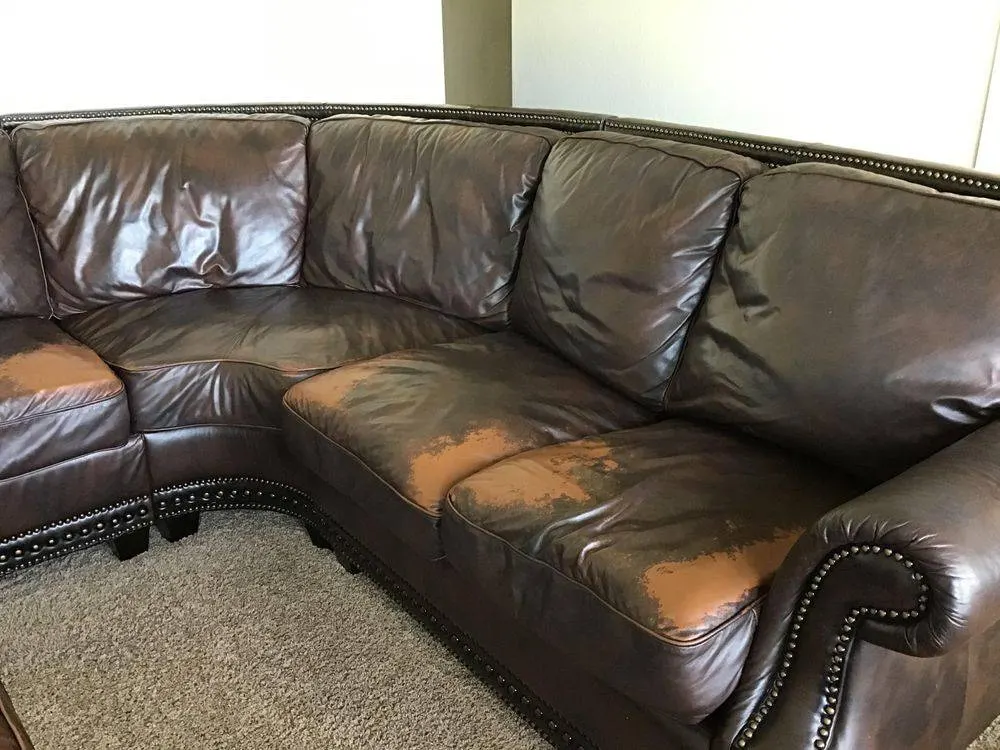
Dark brown behaves the same way and produces the effect people describe most often: a chocolate sofa that has gone orange. The red and yellow components in the mix outlast the darker ones, so what is left is warmer than what was there.
This is also why fading on dark leather rarely looks like a lighter version of the original color. It looks like a different color, which is exactly why it draws the eye.
Reading the pattern to confirm the cause
Before assuming fading, it is worth confirming, because dirt and finish wear can look similar at a glance.
Fading follows light, not use. Look at where the piece sits: the faded area should correspond to a window, a skylight or a lamp, and it should be worst on the surfaces facing that source. A sofa with its right arm toward a west window fades on the right arm and the right end of the back.
Wear follows contact. If the pale areas are the seat someone always uses and the arm they lean on, that is finish wear rather than fading, and the two need slightly different work.
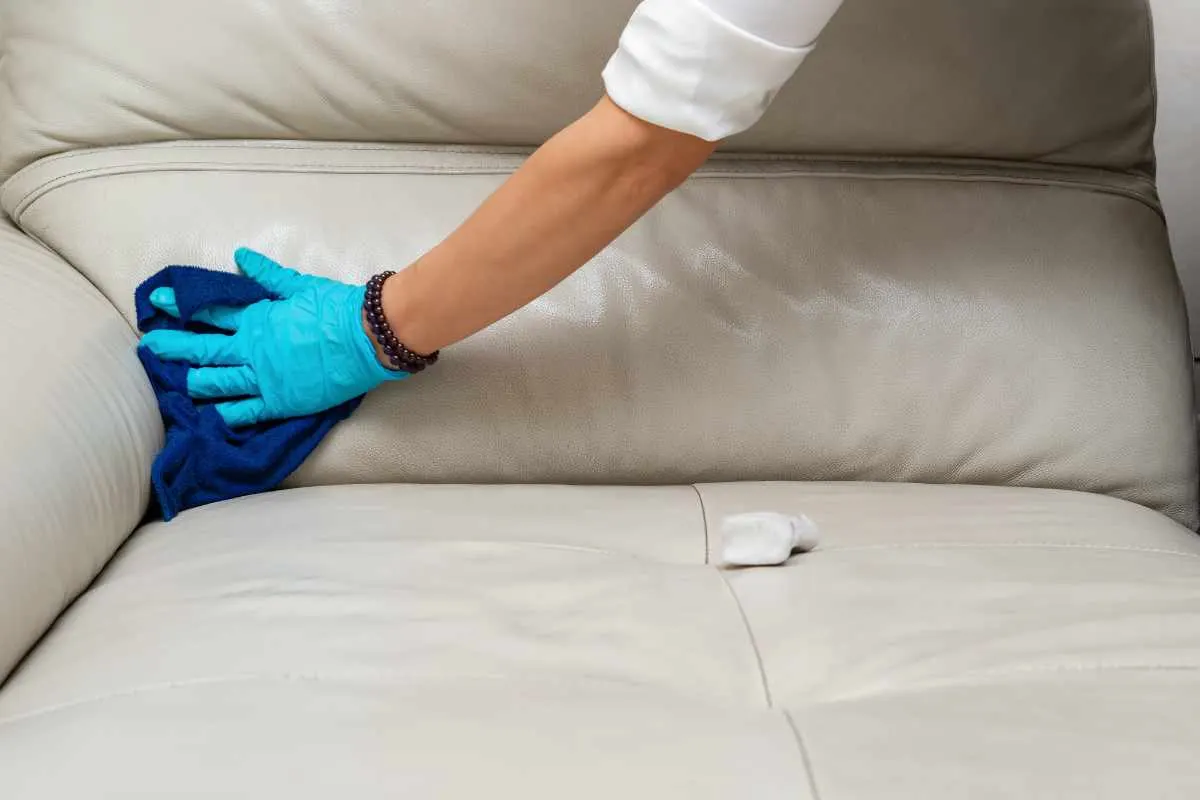
Dirt is removable. Clean a small hidden area properly and compare — if it comes back to full depth, the problem was soil.
Many pieces have all three at once, which is common and simply means the recommendation covers more than one thing.
How the color comes back
The sequence is standard, and every stage matters to the result.
The piece is cleaned and degreased thoroughly. Years of body oil and any silicone dressing have to come off, because pigment applied over contamination lifts later. On an older sofa this stage takes most of the labor.
The remaining finish is assessed and stabilized. Where it is sound it is keyed so new color bonds; where it has broken down it is taken back to something solid. Any worn areas are filled and textured at this point so the surface is level before color goes on.
Color is mixed against the actual leather rather than a chart, and tested on a hidden area, then checked in daylight and again under the room's evening lighting.
It is then sprayed in several thin coats. Thin coats flex with the hide; one heavy coat sits on top of it and cracks.
Finally a flexible topcoat seals it and sets the sheen — matte, satin or slight gloss, which changes the character of the piece as much as the color does.
How wide the blend has to go
This is the question that determines the price, and it is worth understanding rather than just receiving.
If only one panel has faded and the rest of the piece is at full depth, the faded panel is recolored and the color is feathered into its neighbors so no boundary exists. On a piece with several separate panels, that can be a contained job.
But fading is rarely that tidy. Usually there is a gradient — one end noticeably faded, the middle slightly faded, the far end close to original. Matching a repair to any single point on that gradient leaves the rest visibly different.
In those cases the honest recommendation is to recolor the whole piece, which brings every panel back to one depth and costs less than chasing panels individually over several years.
A quick test at home: photograph the piece in flat daylight, then look at the photo rather than the sofa. Cameras are less forgiving than eyes, and a gradient that is easy to ignore in the room is obvious in an image.
Matching to faded, and why it is a mistake
There is a cheaper option that comes up and it is worth warning about.
A repair can be color-matched to the current, faded shade rather than to the original. It costs less because only the damaged area is treated, and on the day it looks correct.
The problem is that it locks the fading in. The faded shade becomes the reference for that piece permanently, and any future work — cleaning that lifts soil, refinishing another panel, even a change of light in the room — makes the mismatch appear.
It also means the piece stays in its degraded state. Fading is usually accompanied by binder loss, so a faded panel that is only spot-matched keeps heading toward cracking.
Recoloring to full depth costs more once and is the answer that actually resolves the problem.
Why this is a North Texas speciality
Fading is the most common single reason furniture here reaches a restoration decision, and the reasons are specific.
The UV load is high and the season is long. West and south-facing windows deliver strong afternoon sun for most of the year, and modern homes have more glass than older ones.
Ordinary window glass blocks much of the shorter-wavelength UV but transmits plenty of the longer-wavelength radiation that degrades pigments, so being indoors is not the protection people assume.
Year-round air conditioning compounds it by keeping the finish dry, which makes the binder loss matter sooner — a dry, faded panel cracks earlier than a supple one.
The practical consequence is timing. A faded panel caught before cracking is a cleaning and recoloring job. The same panel a year later needs filling and texturing as well.
Keeping the color once it is back
Recoloring resets the piece. What happens next depends on whether anything about the exposure changes.
Break the light where you can. Sheer blinds during the strongest part of the afternoon make a measurable difference, and they cost far less than doing the work twice.
Ask for a UV-aware topcoat during the refinish. It does not stop fading, but it slows it, and on a piece that is going back into the same position it is worth specifying.
Rotate cushions periodically so exposure spreads rather than concentrating on the same panels.
Keep the leather conditioned two or three times a year. A supple finish tolerates UV-driven embrittlement far better than a dry one, which is what turns fading into cracking.
And clean on schedule, because soil on the surface both dulls the color and holds heat against it.
Getting it assessed
Photograph the whole piece in flat daylight from a few feet back, positioned so both the faded and unfaded areas are in the same frame. That single image communicates the gradient better than any description.
Take a close-up of the most faded area and another of the least faded, from the same distance and in the same light, for comparison.
Check the faded panel for fine cracking at the fold lines and photograph that at a low raking angle if it is there, because it changes the scope from recoloring to recoloring plus filling.
Say where the piece sits relative to windows and roughly how long it has been there. That answer usually confirms the diagnosis before anyone examines the leather.
And say whether you want the original color back or would consider a change. Since the surface is being rebuilt either way, a color change costs little more than restoring the original — and on a piece that has faded badly, some owners take the opportunity.
It also helps to mention whether the room's lighting has changed — new windows, removed curtains, a skylight added. Owners often date fading from when they noticed it rather than from when the exposure changed, and the actual timeline explains how fast the piece is degrading and how urgent the work is.
Take one more photograph from directly in front of the window that faces the piece, showing the light path. It sounds unnecessary and it is genuinely useful — it establishes the exposure that caused the damage, and it informs the recommendation about topcoat and about whether anything should change before the work is done.
And check the least exposed part of the piece for the original color: the back, the underside of a cushion, or the inside of an arm. That area is the reference for what the finish is supposed to look like, and photographing it alongside a faded panel makes the size of the shift immediately clear.
Questions we get asked next
- Will conditioning bring the color back?
- Only temporarily. Conditioner darkens a surface while it is wet with product and the effect fades as it dries or absorbs. Fading is pigment loss, and the only thing that replaces pigment is recoloring.
- Can just the faded panel be done?
- Yes when the rest of the piece is at full depth. More often there is a gradient across the piece, and matching to any single point on it leaves the rest visibly different — which is why recoloring the whole piece frequently costs less than doing panels one at a time.
- My black sofa has gone gray in patches. Is that fading or wear?
- Look at where the patches are. If they follow the light from a window, it is fading. If they follow where people sit and lean, the finish has worn through and the paler color is the layer beneath. Many older sofas have both, and both are corrected by the same process.
- How long before a recolored sofa fades again?
- It depends entirely on exposure. A piece moved out of direct sun, or shaded by blinds, with a UV-aware topcoat and regular conditioning, holds its color for many years. The same piece returned to the same window without any change will fade again on roughly the same schedule as before.
Sources
- Ultraviolet Radiation and the Degradation of Polymeric Materials — National Institute of Standards and Technology, checked 2026-08-21
- fading
- recoloring
- UV damage