Can Faux or PU Leather Be Repaired Without Replacing the Panel?
PU leather has a much better repair outlook than bonded material, and a worse one than hide. Where your piece sits on that scale is visible in the damage itself.
Quick answer
Yes, when the damage is isolated. A cut, a burn, a puncture or a scuffed area on PU leather is filled, textured and recolored exactly like vinyl, and the repair holds because the knit backing underneath is stable. What does not repair is widespread surface breakdown — a fine crazed pattern spreading across a whole panel, or the coating lifting in several places. That is the material reaching the end of its life rather than damage sitting in it.
At a glance
| Repairs well | Cuts, burns, punctures, scuffs, isolated lifting, single scratched areas |
|---|---|
| Repairs with care | Damage on a high-flex seat front, or on a very light color |
| Does not repair | Crazed surface across a whole panel, coating lifting in several places |
| Key difference from bonded | PU sits on a stable knit backing, so a repair has something to hold |
| Typical life | Good commercial-grade PU outlasts a lot of inexpensive leather |
What PU leather is, and why it behaves better than bonded
Polyurethane leather — sold as PU leather, faux leather, leatherette or vegan leather — is a polyurethane coating applied to a textile backing, usually a knit. There is no leather content in it at all.
That last point matters, because it is what separates PU from bonded leather. Bonded material is a coating containing ground leather fiber applied to a non-woven fabric backing, and its characteristic failure is the coating separating from that backing across the whole sheet.
PU on a knit backing behaves differently. The knit flexes with the coating rather than resisting it, and the bond between them is generally more durable. Good commercial-grade PU is genuinely tough — it is why so much restaurant, healthcare and office seating uses it, in settings where the material takes daily abuse and aggressive cleaning.
So the reputation PU carries from its cheapest examples is misleading. The material spans a very wide quality range, and where a piece sits in that range predicts almost everything about whether repair is worthwhile.
The two failure modes, and how to tell them apart
PU fails in two distinct ways, and they lead to opposite recommendations.
The first is damage: something happened to the material. A cut, a burn, a puncture, an abraded patch on a bolster, a scrape from a table edge. The surrounding surface is intact and continuous.
The second is degradation: the coating itself is breaking down. This shows as a fine crazed pattern — a network of tiny cracks like dried mud, usually starting where the material flexes most — or as the surface going chalky and powdery to the touch.
Run a fingertip across an area away from the obvious damage. If it feels smooth and continuous, you have damage. If it feels slightly rough, powdery, or leaves residue on your finger, the coating is degrading.
Damage repairs. Degradation does not, because there is nothing sound to build on and the areas around any repair keep breaking down.
How the repair is actually done
The method matches vinyl repair rather than leather repair, and the distinction is in the materials rather than the sequence.
The area is cleaned and degreased. On PU this matters particularly, because many of these surfaces have been treated with silicone dressings at some point, and silicone prevents anything from bonding.
Any lifted or loose coating is trimmed back to material that is firmly attached. Leaving a loose edge under a repair guarantees it lifts later.
Where the damage goes through to the backing, a backing patch is bonded behind it so filler has a floor.
Flexible filler formulated for vinyl and PU is built up in thin layers. Vinyl-grade filler is used rather than leather filler, because the two flex differently and bond to different surfaces.
Texture is pressed in to match the surrounding embossed pattern. This step is more reliable on PU than on hide, because the original texture was itself pressed from a roller and repeats — so a grain paper reproduces it accurately.
Color is sprayed in light coats and feathered outward, then sealed with a flexible topcoat matched to the material.
Why texture matching goes so well on PU
This is the quiet advantage of synthetic materials and it is worth understanding, because it explains why PU repairs often look better than repairs on expensive hide.
A natural hide has irregular grain: pore density varies, there are healed marks, and no two areas match. Pressing a regular pattern into a repair inside that irregularity is detectable under raking light.
PU's surface texture was created by pressing a patterned roller into the coating during manufacture. It repeats at a fixed interval. A grain paper that matches that pattern reproduces it exactly, so the repaired area reads as continuous with everything around it.
Combined with an opaque color coat, the result on mid-tone PU is usually undetectable in normal light.
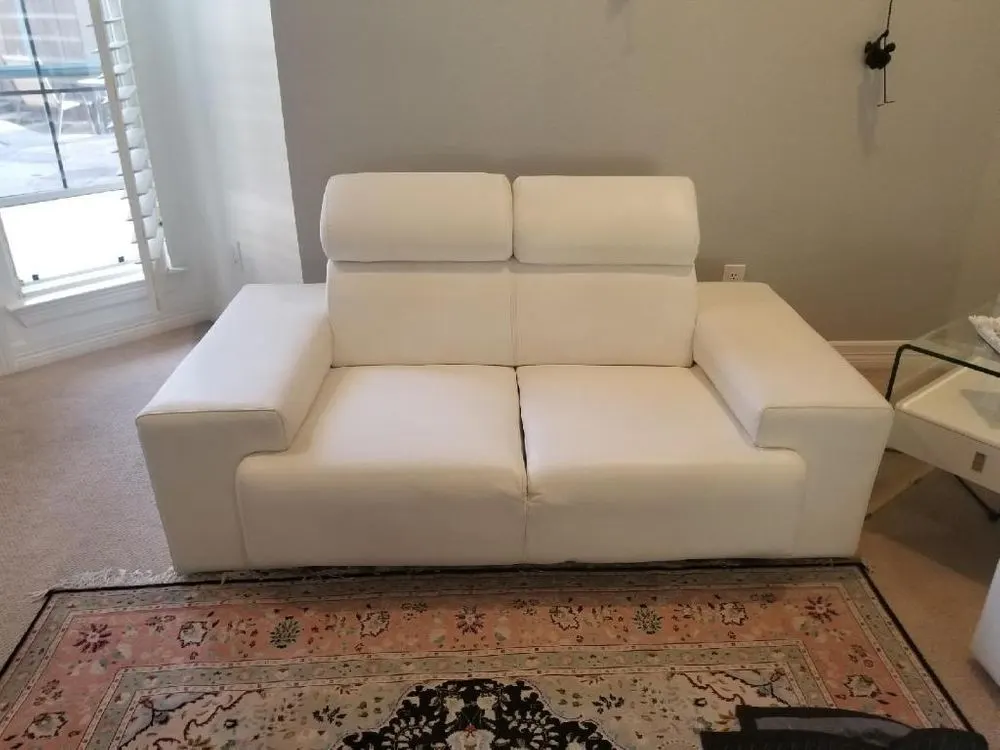
Light colors are the harder case, not because of texture but because the eye picks up tiny color differences far more readily in a pale surface. A white or cream PU sofa needs more blending than the same damage in mid-gray.
Where PU is used, and what that predicts
The setting tells you a lot about the grade.
Commercial seating — restaurant booths, medical exam chairs, salon chairs, office task seating — usually specifies high-grade PU or vinyl chosen for cleanability and abrasion resistance. These pieces repair reliably and are worth repairing.
Automotive uses PU and vinyl on bolsters, seat backs and door panels in mixed-construction interiors. Again, engineered grades, and they repair predictably.
Budget household furniture is where the poorest grades appear, often on inexpensive sofas, dining chairs and bed headboards. These sometimes degrade rather than wear, and repair is worth assessing carefully.
Fashion and accessory PU — bags, jackets — is a different specification again and is not usually a furniture-repair question.
If a commercial piece is failing, it is usually damage. If a very inexpensive household piece is failing, degradation is more likely.
What kills PU faster than it should die
Most premature PU failure is chemical, and most of it is preventable.
Alcohol-based sanitizers dissolve polyurethane. A chair wiped daily with a sanitizing wipe shows a dulled, then sticky, then breaking-down surface within a year or two, and that is exactly the pattern seen across a lot of commercial seating since sanitizing routines intensified.
Degreasers and kitchen cleaners attack the plasticizers that keep the coating flexible, and a stiffened coating crazes.
Silicone dressings do not damage the material directly but contaminate it, which becomes a problem the day a repair is needed.
Heat accelerates everything. In North Texas this is not marginal: PU in a sunroom, in a car parked outside, or in an RV closed up through summer ages far faster than the same material in a shaded, air-conditioned room.
The prevention is a neutral-pH cleaner, applied to a cloth rather than sprayed, and keeping kitchen and clinical chemicals away from seating.
PU versus vinyl versus bonded, in one comparison
These three get conflated constantly and the differences are practical rather than academic.
Vinyl — PVC — is generally the toughest of the three, which is why marine and heavy commercial seating uses it. It repairs extremely well and tolerates aggressive cleaning better than PU.
PU is softer and more leather-like to the touch, breathes slightly better, and in good grades is durable. It repairs well and is the most common synthetic in modern furniture.
Bonded leather is the outlier and the one to avoid. Its coating separates from a non-woven backing across the whole sheet, so it fails everywhere at once and repairs only as a temporary measure.
If a label says bonded, expect a short life. If it says PU, polyurethane or vinyl, the outlook depends on grade and on what has been used to clean it.
When replacing the panel is the better answer
On some pieces, replacing a single panel is genuinely more sensible than repairing it.
Where the damage is very large — most of a seat cushion — filling it produces a large rebuilt area in a high-flex position, and a new panel sewn in is more durable.
Where the piece is commercial seating with a standard construction, replacement panels are often available or easily fabricated, and downtime is the same either way.
Where the material has degraded on that panel but not on the others, replacing the failed one and blending color across its neighbors is a reasonable middle path.
The catch, as always, is color: a new panel is new material, and it will not match aged material without recoloring. On a light-colored piece that difference is obvious, so the new panel and often its neighbors get recolored as part of the job.
Getting a straight assessment
Photograph the damage square-on and then from a low raking angle, so depth and any lifted edges show.
Photograph an area well away from the damage, close up in raking light. This is the image that shows whether the coating elsewhere is sound or crazing, and it is what determines the recommendation.
Photograph the label under the seat deck if there is one, because it distinguishes PU from bonded in one line.
Say what the piece is used for and what it gets cleaned with. In commercial settings that answer frequently explains the failure and changes what should be recommended alongside the repair.
If the surface leaves residue on a fingertip, mention that too. It is the single clearest sign that the coating is degrading rather than damaged, and it saves everyone a wasted appointment.
And say how old the piece is. PU that has lasted a decade and then developed one cut is a good repair candidate; PU that started crazing at three years is a low grade reaching the end of its life, and the honest recommendation in that case is usually to spend the money elsewhere.
Photograph the underside of the material if you can reach it — at a seam, under a cushion, or on the back of the piece. PU on a knit backing looks quite different from bonded material on a non-woven one, and that single image often settles the question of whether the piece is worth spending anything on.
It is also worth saying whether the surface has ever been treated with a dressing or protectant. Silicone-based products are common on synthetic upholstery and they prevent new finish from bonding, so the preparation needed differs substantially depending on the answer.
Questions we get asked next
- Is PU leather the same as bonded leather?
- No, and the difference matters more than almost any other material distinction. PU has no leather content and sits on a stable knit backing; bonded leather is a coating containing ground leather fiber on a non-woven backing that delaminates across the whole sheet. PU repairs and lasts; bonded does neither reliably.
- How long should PU furniture last?
- Good commercial-grade PU handles years of heavy use, which is why it is specified for restaurants and clinics. Inexpensive household PU varies enormously — some lasts a decade, some crazes in three years. Heat exposure and cleaning chemistry make more difference than the original price.
- Can PU leather be recolored to a different color?
- Yes, and it takes color very predictably because the substrate is uniform. It is done routinely on restaurant booths during remodels, and it is one of the cheapest ways to transform a room's seating without replacing anything.
- My PU sofa feels sticky. Can that be fixed?
- Sometimes. If the stickiness is residue from a product, cleaning removes it. If the coating itself has started breaking down — which is what stickiness usually means on older PU — cleaning gives temporary improvement but the surface continues to degrade, and refinishing sits on a failing substrate.
- faux leather
- PU leather
- vinyl repair