Can Bonded Leather Be Repaired Permanently?
The honest answer is no, and understanding why saves people from spending repair money on furniture that is going to keep shedding anyway.
Quick answer
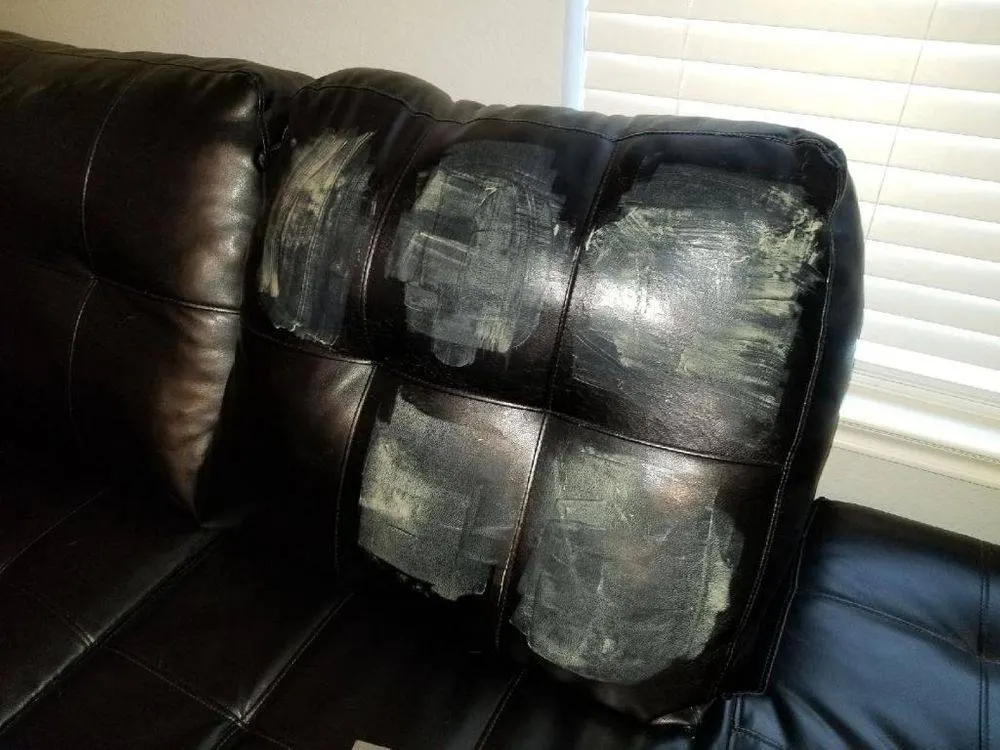
Not permanently. Bonded leather is a polyurethane coating on a fabric backing, and when it flakes, the bond between those two layers has failed — not just where you can see it. A single lifting area on an otherwise sound piece can be sealed and recoated and will hold for a year or two, which is sometimes worth doing. Refinishing a piece that is already flaking in several places is not, because the surrounding coating keeps letting go.
At a glance
| What it is | Ground leather fiber in a polyurethane layer, bonded to a fabric backing |
|---|---|
| How it fails | The coating separates from the backing — adhesive failure across the sheet |
| Worth repairing | One isolated lifting area on a piece you want another year or two from |
| Not worth repairing | Flaking on seats, back and arms — the material has finished |
| Typical service life | Commonly three to five years of regular use, faster in heat |
What bonded leather actually is
The name does most of the damage here, because it implies a kind of leather. It is more accurate to think of it as a coated fabric that contains leather dust.
Manufacturing works like this: leather scrap left over from cutting hides is ground into fiber, mixed into a polyurethane compound, and that compound is applied as a layer onto a fabric backing. The surface is then embossed with a grain pattern and finished so it looks like hide.
The result is convincing when new, considerably cheaper than hide, and consistent in a way real leather never is — which is exactly why it appears so widely in mid-priced sofas, recliners, office chairs and headboards.
But structurally it is two materials stuck together, and everything about how it ages follows from that.
Why it fails, and why it fails everywhere
The failure is adhesive rather than mechanical. Over time, heat, flexing and moisture degrade the bond between the polyurethane layer and its fabric backing.
That degradation happens across the whole sheet, not in one spot. The place you first see flaking is simply where mechanical stress was highest — a seat front, an arm crown, a headrest fold — but the weakness is already present everywhere the material exists.
This is the crucial point and the reason the honest answer is what it is. On genuine leather, damage is local: a worn spot is worn, and the hide two inches away is sound. On bonded leather, a flaking spot is not a local problem — it is the first visible symptom of a condition that the entire piece shares.
Once the coating starts lifting, each flex propagates the separation outward. That is why owners describe it the same way: it started on one cushion, and within six months it was on the arms too.
What a repair on bonded leather can actually achieve
It is not that nothing can be done. It is that what can be done is bounded, and the boundary should be stated before money changes hands.
A lifting area can be stabilized: the loose coating is removed back to material that is still adhered, the exposed backing is sealed, filler is built up to bring the area level with the surrounding surface, texture is matched and color is blended in.
Done well, that repair looks genuinely good and holds for a reasonable period — typically a year or two of normal use, sometimes longer on a low-traffic piece.
What it does not do is stop the coating two inches away from letting go next. The repair is sound; the material around it is still on its original trajectory.
So the correct framing is not repair versus permanent fix. It is: how much longer do you want this piece to last, and is that worth this amount of money?
When it is worth doing anyway
There are legitimate cases, and it is worth being as clear about these as about the limits.
A single lifting patch on a piece that is otherwise intact, where the owner wants another year or two before replacing — that is a reasonable spend, and it is often the difference between a sofa that looks neglected and one that looks fine.
Commercial settings where appearance matters immediately: a reception chair or a waiting-room bench that has started flaking in one visible spot, with a refit already planned for next year. Stabilizing it is cheaper than an unplanned replacement and it removes an eyesore.
Rental and staging furniture, where the piece needs to present well for a defined period rather than last a decade.
And genuine sentimental cases, where the owner knows exactly what they are buying and wants the piece to keep going.
In all of those, the decision is informed. The problem is not repairing bonded leather; the problem is repairing it while believing it is permanent.
When it is not worth doing
Three situations make the answer straightforward.
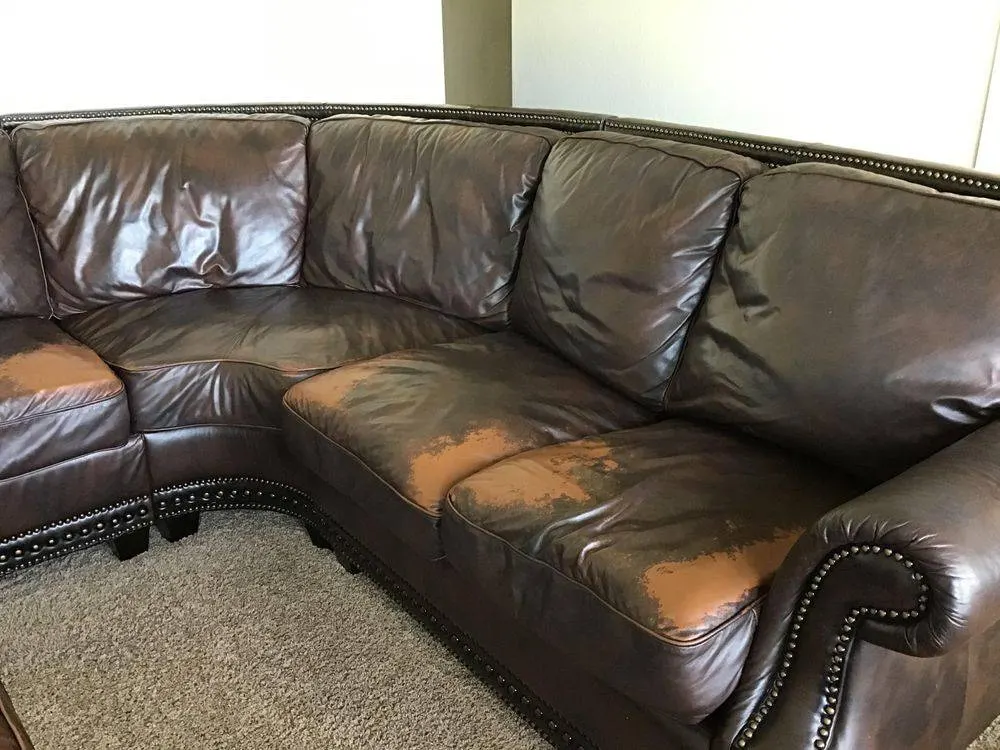
Flaking in multiple areas — seats and arms, or seats and back. That is the sheet failing rather than a spot failing, and refinishing it produces a piece that looks excellent for a few months and then resumes shedding, with the new finish coming away along with the old coating.
Large areas where the backing is already exposed across a whole cushion. There is too much to rebuild, and what is rebuilt sits on a substrate that is no longer holding anything.
Any case where the quote approaches a meaningful fraction of replacing the piece. Bonded furniture is inexpensive by design, which is part of why it is used; spending heavily to extend it rarely makes financial sense.
A specialist should say this plainly rather than quote the work. It is one of the clearer cases in this trade where the right recommendation is to spend nothing.
Why it goes faster in North Texas
Heat is the accelerant, and this region supplies plenty of it.
Elevated temperature speeds up the chemical degradation of the adhesive bond, so a piece in a sunroom, a west-facing living room or a room that gets hot when the air conditioning is off ages faster than the same piece elsewhere.
Year-round air conditioning contributes from the other direction by keeping the material dry, which makes the coating stiffer and less able to flex without separating.
The practical result is that bonded furniture here often starts flaking at the shorter end of its typical life. Owners frequently describe it as the sofa failing early — it did, but not because it was defective.
The same conditions are why bonded material in vehicles and RVs fails particularly fast. Cabin temperatures in a parked car in a Dallas summer are far above ambient, and any bonded or low-grade synthetic trim in that environment is on a short clock.
What to buy instead, if you are replacing
Since the honest answer often ends in replacement, it is worth saying what avoids repeating the experience.
Genuine top-grain or full-grain leather is the durable option, and it is repairable indefinitely because the hide underneath stays sound. It costs more up front and it is the only one of these materials that can be refinished repeatedly over decades.
Good-quality PU or faux leather on a knit backing is a legitimate middle option. It is not hide, but it is a single engineered material rather than two layers with an adhesive between them, and quality versions hold up well — which is why commercial seating uses so much of it.
Read the label before buying rather than after. 'Bonded leather', 'blended leather' and 'reconstituted leather' all describe the same construction. 'Leather match' means hide on the seating surfaces and something else on the sides, which is fine as long as you know.
And check where the piece will sit. A window-facing position in this climate shortens the life of any upholstery material, and it shortens bonded material dramatically. If the only spot available for a new sofa is in afternoon sun, that argues for genuine leather or a quality synthetic rather than the cheapest option, because the cheapest option will not survive the position.
How to slow it down while you decide
If replacement is the answer but not this month, a few things genuinely extend the time you have.
Reduce heat exposure. Move the piece away from direct sun if that is possible, or break the light with blinds during the strongest part of the afternoon. Heat is the main accelerant of the adhesive failure, so this is the highest-value change available.
Stop flexing the failing areas. A throw or a fitted cover over a cushion that has started lifting will not repair anything, but it reduces the mechanical stress that propagates separation and it stops flakes ending up across the room.
Do not condition it. Leather conditioner does nothing for a polyurethane coating and tends to work its way under lifting edges, which loosens them further. Clean it with a barely damp cloth and nothing else.
Do not pick at loose flakes, however tempting. Every flake removed exposes more backing and gives the next section an edge to lift from. Trim what is already hanging with scissors rather than pulling it.
None of this is a repair. It is time, which is sometimes exactly what is needed.
Getting a straight answer about your piece
Photographs settle it quickly, and this is one of the assessments where the answer is often that you should not spend anything.
Photograph the label under the seat deck, every area that is flaking, and the underside of a flake that has already come away. Take a wide shot of the whole piece so the extent is visible, and one close-up of an area that still looks fine.
Say how old the piece is and how it is used. Three years and flaking on the seats is a clear picture; twelve years and flaking on one arm is a different conversation.
The assessment costs nothing, and finding out that a piece is bonded and finished is a genuinely useful result — it is the difference between replacing furniture on your own schedule and replacing it after spending on a repair first.
It is also worth asking specifically what a repair would buy you in time rather than only what it costs. A specialist who has worked on bonded material can usually give a realistic range, and framing the decision that way — this much money for roughly this much longer — makes it a straightforward call rather than a gamble.
Questions we get asked next
- Can bonded leather be reupholstered instead?
- Yes — the frame, springs and foam are usually unaffected, so a piece with a good structure can be re-covered in hide or a quality synthetic. Whether that makes sense depends on the frame: bonded covers are typically fitted to inexpensive frames, and reupholstering a budget frame rarely adds up.
- Will a leather conditioner stop bonded leather from peeling?
- No. Conditioner works on hide, keeping fibers supple. Bonded leather's problem is an adhesive bond failing between a coating and a fabric backing, which conditioner cannot reach or affect. Applied to a flaking surface it mostly makes the flakes slide.
- How long should bonded leather furniture last?
- Commonly three to five years of regular household use before flaking starts, though low-use pieces last longer and hot, sunny positions shorten it considerably. If yours failed inside two years and it was a recent purchase, it is worth checking whether any warranty still applies.
- Is bonded leather the same as faux or PU leather?
- No, and the difference matters. Bonded leather is a coating containing ground leather fiber on a fabric backing, and it delaminates. Faux and PU materials have no leather content and are usually applied to a stable knit backing, which is why good ones hold up considerably better.
- bonded leather
- peeling
- repair limits