Can Ink Be Removed from a Leather Couch Without Damaging the Finish?
Ink is not a difficult stain because it is stubborn. It is difficult because the things that remove it also remove the finish.
Quick answer
Often, and it depends on the leather and how long the ink has been there. Ballpoint ink on pigmented leather, caught early, usually lifts with a dedicated leather ink remover used carefully. What causes most of the damage is the home attempt: alcohol, sanitizer and hairspray dissolve ink and the finish at the same time, leaving a dull bare patch that is worse than the mark. On aniline leather, ink reaches the hide almost immediately and recoloring is usually the route back.
At a glance
| The core problem | Solvents that lift ink also dissolve the finish beneath it |
|---|---|
| Best case | Fresh ballpoint on pigmented leather |
| Worst case | Permanent marker, or any ink on aniline |
| Do not use | Alcohol, sanitizer, hairspray, acetone, melamine sponges |
| If it fails | The panel is recolored to its seam lines — a routine outcome |
Why ink is the hard one
Most stains on leather are a matter of lifting something off a surface. Ink is different, and the reason is chemistry rather than stubbornness.
Ink is designed to be permanent on porous surfaces. Ballpoint ink is a dye or pigment carried in an oil-based paste, formulated specifically to stay where it is put.
The solvents that dissolve it — alcohols, glycols, acetone — are the same solvents that dissolve the polyurethane and acrylic coatings used to finish leather.
So there is no product that attacks the ink and ignores the finish. There is only a matter of degree, and of how carefully the process is controlled.
That is why the professional approach is about dwell time, dilution and technique rather than about having access to a stronger product.
And it is why the most common outcome of a home attempt is a mark that has gone, replaced by a dull patch where the coating went with it.
The kinds of ink, in order of difficulty
They behave differently and the outlook varies considerably.
Ballpoint is the most common and the most treatable. The oil-based paste sits largely in and on the finish, and on pigmented leather a fresh mark often lifts well.
Gel pen ink is water-based and flows more freely, so it spreads further on contact and penetrates faster, though it can respond well if caught quickly.
Rollerball and fountain pen inks are liquid and soak in immediately, which makes them harder on any absorbent leather.
Permanent marker is formulated to resist solvents and it usually reaches the hide. Full removal is uncommon and recoloring is the realistic answer.
Printer and stamp inks vary widely.
And ink that has been through a wash cycle on clothing and then transferred is a different problem again, closer to dye transfer than to a direct mark.
The leather matters more than the ink
Before anything else, establish what the surface is, because it changes the prognosis completely.
Pigmented or protected leather has an opaque coating over the hide. Ink initially sits on and in that coating, which is a barrier and gives you something to work with.
Semi-aniline has a light coating, so ink penetrates faster but is not immediately in the hide.
Aniline has no pigment coating at all. Ink reaches the hide within moments and dyes it, and no surface treatment recovers a dyed hide.
Nubuck and suede absorb instantly and are the worst case of all.
Bonded leather and faux leather have a polyurethane surface, which resists ink reasonably and is also easily damaged by solvents.
A drop of water on a hidden area settles most of this: beading means a sealed surface, soaking in means an absorbent one. That single test tells you whether you are looking at a cleaning problem or a recoloring one.
What to do in the first minutes
The window where an owner can genuinely help is short, and doing less is better than doing more.
Blot gently with a dry cloth, lifting rather than wiping. Wiping spreads ink outward and turns a line into a smear.
Work from the outside of the mark inward for the same reason.
Use a clean part of the cloth each time, since a loaded cloth redistributes ink.
Do not add liquid of any kind at this stage.
Then stop and assess. If it is fresh ballpoint on pigmented leather, a dedicated leather ink remover used exactly as directed is a reasonable next step.
If it is anything else, or if you are not sure what your leather is, photograph it and leave it alone. An untouched ink mark is far easier to treat than one that has had three products on it.
The products that cause the damage
Every one of these appears in online advice, and every one of them arrives at our door regularly.
Rubbing alcohol and isopropyl. They do lift ink, and they strip the finish while doing it, leaving a dull lighter patch with a hard edge.
Hand sanitizer, which is alcohol in gel form and does the same with less control.
Hairspray, which is a solvent in an aerosol plus resins that leave a sticky residue behind.
Acetone and nail polish remover, which remove the coating on contact.
Melamine sponges, which sand off the grain and leave a smooth shiny area that is more noticeable than the ink.
Milk, toothpaste, baking soda and the various household remedies, which do nothing to ink and add their own residue.
And bleach, which damages the leather itself permanently.
The common thread is that they all trade a colored mark for a damaged finish, which is the worse of the two problems.
How a specialist approaches it
The difference is method and judgment rather than a secret product.
The leather is identified first, and the treatment is chosen accordingly rather than starting with the strongest option.
Everything is tested on a hidden area, with the finish's reaction observed before anything touches the visible mark.
Removal happens in stages — brief controlled contact, assess, repeat — rather than one long application. Dwell time is the main variable and it is where damage happens.
The leather is neutralized and cleaned between stages, so the solvent is not left working on the finish.
The process stops when progress stops. Continuing past that point removes finish without removing more ink, and knowing where that line is comes from having crossed it before.
If the finish is thinned during removal, the panel is resealed, which is why this work is often quoted with refinishing as a possible second stage.
When recoloring is the answer
This is a normal outcome rather than a failure, and it is worth understanding as a route rather than a last resort.
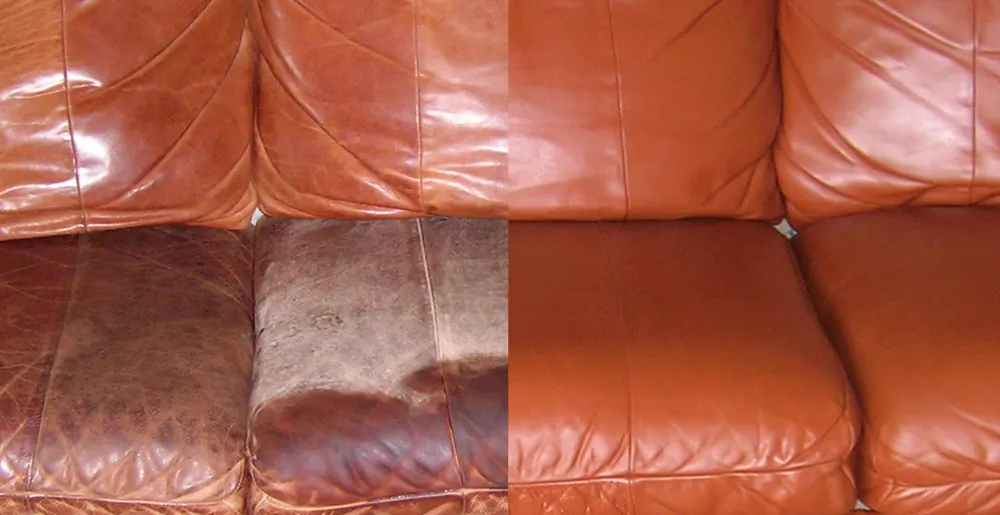
Ink that has reached the hide cannot be lifted out of it. Recoloring covers it and restores an even surface.
The area is cleaned, any residual ink is sealed with a blocking layer so it cannot migrate up through the new color, and the panel is then recolored and sealed.
That blocking step matters. Ink left unsealed under new color can bleed through over months, which is why a quick color touch-up over an ink mark often reappears.
The work runs to seam lines rather than blending mid-panel, since a blend into aged leather is visible at certain angles.
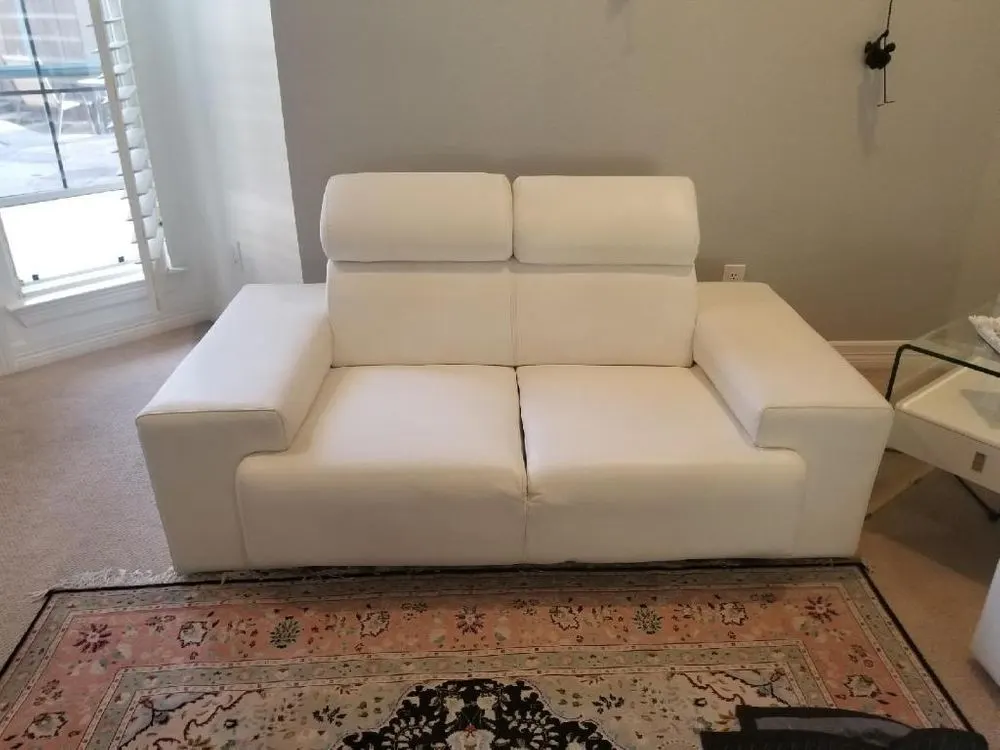
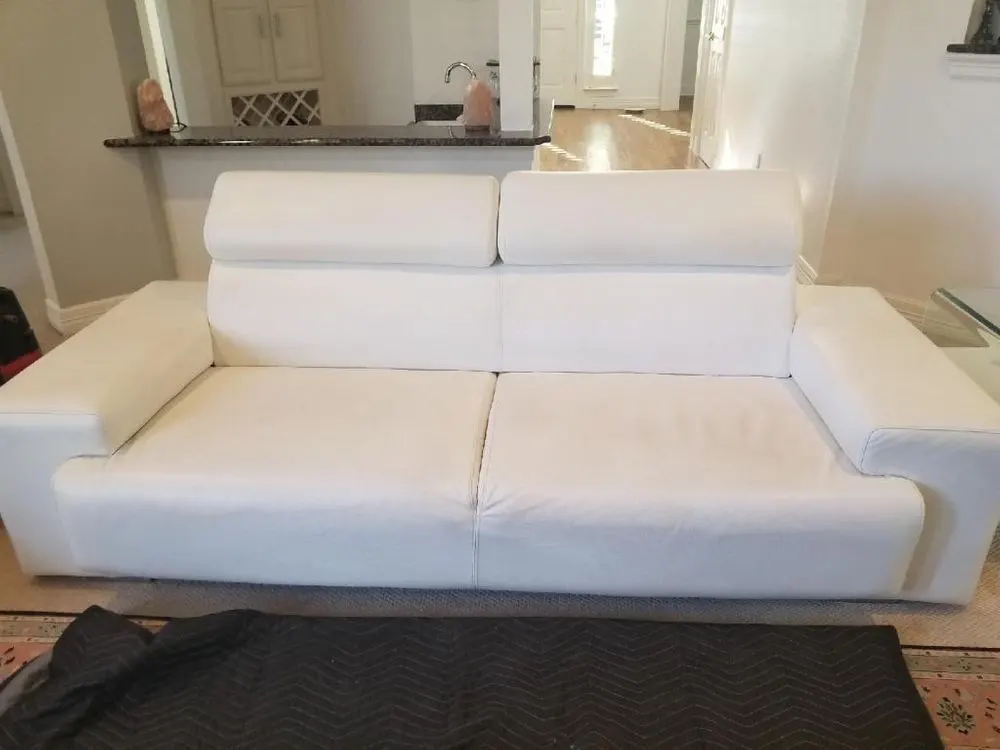
On a light-colored sofa where the ink has spread, recoloring the whole cushion or the whole piece may be the right scope.
The result is a uniform surface with no mark, which for most owners is the actual objective rather than removal specifically.
Ink on aniline and unfinished leather
Worth a section of its own, because the advice is different and the disappointment is common.
There is no coating to protect the hide, so ink is absorbed into the leather itself almost immediately.
Blotting helps in the first seconds and after that there is very little an owner can do.
Solvent-based removal on aniline is high risk: it can lighten the surrounding leather, leave a halo, and change the texture, all of which are more visible on aniline than the ink was.
Some specialists will attempt controlled reduction, and the honest framing is that improvement is possible and full removal is unlikely.
Recoloring an aniline panel changes the character of the leather, since applying pigment to an aniline hide makes it semi-aniline in that area — which has to be a deliberate decision by the owner rather than a default.
For a valuable aniline piece, it is worth getting an assessment before anything at all is tried, because the first attempt usually determines what remains possible.
Preventing the next one
Ink damage is among the most preventable things that happen to leather furniture.
Keep pens off the sofa. Most ink marks come from a pen that was left on a cushion and then sat on, or one used while lying on the piece.
Provide somewhere obvious for pens to live in that room, since a rule without an alternative does not hold.
Be particularly careful with children's markers, and keep permanent markers out of the room entirely.
Watch for pens in pockets, which is how a mark ends up on a seat with nobody knowing how.
Consider a leather protector on light-colored pieces, which buys time before ink penetrates and makes early removal more likely to succeed.
And deal with any mark the same day. The difference in outcome between an hour and a week is larger for ink than for almost any other stain.
What to send for an assessment
Photograph the mark close up with something for scale, in daylight and without flash.
Photograph the whole panel so its position relative to seams is clear, which affects the scope if recoloring is needed.
Say what kind of pen or marker it was, if you know.
Say how long ago it happened — hours, days or months — since that is the strongest predictor of the outcome.
Say exactly what has been tried on it and how many times. This is the single most important thing to disclose, because a mark that has had alcohol on it is a different job from an untouched one.
Do a water-drop test on a hidden area and say whether it beads or soaks in.
Photograph any area where the finish now looks dull, lighter or different from its surroundings, since that is finish damage rather than ink and it needs including in the quote.
Questions we get asked next
- Can I use rubbing alcohol to get ink off my leather sofa?
- It will lift the ink and it will take the finish with it, leaving a dull lighter patch with a hard edge. That patch then needs refinishing, which is more work than the ink would have been. It is the single most common way an ink mark becomes a repair.
- How long do I have to get ink off leather?
- On pigmented leather, hours to a few days makes a real difference; the ink is still largely in the finish. On aniline, effectively seconds — it reaches the hide almost immediately. In every case, blot gently, add nothing, and get advice the same day.
- Will recoloring hide the ink permanently?
- Yes, provided the residual ink is sealed with a blocking layer before the color goes on. Without that step, ink can migrate up through the new color over months, which is why a quick touch-up over an ink mark often reappears.
- Is permanent marker removable from leather?
- Rarely in full. It is formulated to resist solvents and it usually reaches the hide. Improvement is sometimes possible; the realistic route back is sealing and recoloring the panel to its seam lines, which produces an even surface with no mark.
- ink
- stain removal
- couch repair