How Do You Remove Blue-Jean Dye Transfer from Light Leather Furniture?
Dye transfer is the most common complaint on light-colored leather furniture, and it is almost entirely a question of how long it sat.
Quick answer
Fresh transfer on pigmented leather usually cleans off with a leather cleaner worked over the whole panel. Established transfer that has built up over months needs a stronger dye-transfer treatment, which is specialist work because the products that lift indigo also attack finishes. Once the dye has migrated into the finish or reached the hide — most likely on aniline or lightly finished leather — cleaning will not recover it and recoloring the panel is the route back.
At a glance
| Fresh transfer | Usually cleans off pigmented leather with a leather cleaner |
|---|---|
| Built up | Needs a dye-transfer treatment — specialist territory |
| Into the hide | Recoloring rather than cleaning |
| Worst case | Aniline and semi-aniline, which absorb rather than resist |
| Prevention | Wash new denim before wearing it on light leather |
Why denim does this
Indigo is a poorly fixed dye, and that is a design feature rather than a defect.
The faded, worn look denim develops depends on dye leaving the fabric. A jean that never released dye would never fade, and nobody would buy it.
So indigo sits on the surface of the fibers rather than being bonded into them, and it comes off with friction, warmth and moisture.
All three are present when somebody sits on a sofa: the pressure and movement of sitting, body heat, and a small amount of perspiration.
New dark denim releases the most, raw and unwashed denim releases a great deal, and cheaper dyeing releases more than better dyeing.
It is not only denim. Dark clothing generally, dyed cushions and throws, colored newsprint and some upholstery fabrics all transfer, and the mechanism is the same.
But denim accounts for the large majority of what we see, because of how much of it gets worn on sofas.
What the dye actually does to the leather
The progression explains why timing matters so much on this particular problem.
At first the dye sits on top of the finish. At this stage it is soil rather than staining, and a leather cleaner lifts it.
With repeated contact it starts to work into the texture of the grain, which on a heavily grained hide gives it a great many small places to lodge.
Then it begins to penetrate the finish itself. Finishes are not perfect barriers, and warm dye under pressure finds every weakness.
Once it is in the finish, surface cleaning removes what is on top and leaves what is below, which is why an owner can clean a sofa and watch it look blue again within days.
On aniline or lightly finished leather there is little or no barrier, so the dye reaches the hide quickly and dyes it — which is effectively permanent staining.
The practical line is that transfer caught in weeks is a cleaning job and transfer left for a year usually is not.
Where it shows up
The pattern is diagnostic and it is worth checking the whole piece rather than the obvious spot.
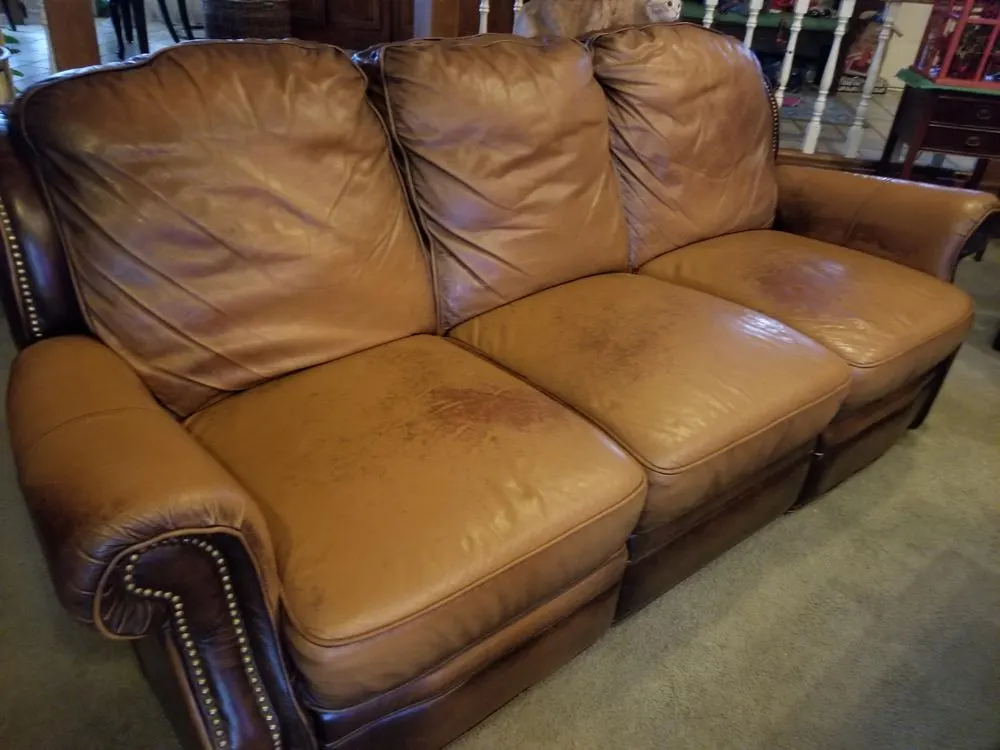
Seat cushions, in the shape of where people sit, which is the classic presentation.
The front edge of the seat, from the backs of legs.
The seat back where people lean, which shows as a broad soft-edged area rather than a defined shape.
Arm tops, from forearms and from sitting on the arm.
The inner faces of arms, which get brushed constantly and are often missed.
And on a recliner, the leg rest and footrest surfaces.
It is usually uneven, following where contact happens, which is what distinguishes it from general soiling — soiling is more even, transfer follows the body.
Treating fresh transfer at home
For recent transfer on pigmented leather, this is genuinely a job an owner can do, with a few conditions.
Use a cleaner made for finished leather, applied to a cloth rather than directly to the surface.
Work the whole panel, not the discolored area. Cleaning a patch on a light sofa leaves a visibly cleaner patch, which is more noticeable than the transfer was.
Use light repeated passes rather than pressure. Scrubbing burnishes the finish and can leave a shiny area.
Change to a clean part of the cloth frequently, since a cloth loaded with lifted dye simply redistributes it.
Expect it to take several passes with drying time between, rather than coming off in one.
Then condition lightly and buff off, since cleaning takes some surface oils with the dye.
If two or three careful attempts have not moved it, stop. That is the point where it has gone into the finish and where escalating causes damage.
What not to reach for
Dye transfer attracts more improvised chemistry than almost any other leather problem, because it looks like it should wipe off.
Household wipes and all-purpose sprays strip the finish. On a light sofa the result is a dull patch that then attracts soil faster than the surrounding area.
Rubbing alcohol and hand sanitizer dissolve the finish along with some of the dye, leaving a bare and lighter patch.
Melamine sponges sand off the grain, leaving a smooth shiny area that is far more visible than blue.
Bleach and bleach-based products attack the leather itself and leave permanent damage.
Acetone removes the coating on contact.
Hairspray, which appears in a lot of online advice, is a solvent in an aerosol and does the same.
The pattern in all of these is that they work on the dye and on the finish at the same time, and the finish is what you are trying to save.
What a specialist does differently
For established transfer there are products that lift dye without destroying the coating, and using them is a skill rather than a purchase.
Dye-transfer removers are formulated to break the bond between the dye and the finish, and they are aggressive enough that dwell time and technique matter.
They are tested on a hidden area first, without exception, since finishes vary and some react badly.
They are worked in stages with assessment between, rather than applied heavily once.
The leather is neutralized and cleaned afterward, because leaving the product on continues its action.
Where the transfer lifts but the finish has been thinned in the process, the panel is resealed — which is why this work is often quoted with refinishing as a possibility rather than a certainty.
And where the dye has reached the hide, the honest answer at that point is recoloring rather than more removal attempts.
When recoloring is the answer
Sometimes cleaning is not the route back, and recognizing that early saves both money and finish.
Transfer that returns within days of cleaning, which means the dye is in the finish rather than on it.
A blue or gray cast across a whole panel rather than defined areas, which is accumulated transfer that has become part of how the leather now looks.
Any significant transfer on aniline or semi-aniline leather, where it has almost certainly reached the hide.
Areas where previous cleaning attempts have thinned or damaged the finish.
In those cases the panel is cleaned as far as it usefully goes, then recolored to its seam lines and sealed.
The new finish also provides a better barrier than what was there, which genuinely reduces how fast transfer builds up afterward.
Scope matters as it always does: whole panels to the seams rather than patches, and matching panels done together.
Preventing it
This problem is unusually preventable, and the measures are small.
Wash new dark denim two or three times before wearing it on light leather. Most of the loose dye comes out in the first few washes.
Wash it inside out in cold water, which removes surface dye without fading the garment as much.
Be particularly careful with raw or selvedge denim, which is designed to release dye heavily and will mark a light sofa on the first sitting.
Use a throw on the seat that gets the most use, which is the single most effective measure and costs almost nothing.
Wipe the high-contact areas every couple of weeks. Transfer removed while it is still on the surface never becomes a problem.
Consider a leather protector on light-colored furniture, which adds a barrier and makes what does transfer easier to remove.
And treat the piece properly from new, since a sound finish resists transfer far better than a worn one.
Buying light leather with this in mind
Worth saying, because this problem is a large part of why people regret a light sofa.
Light leather is beautiful and it shows everything, and dye transfer is the most common thing it shows.
Pigmented light leather is much more resistant than aniline, because the color sits in a protective coating and the dye has a barrier to cross.
Aniline in a light color, in a household where people sit on it in jeans, will discolor. That is not a manufacturing fault and it is worth knowing before buying rather than after.
Textured finishes hold transfer in the grain more than smooth ones, which makes cleaning harder.
A protector applied when the piece is new is far more effective than one applied after transfer has started.
None of this argues against light leather. It argues for choosing pigmented, protecting it early, and keeping a throw on the seat everyone uses.
What to send for an assessment
Photograph the affected areas in daylight without flash, which misrepresents both color and how obvious the discoloration is.
Photograph the whole piece so the pattern of contact is visible.
Photograph an unaffected area of the same leather for comparison.
Say how long it has been building up, which is the most predictive single piece of information.
Say whether it improves at all with a leather cleaner, and whether it returns after cleaning.
Say what has already been tried on it, particularly any household product or solvent.
Do a water-drop test on a hidden area and say whether it beads or soaks in, since that tells us whether we are dealing with pigmented or aniline leather.
And say whether the piece has ever had a protector applied, since that changes both how the dye has behaved and what the surface will accept next.
Questions we get asked next
- Will jean dye come off my light leather sofa?
- If it is fresh and the leather is pigmented, usually yes — with a leather cleaner worked over the whole panel in light repeated passes. Transfer that has built up over months has generally moved into the finish, and at that point it is specialist work.
- Why does the blue come back after I clean it?
- Because the cleaning removed what was on the surface and left what had penetrated the finish. Dye below the surface migrates back up with warmth and use. That pattern is the clearest sign that it needs a dye-transfer treatment or recoloring rather than more cleaning.
- Can I use rubbing alcohol on dye transfer?
- No. It dissolves the finish along with some of the dye, leaving a dull, lighter patch that then needs refinishing. Everything strong enough to lift set indigo quickly is also strong enough to remove the coating you are trying to protect.
- How do I stop it happening again?
- Wash new dark denim two or three times inside out before wearing it on the sofa, keep a throw on the seat that gets the most use, and wipe the high-contact areas every couple of weeks. A leather protector on light furniture makes what does transfer far easier to remove.
- dye transfer
- denim
- light leather