How Much Does Professional Leather Repair Cost, and What Changes the Quote?
The honest answer to what leather repair costs is that it depends on six things — and you can assess most of them yourself in ten minutes.
Quick answer
It depends on the material's condition, the size and type of damage, how many items are being done, whether color work is needed and over what area, the access and location, and the finish type. The single biggest factor is not the damage — it is whether the surrounding material is still sound, because that determines whether the job is a repair, a recoloring or a recovering. Any quote given without seeing photographs is a guess.
At a glance
| Biggest factor | Material condition, not the size of the damage |
|---|---|
| Scope drives cost | Whole panels to seam lines, not patches |
| Volume helps | Setup and color mixing are shared across items |
| Preparation | Degreasing a contaminated area can exceed the repair time |
| Be wary of | A firm price quoted without photographs |
Why nobody can price it over the phone
It is a reasonable question and the honest answer frustrates people, so it is worth explaining what is actually being assessed.
Two sofas with a tear of exactly the same size can be completely different jobs.
On one, the leather around the tear is supple, the finish is intact, and the repair is a contained piece of work that will last.
On the other, the leather has stiffened throughout, so a repair will hold while new cracks appear beside it — which makes the honest recommendation recoloring, recovering, or nothing at all.
The damage looks identical in a description and the work is not comparable.
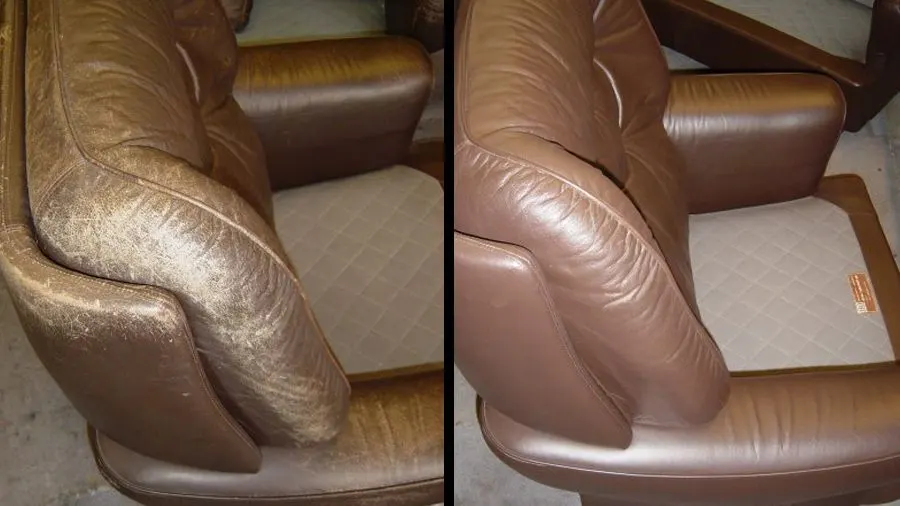
The same applies to color. A small repair on a piece where the panel must be recolored to its seam lines is a different job from the same repair where a touch-in will disappear.
So a specialist quoting firmly from a verbal description is either padding heavily to cover the unknown or setting up a revision when they arrive.
Factor one: the condition of the material
This is the biggest single variable and it is the one owners rarely think to assess.
Press a thumb firmly into the leather or vinyl beside the damage and flex it.
If it yields and springs back, the material is sound. A repair has something stable to build on and it will wear like the material around it.
If it feels board-like, or fine cracks appear under the pressure, the material has aged out. A repair will hold and the area around it will keep failing.
If powder comes off on your thumb, the finish is disintegrating and nothing bonds durably to it.
Those three outcomes lead to three completely different quotes: a repair, a recoloring with repairs, or a recommendation to recover or replace.
Reporting the result of that test with your photographs is the single most useful thing you can do to get an accurate figure.
Factor two: what the damage actually is
Different damage types are genuinely different amounts of work, and size is less important than people expect.
Surface scratches and scuffs in the finish are the least work — cleaned, touched in and sealed.
Color loss and fading is refinishing work, priced by area rather than by severity.
Cracks that have gone into the hide need filling in thin layers with texture matching, which is slower.
Tears and punctures need backing before filling, so they take longer than a crack of similar length.
Burns need the charred material cut back first, which makes the working area larger than the damage.
Chewed and missing material has to be rebuilt in volume, or let in, which is more again.
And structural work — seams, piping, panel replacement — is a different category from surface work.
A photograph tells a specialist which of these it is far better than any description.
Factor three: scope, which is usually the surprise
This is where quotes come in higher than owners expect, and understanding it makes the number make sense.
Repairs are almost never priced as the damaged area alone, because a repair blended into aged leather mid-panel shows at certain angles.
Work runs to seam lines. A worn patch in the middle of a cushion means refinishing that cushion top, edge to edge.
That produces a result the eye accepts, because a seam is a break it already expects.
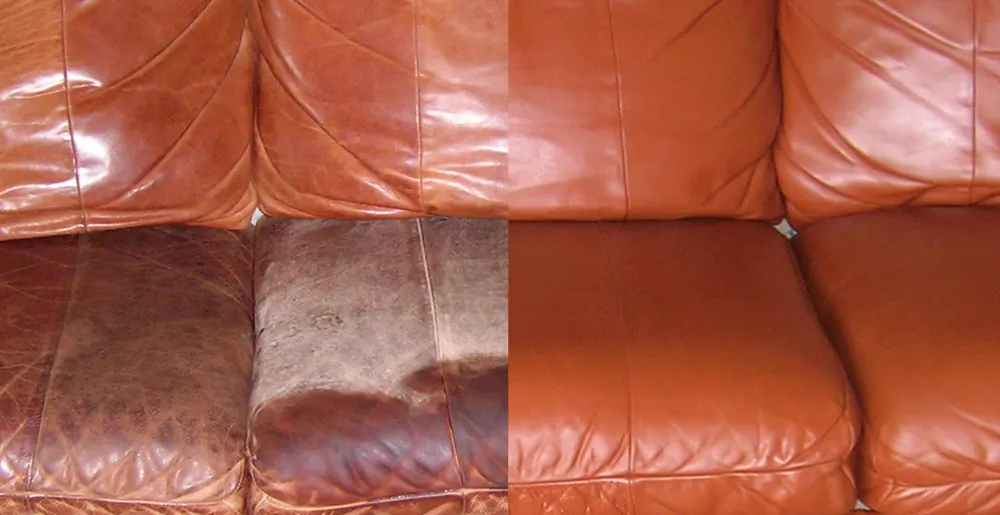
The same logic extends outward. Recoloring one cushion on a three-seat sofa leaves two faded cushions beside a fresh one, so the sensible scope is often the whole piece.
And matching items — a pair of chairs, a set of dining chairs, a sectional — are compared directly, so partial work creates a mismatch.
None of this is upselling. It is the difference between a repair you have to look for and one you have to explain.
It is worth asking a specialist to quote both scopes so you can see the difference rather than assuming.
Factor four: how much preparation is needed
Invisible in a photograph and frequently the largest part of the labor.
Nothing bonds to a contaminated surface. Body oils, old conditioners, silicone dressings and general soil all have to come off completely before anything is applied.
On a headrest that has absorbed years of hair and skin oils, degreasing can take longer than the repair that follows.
On a piece that has had silicone-based dressings applied for years, removing that film is a job in itself.
On commercial seating in a food environment, airborne grease has to be removed from everything.
This is the stage that separates a repair that lasts from one that fails in months, and it is the stage a cheap quote has usually cut.
So a higher quote that specifies thorough preparation is frequently the cheaper option over any real timeframe.
It is a fair question to ask directly: what preparation is included, and how long is it expected to take.
Factor five: volume
The factor most in your control, and it moves the per-item cost substantially.
Travel, setup, cleaning products and color mixing are largely fixed per visit rather than per item.
Color mixing in particular is a real part of any refinishing job, and it is done once for everything of the same color in one visit.
So the second item costs meaningfully less than the first, and the fifth costs less again.
That is why a sofa and its matching chair done together cost far less than the same two done a year apart.
It is also why commercial work is priced per visit rather than per item.
The practical implication: walk the whole house or the whole site before booking, and get everything into one assessment even if you then phase the work.
Owners regularly find the difference changes what they decide to do.
Factor six: access, location and conditions
Practical variables that affect the time a job takes.
Mobile work at your home or premises removes transport entirely, which is why most furniture and vehicle work is done that way.
Items that have to be collected and returned carry that handling cost.
Fixed items in awkward positions take longer than accessible ones.
Working conditions matter more than people expect. Direct sun affects color matching because the eye judges color badly in glare, and surface heat affects how coatings flow and cure.
In this climate, an August afternoon in an unshaded driveway or an unconditioned garage is a genuinely worse working environment, and a shaded or cooled space produces a better result in less time.
Ventilation requirements in enclosed spaces can affect scheduling.
And commercial work outside operating hours is priced differently from daytime work, which is usually still worth it against the cost of closing.
What makes a quote cheap, and why that matters
Being direct about this, because the cheapest quote is frequently the most expensive outcome.
Cheap quotes usually cut preparation. Skipping proper degreasing is the single most common reason repairs lift within months.
They apply filler in one thick pass rather than thin layers, which cures rigid and cracks along its own edge at any flex point.
They use a generic color rather than mixing on site against the actual item, which produces a near-match that reads as wrong.
They skip texture matching, leaving a smooth patch in a grained surface.
They omit the topcoat, so the repair has a different sheen and soils faster.
And they treat the damaged area only rather than working to seam lines, so the repair is visible from certain angles.
The result is a repair that has to be redone, and redoing it costs more than doing it properly first because the failed work has to be removed.
Getting a number you can rely on
A short process that produces an accurate quote rather than a range.
Photograph the whole item, then each damaged area close up, then again at a low raking angle.
Photograph a hidden area of the same material for color reference.
Do the thumb-flex test and report the result in words.
Do a water-drop test on a hidden area and say whether it beads or soaks in, which identifies the finish type.
Say what has already been applied to it, including any household product or repair kit, because that changes the preparation.
Say what else in the house or on the site might be included, since volume changes the figure.
And say what you want from it — a fix that lasts as long as you keep the item, or something presentable for a defined period — because those are different jobs and both are legitimate.
Comparing repair against the alternative
The comparison worth running, since the quote only means something against something else.
For furniture, price the repair against reupholstery and against replacement of an equivalent piece, including delivery.
For a vehicle, price it against what the interior condition is costing at trade-in or sale.
For commercial seating, price it against reupholstery and against the disruption of replacement.
Factor in the frame. On contract furniture and on well-made domestic pieces, the frame typically outlasts several coverings, which shifts the comparison substantially toward keeping it.
Factor in fit. A piece chosen for a specific space, or a chair adjusted to one person, has value a replacement does not deliver.
And factor in how long you are keeping it, which changes the answer more than any other single input.
A specialist who tells you the repair is not worth doing on a particular item is giving you the most valuable answer available, and it is worth choosing one who will.
Questions we get asked next
- Why will nobody give me a price over the phone?
- Because two identical-sounding tears can be completely different jobs depending on whether the surrounding material is still sound. A firm price without photographs is either padded to cover the unknown or will be revised on arrival. Photographs plus a thumb-flex test result get you an accurate figure.
- Why is the quote for more area than the damage?
- Because a repair blended into aged leather mid-panel shows at certain angles, so work runs to seam lines where the eye already expects a break. On matching items it extends further, since a set is compared directly and partial work creates a visible mismatch.
- Is the cheapest quote a false economy?
- Usually. Cheap quotes cut preparation, apply filler in one thick pass, use generic colors and skip texture matching or the topcoat. The repair then lifts or reads as a patch, and redoing it costs more than doing it properly because the failed work has to be removed first.
- How can I bring the cost down legitimately?
- Volume. Setup, travel and color mixing are shared across everything done in one visit, so getting all the affected items into one assessment lowers the per-item cost substantially. Walk the whole house or site before booking, even if you then phase the work.
- cost
- quotes
- estimates