What Should You Ask About Durability, Aftercare and Repair Guarantees?
You do not need to know the trade to judge it. The right ten questions do the work for you.
Quick answer
Ask what preparation is included, how the material's condition was assessed, how the color will be matched, how the texture and sheen will be matched, what scope the quote covers, how long the cure period will be and what to avoid during it, what is guaranteed and what is excluded, what aftercare is needed, and what they would not recommend doing. The last question is the most revealing — a specialist who will tell you to skip something is worth using.
At a glance
| Most revealing | What would you not recommend doing? |
|---|---|
| Preparation | Ask specifically — it is where cheap quotes cut |
| Material condition | Ask whether they did the flex test and what it showed |
| Scope | Ask whether it runs to seam lines and why |
| Get it in writing | Scope, cure instructions and guarantee terms |
Why these questions work
You do not need technical knowledge to assess a specialist. You need questions whose answers reveal whether they have one.
Leather repair has a small number of things that determine whether a job lasts, and every competent specialist knows them.
Someone who cannot answer clearly on preparation, material condition and scope either has not assessed your item properly or does not work that way.
The questions below are also the ones whose answers you should have anyway, regardless of who does the work — because several of them are things you need to know afterward.
None of them are confrontational. A good specialist will be pleased to be asked, because these are the questions that justify their price against a cheaper quote.
And the answers give you something concrete to compare between quotes, which a price alone does not.
Question one: what preparation is included
The most important question and the one that most reliably separates quotes.
Nothing bonds to a contaminated surface. Body oils, old conditioners, silicone dressings and general soil all have to come off completely before anything is applied.
On a headrest or an arm that has absorbed years of oils, degreasing can take longer than the repair itself.
Skipping or shortening it is the single most common reason repairs lift within months, and it is invisible on the day.
So ask specifically: what cleaning and degreasing is included, and roughly how long do you expect it to take.
A specialist who talks about degreasing as a distinct stage with a test for completion is telling you they work properly.
One who treats it as wiping the area down before starting is quoting a repair that will lift.
Question two: what condition is the material in
This determines whether the work will hold at all, and it should have been assessed before quoting.
Ask whether they did a flex test on the material and what it showed.
Supple material that springs back means a repair has something stable to build on.
Board-like material, or fine cracks appearing under thumb pressure, means the material has aged out — and a repair will hold while new damage appears beside it.
A specialist who has done that test and tells you the honest answer is worth considerably more than one who has not.
If the answer is that the material has stiffened, ask what they recommend instead and why.
And if they still recommend a repair on stiffened material, ask them to say explicitly how long they expect it to hold — there are legitimate reasons to do it for a defined period, and that should be stated rather than implied.
Questions three and four: color, texture and sheen
Three variables have to be right for a repair to disappear, and asking about all three is worthwhile.
Ask how the color will be matched. The right answer is mixed on site, against the material as it is now, checked in daylight and in the room's own lighting. A factory color code or a pre-mixed standard color produces a visible mismatch, because the item has aged away from its original color.
Ask how the texture will be matched. A filled repair is smooth, and a smooth area in a grained surface catches light differently from every angle.
Ask how the sheen will be matched. This is the one most often overlooked, and a gloss mismatch is more visible than a color mismatch because the eye reads it as a change of material.
The correct answer on sheen is that it is tested on a hidden area and adjusted, rather than using whatever finish came with the color.
Clear answers on all three indicate someone who does this regularly rather than occasionally.
Question five: what scope does the quote cover
The question that prevents the most disappointment, and it is about expectations rather than skill.
Ask whether the work runs to the seam lines of the panel or only over the damaged area.
Working to seams gives the eye a natural break, so small differences are absorbed. A repair blended mid-panel into aged material shows at certain angles.
Ask what the quote would be for a wider scope — the whole cushion, the whole piece, the matching chair — so you can see the difference rather than assume it.
Ask specifically about matching items, since a set is compared directly and partial work creates a visible mismatch.
And ask what the result will look like at each scope, in plain terms.
A specialist who explains this without being asked is doing the right thing, and one who quotes only the damaged area without mentioning it may be quoting to win rather than to satisfy.
Questions six and seven: cure period and aftercare
The practical questions, and you need the answers regardless of who does the work.
Ask how long the cure period will be and what it depends on. The right answer is that it depends on the work and on the day's temperature and humidity, and will be confirmed at the end. A fixed figure promised in advance is a product sheet rather than the actual job.
Ask specifically what to avoid during it — sitting, sliding across, operating a mechanism, placing anything on it — since the specific instruction matters more than a general time.
Ask what to do if something contacts it too early.
Ask what aftercare is needed and on what schedule. In this climate that usually means conditioning three or four times a year rather than annually, and it matters because whatever caused the original damage is often still operating.
Ask what products to use and, just as importantly, what to keep away from it.
And ask when normal cleaning and conditioning can resume, which is later than when it can be sat on.
Question eight: what is guaranteed
Worth asking plainly and worth getting in writing.
Ask what is guaranteed and for how long.
Ask what specifically is covered — the bond, the color, the finish, or all three.
Ask what is excluded. New damage, damage elsewhere on the item, and failure attributed to aftercare are common and reasonable exclusions.
Ask what happens if the material continues to fail around the repair, since that is the most likely scenario on an older piece and it is not a repair failure.
Ask whether the guarantee depends on you following particular aftercare, and get that in writing too.
A specialist confident in their work answers all of this without hesitation.
And a guarantee is only as good as the willingness to decline work that will not hold, which is why the next question matters as much.
Question nine: what would you not recommend
The single most revealing question you can ask, and it is worth asking directly.
On almost any item there is something not worth doing — damage that is stable and out of sight, an area a buyer will never see, a piece where the material has aged out, or a repair that will not return its cost.
A specialist who has assessed properly will have a view on this.
One who recommends everything either has not looked carefully or is quoting to maximize the invoice.
The answer also tells you how they think about your situation rather than about the work — whether they have taken account of how long you are keeping the item, what you want from it, and what will actually change the outcome.
It is the question that most often produces genuinely useful advice, and it costs nothing to ask.
The best answer you can get is being told an item is not worth repairing, because that is the advice nobody has an incentive to give.
Question ten: can I see comparable work
A fair question, with a caveat about how to read the answer.
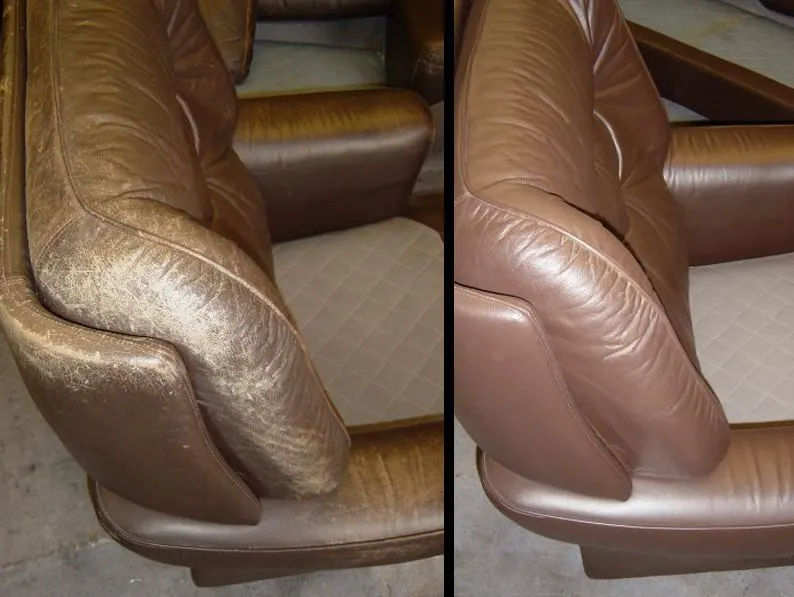
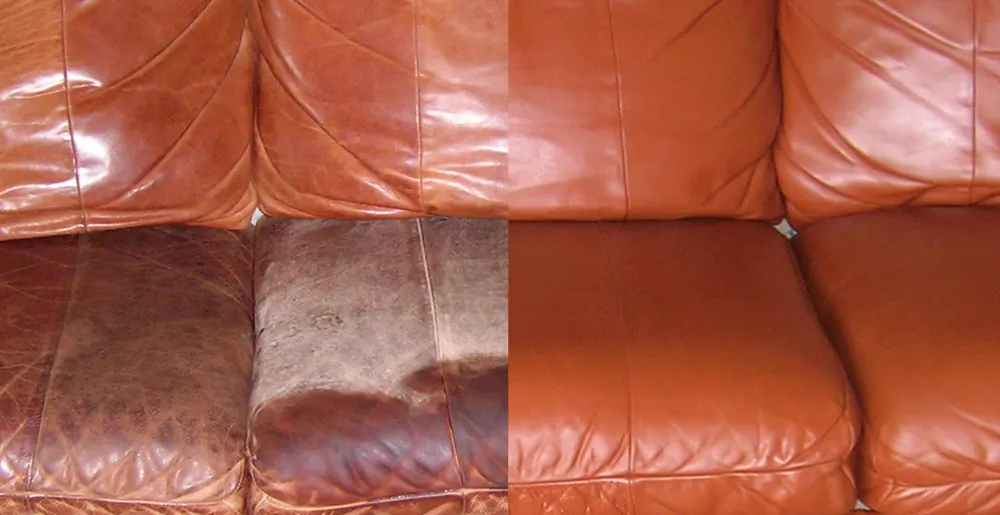
Ask to see before-and-after examples of work on a similar material, a similar color and a similar type of damage.
Similar matters. Vinyl repairs are easier to make invisible than leather repairs, and a portfolio of vinyl work tells you little about how a black aniline sofa will come out.
Look at the photographs critically. Are the after shots taken in the same light and from the same angle as the before shots, or from a distance and in flattering light.
Ask whether any of the examples are on items of a similar age, since a repair on new material is a different job from one on aged material.
Ask for references or reviews from customers with comparable items.
And ask how long ago the example work was done, since a repair that looked good on the day and a repair that has held for three years are different claims.
What to get in writing
A short list, and none of it is unusual to ask for.
The scope — what is being done, to which items, and over what area.
What is explicitly not included, particularly any exclusion such as an airbag deployment area on a vehicle seat.
The preparation included.
The expected timeline, including whether it is one visit.
The cure instructions, since the person present when they are given is often not the person who sits down first.
The aftercare requirements, especially any that affect a guarantee.
The guarantee terms and exclusions.
And the price, with any variables identified — such as additional preparation if the surface turns out to be more contaminated than the photographs suggested.
A specialist who provides all of this as a matter of course is telling you something useful before you have asked anything.
Questions we get asked next
- What is the most useful question to ask?
- What would you not recommend doing. On almost any item something is not worth doing, and a specialist who has assessed properly will have a view. One who recommends everything either has not looked carefully or is quoting to maximize the invoice.
- How do I compare a cheap quote against an expensive one?
- Ask both what preparation is included and how long they expect it to take. Cheap quotes almost always cut degreasing, which is invisible on the day and is the most common reason repairs lift within months. The preparation answer explains most price differences.
- Should I expect a written guarantee?
- You should be able to ask for one and get a clear answer on what is covered, for how long, and what is excluded. New damage, damage elsewhere and aftercare-related failure are reasonable exclusions. Get any aftercare condition in writing too.
- Is it reasonable to ask to see examples?
- Yes, and ask for work on a similar material, color and damage type — vinyl repairs are far easier to make invisible than leather repairs, so a vinyl portfolio says little about a leather job. Also ask how long ago the example work was done.
- choosing a specialist
- guarantees
- aftercare