Twelve Common Leather Damage Patterns and What They Usually Mean
Most leather damage arrives in one of about twelve shapes, and the shape tells you the cause before you have touched anything.
Quick answer
Damage has a geometry, and the geometry names the cause. Even hairline cracking across a whole panel is stiffening. Cracking that traces a repair outline is filler applied too thickly. A dark band at head height is absorbed oils. A hard line across a cushion is a shadow edge from a window. Reading the shape first tells you what to fix, which is frequently not the same as what you can see.
At a glance
| Even hairlines | Stiffened material — the whole panel, not the damage |
|---|---|
| Cracks tracing an outline | A previous repair filled too thickly |
| Dark band at head height | Absorbed skin and hair oils |
| Hard-edged line | A shadow boundary from a window |
| Simultaneous failure | Chemical, not wear — everything got the same treatment |
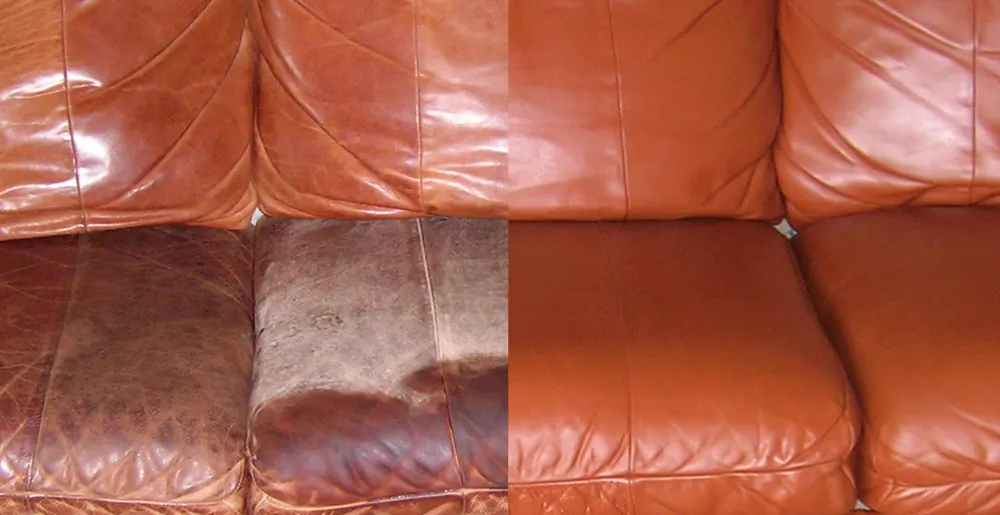
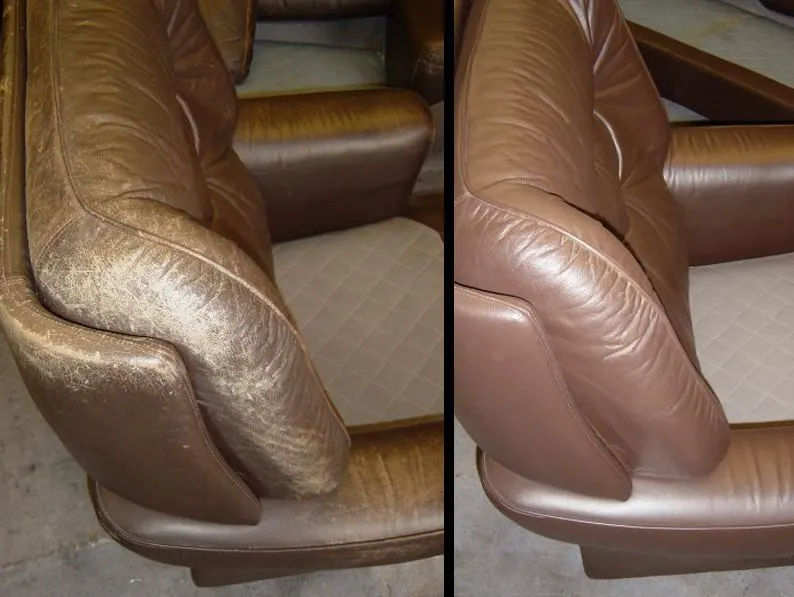
One: even hairline cracking across a panel
A fine network of lines covering a whole area rather than concentrated anywhere, usually only visible at a raking angle at first.
This is stiffening. The material has lost the moisture and fatliquors that let it flex, so it resists bending and the finish takes the stress instead.
It appears on the panels that flex — seat tops, cushion fronts, arm tops — while static panels on the same item stay clear.
The cause is dry air and depleted conditioning rather than use, which is why it appears on lightly used pieces too.
What it means practically is that the whole panel is the problem rather than any individual line, so filling the visible cracks chases a symptom.
Caught at the finish stage it refinishes well. Once the cracks reach the hide and the material crazes under thumb pressure, the honest answer is recovering.
It is the single most common thing that comes through the door, and it is almost entirely preventable with regular conditioning.
Two: cracking that traces a rectangle or an oval
A crack that follows an outline rather than running randomly, often with a slight change in texture inside the shape.
This is a previous repair failing, and the outline is its perimeter.
The cause is almost always filler applied in one thick pass. It cures rigid and under internal stress, so at the first real flexing it splits along its own edge.
It appears within weeks to a few months of the original work rather than gradually.
The repair inside the outline is often perfectly sound, which is why it looks odd — a good patch surrounded by a crack.
The fix is to remove the rigid fill entirely and rebuild in thin flexible layers, which is more work than the original repair would have been.
It is the clearest evidence there is of a corner cut on technique rather than on preparation.
Three: a repair that lifted cleanly at one edge
The repair material has separated from the surface, leaving the original underneath intact and undamaged.
This is a bonding failure, and the giveaway is that the surface beneath looks fine.
The cause is contamination — body oils, old conditioner, or a silicone dressing that was never removed.
The repair bonded to that film rather than to the material, so it was never attached to anything stable.
It shows up at an edge first, usually after the first proper use.
It concentrates exactly where repairs are most needed: headrests, arm tops, seat contact points, all of which are contaminated by definition.
The fix is thorough degreasing and rebuilding, and the degreasing is the part that was skipped the first time.
Four: a dark band at head height
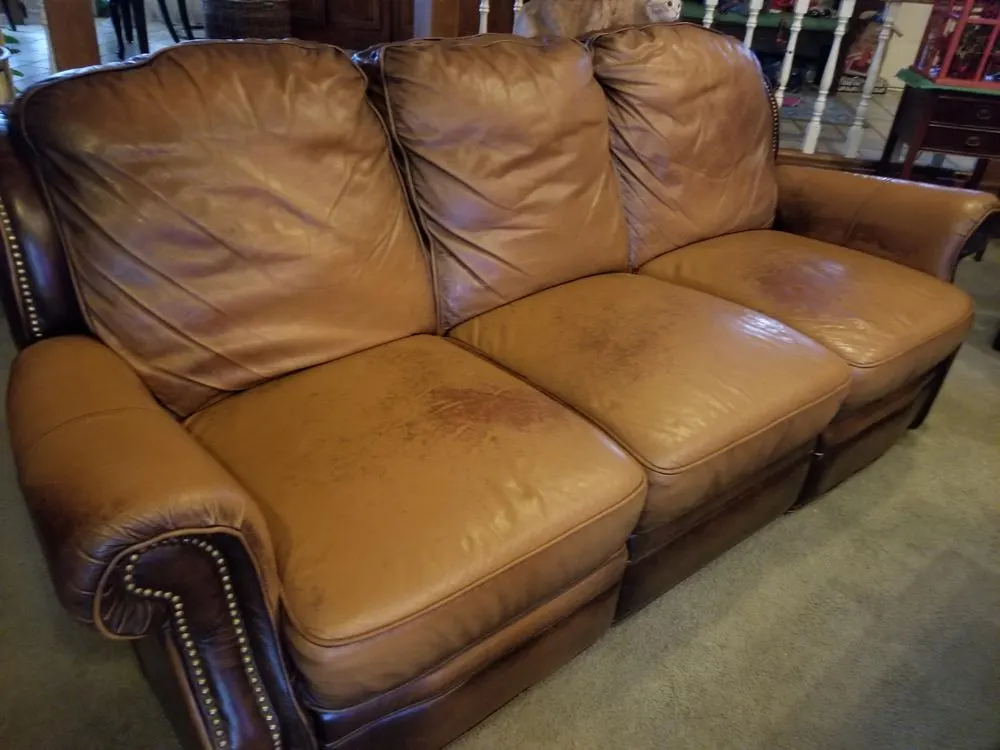
A darkened, often slightly shiny or tacky area on a seat back, a headrest or a recliner, at exactly the height of somebody's head.
This is absorbed skin and hair oils, deposited continuously over years.
It progresses through stages: on the finish and cleanable, then into the finish where cleaning stops working, then into the hide where it is permanent.
The test is whether cleaning improves it and how quickly it returns. Return within days means it is below the surface.
The area often feels different before it looks different — slick or tacky rather than dry.
Cleaning harder makes it worse, because the softened finish is removed along with the surface oil.
It needs degreasing rather than cleaning, and where the hide has darkened, refinishing the panel.
Five: a hard-edged line across a panel
A distinct boundary where the color changes, with lighter material on one side and original color on the other.
This is a shadow edge. Something cast a shadow across the item for years — a curtain edge, a lamp, another piece of furniture, a cushion.
The line is where the sunlight stopped.
It is diagnostic of window exposure rather than anything the owner did, and it means the exposed side has both faded and dried.
It also means recoloring the faded side alone will not satisfy, since the unfaded side keeps its color and the boundary stays visible.
The scope answer is usually the whole panel or the whole piece.
And the actual fix is the window, since new color in the same light fades the same way.
Six: wear concentrated on one bolster or one arm
One side of a vehicle seat, or one arm of a sofa, visibly worse than its twin.
On a vehicle this is entry and exit — the driver's outer bolster takes body weight sliding across it thousands of times.
On furniture it is usually habit, since households have a favorite seat and a favored arm.
It can also be environmental. One arm nearer a supply vent or a window ages faster on the same piece.
The distinction matters: use wear shows as abrasion at contact points, while environmental damage shows as stiffening and fading across a wider area.
If one arm is worse and there is no obvious usage reason, look up — there is often a vent above it.
And the scope answer usually involves both sides, since a restored arm beside an untouched one is more noticeable than the original wear.
Seven: everything failing at once across a site
Multiple items — a whole restaurant's booths, a clinic's tables, a gym's pads — cracking within a short period of each other.
This is chemical, not wear, and the simultaneity is the entire diagnosis.
Wear appears gradually and concentrates in the busiest positions. Chemical degradation affects every item that received the same treatment, including the ones nobody uses.
The cause is a cleaning or disinfection product drawing plasticizers out of vinyl or stripping finishes off leather.
The check is to press an item nobody uses. If it is as stiff as the busiest one, use is not the cause.
The fix has two parts, and the second is the one that matters: address the material, and change the product — otherwise the replacement goes the same way.
It is the most expensive pattern on this list and the cheapest to prevent.
Eight: peeling in flakes with a fabric layer beneath
The surface lifting away in sheets or flakes, revealing something that looks like woven cloth underneath.
This is bonded leather or a coated synthetic, and it is delaminating rather than wearing.
Genuine hide has no separate surface layer to shed — it cracks, thins and abrades instead.
The cause is the polyurethane surface and the adhesive breaking down, driven by heat, humidity and time, and it proceeds regardless of use.
It starts at high-contact points and edges, then spreads across the item within a year or two.
It cannot be durably repaired once it is widespread, because a new coating lifts along with the substrate under it.
The honest options are recovering, replacement, or a cover — and an isolated patch can be rebuilt as a holding measure if that is described accurately.
Nine: a smooth shiny patch in a grained surface
An area that catches the light differently, with no texture, usually smaller than a hand.
This is abrasion damage, and the most common cause is a melamine sponge.
The grain was embossed or natural, and it has been sanded off along with whatever mark was being removed.
It is more noticeable than the original stain, because the eye reads a reflectance difference as a change of material.
It can also come from scouring pads, aggressive scrubbing, or a repair where texture was never matched.
It refinishes well on sound material — the panel is cleaned, texture-matched and recolored — and the texture matching is the part that makes it disappear.
It is entirely preventable, which is why melamine sponges are worth keeping away from any grained surface.
Ten: a dull patch with a hard edge, lighter than its surroundings
A defined area where the finish looks flat and the color reads lighter, with a distinct boundary rather than a gradient.
This is solvent damage. The coating has been dissolved and removed, taking the color with it.
The usual causes are alcohol, hand sanitizer, acetone, nail polish remover, hairspray, or a household cleaner used on a mark.
The hard edge is the tell — it marks where the product stopped, whereas wear produces a gradient.
It frequently appears where somebody was trying to remove ink, dye transfer or a stain, and the mark is often still there underneath.
It refinishes routinely: the panel is cleaned, any residual staining is blocked, and the area is recolored and sealed.
The lesson embedded in this pattern is that everything strong enough to lift a stain quickly is strong enough to lift the finish under it.
Eleven: cracking radiating from a single point
Lines spreading outward from one spot, most often a button on tufted furniture or a fixing point.
This is tension concentration. The material is being pulled hardest at that point and it fails there first.
On deep-buttoned furniture it is the classic failure, and it frequently indicates that the padding beneath has degraded and no longer supports the button properly.
On vehicle seats it appears around fixings and at points where the cover is pulled tight over a frame edge.
Repairing the surface without addressing the tension means the same point fails again.
So the useful reading is that this pattern points underneath rather than at the surface.
If several buttons in one area have gone, that area's padding is the actual job.
Twelve: staining that spreads outward from an opening
Discoloration radiating from a tear, a seam or a puncture rather than sitting as a discrete mark.
This means something has been getting in and moving through the material from below.
On boats it is the pink-staining pattern, where pigment produced by bacteria in wet foam migrates up into the vinyl.
On furniture it can be a spill that reached the foam, or pet urine, both of which wick outward and reappear at the surface.
The distinguishing feature is direction: surface soiling sits where it landed, while this spreads from a point of entry.
It means the foam is involved, so surface cleaning will not resolve it and surface repair over it will not last.
The order is always the same — close the opening, deal with the foam, then do the covering, and fix the conditions that let moisture in.
Questions we get asked next
- How can you tell chemical damage from ordinary wear?
- By where it appears. Wear concentrates in the positions people actually use and develops gradually. Chemical damage affects everything that got the same treatment, including items nobody uses, and appears across a site within a short period. Press an unused item — if it is as stiff as the busy ones, it is chemical.
- What does a crack in the shape of a rectangle mean?
- A previous repair failing at its perimeter, almost always because filler was applied in one thick pass. It cures rigid and splits along its own edge at the first real flexing. The repair inside the outline is often sound, which is why it looks odd.
- Why does a dull patch have a hard edge?
- Because that is where a solvent stopped. Wear produces a gradient; a chemical produces a boundary. It usually appears where somebody tried to remove ink or a stain with alcohol, sanitizer, acetone or a household cleaner — and the original mark is often still there underneath.
- What does staining spreading from a tear indicate?
- That something reached the foam and is migrating back up through the material. Surface cleaning will not resolve it and a surface repair over it will not last. Close the opening, deal with the foam, then do the covering — in that order.
- field notes
- diagnosis
- damage patterns