Why Do White and Light-Colored Leather Show Damage Differently?
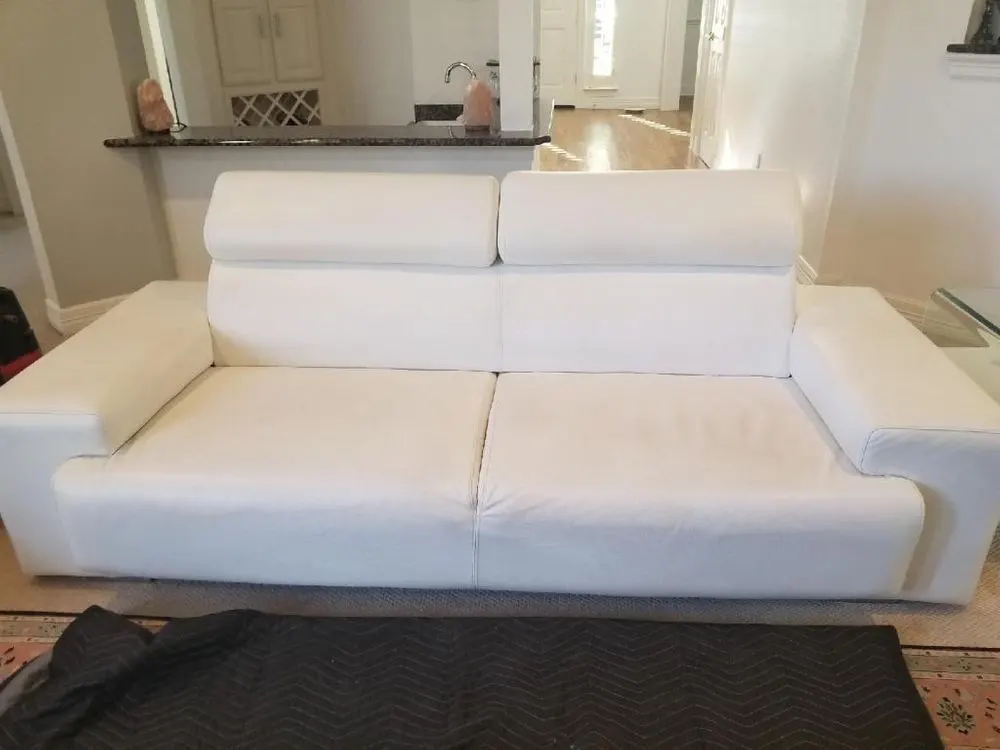
A white sofa and a chocolate sofa in the same room take identical wear. Only one of them announces it, which changes both maintenance and repair.
Quick answer
Light leather takes the same wear as dark leather but conceals almost none of it. Three problems dominate: dye transfer from denim and other clothing, body-oil darkening on headrests and armrests, and the visibility of every scuff because there is no dark pigment to absorb the shadow. All three are correctable on pigmented white leather, and the maintenance that prevents them is straightforward — it just has to actually happen.
At a glance
| Dye transfer | Denim, newsprint and colored throws leave a blue or gray haze |
|---|---|
| Body oil | Headrests and armrests darken and eventually go tacky |
| Scuffs | Every mark shows, because there is no dark pigment to absorb it |
| Good news | Pigmented white leather cleans and refinishes very well |
| Bad news | Repairs need more blending, because the eye detects tiny color differences in pale surfaces |
Light leather does not wear faster
This is worth establishing first, because owners of white furniture often assume they bought something fragile.
The hide and the finish on a white pigmented sofa are the same construction as on a brown one. The pigment differs; the durability does not. Given identical use, both develop identical wear.
What differs is contrast. On dark leather, a scuff, a smudge or a transferred mark sits close in tone to the surface around it, so the eye skims over it. On white, the same mark has maximum contrast and reads as damage from across the room.
This has a practical upside that gets overlooked: problems on light leather are noticed early, while they are still cleaning problems rather than refinishing problems. Dark leather hides deterioration until it is advanced.
So the correct mental model is not that white leather is delicate. It is that white leather is honest.
Problem one: dye transfer
This is the most common complaint on light furniture by a wide margin, and it catches people out because it is not a stain in the usual sense.
Indigo dye in denim is not fully fixed, and it migrates onto anything it rubs against under pressure and warmth. On a light sofa, the result is a blue or gray haze on the seat and the front of the back cushions — exactly where jeans make contact.
Newsprint, colored cushions, throws, and cheap upholstered chairs beside the piece all do the same thing to a lesser degree.
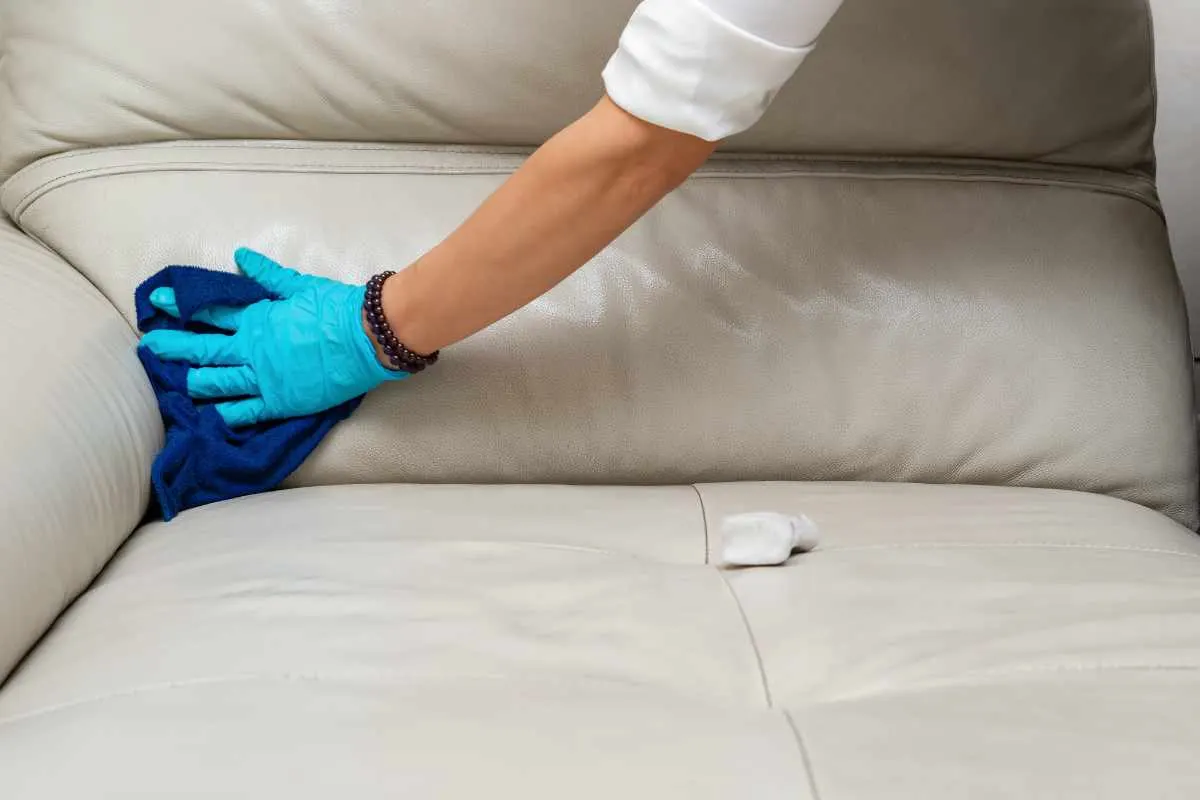
On pigmented leather with an intact topcoat, most dye transfer sits on the surface and cleans off with an appropriate leather cleaner, worked gently over the panel rather than scrubbed at the darkest point.
Where it has been left long enough to bond into the finish, cleaning lifts some of it and the panel is then refinished to remove the remainder. That is a routine job rather than a crisis.
Where the topcoat has worn thin — usually on the most-used seat — the dye reaches the pigment layer itself, and that area needs refinishing rather than cleaning.
Problem two: body oil on the contact points
Headrests and armrests on light leather darken visibly over a few years, and the mechanism is chemical rather than dirt.
Skin oil, hair products and sunscreen transfer to the surface and gradually migrate into the finish. Many of those products contain solvents and silicones that soften a coating, which then absorbs more.
The visible sequence is: a slightly gray area, then a distinctly darker one, then a surface that feels tacky.
Cleaning removes what is on top. Once the oil is in the finish rather than on it, degreasing is needed — repeatedly, in some cases — because oil wicks back to the surface after each pass.
The important instruction: a tacky headrest needs degreasing, not conditioner. Applying conditioner to a breaking-down finish makes it worse, and it is the single most common mistake on light furniture.
Prevention is straightforward and genuinely effective. Wipe headrests and armrests with a barely damp cloth weekly. It takes a minute and removes the oil before it has time to migrate.
Problem three: everything else shows
Scuffs, shoe marks, pet paw marks, food, ink and general grubbiness are all more visible against white.
The good news is that most of them are surface problems on a sealed pigmented finish and clean off promptly if dealt with promptly.
The exception worth naming is anything solvent-based — nail polish remover, hand sanitizer, alcohol wipes — which dissolves the finish rather than staining it. On white leather that produces a visibly duller or yellower patch where the topcoat has gone, and no amount of further cleaning improves it. That area needs refinishing.
Ink is variable. Fresh ballpoint on a sealed white finish often lifts; ink that has sat for weeks may need the area refinished.
And yellowing over time is a real phenomenon on some white finishes, particularly in strong light. It is not dirt, and it does not clean off — it is the finish itself aging, and the fix is recoloring.
Why repairs on white need more blending
This is the technical consequence that matters when something does need repairing.
Human vision discriminates small differences in light tones far more readily than in dark ones. A slight mismatch that would be invisible in chocolate brown is obvious in ivory.
So a repair on white leather is feathered over a wider area than the same repair on a dark piece, and often blended across the whole panel rather than a small radius, so there is no boundary anywhere for the eye to find.
Sheen matters more too. A repaired area with slightly different gloss reads as a patch even when the color is perfect, because light bounces off it differently — and pale surfaces show that more.
The practical implication for a quote: a repair on white furniture may legitimately cover more area than the damage itself. That is not padding, it is what makes the result invisible.
The Texas complication
Two local conditions interact badly with light leather.
Strong sun through west and south-facing windows drives the yellowing described above, because UV degrades the binder in the finish and the residue reads as a warm cast. On white this is far more visible than an equivalent change on a mid-tone piece.
Second, heat accelerates dye transfer. Indigo migrates more readily when both surfaces are warm, which is why a white sofa in a sunlit room picks up denim haze faster than the same sofa in a shaded one.
Combined with year-round air conditioning drying the finish, the practical result is that light furniture here needs its maintenance schedule kept rather than intended.
Cleaning every six to eight weeks on a well-used light sofa is a realistic interval in this climate, with headrests and armrests wiped more often than that.
Protection that actually helps
Light leather is the one case where a protective treatment earns its cost reliably.
A protector for finished leather makes the surface less receptive to dye migration and gives spills a longer window before they matter. On a white sofa in a household that wears denim, that is a meaningful difference rather than a marginal one.
It needs reapplying after cleaning, because cleaning removes it along with everything else. That is worth knowing, since a protector applied once at delivery and never renewed is doing nothing three years later.
It does not replace cleaning. A protected surface still accumulates oil and soil; it just holds them where they can be removed.
Test any product on a hidden area first, and be particularly careful with anything that claims to condition and protect in one step — heavy conditioners on a light finish can leave a slightly yellow cast.
Living with light leather deliberately
A few decisions make the difference between a white sofa that looks good for a decade and one that becomes a source of irritation.
Think about where it sits. Out of direct afternoon sun, and away from the chair someone always drops a bag onto.
Think about throws. A throw over the most-used seat during heavy periods costs nothing and prevents the dye transfer that otherwise concentrates there.
Keep the cleaning products right: a cleaner made for finished leather, applied to a cloth, never an all-purpose spray and never a disinfectant wipe.
Deal with spills immediately, because prompt beats thorough on a sealed finish.
And accept the maintenance interval as part of owning the piece. Light leather rewards routine and punishes neglect more visibly than any other color.
What to send for an assessment
Photograph in daylight without flash. Flash on white leather blows out the surface and hides exactly the tonal differences that need assessing.
Take a wide shot of the whole piece so the pattern of discoloration is visible — dye transfer follows contact areas, sun damage follows the light, oil follows heads and arms.
Take close-ups of the worst area square-on and from a low raking angle.
Include a shot of an unaffected area, which on light leather is genuinely useful as a reference for how far the visible areas have shifted.
Say what has been used on it, and whether any area feels tacky rather than merely discolored. Tackiness indicates a finish that is breaking down and changes the recommendation from cleaning to refinishing.
Finally, say how old the piece is and whether it has ever been professionally cleaned. Light leather that has never had a proper degrease often responds dramatically to one, and knowing that no deep clean has happened changes the first recommendation from refinishing to cleaning — which is a considerably cheaper place to start.
One more thing worth photographing: the seams. On light leather, soil and dye concentrate along stitching lines because thread is absorbent and the recess traps whatever lands in it. Seams that have gone gray while the panels around them are still clean tell a specialist that the piece has never had a deep clean, and they are also the areas most likely to need attention after refinishing.
Finally, be realistic about what the piece will look like afterward. A properly cleaned and refinished white sofa comes back to an even, bright color across every panel — but it goes back into the same room, with the same denim and the same sunlight. The maintenance schedule is what determines whether it stays that way, and it is worth agreeing on one before the work rather than after.
Questions we get asked next
- Can blue jean dye be removed from a white sofa?
- Usually, yes. On a sealed pigmented finish most of it sits on the surface and cleans off. Where it has been left long enough to bond into the finish, cleaning lifts part of it and the panel is refinished to remove the rest — a routine job rather than a lost cause.
- Is white leather a bad choice with children or pets?
- It is a higher-maintenance choice rather than a bad one. Pigmented white leather cleans well and refinishes well, so most incidents are recoverable. What it demands is that cleaning actually happens on schedule rather than when someone notices a problem.
- My white sofa has turned yellowish. Will cleaning fix it?
- If it is soil, yes. If the finish itself has yellowed with age and UV exposure, no amount of cleaning changes it — that is the coating aging rather than dirt sitting on it, and the fix is recoloring the piece back to white.
- Why does a repair on my white chair cover more area than the damage?
- Because the eye detects tiny tonal differences far more easily on pale surfaces. Feathering the color across a wider area, often the whole panel, is what removes any boundary for the eye to find. On a dark piece the same repair could be blended in a much smaller radius.
- white leather
- dye transfer
- light colors