Can Alcohol, Hand Sanitizer or Disinfectant Damage Leather?
This is the damage nobody sees coming, because each individual use looks harmless. The failure is cumulative and it always appears in the same places.
Quick answer
Yes. Alcohol is a solvent, and the binder holding a leather finish together is exactly what it dissolves. A single drip usually leaves nothing visible. Repeated contact — a headrest wiped with sanitizer gel on hands, an armrest cleaned with disinfectant wipes, a car console wiped daily — removes the topcoat, then the pigment, leaving a dull, pale, eventually tacky patch. It is not a stain, so cleaning does not fix it. The area needs refinishing.
At a glance
| What it does | Dissolves the topcoat and then the pigment layer beneath it |
|---|---|
| Not a stain | Nothing has been added — coating has been removed. Cleaning does not help |
| Where it shows | Headrests, armrests, steering wheels, gear selectors, door pulls, seat sides |
| Warning signs | Dull patch, then color loss, then a tacky surface |
| The fix | Clean, stabilize, rebuild color, reseal — a refinishing job |
Why alcohol attacks a leather finish
A finished leather surface is a coating: pigment held in a flexible binder, protected by a clear topcoat. Both the binder and the topcoat are polymers, and polymers have solvents that dissolve them.
Ethanol and isopropanol — the alcohols in hand sanitizer, disinfectant wipes and many cleaning sprays — are among them. On contact they soften the topcoat. Given time or repetition, they take it away.
Once the topcoat is gone, the pigment layer beneath is exposed and it goes the same way, which is when a dull patch turns into a pale one.
This is fundamentally different from staining. A stain adds something to the surface that can, in principle, be lifted. Alcohol damage removes something, and nothing can be cleaned back into place.
Understanding that distinction saves people from the usual response, which is to clean the area harder — that removes more coating and makes it worse.
The pattern of damage, and where it appears
Alcohol damage is diagnostic because it appears in specific places that correspond to human habits.
Headrests on sofas and car seats: sanitizer applied to hands, then hands to hair, then head to headrest. It is indirect and it is remarkably consistent.
Armrests and the tops of door panels in vehicles: sanitizer rubbed in while sitting, hands still wet, resting on the nearest surface.
Steering wheels and gear selectors: these get the heaviest exposure of anything in a car, because they are touched with freshly sanitized hands every trip.
Office chair arms: disinfectant wipes used by cleaning staff on a daily schedule. This is the single most common cause of premature failure in commercial seating.
The give-away is a boundary. Sun damage and ordinary wear fade gradually into the surrounding leather; chemical damage often has an edge corresponding to where someone wiped or where a hand rested.
How the damage progresses
It happens in stages, and catching it early makes a substantial difference to the cost of putting it right.
Stage one is a change in sheen. The area looks slightly duller or slightly shinier than its surroundings depending on the original finish. Nothing else is wrong yet, and this is the point at which stopping the exposure prevents everything that follows.
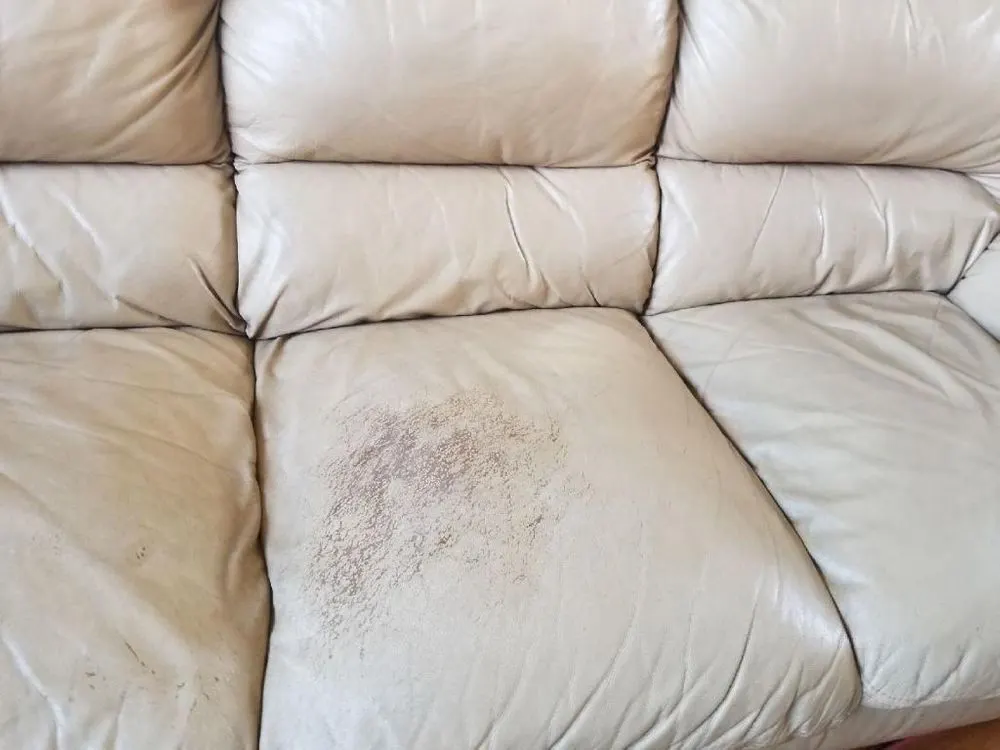
Stage two is color loss. The pigment layer has been reached, so the area looks pale, washed out, or shows a different tone where an underlying color is exposed.
Stage three is tackiness. The remaining coating has broken down enough to become soft and slightly sticky. This is the stage people usually notice, and it is frequently misdiagnosed as the leather being dry.
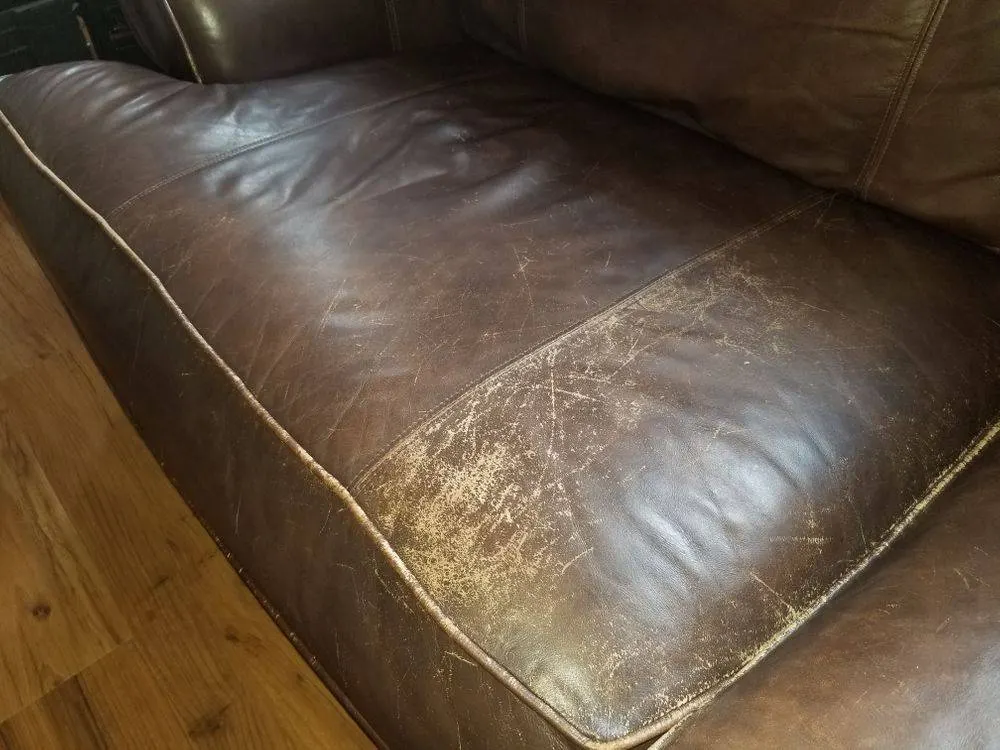
Stage four is cracking. With the flexible coating gone, the exposed surface has no protection, so it dries and fails at the fold lines.
Stage three is the important one to recognize, because the natural response — applying conditioner — makes a breaking-down finish worse rather than better.
Why conditioner is the wrong answer
A tacky headrest feels like it needs something, and conditioner is what most people reach for. It is precisely the wrong product.
Conditioner is designed to add flexibility to leather through an intact finish. Applied to a coating that is already softening and breaking down, it adds more softness to something that is failing because it is too soft.
It also does not address the cause. Whatever is dissolving the finish continues, and the conditioner layer traps residue against the surface.
The correct response at that stage is degreasing and cleaning to remove what is left of the failing material and any accumulated oil, followed by refinishing.
If the area is genuinely just dull rather than tacky, stopping the alcohol exposure and cleaning gently with an appropriate leather cleaner may be enough. Conditioner still is not the answer — a dull patch is missing topcoat, not missing moisture.
The products this covers
Worth naming, because several of them are marketed for use on surfaces generally.
Hand sanitizer gel, typically 60 to 70 percent alcohol. Transferred by hands rather than applied deliberately, which is why the damage is often puzzling.
Disinfectant wipes. Most contain alcohol, quaternary compounds or both, and none are formulated for coated leather. These do the most damage in commercial settings because they are used on a schedule.
Rubbing alcohol used deliberately to remove ink or a mark. It frequently removes the ink and the finish together.
Hairspray, recommended constantly online for ink removal, which is alcohol plus a resin — the worst of both.
Nail polish remover, which contains acetone and removes finish instantly.
Many all-purpose sprays, which combine solvents with degreasers.
And some hand creams and sunscreens, which contain alcohols along with oils, and which cause a combined chemical and oil problem on headrests.
What to use instead, in each situation
There are legitimate needs behind all of this, and they can be met without destroying the surface.
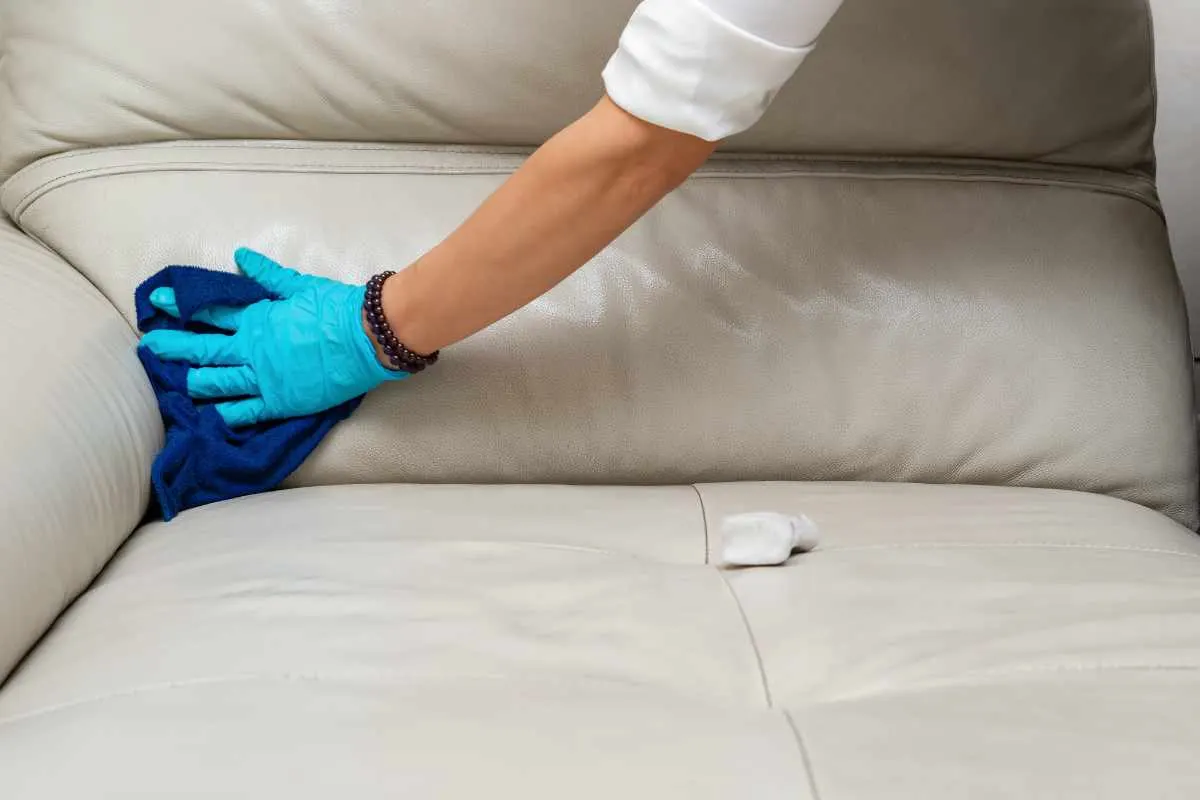
For general cleaning of finished leather: a cleaner made for leather upholstery, applied to a cloth rather than sprayed, worked over a whole panel rather than a spot.
For sanitizing in commercial settings — genuinely necessary in food service and healthcare: a neutral-pH product suitable for coated upholstery. Ask the supplier specifically whether it is safe on vinyl and finished leather, and supply it to the cleaning team rather than assuming.
For hands: let sanitizer dry completely before touching upholstery. It takes about twenty seconds and it removes the entire problem.
For ink: nothing from a home cupboard. Specialist ink removers exist and the home alternatives dissolve finish.
For steering wheels and high-touch vehicle surfaces: a dedicated interior cleaner, and a dressing formulated for the material afterward.
The commercial version of this problem
In offices, clinics and restaurants this is not an occasional accident but a scheduled process, and it destroys upholstery predictably.
A floor of executive chairs wiped daily with disinfectant wipes shows pale arm caps within a year and a failing seat front within two or three. The chairs are not low quality; they are being chemically stripped.
Medical and dental settings have a genuine requirement to disinfect between patients, so the answer is choosing a product compatible with the surface rather than reducing frequency.
Restaurants have the same issue with degreasers, which attack the plasticizers in vinyl and crack it years early.
The highest-value intervention on any commercial job is usually the conversation with whoever cleans: supply the right product, label it for seating, and the refinishing work lasts several times longer.
How it is repaired
The good news is that this is a well-understood job with a reliable outcome, provided the damage has not reached the cracking stage.
The area is cleaned and degreased thoroughly, which removes both accumulated body oil and whatever remains of the softened coating.
The remaining finish is stabilized — keyed where it is sound, taken back where it has failed — so new material bonds to something solid.
Where the surface has become uneven, flexible filler levels it and grain is pressed to match the surrounding texture.
Color is rebuilt in thin coats, matched against the actual leather and blended well past the damaged area so no boundary exists. On a headrest or an arm cap the blend usually covers the whole panel.
A flexible topcoat seals it, and the sheen is matched to the rest of the piece.
Once cracking has begun, the same process applies with more filling and texturing — still repairable, more work.
Why this got worse everywhere at once
The volume of this damage increased sharply and stayed high, for reasons that are not mysterious.
Sanitizer use became routine and never went back to previous levels. Bottles live in cars, on desks and by doors, and hands are treated far more often than before.
Disinfectant wiping became a scheduled task in offices and public spaces rather than an occasional one.
Neither habit is wrong, and neither is going away. What changed is that upholstery is now exposed to a solvent on a regular schedule, which it never was previously.
In this climate there is an additional factor: heat. Warm surfaces absorb solvents more readily, so the same wipe on a car seat in a Dallas summer does more than it would in a cool garage. Vehicles show this damage faster than furniture for exactly that reason.
Catching it early
The check takes ten seconds and is worth doing on any high-touch area every few months.
Look at the headrest, the arm caps and — in a vehicle — the steering wheel and console, from a low angle with light coming from the side. Compare each with a nearby area that gets no contact.
A difference in sheen is stage one, and stopping the exposure at that point resolves it without any work.
Run a fingertip across the area. Any tackiness means the coating is breaking down and the piece needs attention rather than more product.
If you find it, the useful things to change are: let sanitizer dry before contact, switch the cleaning product, and wipe high-touch areas with a barely damp cloth weekly to remove residue before it accumulates.
Photograph the area square-on and from a raking angle if you want it assessed, and say plainly what has been used on it — that answer determines the preparation more than the appearance does.
It is also worth checking the surfaces nobody thinks of: seat belt buckles rest against the seat side, phones treated with sanitized hands sit in door pockets, and bags go down on the same patch of a sofa arm every day. Those spots show the same pattern and are usually found only when someone goes looking for them.
Questions we get asked next
- One drop of sanitizer landed on my sofa. Is it ruined?
- Almost certainly not. A single brief contact usually leaves nothing visible on a sealed pigmented finish. Wipe it with a barely damp cloth, let it dry, and check the sheen against the surrounding area a day later. It is repetition rather than single incidents that causes the damage described here.
- My office chair arms have gone pale. Can that be fixed?
- Yes, and it is routine work. The arm caps are cleaned, stabilized, filled if the surface has become uneven, then recolored and sealed. The important second step is changing what the cleaning team uses, or the same chairs are back in the same state within a year.
- How do I sanitize leather safely?
- Use a product specifically stated to be safe on coated upholstery and finished leather, applied to a cloth rather than sprayed. In commercial settings ask the chemical supplier directly rather than assuming — most standard disinfectants are formulated for hard surfaces, not for a flexible polymer coating.
- Is the damage from alcohol reversible without refinishing?
- No. The coating has been removed rather than soiled, so there is nothing to clean back. Stopping the exposure prevents further loss, but restoring the appearance means rebuilding the color and topcoat over the affected area.
- alcohol
- sanitizer
- chemical damage