Leather Stain Emergency Guide: What to Blot, What to Avoid and When to Stop
Most permanent leather stains were recoverable for the first sixty seconds. What people reach for in that minute is usually what makes them permanent.
Quick answer
Blot immediately with a dry cloth, working from the outside of the spill inward, using no pressure and no rubbing. Do not reach for a cleaner, a wipe, water or a stain remover yet. Let the area dry naturally away from heat, then assess. Stop and call a specialist for oil and grease, ink, anything on aniline leather, and any spill on a surface that has already lost its finish — those four get worse with almost every home attempt.
At a glance
| First move | Dry cloth, blot only, outside inward, no pressure |
|---|---|
| Never | Rub, scrub, use heat to dry, or apply an unknown product |
| Usually recoverable | Water, most drinks, food, mud, makeup on sealed pigmented leather |
| Stop immediately | Oil and grease, ink, anything on aniline, spills on worn-through finish |
| Why speed matters | A sealed surface holds a spill briefly — then it starts penetrating |
The first sixty seconds
Almost every permanent leather stain that reaches a specialist was recoverable at the moment it happened. What made it permanent was the response.
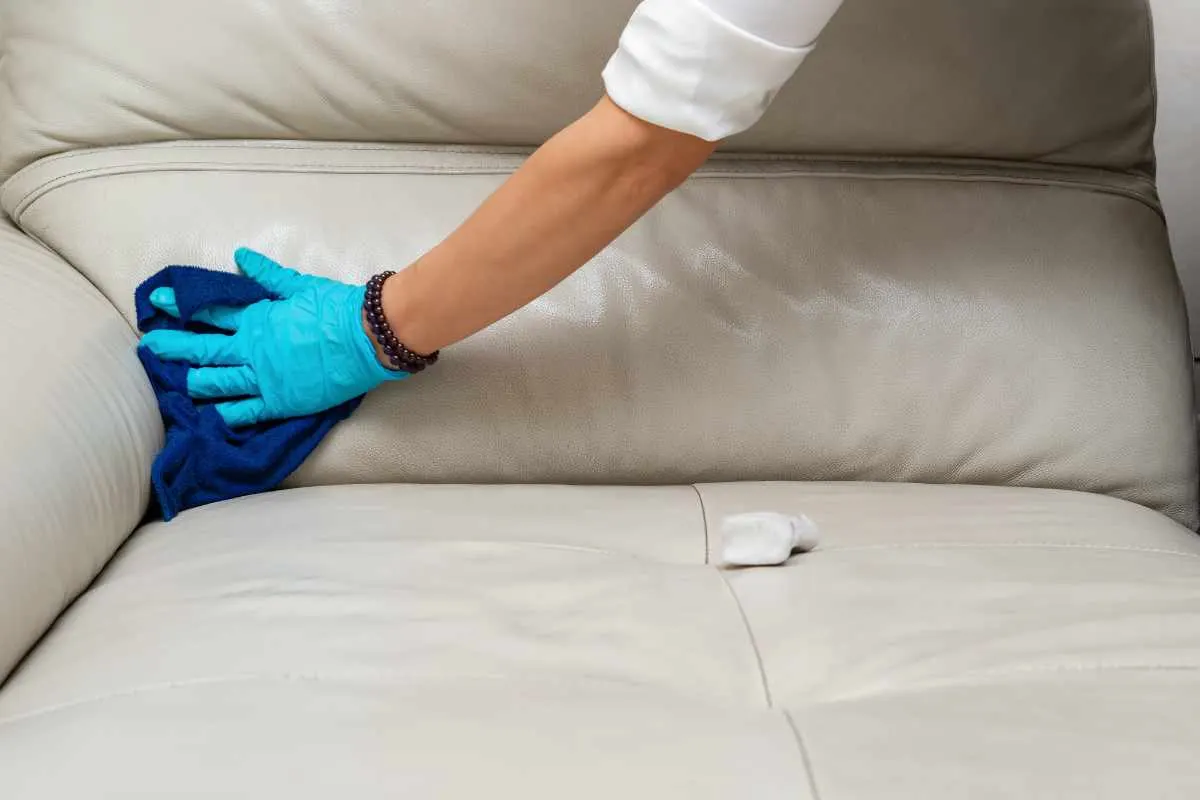
Take a dry, clean, absorbent cloth — a dish towel, paper towels, anything that is not colored or printed. Lay it on the spill and press gently straight down. Lift, move to a clean part of the cloth, repeat.
Work from the outside of the spill toward the middle. Blotting from the center outward pushes liquid into clean leather and makes the affected area larger.
Do not rub. Rubbing does two things, both bad: it drives liquid into the grain and, on any surface with a finish, it abrades that finish while it is wet and at its most vulnerable.
Do not press hard. Pressure forces liquid through seams and into the foam beneath, which turns a surface problem into an odor problem.
And do not add anything yet. No water, no cleaner, no wipe. Get as much of the liquid out as possible first, then stop and think.
Then stop, and find out what you have
The correct next step depends entirely on the finish, and it takes ten seconds to establish.
Put one drop of water on a hidden area — under a cushion, on the underside of an arm. If it beads and sits there, the leather is pigmented and sealed, which is the forgiving case and covers most family furniture and vehicle seats.
If it soaks in and darkens the leather within a few seconds, the finish is aniline or lightly semi-aniline. That is the absorbent case, and home cleaning on it goes wrong more often than it goes right.
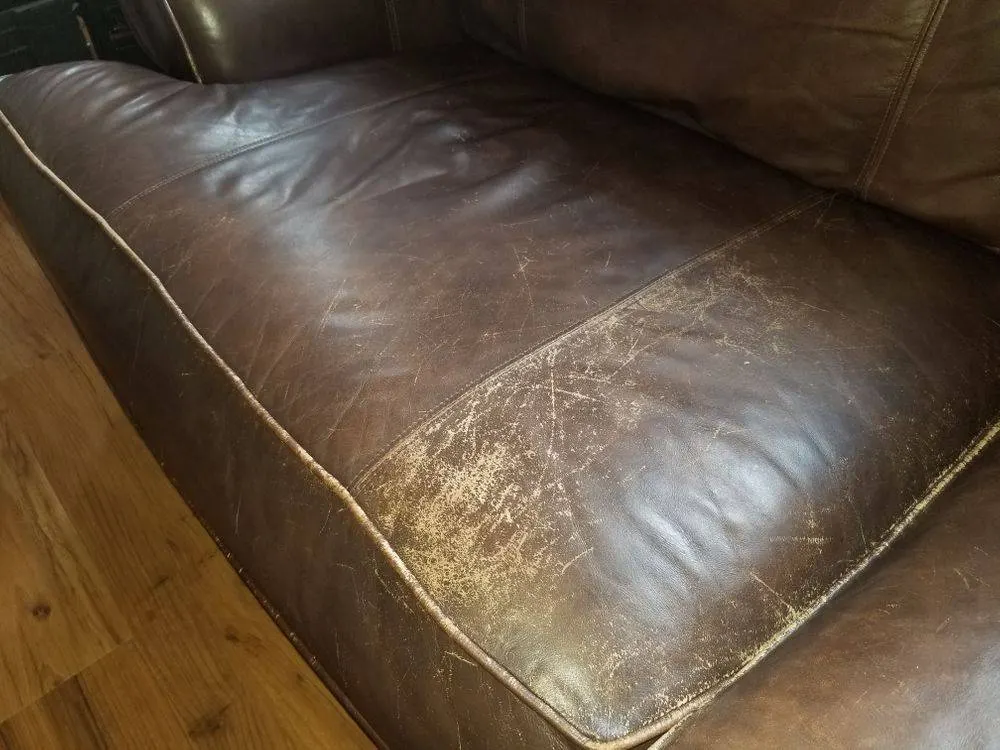
Also check the area around the spill. Press a thumb firmly on the leather a few inches away. If the surface flakes, feels papery or shows fine cracking, the finish there has already failed — which means the spill has reached hide rather than sitting on a coating, and the response is different again.
Those two checks determine everything that follows, and doing them before acting is the single most useful habit in leather care.
Spills that usually come out
On sealed, pigmented leather with an intact finish, most household spills are recoverable if they were blotted promptly.
Water, tea, coffee, soft drinks and most alcoholic drinks sit on the surface long enough to be blotted, then cleaned with a leather cleaner applied to a cloth. Work over the whole panel rather than scrubbing the spot, so no cleaning boundary is left.
Food, sauces and most sticky residues respond to the same treatment once the bulk has been lifted with a dry cloth.
Mud and dry soil should be left to dry completely, then brushed off gently before any wet cleaning. Attacking wet mud spreads it and grinds grit into the finish.
Makeup, sunscreen and body lotion clean off promptly but stain persistently if left, because many of them contain oils and pigments designed to stay put.
In every case: clean the panel, not the spot. A perfectly cleaned circle inside a slightly soiled panel is more visible than the original mark was.
The four cases where you should stop and call
These are where home attempts reliably make things worse, and where a specialist has a genuinely better chance.
Oil and grease. Butter, cooking oil, salad dressing, hair product, pizza. Oil migrates into leather rather than sitting on it, and consumer cleaners either fail to lift it or lift it unevenly and leave a lighter halo. Blot as much as possible, then leave it alone.
Ink. Fresh ballpoint on a sealed pigmented finish sometimes lifts with specialist products, but the common home attempts — alcohol, hairspray, hand sanitizer — dissolve the finish along with the ink and turn a line into a pale patch.
Anything on aniline leather. There is no protective coating, so liquid is in the hide within seconds and any cleaning attempt risks lifting dye or leaving a ring.
Any spill on a surface that has already lost its finish. Without a coating, the spill is in the hide, and cleaning at that point is closer to conservation than housekeeping.
In all four, the useful thing to do is blot, photograph, and ask. The attempt is what closes off the options.
Products that cause more damage than the spill
This list accounts for a large share of avoidable refinishing work, and every item on it appears regularly in home advice.
Alcohol, hand sanitizer and disinfectant wipes dissolve leather finishes. A single use may not show; repeated use on the same spot strips a visible pale area.
All-purpose household sprays are formulated to cut grease, and the binder in a leather finish is exactly what they cut.
Nail polish remover removes finish instantly and permanently.
Hairspray, recommended constantly for ink, is a solvent plus a resin — it can spread the ink and leaves a sticky residue that attracts soil.
Baby wipes contain surfactants and fragrance not intended for a coated surface, and used regularly they degrade a finish.
Melamine sponges are abrasive and take the finish off with the mark.
Olive oil, coconut oil and other kitchen oils do not absorb, go rancid, and darken the area permanently.
Heat — a hairdryer to speed drying — stiffens leather and can set a stain into the finish.
How to clean properly once the emergency is over
If the checks say your leather is sealed and pigmented and the spill is in the recoverable category, this is the method.
Vacuum the area first with a soft brush attachment, especially in the seams, so nothing gritty gets dragged across the finish.
Test the cleaner on a hidden area and let it dry fully before judging.
Apply cleaner to a cloth, never directly to the leather, so liquid cannot pool in a seam or run into perforation.
Work in overlapping circles with light pressure across the whole panel. Pressing harder does not clean better; it drives soil into the grain.
Wipe with a second, barely damp cloth to lift residue, then dry with a third.
Let the piece dry naturally, away from direct sun and away from a heat vent.
Condition only once it is completely dry, and only if the piece is due for it — conditioning is not a stain treatment.
Spills that soak through, and why they are different
Some liquids do not stop at the leather, and those are a different category of problem.
Pet urine, milk, vomit and any large volume of liquid can pass through seams into the cushion core. The leather cleans perfectly well and the smell comes back, because the source is the foam underneath.
Foam is open-celled and absorbent by design, so once a liquid is in it, surface treatment only masks it. Deodorizing sprays produce a room that smells of deodorizer and the original problem together.
The reliable fix is replacing the affected cushion cores and cleaning the cover, and where the deck padding beneath also got soaked, that layer too.
It is worth being direct about this early, because otherwise the same piece gets cleaned twice before anyone addresses what is actually causing the smell.
The prevention, where a spill is large, is to get the cushion off the frame immediately and blot from both sides rather than only from the top.
Why spills behave differently in this climate
North Texas conditions change the timing of everything above.
Dry conditioned air runs in most homes for most of the year, so a spill dries faster than it would in a humid climate. That sounds helpful and is not — faster drying means less time to blot, and a stain that dries into the finish is harder to lift than one that is still wet.
Heat has the same effect. A spill on a sofa in afternoon sun, or on a car seat in a parked vehicle, is working into a warm surface, and warm finishes absorb more readily.
Vehicles are the extreme case. A drink spilled in a car left in a Dallas parking lot in August is effectively being baked into the seat, which is why interior spills should be dealt with before leaving the vehicle rather than at the end of the day.
The practical adjustment: treat spills here as more urgent than the general advice implies, and move the piece out of direct sun before doing anything if you can.
What to do while you wait for help
If the spill is in the stop-and-call category, a few things genuinely help before anyone arrives.
Keep blotting with dry cloths while liquid is still lifting. Dry blotting is safe on every material and it removes what would otherwise soak deeper.
For oil and grease, some specialists suggest a light dusting of an absorbent powder such as cornstarch left on the surface to draw oil out, brushed away gently afterward. Ask first if you can, because on aniline it can leave its own mark.
Keep the area out of sunlight and away from heat.
Do not cover it with a damp cloth in the hope of keeping it workable. That drives moisture into the hide.
Photograph it now, before anything dries or changes. A photograph of a fresh spill is far more diagnostic than one taken a week later, and it tells a specialist what they are dealing with before they arrive.
Getting it assessed
Photograph the affected area square-on in daylight without flash, and again from a low raking angle so any change in surface texture shows.
Photograph an unaffected area of the same leather for comparison.
Say exactly what was spilled, how long ago, and — most importantly — everything that has been applied to it since. That last answer changes the approach more than the spill itself does, and there is no benefit to leaving anything out.
Say whether the piece is pigmented or aniline, based on the water-drop test, and whether the spill soaked through into the cushion.
Prompt honest information gets a useful answer quickly. Most spills that are dealt with within a day or two on sealed leather come out completely, and the ones that do not are usually the ones that were treated three times at home first.
Questions we get asked next
- Should I use water on a fresh spill?
- Not as a first move. Blot with a dry cloth first and get as much liquid out as possible. Water is safe on sealed pigmented leather afterward, applied to a cloth rather than the surface, but on aniline or on leather whose finish has worn through it can leave a ring of its own.
- How long do I have before a spill becomes permanent?
- On sealed pigmented leather, minutes rather than seconds for most liquids — the coating holds them on the surface. On aniline, seconds. On any surface where the finish has worn away, effectively no time at all, because there is nothing holding the liquid out of the hide.
- The stain came out but left a lighter patch. What happened?
- The cleaning lifted finish along with the stain, usually because the product was too aggressive or the area was rubbed. That is a refinishing job rather than a cleaning one — the area is cleaned, stabilized, recolored and blended so no boundary remains.
- Is it worth having a leather protector applied?
- On light-colored furniture and on anything in a household with children, yes. It makes the surface less receptive to spills and dye transfer and buys real time when something happens. It needs reapplying after cleaning, since cleaning removes it along with everything else.
- stains
- spills
- emergency