Why Are the Sides of My Car Seat Peeling While the Center Still Looks Good?
It looks like a defect and it is normally a construction detail: two materials on one seat, aging at completely different rates.
Quick answer
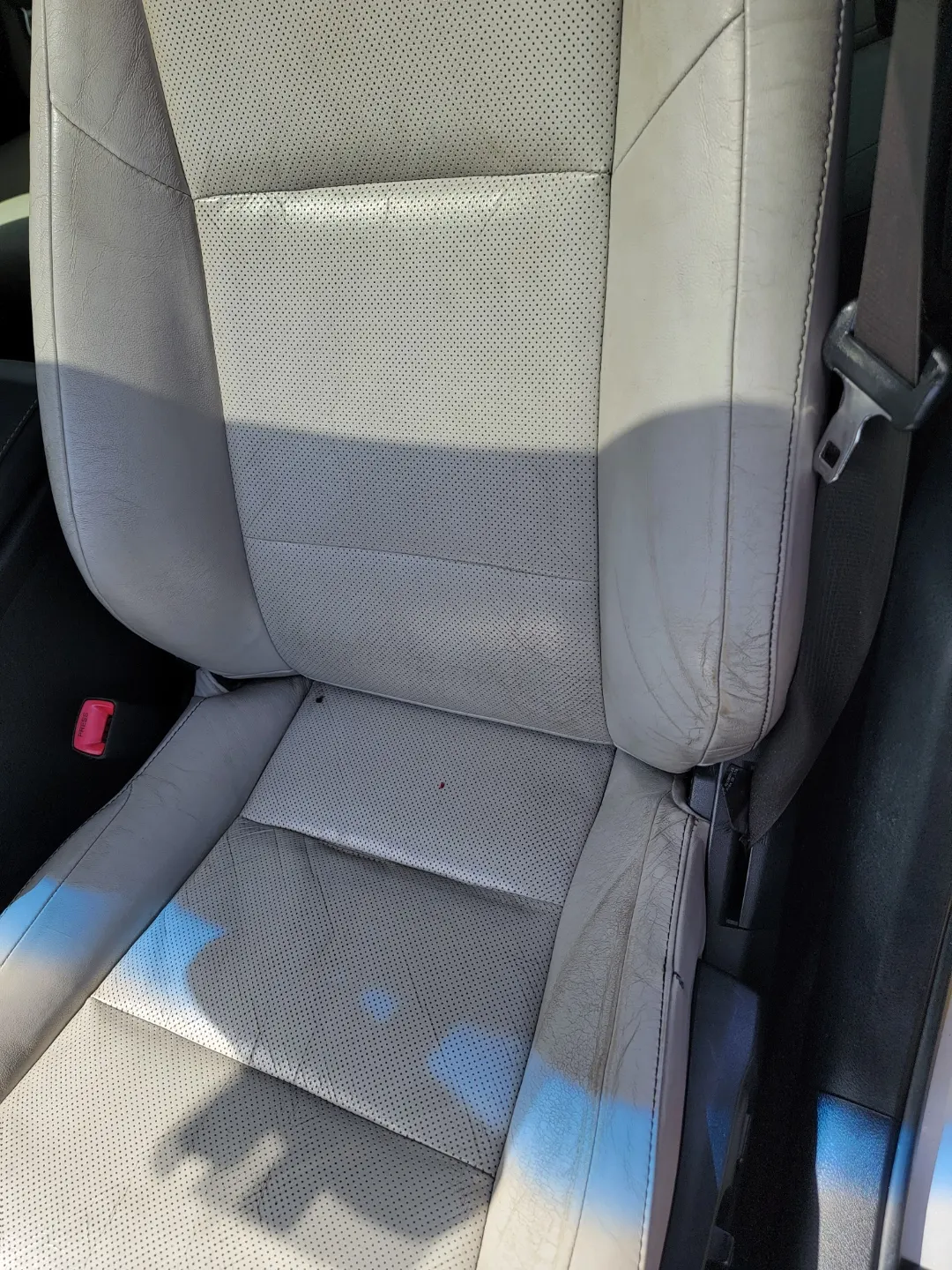
Almost always because the sides are a different material from the center. Most vehicles specify genuine leather for the seating surfaces and a coordinated vinyl or synthetic for the bolsters, backs and sides — a construction marketed as leather-appointed or leather-trimmed. Synthetics peel when their coating separates from its backing; hide does not peel at all. So the pattern you are seeing is two materials behaving normally, not one material failing.
At a glance
| Most likely cause | Mixed construction — hide on seating surfaces, synthetic on sides and backs |
|---|---|
| How synthetics fail | The coating separates from its backing and lifts in flakes |
| How hide fails | It does not peel — the finish wears matte and pale, then cracks |
| Second cause | Sun through the side glass hitting the outboard panels hardest |
| Repair outlook | Isolated peeling repairs; widespread delamination means panel replacement |
The construction detail behind it
Manufacturers routinely build a single seat from two materials, and it is standard practice rather than a shortcut.
Genuine leather goes on the surfaces a body touches — the center of the cushion and the center of the backrest — because that is where breathability and the way hide warms actually matter.
A coordinated vinyl or polyurethane goes on the outer bolsters, the seat back, the sides and often the headrest sides, where nobody's skin makes contact.
The color and grain are matched closely enough that most owners never notice, which is why the failure pattern is so surprising when it appears.
The marketing language reflects it: 'leather-appointed', 'leather-trimmed' and 'leather seating surfaces' all describe mixed construction. 'Full leather' is a genuinely different specification, usually on higher trims.
So a seat whose sides are flaking while the center looks new is showing you two materials with two different lifespans, both behaving as expected.
How to confirm it in two minutes
Four checks, none of which damage anything.
Look at a flake, if one has already lifted. A flake with fabric fibers on its underside is a coating that has separated from a backing — synthetic. A thin brittle film of finish over a fibrous surface is a failed finish coat on hide, which is a different problem.
Look at the exposed area underneath. A lighter woven or knit backing means synthetic. A fibrous hide surface means leather.
Put a palm flat on the center of the cushion for thirty seconds, then on the side panel. Leather warms and stays warm; synthetics warm slowly and can feel slightly clammy.
Look at both surfaces under strong light with a phone camera zoomed in. Synthetics carry an embossed pattern that repeats at a fixed interval. Hide does not repeat and shows small natural variations.
If the center reads as leather and the side reads as synthetic, you have your answer — and the good news is that the center is not following.
The other cause: sun on the outboard panels
Where the sides and the center are the same material, the explanation is usually exposure rather than construction.
The outboard side of a seat faces the side glass. It takes direct sun for hours whenever the vehicle is parked with that side toward the light, and it takes it from an angle the center of the seat never sees.
UV degrades the binder in the finish, so the outboard panel becomes brittle before the center does. Heat drives plasticizers out of the same panel faster.
The tell is asymmetry between the two front seats. If the driver's outboard side is deteriorating and the passenger's outboard side is fine, and the vehicle is habitually parked with the driver's side toward the sun, exposure is the cause.
This version usually presents as cracking and dulling rather than true peeling — hide does not flake in sheets.
What repairs and what does not
The material determines the outlook completely, which is why the identification above matters.
Automotive vinyl and quality PU with isolated damage repair very predictably. A lifting area is trimmed back to sound material, the exposed backing is sealed, filler is built up level, grain is pressed to match and color is blended in. Vinyl textures are embossed and repeat, so the match is good.
Widespread delamination across a whole panel does not repair durably. The bond between coating and backing has failed across the sheet, so recoating one area does nothing for the next.
Leather with a failed finish coat refinishes normally — cleaned, stabilized, filled where worn, textured and recolored.
Leather with cracking from sun and heat needs filling and texturing as well as color, which is more work but entirely routine.
The dividing line is whether the damage is in one place or is the first visible symptom of a material that has reached the end of its life.
When to replace the panel instead
Seat covers are assembled from separate sewn panels, which is genuinely useful here.
A side panel or bolster can be removed and replaced without touching the rest of the seat, and on a synthetic panel that is delaminating widely, that is usually the better answer than trying to refinish a failing surface.
The catch is color. New material does not match a panel that has aged for eight years in a Texas car, so the new panel is normally recolored and its neighbors blended so the seat reads as one piece.
Sourcing is easier on common vehicles and harder on older or low-volume models, which sometimes pushes the decision back toward repair.
On a mixed-construction seat there is one more consideration: replacing a synthetic side panel with a matching synthetic keeps the original specification, and replacing it with hide changes how that area wears and costs considerably more for a surface nobody touches.
The airbag boundary
This matters here more than in most automotive articles, because the damage in question is on the outboard edge.
Most modern vehicles deploy a side airbag through a designated seam in the outboard edge of the seat back — which is exactly the area that peels.
That seam is engineered to split at a set force, and filler, adhesive, backing material or ordinary thread across it can change how it opens.
Look for an SRS or AIRBAG tag on that edge, and treat the whole seam plus a hand's width either side as off limits for cosmetic repair.
Peeling on the outboard side of a seat back is therefore worth photographing carefully and flagging specifically, because part of that panel may be repairable and part of it may not.
Damage inside the exclusion zone belongs to an automotive trim shop working to the manufacturer's specification.
Why it happens faster here
Synthetic panels in North Texas vehicles have a hard life, and the timeline is compressed compared with milder regions.
Cabin temperatures in a car parked outside run far above ambient for months, and heat accelerates the adhesive degradation that causes delamination.
The outboard panels take direct UV through the side glass on top of that.
Humidity in summer contributes, because some polyurethane systems break down through hydrolysis in warm humid conditions — which is also why a vehicle closed up for weeks in summer can develop a tacky surface across the same panels.
So a synthetic side panel that might last a decade elsewhere frequently starts lifting at six or seven years here.
Parking in shade and using a windshield sunshade slow it, and beyond that there is not much an owner can do about a material whose bond is failing. Conditioning does not help synthetic panels the way it helps hide, because the problem is an adhesive bond rather than a loss of flexibility, and product working under a lifting edge loosens it further.
Whether it is worth pursuing as a defect
Owners often ask whether peeling side panels are a warranty matter, and the answer depends heavily on timing.
Within the first two or three years, widespread delamination is worth raising with the dealer. Some manufacturers have issued goodwill repairs for particular model years where a synthetic material underperformed.
After that, most upholstery coverage has expired and it is treated as wear.
It is worth checking whether your vehicle has any technical service bulletin relating to interior trim, which a dealer can look up by VIN.
Either way, do not delay the assessment while you investigate. Peeling spreads, and a panel with one lifting area is cheaper to address than the same panel six months later. Warranty conversations take weeks; the material does not wait for them.
Getting it assessed
Photograph the peeling area square-on with the door open, in daylight, no flash.
Photograph a flake's underside if one has come away on its own — that single image usually identifies the material.
Photograph the center seating surface close up in the same light, for comparison. The difference between the two is what confirms mixed construction.
Photograph the whole seat so the extent is visible, and the opposite seat for comparison.
Say what the vehicle is and roughly its age, whether it is parked outside, and whether the seat is heated or ventilated.
And check the outboard edge of the seat back for an SRS or AIRBAG tag, photographing it if present, since that determines whether part of the damaged area is excluded from cosmetic repair.
It is worth photographing the rear seats too, even if they look fine. On mixed-construction interiors the rear seats often use a higher proportion of synthetic material than the fronts, and they are frequently the next panels to start lifting. Knowing that in advance lets you decide whether to address everything in one visit or wait.
Say how the vehicle is parked day to day — outside, in a garage, and which way it faces. Where the damage sits relative to the sun is often the difference between a construction explanation and an exposure one, and that changes what should be recommended alongside the repair.
And say what you are planning for the vehicle. A car being kept for another five years and a car going on the market next month deserve different recommendations: the first is about durability, the second is about how the interior presents to someone sitting in it for the first time.
Questions we get asked next
- I paid for leather seats. Should the sides be leather too?
- If the vehicle was described as leather-appointed, leather-trimmed or having leather seating surfaces, mixed construction is what was specified and it is standard across most manufacturers at mid trim levels. Full leather is a different specification, usually on higher trims and stated as such.
- Can the peeling side panel be made to match the leather center?
- It can be repaired or replaced and recolored so it matches visually, which is what most owners want. Replacing it with actual hide is possible through a trim shop, costs considerably more, and puts a material that needs conditioning on a surface nobody touches.
- Will the peeling spread to the seating surface?
- Not if the seating surface is genuine leather — hide does not delaminate, because there is no coating separating from a backing. It has its own failure mode, cracking from heat and UV, but it is independent of what the synthetic panels are doing.
- Is it worth repairing if the car is a few years from replacement?
- For an isolated lifting area, often yes — it is inexpensive and it stops the area growing and shedding. For widespread delamination on a vehicle you plan to sell soon, replacing the panel usually presents better than refinishing a failing surface, and interior condition weighs heavily in appraisal.
- peeling
- vinyl
- mixed construction