Leather Cleaning vs. Conditioning vs. Recoloring vs. Full Restoration
These four words get used interchangeably by customers and quoted very differently by specialists. Knowing which one your piece needs is worth real money.
Quick answer
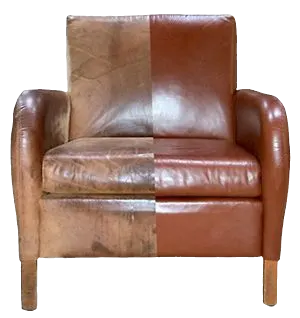
Cleaning removes what is on the surface. Conditioning restores flexibility to a sound finish. Recoloring replaces pigment that has faded or worn away. Full restoration does all three plus filling, texturing and resealing the entire piece. Work up the list: if cleaning fixes it, stop there. If the color is gone, cleaning cannot bring it back. If the surface is cracked or worn through, recoloring alone sits on a failing foundation.
At a glance
| Cleaning | Removes soil, body oil, dye transfer. Cheapest. Try this first |
|---|---|
| Conditioning | Restores flexibility to sound leather. Preventive, not corrective |
| Recoloring | Replaces faded or worn pigment. Fixes color, not texture or cracks |
| Full restoration | Clean, stabilize, fill, texture, recolor, seal the whole piece |
| Rule of thumb | Always ask whether the cheaper option would be enough first |
Why the words matter
A customer asks for a sofa to be restored when it needs cleaning, and pays several times what the problem costs to solve. Another asks for cleaning on a sofa whose color has gone, is disappointed with the result, and concludes that leather care does not work.
Both are avoidable, and the fix is being able to describe your own problem in the right terms before asking anyone for a price.
The four services form a ladder. Each one includes the ones below it in scope, costs more, and addresses a different kind of failure.
The useful discipline is to work up from the bottom: ask whether the cheaper option would be enough, and only move up when the answer is clearly no.
Cleaning: removing what is on the surface
Cleaning addresses anything that has landed on the leather and stayed there: body oil, skin cells, food residue, dust, dye transferred from clothing, general grubbiness.
It is the cheapest of the four by a wide margin and it fixes more than people expect. A sofa that looks tired frequently has years of accumulated body oil on the headrests and arms, and a proper clean transforms it.
Professional cleaning uses degreasing agents that are not sold to consumers, which is the difference between removing what sits on the surface and removing what has migrated into the finish.
What cleaning cannot do: restore color that has faded, close a crack, level a worn area, or fix a finish that has broken down. Those are additions rather than deposits.
The test: clean a small hidden area properly and let it dry. If it comes back to full color and the surface feels right, the whole piece needs cleaning and nothing more.
Conditioning: restoring flexibility
Conditioning is a maintenance treatment rather than a repair. It replenishes the plasticizers that keep a finish and hide flexible, so the material bends without splitting.
It belongs on leather that is sound. Its value is entirely preventive — a conditioned piece does not reach the cracking stage on the schedule an unconditioned one does.
It is often bundled with cleaning, because the two go together in that order: clean first, let it dry, then condition. Conditioning over soil seals the soil against the finish.
What conditioning cannot do: close existing cracks, restore faded color, or fix a tacky surface. On a tacky surface it makes things measurably worse.
The test: press a thumb at a fold line. If the leather feels board-like or papery but shows no cracking, conditioning is the right answer and it is the moment it pays for itself.
Recoloring: replacing pigment
On finished leather, the color you see lives in a pigment layer on top of the hide. Recoloring rebuilds that layer.
It is the answer to fading, to color worn away on high-contact areas, to a piece that has gone gray or orange under UV, and to a deliberate color change.
The work is real: cleaning and degreasing first, stabilizing what remains of the old finish, then spraying color in thin coats and sealing with a flexible topcoat. Preparation is most of the labor and it is what determines whether the result lasts.
Recoloring can be done on a panel or across a whole piece. On a piece with a fade gradient, the honest recommendation is usually the whole piece, because matching a repair to any single point on a gradient leaves the rest visibly different.
What recoloring alone cannot do: fill cracks, rebuild worn texture, or fix a surface whose coating has broken down. Color applied over those problems looks correct briefly and then follows the failing layer beneath it.
Full restoration: the whole surface
Restoration is the complete job, and it is the option most people do not know exists as a distinct service.
The piece is cleaned and degreased thoroughly. The existing finish is stabilized where sound and taken back where it has failed. Worn areas are filled with flexible material and grain is pressed to match the surrounding texture. The entire piece is then recolored and sealed.
This is what brings back a sofa that has faded unevenly, worn through on the seats and arms, and started to crack at the fold lines — all at once, which is how most tired furniture actually presents.
It costs the most of the four and a fraction of reupholstery, because the frame, the springs, the foam and the hide are all retained.
One myth worth killing: a professional restoration is not a temporary coat that peels in a year. The failures people remember come from consumer dye kits applied over contaminated or unstabilized surfaces, which is a preparation failure rather than a limit of the method.
The diagnostic sequence
Run these four checks in order and you will land on the right service almost every time.
One: clean a small hidden area properly and let it dry. If the color comes back and the surface feels normal, the answer is cleaning.
Two: press a thumb at a fold line. Board-like or papery with no cracking means conditioning. Fine cracks that remain means the finish has split and you are above conditioning.
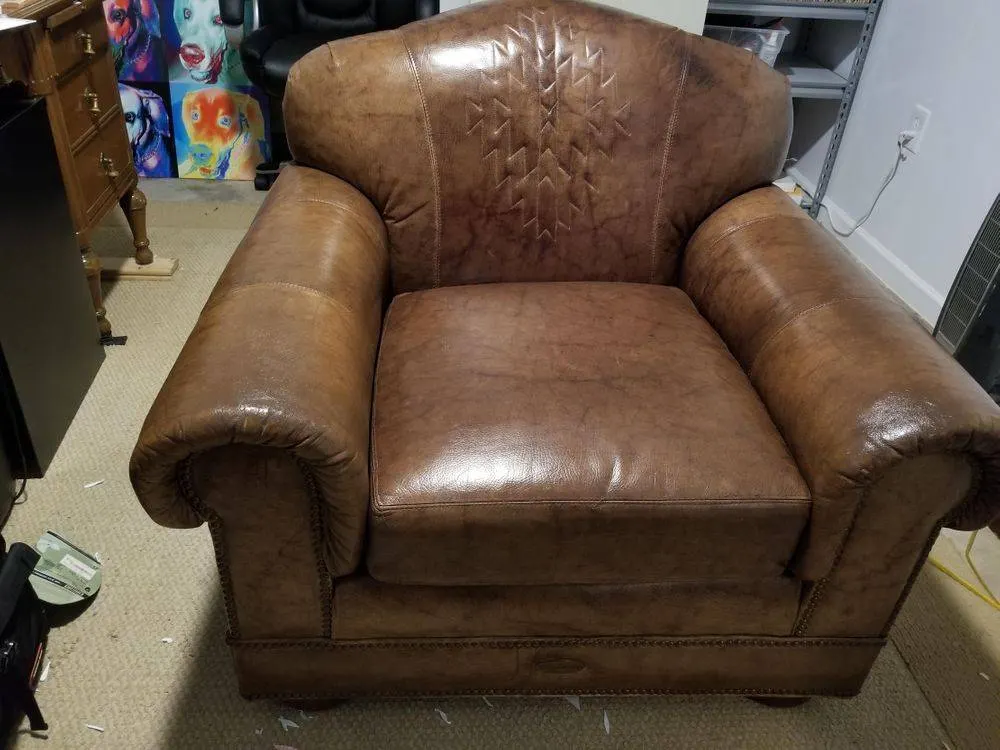
Three: compare a used area with an unused one — the back of the piece, or under a cushion. If the used areas are visibly lighter or duller and the unused area is at full depth, the pigment has gone and you need recoloring.
Four: press a thumb on several panels and look for flaking, powdering, or cracking appearing in new places. If more than one panel shows it, the finish has aged out across the piece and full restoration is the correct scope.
Those four answers usually make the recommendation obvious before anyone quotes.
What each one does not fix
Worth stating plainly, because these are the mismatches that produce disappointment.
None of the four repair physical damage. A tear, a burn, a hole or a split seam is a repair, handled separately and often at the same visit.
None of them fix structure. If the frame creaks or the foam has collapsed, no surface work changes how the piece sits.
None of them save bonded leather that is delaminating across panels. The coating is separating from a fabric backing, and anything applied on top comes away with the next flake.
None of them work on suede or nubuck in the way described here. Those materials need a different, narrower set of processes.
And none of them remove odor from cushion foam. That is a core replacement question, however perfectly the cover is cleaned.
How the Texas climate shifts the answer
Local conditions push pieces up the ladder faster than they would elsewhere, and in a predictable order.
Strong UV through west and south-facing windows degrades pigment first, so fading arrives early — which means recoloring becomes relevant sooner here than in a milder climate.
The same UV degrades the binder holding the finish together, and year-round air conditioning keeps the material dry, so stiffness follows fading and cracking follows stiffness.
The result is that a piece which needed cleaning two years ago often needs recoloring now and restoration in another two.
That progression is the argument for the cheaper interventions on a schedule. Cleaning and conditioning a few times a year keeps a piece at the bottom of the ladder for years longer, which is where the money is.
What to expect on price and time
Nobody can quote any of these honestly without seeing the piece, but the relative shape is consistent.
Cleaning and conditioning together is the least expensive and typically a single shorter visit.
Recoloring a panel sits above that. Recoloring a whole piece is more, and it usually needs one longer visit because color goes on in several thin coats with cure time between them.
Full restoration is the largest of the four and may run to a second visit on a big sectional or a set of chairs.
What moves any of them: the number and size of areas, the complexity of the color — a plain dark pigmented finish matches faster than a two-tone antiqued one — and access.
Set against all of it, replacement is not just the price of new furniture. It is delivery, disposal, and the real possibility that a mass-market replacement is built worse than the piece being replaced.
Asking for the right thing
When you request an assessment, describe the symptom rather than the service. Say the color has gone patchy, or the seats have cracked, or it feels sticky — not that you want it restored.
Send the standard photo set: a wide shot of the whole piece in daylight, close-ups of the worst areas square-on and from a low raking angle, and a shot of an unused area for comparison.
Report the results of the four checks above. A specialist who is told that cleaning a hidden area brought the color back has been handed the diagnosis.
Ask explicitly whether a cheaper option would be enough. A good specialist will already have said so, and asking makes it easy for them to.
And say what has been applied to the piece over its life. Silicone dressings, kitchen oils and heavy consumer conditioners all change the preparation required, which affects both the quote and the outcome.
Questions we get asked next
- Is restoration just recoloring with a better name?
- No. Recoloring replaces pigment; restoration also cleans and degreases thoroughly, stabilizes or removes the failed finish, fills worn areas and presses grain to match before any color goes on. On a piece that is only faded, recoloring is enough. On one that is faded and worn through, it is not.
- Can I have cleaning done and decide about recoloring afterward?
- Yes, and it is often the sensible route. Cleaning reveals what is actually underneath years of soil, and pieces regularly turn out to need less than the owner assumed. A specialist should be willing to clean first and reassess rather than quoting the largest job upfront.
- How long does each option last?
- Cleaning lasts until the piece gets dirty again — a matter of months in normal use. Conditioning lasts a few months and is a schedule rather than an event. Recoloring and restoration last years, and how many depends mostly on sun exposure and whether the piece is conditioned afterward.
- Which one do I need if my sofa just looks tired?
- Start with the hidden-area cleaning test. 'Tired' most often turns out to be accumulated body oil and soil, which is the cheapest of the four to fix. If the test area comes back looking new, you have your answer without spending anything.
- service comparison
- restoration
- decision guide