Is It Worth Repairing Executive Leather Office Chairs?
The value of an executive chair is in the mechanism, not the leather. That single fact usually settles the repair-or-replace question.
Quick answer
On a genuine high-specification chair, almost always. The expensive parts are the mechanism, the base and the frame, and those routinely outlast the upholstery — many carry warranties measured in years for exactly that reason. Refinishing worn leather on a sound chair costs a fraction of replacing it. The exception is an inexpensive chair with a bonded-leather covering, where the material is delaminating and the mechanism is not worth keeping.
At a glance
| The value | Mechanism, base and frame — not the covering |
|---|---|
| Usually worth it | A specified chair with sound mechanism and worn leather |
| Usually not | An inexpensive chair with peeling bonded material |
| Check first | The warranty — many cover the mechanism for years |
| Batch them | An office full of the same chair is one color match |
Where the money in a chair actually is
This is the fact that decides the question, and it is not obvious from looking at a chair.
On a properly specified office chair, the cost is concentrated in the mechanism — the synchro or multi-tilt assembly, the gas lift, the base, the casters, the arm assemblies and the frame.
Those are engineered components with a defined service life, tested to standards, and they are what you are paying for.
The upholstery is a covering over that engineering. It is the part that touches people, so it wears first, and it is not where the value sits.
That inversion is why refinishing makes so much sense on a good chair. You are restoring the cheap part of an expensive object.
It also explains why manufacturers of high-specification chairs frequently warrant the mechanism for a long period while treating upholstery as a wear item.
So the first question on any executive chair is not what the leather costs to fix. It is what the chair underneath is worth keeping.
Check the warranty before anything else
This step is routinely skipped and it occasionally makes the whole conversation unnecessary.
Many contract chair manufacturers offer long warranties on mechanisms, frames and gas lifts — often substantially longer than people assume, and sometimes transferable.
Upholstery is usually excluded or covered for a much shorter period, which is consistent with it being a wear item.
So a chair with a failing mechanism may be repairable under warranty at no cost, while its worn leather is a separate job.
Replacement parts are also widely available for specified chairs — arm pads, casters, gas lifts and seat pans can often be bought individually.
That means a chair that feels tired can frequently be brought back to full function with parts plus a leather refinish, for a fraction of a new chair.
Find the model number, usually on a label under the seat, before deciding anything.
Where executive chairs wear
The pattern is consistent and it is concentrated in a small number of places.
The arm tops, which take forearms for hours a day. This is the most common failure on any office chair and often the only one.
The seat front edge, which takes the backs of legs and the abrasion of getting in and out.
The outer seat edges, where people slide across.
The seat back at shoulder and head height, which takes hair products and skin oils and darkens before it wears.
The lumbar area on chairs where the leather stretches over a support.
Piping and edge welting, which abrades before the panels.
And on a chair used at a desk with a hard edge, the front of the seat where it meets the desk repeatedly.
What refinishing an office chair involves
It is straightforward work, and the degreasing stage matters more here than on most furniture.
The chair is cleaned and thoroughly degreased. An executive chair carries years of skin oil concentrated on the arms and the back at head height, and nothing bonds through it.
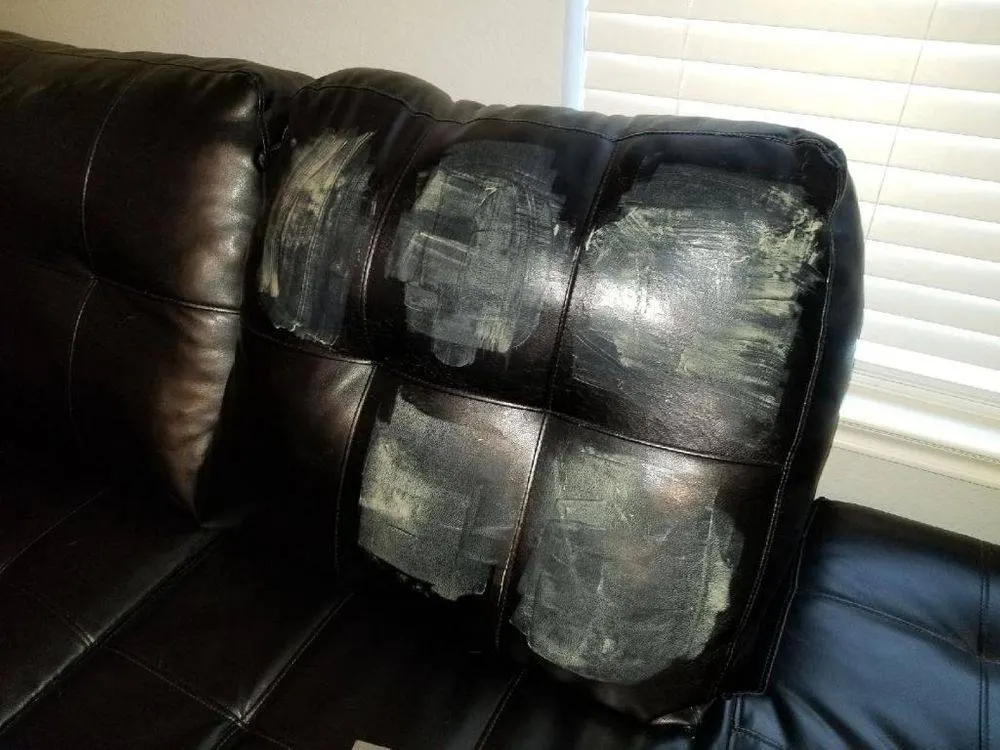
Worn areas are filled with flexible compound in thin layers, each allowed to set.
The texture is matched to the surrounding grain.
Color is mixed on site against the chair as it is now, applied in light coats, and sealed with a flexible topcoat at a matched sheen.
Arm pads that are removable can be taken off and treated separately, which gives better access and a cleaner result.
The chair needs to cure before it is sat in, which for an office is usually an overnight matter rather than a scheduling problem.
And the whole panel is worked to its seam lines rather than the worn patch, since blending into aged leather shows.
Bonded leather chairs, and being honest about them
A large share of chairs sold as executive leather are covered in bonded material, and the answer for those is different.
Bonded leather delaminates. The polyurethane surface separates from its backing and sheds in flakes, and no care or repair stops the process because the material is degrading throughout.
On an office chair the flaking is particularly noticeable, because it ends up on clothing and on the carpet around the chair.
An isolated patch can be rebuilt as a holding measure. Widespread peeling cannot be durably repaired.
The relevant question then becomes whether the chair underneath is worth recovering. On an inexpensive chair with a basic mechanism, usually not — replacement is the honest answer.
On a good chair that happened to be specified with bonded upholstery, recovering the seat and back in genuine leather or a contract-grade vinyl is worth considering, since the mechanism is still the valuable part.
Identifying which you have takes two minutes: peeling in flakes with a fabric layer underneath is bonded, while cracking and wearing without shedding is hide.
The comparison worth actually running
A short calculation that usually settles it, and it is worth doing properly rather than by instinct.
What would an equivalent new chair cost, including delivery and assembly?
What does refinishing the existing chair cost?
Is the mechanism sound, and if not, is it under warranty or are parts available?
How long is the chair expected to remain in service?
Is it assigned to one person or in a pool, since a chair fitted to an individual has value beyond its specification?
For a specified chair with a sound mechanism, refinishing typically comes out well ahead.
For an inexpensive chair with a failing mechanism and peeling bonded material, replacement is the clear answer — and the useful outcome of the assessment is being told that plainly rather than being quoted for work that does not make sense.
Doing a floor of chairs at once
Offices rarely have one chair, and the economics change substantially with volume.
An office usually has many chairs of the same model in the same color, bought at the same time.
They have been used similarly, so they have failed similarly.
One color is mixed once and used across all of them.
Setup and travel are per visit rather than per chair.
So a batch of chairs costs far less per chair than one, and the difference is real rather than a discount.
The practical arrangement is to work overnight or over a weekend, taking chairs in groups so nobody is without a chair during working hours.
Where the office has spare chairs, rotating them through means no disruption at all — chairs go out, refinished ones come back, and nobody notices except that the chairs look better.
Environment and ergonomics
Two considerations specific to office chairs that affect both the decision and the result.
Air conditioning runs in offices for most of the year in this region, and it dries leather continuously. Office chairs frequently stiffen faster than domestic furniture for exactly that reason, and a chair by a vent ages faster than the one beside it.
So conditioning as part of a maintenance routine matters more in an office than most facilities teams realize.
On the ergonomic side, a chair assigned to an individual has usually been adjusted to them, and that fit has value. Replacing it means a new chair and a new adjustment.
It also means the wear pattern reflects one person's use, which is why chairs in the same office can be at very different stages.
And a chair that is uncomfortable because the foam has compressed is not a leather problem — that is a seat pan or cushion issue, and it should be identified before anyone quotes on refinishing.
Keeping refinished chairs longer
Straightforward, and mostly about the contact points.
Wipe the arm tops and the back at head height every few weeks with a barely damp cloth, since skin oils build up invisibly and are the main cause of the darkened, shiny areas.
Keep household and general office cleaning wipes away from the chairs, which strip finishes gradually.
Condition several times a year, and more often for chairs sitting in the path of a vent.
Move chairs out of direct window light where the layout allows, since sun fades and dries at the same time.
Vacuum the seams and the joins around the seat pan.
And in a pooled environment, rotate chairs so the same ones are not always in the busiest positions.
Chairs assigned to individuals
There is a human dimension here that facilities decisions often miss, and it usually favors repair.
A chair that has been adjusted to one person over years fits them in a way a new chair will not without setup, and for anyone with a back or posture issue that fit is not trivial.
People also form attachments to their chair, and replacing a comfortable chair with a new one that looks better is not always experienced as an upgrade.
Refinishing keeps the chair and the fit while removing the reason it looked tired, which is usually the outcome the person actually wanted.
It also avoids the disposal question, which for a working chair with a sound mechanism is worth considering.
The practical approach on an assigned chair is to ask the person what is wrong with it before assuming. Frequently the complaint is the worn arm pads rather than the chair.
Arm pads on many specified chairs are a replaceable part, which means the fix can be a part plus a refinish rather than anything larger.
What to send for an assessment
Photograph the whole chair, then close up on the arms, the seat front and the back at head height.
Photograph the label under the seat if there is one, since the model determines parts and warranty.
Say whether the damage flakes and sheds or cracks without shedding, which identifies the material.
Sit in it and report whether the mechanism works properly, whether the gas lift holds height, and whether anything creaks or wobbles.
Press the seat and say whether the foam recovers.
Say how many chairs of the same model are in the building, since that changes the cost per chair substantially.
Say whether chairs are assigned or pooled, and whether spares exist.
And say what an equivalent replacement would cost, since the comparison is the actual question.
Questions we get asked next
- Is it cheaper to refinish an executive chair or replace it?
- For a properly specified chair with a sound mechanism, refinishing is typically well ahead — the expensive parts are the mechanism, base and frame, and those outlast the upholstery. For an inexpensive chair with peeling bonded material, replacement is usually the honest answer.
- My chair is peeling in flakes. Can it be repaired?
- That is bonded material rather than hide, and it delaminates throughout, so widespread peeling cannot be durably repaired. An isolated patch can be rebuilt as a holding measure. Whether it is worth recovering depends entirely on the quality of the chair underneath.
- Should I check the warranty first?
- Yes, and it is routinely skipped. Many contract manufacturers warrant mechanisms, frames and gas lifts for long periods, and replacement parts are widely available. Find the model number under the seat — a chair can often be brought back to full function with parts plus a leather refinish.
- Can a whole office of chairs be done at once?
- Yes, and it is far cheaper per chair. Offices usually have many identical chairs in the same color and condition, so one color mix and one setup serve all of them. Working overnight or in groups means nobody is without a chair during working hours.
- office chairs
- executive
- repair economics