Why Is My Leather Couch Peeling, and Is the Damage Worth Fixing?
Genuine leather does not peel. So the first question is not how to fix it — it is what the couch is actually made of.
Quick answer
Because it is almost certainly bonded leather or a coated synthetic rather than hide. In those materials a polyurethane surface is bonded to a fabric backing, and heat, use and age break that bond so the surface lifts and flakes. Genuine leather cracks and wears; it does not shed a layer. Whether it is worth fixing depends on how much has gone: an isolated patch can be rebuilt convincingly, while widespread peeling means the whole material is failing and refinishing will not hold.
At a glance
| Peeling means | Bonded or coated synthetic — not genuine hide |
|---|---|
| Isolated patch | Can be rebuilt and recolored convincingly |
| Widespread | The whole material is delaminating — refinishing will not hold |
| The real options | Recover, replace, or cover and accept it |
| What accelerates it | Heat, sun, body oils and household cleaners |
The first thing to establish
Peeling is the most diagnostic damage there is, because genuine leather does not do it.
Hide is a single material all the way through. It cracks, it wears thin, it abrades, it fades — and there is no separate surface layer to come away, because there isn't one.
What peels is a coating that was applied to a backing. When the bond between them fails, the coating lifts and sheds.
So a peeling couch is bonded leather, a polyurethane synthetic, or in rarer cases a hide with a badly failed refinish applied over it at some point.
This matters because it changes the entire conversation. If the couch were hide, the damage would be repairable and the piece would be worth restoring. Because it is not, the question becomes an economic one rather than a technical one.
It is also worth knowing regardless of what you decide, because it tells you what to look for next time you buy.
Confirming it in two minutes
You do not need equipment, just good light.
Look at the edge of a peeling area. If there is a woven or knit fabric layer under the coating, it is bonded or synthetic. Hide has no fabric in it.
Look at the grain across a large panel. A pattern that repeats exactly has been embossed onto a manufactured material. Natural hide grain is irregular and never repeats.
Check a cut edge or the underside of a cushion. Leather panels have a suede-like reverse; synthetics have a backing cloth.
Put a drop of water on a hidden area. Both pigmented leather and synthetics will bead, so this alone does not settle it — but combined with the grain and the backing it does.
Feel it. Leather warms to the touch and softens with use. Synthetics stay uniform and cool until they fail.
And check the label and the original invoice if you have them. Terms like bonded leather, leather match, or simply a lack of any leather claim are all informative.
Why bonded material fails, and why it is not your fault
Owners often assume they did something wrong. In almost every case they did not.
Bonded leather is built in layers: a fabric backing, an adhesive layer carrying ground leather fibers and filler, then a polyurethane surface with grain embossed into it.
Polyurethane degrades through hydrolysis — a reaction with atmospheric moisture that proceeds regardless of use. The adhesive layer degrades too.
Heat accelerates both substantially, which is why this shows up faster in a Texas house than in a mild climate.
Body oils at the contact points soften and break down the coating locally, which is why it starts on headrests, arm tops and seat fronts.
Household cleaners strip and degrade the surface, bringing the failure forward.
But the timeline is fundamentally set by the material. Bonded leather has a service life measured in a handful of years, and careful ownership extends it rather than avoiding the outcome.
Where it starts and how it spreads
The progression is consistent, and where you are in it determines the options.
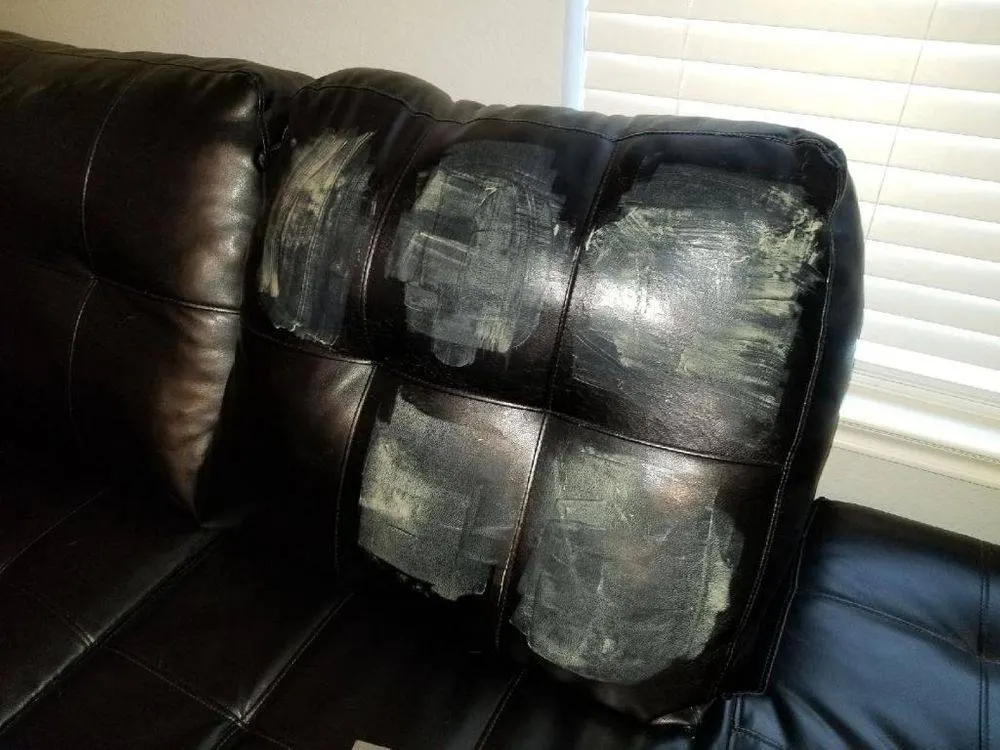
It begins at the highest-contact points: the headrest area, the tops of arms, the front edge of the seat cushions, and wherever someone habitually sits.
The first sign is often a change in sheen rather than visible peeling — a patch that looks slightly different, slightly tacky, or that has lost its texture.
Then small flakes start lifting at the edges of that patch.
Then the patch spreads outward, and new patches appear elsewhere on the same piece.
Within a year or two of the first patch, most of the high-contact surfaces are affected.
The shedding itself becomes the practical problem — flakes on clothing, in the carpet, on anyone who sits down — and that is usually what pushes owners to act rather than the appearance.
What a repair can honestly achieve
There is a real repair here and it has a defined scope, so it is worth being precise.
An isolated peeling area on a piece that is otherwise sound can be rebuilt: the loose material is removed back to a firmly bonded edge, the area is filled level, texture-matched to the surrounding grain and recolored to match.
Done well, that repair looks right and it holds for a reasonable period.
What it does not do is stop the surrounding material from failing, because the degradation is happening throughout rather than only where it shows.
So the honest description is that it buys time on that area, not that it fixes the couch.
Where peeling is already across multiple panels, refinishing all of it is a poor spend — a new coating over a failing substrate lifts along with the substrate.
There is one legitimate case for doing it anyway: a piece that needs to look presentable for a defined period, where the owner understands the limitation. That is a reasonable decision, and it should be described as what it is.
Working out whether it is worth it
This is an arithmetic question and it comes down to four things.
How much has gone. One patch is a different situation from four panels, and the cost scales with the area rather than with the number of spots.
How long you are keeping it. A couch you expect to have for another eight years and one you plan to replace next year justify completely different decisions.
What the piece is worth to you beyond its price. A well-fitting sectional in an awkward room has value that a replacement may not deliver.
And what a replacement actually costs, including delivery and the disruption of choosing one.
Where the answer is a small repair on a piece you like and intend to keep, it is straightforwardly worth doing.
Where the answer is refinishing most of a couch that will keep failing, it usually is not, and hearing that plainly is the useful outcome of an assessment.
The three real options
Once refinishing is off the table, there are three routes and they suit different situations.
Reupholstery in a durable material. The frame, the springs and the fit are all fine — it is only the covering that has failed. Recovering in a genuine hide or a contract-grade vinyl solves the problem permanently, and on a well-made frame it is a sound investment.
It is worth pricing honestly against replacement, because on an inexpensive frame reupholstery can cost more than a new couch.
Replacement, which is often the right answer for a piece that was inexpensive to begin with. This time, buy hide or buy a good-quality vinyl deliberately rather than by accident.
Covers, as a genuine interim option. A fitted cover contains the shedding, costs very little, and buys a year or two while you plan. It is not a repair and it solves the practical problem of flakes everywhere.
Which of the three is right depends almost entirely on the quality of the frame underneath, which is worth assessing before deciding.
If the frame is good, reupholstery deserves a look
This is the option owners most often overlook, and on some pieces it is clearly the best one.
Check the frame. Sit on it and feel for any give or creak. Look underneath for hardwood rather than particle board, and for joints that are doweled or bracketed rather than stapled.
Check the suspension — eight-way hand-tied springs or a good sinuous spring system means a frame worth keeping.
Check the fit. If the piece was chosen for a specific space and works there, that is worth real money.
A good frame with failed bonded covering is a candidate for recovering, and the result is effectively a new couch with a better material than it started with.
A stapled particle-board frame with failed covering is not, and replacement is the honest recommendation.
Most bonded-leather couches are at the inexpensive end of the market, so the frame answer is often no — and it is worth checking rather than assuming, because when it is yes the economics change completely.
Buying so it does not happen again
Since this conversation usually ends in a purchase, the terms are worth knowing.
Bonded leather is the material that peels. Avoid it for anything you intend to keep.
Leather match means hide on the seating surfaces and a matching synthetic on the sides and back. That is a reasonable compromise and it should be a known one.
Top grain and full grain are hide, and both last decades with care.
Genuine leather as a phrase is not a quality claim and it is used loosely, so it is worth asking what it actually means on that piece.
Faux leather, PU and vinyl are honest synthetics. Good-quality contract or marine-grade vinyl is genuinely durable and far better than bonded, and it does not pretend to be hide.
Ask what the seating surfaces are, specifically, and get the answer in writing on the invoice.
And in this climate, ask about heat: whatever you buy will spend years in a house that runs warm, and that is what determines how it ages.
What to send for an assessment
Photograph the whole couch so the extent is visible at a glance.
Photograph each peeling area close up, with something for scale.
Photograph the edge of a peeling patch so what is underneath shows — a fabric backing is the decisive detail.
Photograph a panel that has not started peeling yet, including a close view of the grain.
Say how old the piece is and roughly when the peeling started.
Say whether it is spreading, and how quickly.
Look underneath and say what the frame looks like — hardwood or particle board, and whether it feels solid when you sit.
And say how long you want to keep it, because that determines the recommendation more than the damage does.
Questions we get asked next
- Does peeling always mean my couch is not real leather?
- Almost always. Hide has no separate surface layer to shed — it cracks and wears instead. Peeling means a coating separating from a backing, which is bonded leather or a synthetic. The rare exception is a hide that had a bad refinish applied at some point.
- Can peeling bonded leather be permanently repaired?
- No. An isolated patch can be rebuilt convincingly and it buys time, but the polyurethane and adhesive are degrading throughout the material, so new areas keep failing. Anyone describing widespread bonded peeling as a permanent fix is worth questioning.
- Is it worth reupholstering a bonded leather couch?
- It depends entirely on the frame. A hardwood frame with good springs and a fit that works in your room is worth recovering, and the result is better than it started. A stapled particle-board frame is not, and replacement is the honest answer.
- Did I cause this by not looking after it properly?
- Almost certainly not. Bonded leather degrades through a reaction with atmospheric moisture that proceeds regardless of use, and heat accelerates it. Care and shade extend its life; they do not change the outcome, because the service life is set by the material.
- peeling
- bonded leather
- couch repair