What Causes Dark, Greasy Patches on Leather Headrests and Armrests?
The dark patch on a headrest is not dirt. It is oil that has been arriving in the same place, a little at a time, for years.
Quick answer
Skin and hair oils, deposited continuously at the points where people rest. Unlike a spill there is no moment anyone notices, so it accumulates for years. Early on it sits on the finish and a leather cleaner removes it. Once it penetrates, the finish softens and goes tacky and then shiny, and ordinary cleaning stops working because the contamination is below the surface. At that stage it needs proper degreasing, which is a different process from cleaning.
At a glance
| The source | Skin and hair oils, deposited constantly at contact points |
|---|---|
| Stage one | On the finish — a leather cleaner removes it |
| Stage two | In the finish — tacky, then shiny; cleaning stops working |
| Stage three | In the hide — permanent darkening, needs refinishing |
| The test | Does it come back within days of cleaning? |
Why these spots and not others
The pattern is remarkably consistent across every piece of leather furniture, and it maps exactly onto where bodies touch it.
Headrests and the upper seat back, where heads rest. Hair carries oils and so do the products people use in it, and the scalp and neck produce sebum continuously.
Arm tops, where forearms and hands rest for hours.
The front inner edge of arms, where hands grip when getting up.
The seat front, from the backs of legs.
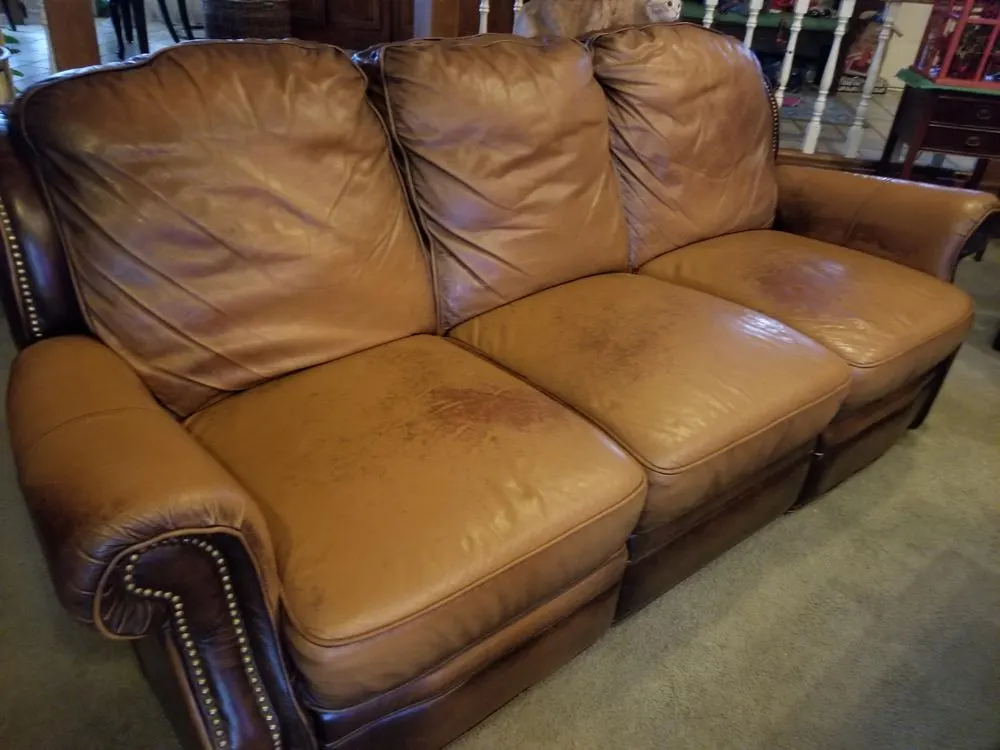
And on a recliner, wherever the occupant's head and arms habitually sit — which is a narrower, more concentrated area than on a sofa because one person uses it in one position.
Everywhere else on the same piece stays clean, which is why this reads as damage rather than as general soiling.
Why it builds up unnoticed
This is what makes it different from every other kind of mark on furniture.
A spill is an event. Something lands, somebody notices, and it gets dealt with.
Body oil arrives in microscopic quantities, thousands of times, over years. There is never a moment when anybody thinks to wipe it.
Each individual deposit is invisible. The accumulation is not, and by the time it is noticeable the material has usually changed.
Warmth accelerates the process, and a headrest under a person's head is warm for hours at a stretch.
It also darkens gradually, so the household adjusts to it. Owners are often genuinely surprised by the contrast when a cushion is turned or a matching chair is compared.
Which is why the practical answer is a routine rather than a response: wiping the contact areas every few weeks prevents almost all of it.
The three stages, and how to tell which you have
The outlook differs completely between them, so this is the useful diagnosis.
Stage one, on the finish. The area looks darker and slightly dulled. A leather cleaner removes it and the leather returns to normal. It stays clean for a reasonable period.
Stage two, in the finish. The area feels slick or tacky, and often looks shiny where it is rubbed. Cleaning improves it and it comes back within days or weeks, because what was removed was only the top layer.
Stage three, in the hide. The leather is permanently darkened, the finish may have worn away entirely in the middle, and the surface can feel soft or spongy compared with the leather around it.
The test that separates two from three: clean it properly and wait a week. If it returns quickly, the oil is below the surface.
Press it as well. Leather that feels softer and more yielding than the surrounding panel has been changed by prolonged oil saturation.
Stage one is a cleaning job, stage two needs degreasing, and stage three needs degreasing plus refinishing.
What the oil does to the material
Understanding this explains why the progression is one-way without intervention.
Leather finishes are polymer coatings. Oils act as plasticizers on them — they soften the coating and change how it behaves.
A softened coating is tackier, which is why a contaminated headrest feels different from the rest of the chair before it looks different.
Tacky surfaces attract dust and soil, which compounds the darkening.
The softened finish then wears away faster under ordinary friction, exposing the hide.
Once oil reaches the hide it darkens it and changes how it accepts anything applied later — including color, which is why an untreated area refuses to match after refinishing.
Prolonged saturation can also soften and stretch the leather locally, which is the spongy feel and is the one part of this that is not recoverable.
Cleaning it properly at stage one
For surface-level oil, this is straightforward and an owner can do it.
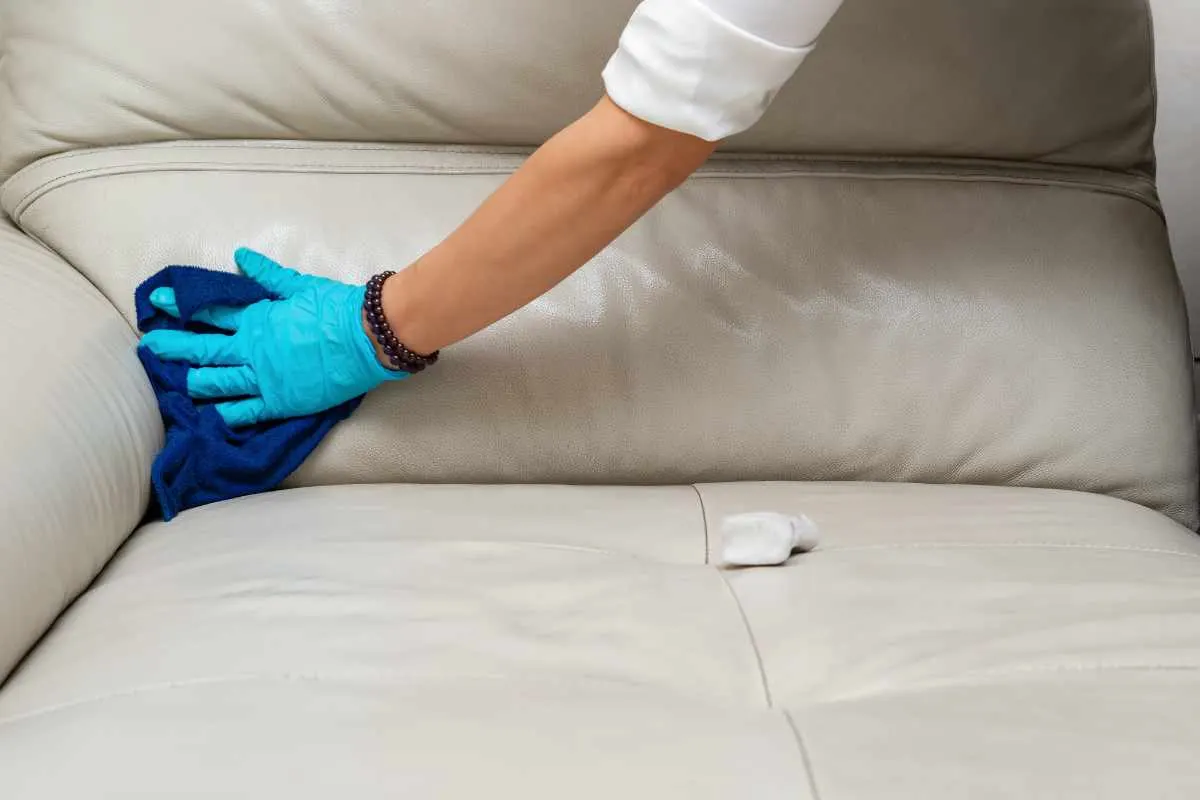
Use a cleaner made for finished leather, applied to a cloth rather than to the surface.
Work the whole panel rather than the darkened patch, because cleaning a patch on a soiled panel leaves a visibly cleaner area that is more noticeable than the original.
Use light repeated passes rather than pressure. Scrubbing burnishes the finish and creates the shine you are trying to remove.
Change to a clean section of cloth frequently, since a loaded cloth spreads oil rather than lifting it.
Expect several passes with drying between rather than one attempt.
Then condition lightly and buff off, since cleaning removes some of the leather's own oils along with the contamination.
If two or three careful attempts have not moved it, or if it returns within days, stop — that is stage two and it needs different products.
Why household products make it worse here
Greasy patches attract improvised cleaning more than almost anything, because they look like they should wipe off.
Dish soap is designed to cut grease and it does not remove absorbed oil. It cleans the top, leaves the material contaminated, and strips whatever finish protection remains.
Household wipes and all-purpose sprays remove the softened finish along with the surface oil, which accelerates the move to stage three.
Alcohol and sanitizer dissolve the coating, and on an already-softened headrest they do it quickly.
Melamine sponges sand off the grain, leaving a smooth shiny patch exactly where you were trying to remove shine.
Degreasing products made for kitchens are far too aggressive and damage the hide.
The pattern is the same throughout: on a surface where the finish is already compromised by oil, anything harsh removes what is left of the protection.
What proper degreasing involves
This is the stage-two answer and it is genuinely a different process from cleaning.
The products are formulated to draw oil out of the finish and the hide rather than to lift soil from the top of it.
They are applied, allowed to work, and removed — usually several times, with drying between applications.
Progress is assessed between passes, since the objective is a uniformly matte, dry-feeling surface rather than simply a lighter one.
On a heavily contaminated headrest this can take longer than any other part of the job.
The finished test is that the area should look slightly lighter than its surroundings and matte, and feel dry rather than slick. If it still looks glossy in the middle, there is oil left.
That matters because anything applied afterward — color, topcoat, even conditioner — will not bond to a surface that still has oil in it.
Refinishing after degreasing
Where the finish has been damaged or the hide darkened, degreasing is the first half and refinishing is the second.
Any area where the finish has worn through is filled with a flexible compound in thin layers.
The texture is matched to the surrounding grain so the area does not read as a smooth patch.
Color is mixed to the piece as it is now, since the rest has faded over the years the patch was forming.
It is applied in light coats and sealed with a topcoat at a sheen matched to the rest of the piece — which matters especially here, because a glossier patch on an arm or headrest is at eye level.
The work runs to seam lines rather than blending mid-panel.
And where there is a matching chair or the other arm of the same sofa, doing both keeps them consistent, which is usually worth the small additional cost.
Preventing it from returning
The repair addresses what happened; these habits address why, and without them the patch comes back.
Wipe the contact areas every few weeks with a barely damp cloth. Oil removed before it penetrates never becomes a problem, and this is the single most effective habit.
Use headrest covers or antimacassars on chairs where one person sits every day. They existed for exactly this reason, and modern versions are unobtrusive.
Arm caps on the arm that gets used most.
Clean and condition the whole piece three or four times a year, since a sound finish resists penetration far better than a worn one.
Rotate seating positions where the household allows.
And be aware that some hair products are considerably more aggressive on finishes than natural skin oils, so a change in routine can show up on the furniture.
Why it shows up worse on some leathers
The same household produces very different results depending on what the furniture is finished with.
Pigmented leather has an opaque coating, which is a genuine barrier. Oil sits on it for a long time before penetrating, so the surface stage lasts and regular wiping keeps it there indefinitely.
Semi-aniline has a thin coating, so the progression is faster and the darkening more pronounced once it starts.
Aniline has no pigment coating at all. Oils reach the hide quickly and darken it, which is why aniline furniture develops such distinct dark patches at contact points — and why on that material it is called patina by some people and damage by others.
Light-colored leather shows every stage far more visibly than dark, which is why the same amount of oil produces a complaint on a cream sofa and goes unnoticed on a dark brown one.
Bonded and coated synthetics do not absorb oil into a fiber structure, and the oil does soften their polyurethane surface, which is one of the reasons they fail first at exactly these contact points.
So the same advice applies everywhere and the urgency differs: on aniline and light leather, the wiping routine matters considerably more.
What to send for an assessment
Photograph the darkened area straight on and at a low raking angle, which shows the shine that a straight photograph misses.
Photograph the whole piece so the contrast with the unaffected areas is visible.
Photograph any matching chair or the opposite arm, since that usually affects the scope.
Run a finger across the area and say whether it feels slick, tacky, or dry.
Say whether a leather cleaner improves it at all, and whether it comes back — and how quickly.
Press it and say whether it feels softer or spongier than the leather around it.
Say what has already been used on it, particularly dish soap or any household cleaner.
And say how old the piece is and whether one person uses it consistently, which explains the concentration.
It is also worth photographing the arm tops and the seat front even if they look acceptable. Those areas are usually a stage behind the headrest rather than unaffected, and including them while a piece is already being worked on costs far less than a separate visit later.
Questions we get asked next
- Is the dark patch on my headrest dirt?
- No. It is skin and hair oil that has been deposited in the same place continuously for years. That distinction matters because dirt sits on the surface and comes off, while oil penetrates the finish and eventually the hide, which needs degreasing rather than cleaning.
- Why does it come back a week after I clean it?
- Because the cleaning removed what was on the surface and left what had penetrated the finish. Oil below the surface migrates back up with warmth and use. That quick return is the clearest sign it has moved past the cleaning stage.
- Can I use dish soap on a greasy headrest?
- It cuts grease on dishes and it does not remove absorbed oil from leather. It cleans the top while leaving the material contaminated, and it strips whatever finish protection is left — which brings forward the point at which the area needs refinishing.
- Will the darkening ever come out completely?
- At the surface stage, yes. Once oil has reached the hide, the darkening is in the leather itself and cleaning will not recover it — the route back is degreasing followed by refinishing the panel, which produces an even surface with no patch.
- grease
- body oils
- cleaning