Five Leather-Conditioning Myths That Can Shorten Furniture Life
Most of the conditioning damage we see was done carefully, by someone following advice that sounded reasonable.
Quick answer
The five that cause the most damage: that more conditioner is better, that household oils work as a substitute, that conditioner repairs cracks, that every leather needs the same treatment, and that a shiny finish means the leather is healthy. Each of them leads to a specific and avoidable failure — surface film and soil, permanent darkening and rancidity, deferred repairs, wasted product on materials that cannot absorb it, and residue that makes future refinishing harder.
At a glance
| Myth 1 | More is better — excess sits on the surface and attracts soil |
|---|---|
| Myth 2 | Household oils work — they darken permanently and go rancid |
| Myth 3 | Conditioner repairs cracks — it hides them while they grow |
| Myth 4 | All leather is the same — finish type changes everything |
| Myth 5 | Shine means healthy — usually it means residue |
Why bad conditioning advice is so persistent
Most of it comes from a world that no longer applies, and that is worth saying up front because it explains why the advice sounds authoritative.
Saddlery, boots and traditional harness leather are thick, minimally finished, and used outdoors in wet conditions. They genuinely need heavy dressings, and the products developed for them — neatsfoot oil, mink oil, heavy waxes — do exactly what they should.
Modern furniture and automotive leather is thin, heavily finished, and lives indoors. It has a pigmented or semi-aniline coating over the surface that controls how much anything can penetrate at all.
Applying saddlery logic to a finished sofa produces a predictable result: product sitting on top of a coating, doing nothing useful and creating problems.
The other source is marketing, which sells volume by encouraging frequent heavy application.
And the third is that conditioning feels productive. Rubbing something into leather is satisfying in a way that leaving it alone is not, which is why the error is nearly always doing too much rather than too little.
Myth one: more conditioner is better
This is the most common and the most damaging, because it is done by exactly the people who care most about their furniture.
Leather absorbs what its fiber structure can hold and no more. On a finished hide, that quantity is modest, and it is reached quickly.
Everything applied beyond that point stays on the surface. It does not soak in later, however long it is left.
That surface residue is tacky at a microscopic level, so it collects dust, skin oils and airborne soil, and the piece gets dirty faster than it did before.
It builds up in seams, tufting and grain, where it darkens and becomes genuinely difficult to remove.
And it interferes with any future work, because a heavy conditioner film — silicone-based products especially — leaves a surface that recoloring will not bond to. That is a real cost, since preparation time goes up and it has to be stripped before anything else can happen.
The correct approach is a small amount, worked in, then buffed off with a clean cloth. If the surface still feels slick after buffing, too much went on.
Myth two: household oils work
Olive oil, coconut oil, baby oil, petroleum jelly, furniture polish and cooking sprays all appear in online advice, and every one of them causes a specific problem.
Vegetable and food oils go rancid. They oxidize over months, producing a smell that cannot be removed from the hide because the oil is in the fiber structure rather than on it.
They darken leather permanently and unevenly. An oiled patch on a tan sofa stays a different color forever, and it is one of the few kinds of damage that recoloring struggles with, because the oil keeps migrating.
They do not carry the fatliquors leather actually needs, which are formulated to bind with the fiber structure rather than simply sitting in it.
Petroleum products and furniture polish attack finishes and can soften the coating.
Silicone-based furniture sprays leave a film that nothing bonds to afterward.
The practical rule is simple: if it was not made for leather, it does not go on leather. Products made for leather cost very little relative to the furniture, and none of the alternatives are cheaper once the damage is counted.
Myth three: conditioner repairs cracks
It appears to, briefly, which is precisely why this one costs people money.
Applying conditioner to a cracked area darkens it and fills the surface texture temporarily, so the cracks become less visible for a few days.
Nothing has been repaired. A crack is a physical split in the finish or the hide, and no liquid closes it.
Meanwhile the crack keeps growing, because whatever caused it — stiffness, flexing, abrasion — has not changed.
The real cost is the delay. A crack in the finish, caught early, is a straightforward repair: clean, fill in thin flexible layers, texture-match and recolor. The same crack a year later has gone through into the hide and the repair is larger.
And on a piece that has been repeatedly conditioned to hide cracking, the accumulated residue has to be stripped before any repair can bond, which adds cost.
Conditioning prevents cracking. It does not fix it. Those are different jobs and the second one needs a specialist.
Myth four: all leather takes the same treatment
This is the one that leads to wasted product and to actual damage on the wrong material.
Pigmented or protected leather — the majority of furniture and nearly all automotive leather — has an opaque coating over the hide. Very little penetrates it, so conditioning is about maintaining the finish and the small amount of exchange that does happen. Light applications, less often than people think.
Aniline leather has no pigment coating. It absorbs readily, stains readily, and needs a product formulated for it. It also needs more care about what it comes into contact with generally.
Semi-aniline sits between the two and takes a light-finish product.
Nubuck and suede should not be conditioned with a cream or oil at all. Those products mat the nap and leave permanent dark patches. They need brushing and dedicated nubuck products.
And bonded leather, polyurethane and vinyl have no fiber structure to condition. Products applied to them sit on top doing nothing, and a heavy application makes them tacky.
The identification takes two minutes — a water drop that beads means a finished surface; one that darkens and soaks in means an absorbent one — and it changes both the product and the frequency.
Myth five: shiny leather is healthy leather
This one is worth unpicking because it inverts what a good result looks like.
Healthy conditioned leather has a soft, low sheen. It looks slightly richer than before and it feels supple rather than slick.
A high gloss on furniture leather usually means one of three things, and none of them are good.
Conditioner residue that has not been buffed off, which will attract soil.
A silicone dressing, which builds a film and complicates any future refinishing.
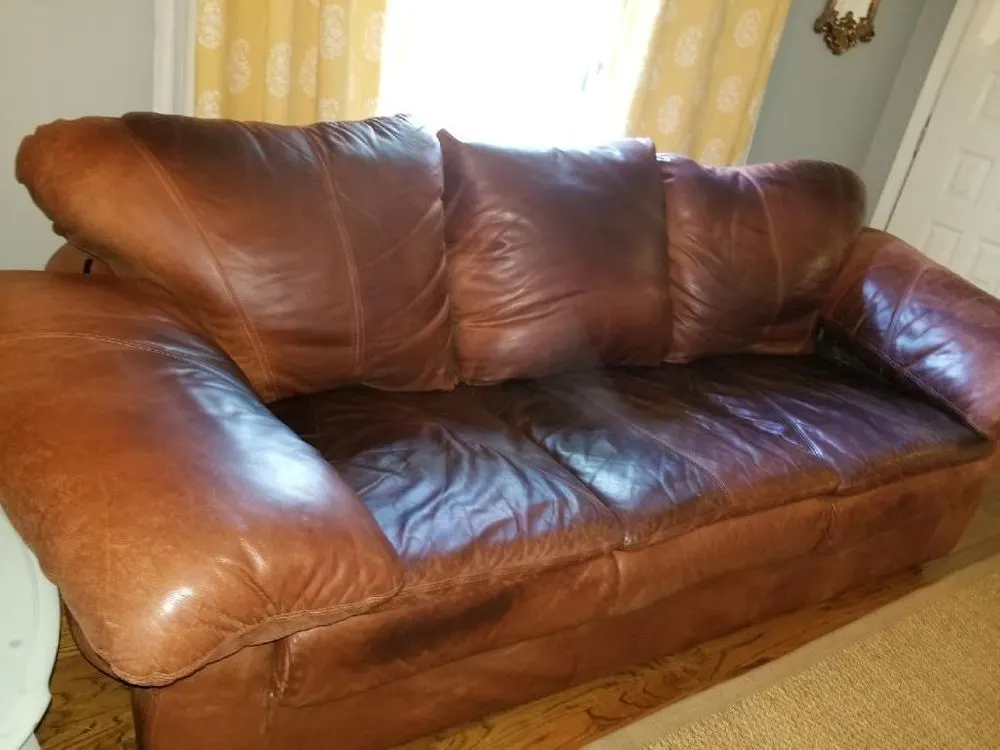
Or body oils and wear — the shine on an arm or a headrest that has been rubbed for years, which is actually a worn area rather than a healthy one.
That last case is the important one. The shiniest parts of an old sofa are typically the most damaged, and they need cleaning and often refinishing rather than more product.
So the useful test is touch rather than appearance. Supple and dry to the touch is right. Slick, tacky or glossy is residue.
What good conditioning actually looks like
Having cleared the myths, the practice itself is short and unglamorous.
Clean first, always. Conditioner over soil drives the soil into the hide and seals it there.
Use a product matched to the leather type, made by a manufacturer that specializes in leather rather than in furniture care generally.
Apply a small amount to a cloth rather than directly to the leather, so it goes on evenly and you control the quantity.
Work it in with light circular motions, covering the whole panel rather than only the areas that look tired.
Let it sit briefly, then buff off with a clean dry cloth. The buffing is not optional — it is what removes the excess that would otherwise become residue.
In this climate, three to four times a year on indoor furniture is a reasonable rhythm, more often for pieces in direct airflow or strong light, less for pieces that see little use.
And test any new product on a hidden area first, particularly on aniline or older leather.
The signals worth reading instead
Rather than conditioning on a feeling, a few checks tell you what the leather actually needs.
Press a thumb into the hide beside a seam. It should yield and spring back. Board-like resistance means it has stiffened and needs attention.
Look at a flex point at a raking angle — the front edge of a seat cushion, the top of an arm. Fine lines appearing there are the earliest warning, well before anything is visible straight on.
Run a hand across the surface. Dry and slightly grippy is normal. Slick or tacky means residue.
Compare a used panel against an unused one, such as an outside back. That is the clearest picture of what use and the room have done.
Notice color depth, since flattening color is usually light exposure rather than dryness and needs a different answer.
Reading those takes a minute and it prevents both of the common errors — conditioning a piece that does not need it, and missing one that does.
When to stop conditioning and call someone
There is a point at which continuing is spending money to delay a decision.
Cracks that have gone through the finish into the hide. Conditioning hides them and they keep growing.
Color loss, which is a recoloring job and does not respond to conditioning at all.
Surface peeling or flaking, which means either a failed finish or a bonded material — and on bonded material, no product helps.
Areas worn through to a different texture or to the backing.
Stiffness that has not improved after several months of proper conditioning, which suggests the fiber structure will not recover.
And any tacky or sticky surface, which is either residue that needs stripping or a coating that has broken down, both of which need addressing rather than covering.
In each case an assessment costs nothing and it usually turns out that the repair is smaller than the owner feared — provided it happens before another year of conditioning goes over the top of it.
Questions we get asked next
- How often should leather furniture be conditioned?
- Three to four times a year for indoor furniture in this climate, more often for pieces sitting in direct airflow or strong light. Regularity matters more than quantity, and it should be done before anything looks dry rather than in response to it.
- Is olive oil really that bad for leather?
- Yes. It goes rancid over months, producing a smell that cannot be removed because the oil is inside the fiber structure. It also darkens the hide permanently and unevenly, and it keeps migrating, which makes it one of the harder things to correct afterward.
- My sofa is shiny after conditioning. Is that good?
- No — it means excess product was left on the surface. Conditioner should be buffed off with a clean dry cloth after it has been worked in. Healthy leather has a soft, low sheen and feels supple rather than slick. Residue attracts soil and complicates future refinishing.
- Does vinyl or bonded leather furniture need conditioning?
- No. Neither has a fiber structure to condition, so leather products sit on the surface doing nothing useful and can leave them tacky. They need cleaning with a neutral product, and on bonded leather the real issue is delamination, which no treatment addresses.
- conditioning
- leather care
- myths