Why Year-Round Air Conditioning Dries Leather Indoors
The leather in an air-conditioned living room is not being damaged by heat. It is being slowly dried by the machine keeping the room comfortable.
Quick answer
Because cooling air removes water from it. An air conditioner works by condensing moisture out of the air it passes over the coil, so a home that runs its system for most of the year sits at a lower indoor humidity than the outdoor climate suggests. Leather is hygroscopic — it exchanges moisture with the air around it continuously — so it gives up moisture to that dry air. Over years the hide stiffens, and stiff leather abrades and cracks where it flexes.
At a glance
| The mechanism | Cooling condenses moisture out of the air as a side effect |
|---|---|
| Why it matters here | DFW homes run air conditioning for much of the year |
| What leather does | Exchanges moisture with the surrounding air continuously |
| The result | Gradual stiffening, then abrasion and cracking at flex points |
| The answer | Conditioning on a schedule, not when the leather looks dry |
The thing about air conditioning nobody mentions
Everyone in North Texas understands that the summer heat is hard on things. Far fewer people think about what the air conditioning itself is doing, because it feels like the solution rather than a factor.
An air conditioner does not simply make air colder. It pulls air across a cold evaporator coil, and because cold air holds less water vapor than warm air, moisture condenses out onto that coil and drains away. That condensate running out of the drain line is water taken out of your house.
That is not a fault or an inefficiency. It is how the system works, and it is a large part of why an air-conditioned room feels comfortable rather than merely cool.
The consequence is that a home running its system for a substantial part of the year sits at a lower indoor relative humidity than the outdoor climate would suggest.
People assume that because Dallas summers are humid outdoors, their interiors are humid too. Inside a conditioned house, the opposite is usually closer to the truth.
And leather sitting in that room has been quietly equilibrating with it the entire time.
Leather exchanges moisture with the air constantly
This is the property that makes the whole thing work, and it is worth understanding properly because it explains the timescale.
Leather is hygroscopic. The collagen fiber structure holds a percentage of moisture, and that percentage moves toward equilibrium with the humidity of the surrounding air. It is not sealed, even under a pigmented finish — a finish slows the exchange rather than preventing it.
Put leather in humid air and it takes moisture up. Put it in dry air and it gives moisture off.
That happens continuously and slowly, which is exactly why the damage is invisible while it is occurring. Nothing changes from one week to the next.
Alongside the water, leather contains fatliquors — the oils and waxes introduced during tanning that let the fiber bundles slide against each other instead of binding together.
Those migrate and deplete over time as well, and heat and airflow both accelerate it.
So a hide in a dry, conditioned room is losing two things at once, and it is the combination that produces stiffness.
What stiff leather actually does
The failure sequence is consistent and it explains why damage appears where it does.
Supple leather flexes. When someone sits, the hide bends and the fiber bundles slide past one another, then return. Nothing is damaged because the movement is distributed through the material.
Stiff leather does not distribute that movement. It resists the bend, so the stress concentrates in a line rather than spreading, and the surface finish takes the load rather than the fiber structure beneath it.
The first result is finish cracking — fine lines in the coating, usually visible only at a raking angle at first.
Then the surface begins to abrade, because a stiff surface scuffs where a supple one would deform.
Then the cracks reach the hide itself, and at that point the material is genuinely damaged rather than the finish on it.
Which is why the same seat cushion that looked fine for eight years can appear to fail suddenly. It did not. The stiffening happened for eight years and the visible failure took a few months.
Winter heating does the same thing
The pattern is year-round in this region, which is what distinguishes it from milder climates.
In summer, cooling removes moisture from indoor air.
In winter, heating warms cold outdoor air that was already holding little moisture. Warming it does not add any, so the relative humidity of the heated air drops sharply.
The result is that both seasons produce dry indoor air, by different mechanisms.
Between them there is a genuinely mild period in spring and fall when systems run less and indoor humidity comes up, and that is a real recovery window for leather in the house.
It is also short. In a typical North Texas year the systems are doing something for most of the calendar.
So the honest picture is that indoor leather here spends the majority of the year in air that is drier than it would prefer, with brief periods of relief.
Where it shows up first in a room
Not all leather in a house ages at the same rate, and the pattern points at airflow more than anything else.
Furniture directly in the path of a supply vent ages fastest. Air moving across a surface accelerates moisture loss in exactly the way it does with anything else, and a vent aimed at a sofa arm is a small wind tunnel running for months.
Pieces near a return vent see constant air movement too.
Anything close to a fireplace, a heater or a radiant heat source dries locally and faster than the rest of the same piece.
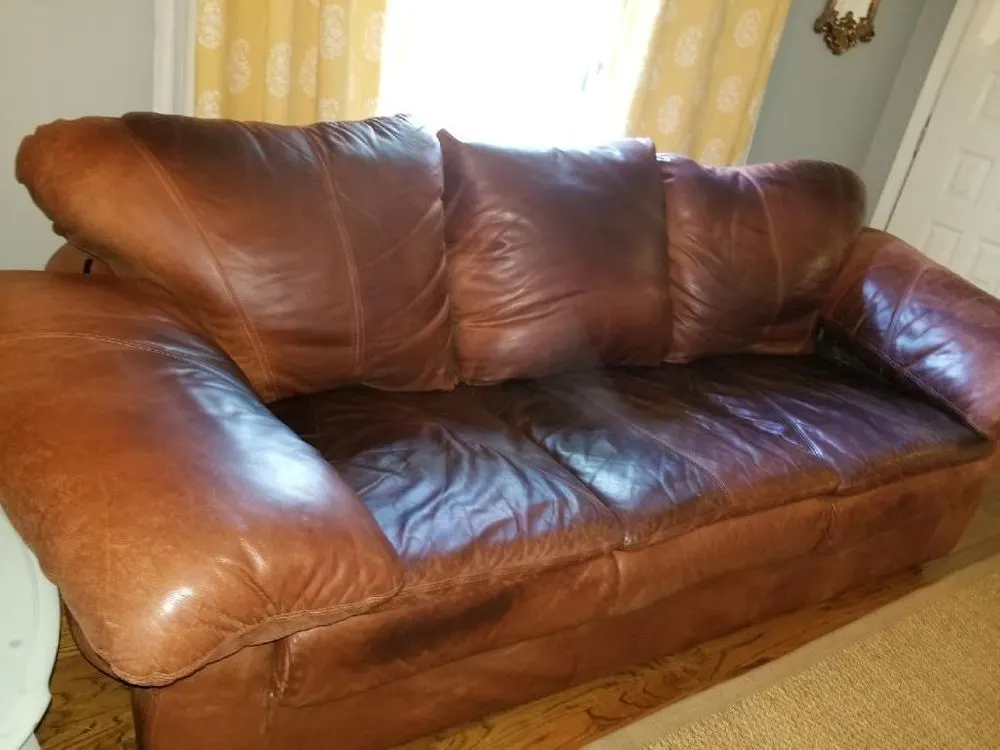
Seat cushions and arms — the parts that flex and are handled — show it first, because they are where stiffness turns into visible damage.
Back panels and sides stiffen at the same rate and show nothing, because nothing is bending them.
The practical version of this: if one arm of a sofa is noticeably worse than the other, look up. There is usually a vent above it.
Conditioning is maintenance, not treatment
This is the single change in thinking that saves the most furniture.
Most people condition leather when it starts to look dry. By the time leather looks dry, the fiber structure has already been depleted for a long time, and conditioning at that point slows further decline rather than reversing what has happened.
Conditioning on a schedule, before anything looks wrong, is the version that actually works. It replaces what is being lost as it is lost.
In this climate, three to four times a year is a reasonable rhythm for indoor furniture in a conditioned home, which is more often than the once-a-year advice written for milder places.
The product matters less than the regularity, provided it is made for leather and matched to the finish type. A pigmented sofa and an aniline chair take different products and different amounts.
Little and often beats a heavy application. Leather absorbs what it can hold and the rest sits on the surface, collecting dust and leaving a film.
And it goes on clean leather, because conditioner over soil drives the soil in.
Managing the room rather than the furniture
There are a few things worth doing to the environment, and they are cheaper than any of them sound.
Redirect supply vents away from leather furniture. Adjustable vent deflectors cost very little and they remove the single worst local factor.
Move furniture out of the direct path of airflow where the layout allows, even by a foot or two.
A humidifier is worth considering in a home that runs very dry, particularly in winter. It is not necessary in most DFW homes, and it helps where the air is noticeably dry to live in.
Ceiling fans are fine — they move air across people rather than across furniture, and they let the thermostat sit higher.
Keep leather away from fireplaces and space heaters, which produce a local dry zone far more aggressive than the room average.
None of this requires changing how you run the house. It is placement and airflow, and it is worth doing once rather than repeatedly.
Second homes, rentals and empty houses
The worst cases seen in this region are not lived-in homes. They are houses that sit.
A house closed up with the system set high in summer, or off entirely, has a different problem — heat and humidity together, which is a mold question rather than a drying one.
A house running the system hard while nobody is in it has the drying problem at full strength, with nobody noticing for months.
A vacation property or a staged house for sale can go a whole season without anyone looking at the furniture closely.
Storage units are the most extreme version, because they combine temperature extremes with no moisture management at all.
For any of these, the answer is a check on the furniture whenever someone is there, and conditioning before a long unoccupied stretch rather than after.
Leather that has spent a summer in a hot closed house needs assessing before it is used, since it may be stiff enough that ordinary use will crack it.
What conditioning cannot do
Being clear about the limits keeps expectations honest and stops money going in the wrong direction.
It does not repair cracks. Once the finish or the hide has split, conditioner may make the area look better temporarily by darkening it, and the split is still there and still growing.
It does not restore color. Faded leather needs recoloring, which is a different process.
It does not rebuild a hide that has genuinely hardened throughout. There is a point past which the fiber structure will not soften usefully, and honest assessment matters more than another application.
It does not help synthetic materials. Bonded leather, polyurethane and vinyl have no fiber structure to condition, and products applied to them sit on the surface doing nothing useful.
And it does not compensate for a vent blowing directly onto a sofa, which will keep removing moisture faster than you replace it.
What it does, reliably, is keep sound leather supple — which is the whole job, and it is worth far more than any repair it prevents.
What to send for an assessment
Photograph the piece as a whole in daylight, then close up on the areas that flex — seat cushions, arm fronts, the top of the back.
Take a close-up at a low raking angle, which is what reveals fine finish cracking before it is visible straight on.
Photograph a panel that does not get used, such as an outside back or a side, which shows the same leather without the flexing.
Press a thumb into the leather beside the worn area and say what it does: yields and springs back, or feels board-like and resists.
Say how old the piece is, how it has been cared for, and what has been applied to it.
Say where it sits in the room relative to vents, windows and any heat source, since that often explains why one part is worse than another.
And say whether the house is occupied year-round, because a piece that has spent seasons in an empty conditioned house is a different assessment from one in daily use.
Questions we get asked next
- Is air conditioning really bad for leather?
- It is not bad for it so much as drying. Cooling removes moisture from indoor air as a side effect, and leather exchanges moisture with the air around it, so it gradually gives some up. The answer is regular conditioning rather than running the house differently.
- How often should I condition leather in a DFW home?
- Three to four times a year for indoor furniture in a conditioned house, which is more often than the once-yearly advice written for milder climates. Regularity matters more than the product, and it should be done before anything looks dry rather than after.
- Do I need a humidifier for my leather furniture?
- Usually not. Most DFW homes sit in a range leather tolerates, provided the furniture is conditioned regularly and is not in the direct path of a vent. A humidifier is worth considering in a home that runs noticeably dry, particularly through winter heating.
- One arm of my sofa is worse than the other. Why?
- Almost always airflow. Check for a supply vent above or aimed at that side — moving air across a surface accelerates moisture loss considerably. A vent deflector costs very little and removes the cause rather than managing the symptom.
- air conditioning
- humidity
- conditioning