Is Mold or Mildew on Leather Cleanable, or Has the Material Been Damaged?
Mold on leather looks alarming and is often the least of the problem. What matters is what is behind the panel, not what is on it.
Quick answer
Surface mold on finished leather is usually cleanable, and the hide underneath is normally undamaged — the coating kept the growth on top of it. What decides the outcome is depth: mold that has reached unfinished leather can leave permanent staining, and mold in cushion foam cannot be cleaned out at all and means replacing the cores. Wipe the surface dry first, get the piece into dry moving air, and do not reach for bleach.
At a glance
| On finished leather | Usually surface only. Cleans off; hide underneath normally fine |
|---|---|
| On aniline or suede | Can penetrate and stain permanently |
| In cushion foam | Not cleanable. Cores have to be replaced |
| Never use | Bleach, ammonia, or a soaking wet cloth |
| The real fix | Remove the moisture source, or it returns in weeks |
What you are actually looking at
Mold and mildew on upholstery appear as a gray, green, white or black bloom, often powdery, with a distinct musty smell. On leather it typically starts in the places air does not reach: the crease where a cushion meets the back, the underside of an arm, the panel facing a wall.
Mold needs three things — moisture, a food source, and still air. Leather itself supplies the food source in the form of oils and organic residue on the surface, so the variable that matters is moisture.
On finished leather, the important structural point is that the coating is a barrier. Mold grows on top of it, feeding on body oils, dust and skin cells that have accumulated there rather than on the hide.
That is why the usual outcome is better than it looks: the bloom cleans off and the leather is intact. The material only suffers when moisture and growth get past the coating, or when they were never on the coating at all.
The first thing to do, and the first thing not to
Take the piece somewhere ventilated if you can, or open the room up and get air moving. Mold in still air keeps growing.
Wipe the visible bloom off with a dry cloth first, or vacuum it with a soft brush attachment and a machine you can empty outside. Do this before introducing any liquid, because wetting a dry bloom drives spores into the surface and into the seams.
Then let the piece dry thoroughly in moving air at room temperature. Drying is more than half the job.
What not to do: bleach. It is the reflex for mold on hard surfaces and it damages leather — it strips finish, it can leave a permanent pale patch, and on the hide itself it degrades the fiber structure. Ammonia and strong household cleaners do their own version of the same thing.
Also avoid soaking the area. Adding water to a moisture problem is self-defeating, and a wet panel in a warm room is precisely the condition the mold wanted.
Cleaning surface mold properly
Once the loose bloom has been removed dry and the piece is no longer damp, the surface can be cleaned.
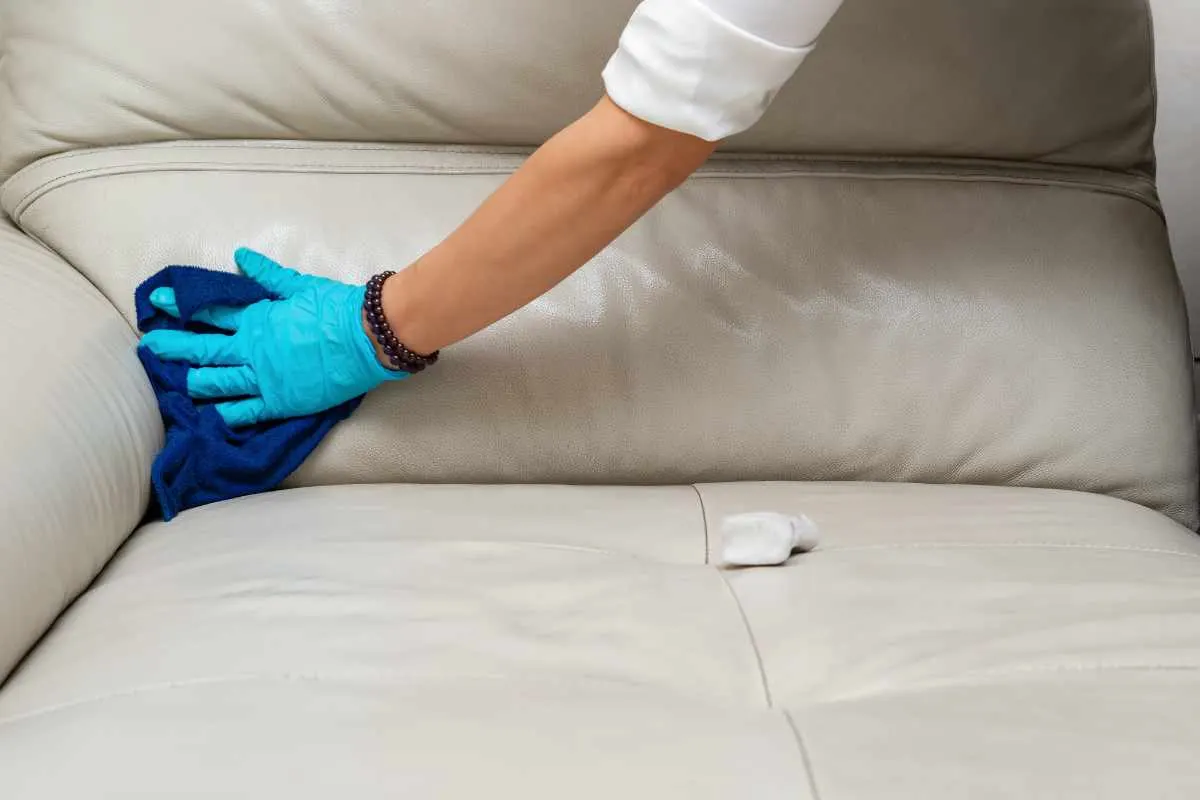
Use a cleaner intended for finished leather, applied to a cloth rather than sprayed. Test it on a hidden area first, as always.
Work over the whole panel rather than the visible patch, so no cleaning boundary is left behind and so any spores that spread beyond the obvious bloom are picked up.
Pay particular attention to seams and crevices, because that is where growth persists after the flat surfaces look clean. A soft brush helps here; pressing harder with a cloth does not.
Wipe with a second, barely damp cloth to lift residue, dry with a third, and let the piece finish drying in moving air.
Condition only once everything is completely dry and only if the piece is due for it. Conditioner on a damp surface traps moisture and gives the problem somewhere to restart.
When it has gone deeper than the surface
There are two cases where the leather itself is affected rather than just soiled.
The first is unfinished leather — aniline, nubuck, suede. Without a coating there is nothing keeping growth on the surface, so it establishes in the fiber and often leaves a permanent stain or a change in texture. Cleaning can reduce it; it frequently cannot remove it entirely.
The second is finished leather whose coating has already worn through. On seat fronts, arm crowns and headrests where the finish has gone, mold has direct access to the hide.
In both cases the piece can usually be saved, but the route is different: specialist cleaning, then refinishing the affected panels so they have a protective coating again. That is a restoration job rather than a cleaning one.
The tell is straightforward. If the bloom wipes away and leaves clean-looking leather, it was on the surface. If it leaves a shadow, a stain or a roughened area, it got in.
The foam problem, which is the real one
This is where mold on upholstery is genuinely serious, and it is invisible from the outside.
Cushion foam is open-celled and absorbent. If moisture reached it — a spill that soaked through, a leak, a flood, or a long period of high humidity in a closed room — mold can establish inside the cushion.
Once that has happened, cleaning the leather perfectly does nothing. The musty smell comes from inside the core and returns within days of any surface treatment.
You cannot reliably clean mold out of foam. The structure is porous, cleaning agents cannot reach through it, and drying it does not remove what has already grown. The honest answer is replacing the cores, which is the cheapest component of any upholstered piece.
The deck padding under the cushions matters too. If water pooled on the frame, that layer holds it and dries even more slowly.
A quick diagnostic: press firmly into the cushion and smell your hand, or unzip a cover and smell the core directly. If the smell is stronger inside than on the surface, the problem is the foam.
Why this happens in North Texas
This region produces a specific pattern, and it is not the one people expect from a hot, dry-sounding climate.
Summer humidity here is high, and the contrast with heavily air-conditioned interiors creates condensation conditions — particularly on furniture against an exterior wall, in a room that gets closed off, or in a house where the air conditioning is turned down while nobody is home.
Storm season produces intense rainfall over short periods, which is what causes water coming in under doors, through window frames and up through flooring rather than a slow, obvious leak.
Garages, sunrooms and storage units are the worst environments: warm, humid, and with no air movement. Furniture stored in a Dallas garage over one summer routinely comes out with a bloom on it.
Boats and RVs are the extreme version — closed up, warm, and often with residual moisture inside. Marine and RV upholstery mold is common enough here to be a seasonal expectation rather than a surprise.
Fixing the cause, not just the bloom
Cleaning mold without changing the conditions means doing it again in a few weeks.
Move the piece away from the wall so air can circulate behind it. A few inches makes a measurable difference.
Improve air movement in the room — a ceiling fan, a standing fan, or simply leaving interior doors open so the air conditioning reaches that space.
Reduce humidity. In this climate the air conditioning is the main dehumidifier, so a room that is closed off from it is the room where mold appears. A portable dehumidifier is worth it for a problem space.
Find and fix any water source: a window that leaks in a storm, a nearby plant that gets watered generously, a damp spot on a slab.
For storage, do not wrap leather furniture in plastic. Plastic traps moisture against the surface and produces exactly this problem. Breathable covers, with the piece raised off a concrete floor, are the right approach.
Health and when to hand it over
Mold is a health question as well as an upholstery one, and it is worth treating it that way.
The EPA's guidance on mold remediation is straightforward on the principle: fix the moisture problem, clean what can be cleaned, and remove porous materials that have been colonized rather than trying to clean them. Cushion foam is porous by that definition.
Anyone in the household with asthma, allergies or a compromised immune system should not be doing the cleaning, and the room should be ventilated during and after.
For a small surface bloom on a finished leather panel, home cleaning as described above is reasonable.
For anything larger than a hand-sized area, anything with a persistent smell, anything on unfinished leather, or anything following a flood, get advice before starting. Those are the situations where the wrong first move is expensive.
Vehicles, boats and RVs
Enclosed vehicles are the most common mold call in this region, and the mechanics are the same with worse conditions.
The usual causes are a leaking sunroof or windshield seal, a window left open in a storm, a spill left in the footwell, or a wet floor mat put back down over damp carpet.
Carpet padding is the equivalent of cushion foam: absorbent, slow to dry, and impossible to clean out once colonized. A car that smells musty a week after getting wet has a padding problem rather than a seat problem.
Boat and RV upholstery stored closed through a Texas summer is a predictable case. Cushions stored on edge with air circulation, and hatches or vents left open where security allows, prevent most of it.
In all three, the seats themselves usually clean up. It is the layer underneath that determines whether the smell goes away.
What to send for an assessment
Photograph the bloom square-on and from a low raking angle, in daylight without flash.
Photograph the crevices and the panel edges, since that is where growth persists and where a specialist looks first.
If you can unzip a cushion cover, photograph the foam inside — that single image often answers the whole question.
Say how long the piece has been affected, what the moisture source was if you know it, and whether the smell is stronger near the cushions or on the surface.
And say what you have already used on it. If bleach has been applied, that changes what is possible and it is much better known in advance than discovered during the work.
Questions we get asked next
- Can I use vinegar on mold on leather?
- Diluted white vinegar is sometimes suggested and it is milder than bleach, but it is acidic and can dull or strip a finish, and on unfinished leather it can affect the dye. A cleaner made for finished leather, used after removing the loose bloom dry, is the safer route.
- The mold is gone but the smell is not. Why?
- Almost always because growth is established in the cushion foam or in deck padding rather than on the cover. Surface cleaning cannot reach it and deodorizers only add a second smell. That is a core replacement rather than a cleaning problem.
- Will mold come back after cleaning?
- Yes, if the conditions that produced it are unchanged. Cleaning removes the growth; air movement, lower humidity and fixing the moisture source are what stop it returning. Cleaning alone typically buys a few weeks.
- Is furniture stored in a garage over the summer recoverable?
- Often, if the growth stayed on a finished surface. Bring it into conditioned air, let it dry fully, clean the panels, and check the cushion cores for smell. If the cores are affected, replacing them is inexpensive relative to replacing the piece.
Sources
- Mold Remediation in Schools and Commercial Buildings — U.S. Environmental Protection Agency, checked 2026-08-21
- mold
- mildew
- humidity