Can a Sun-Faded Leather Sofa Near a Window Be Recolored Evenly?
A sofa faded at one end is the most common recoloring job there is. Getting it even is a question of scope more than of skill.
Quick answer
Yes. Evenness comes from working whole panels to their seam lines rather than blending into faded leather, from mixing color on site against the actual sofa rather than to a factory reference, and from matching sheen as carefully as color. The one thing to do first is control the light — film, a treatment or moving the piece — because new color in the same window fades the same way, and recoloring before that means paying twice.
At a glance
| Fix the light first | New color in the same window fades the same way |
|---|---|
| Whole panels | Work to seam lines — blends into faded leather show |
| Match to now | Color mixed on site against the sofa, not to a code |
| Sheen matters | A gloss mismatch is more visible than a color one |
| Whole piece | Usually the right scope when fading is uneven across it |
What sun does to leather color
Fading is not simply lightening, and knowing what actually happens explains why matching is harder than it looks.
Ultraviolet light and strong visible light break down the pigments and dyes that give leather its color. Ordinary window glass blocks some UV and passes the rest along with the whole visible spectrum, so a window does not protect against this.
Different pigments break down at different rates. So the color does not fade uniformly toward a lighter version of itself — it shifts.
Browns commonly go orange or yellow as the cooler components break down first. Reds go pink. Blacks go charcoal or brown. Blues go gray.
That is why matching a faded sofa to its original color code produces something visibly wrong: the sofa is no longer a lighter version of that color, it is a different color.
Sun also dries the leather, so a faded end is usually a stiffer end as well, and both often need addressing together.
The pattern on a real sofa
Fading follows light exactly, which makes it easy to read.
The end nearest the window is worst, and the gradient runs across the piece.
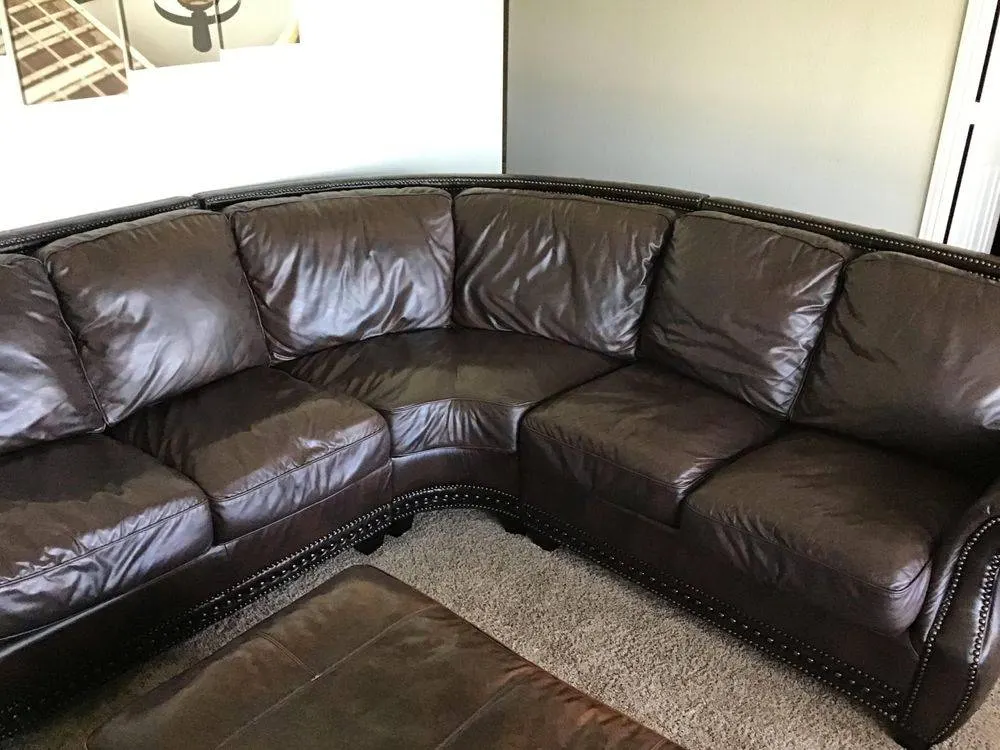
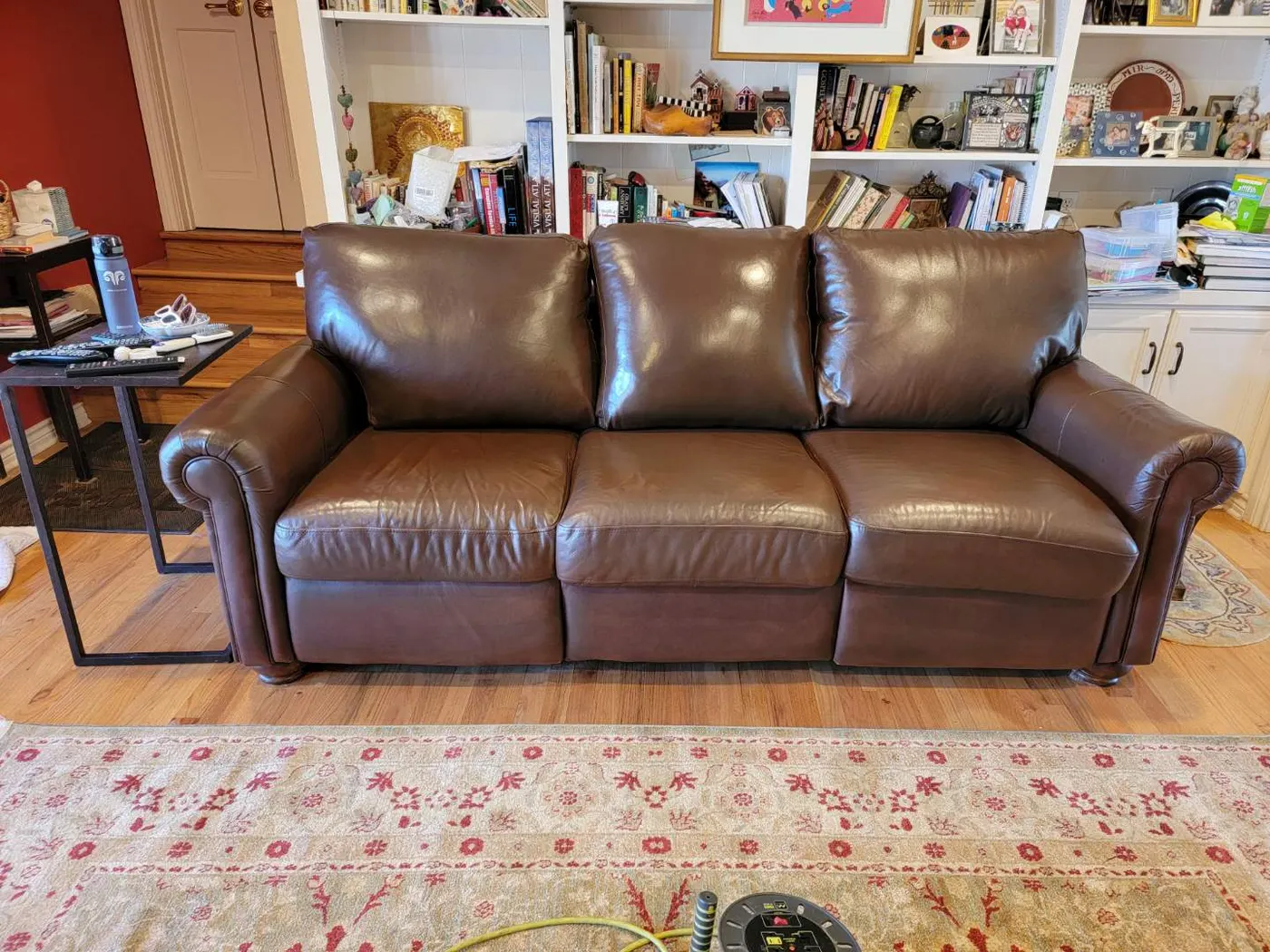
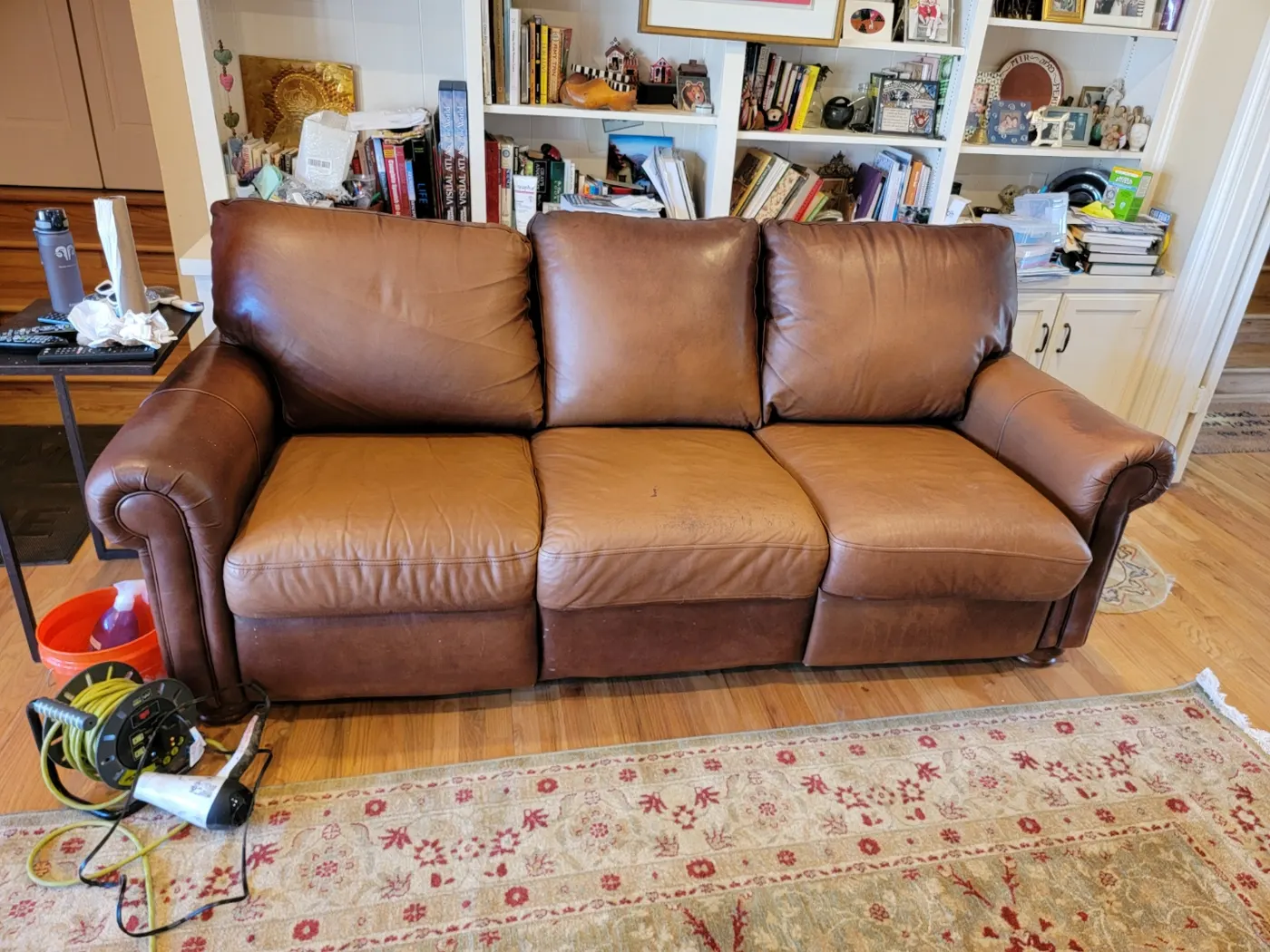
Panels facing the window fade while panels facing away do not, so a single cushion can be two tones — bright on the front, original on the back.
There is often a hard line where a curtain edge, a lamp or another piece of furniture cast a shadow.
Horizontal surfaces take more than vertical ones, so seat tops and arm tops go before the fronts of arms.
The tops of seat backs fade before the lower portions.
And the outside back, if it faces away from the window, usually shows the original color — which makes it the reference point for what the sofa used to be.
Deal with the window first
This is the sequencing point that determines whether the work holds, and it belongs before any quote.
New color in the same light fades in the same way. A fresh topcoat with UV filtering slows it somewhat, and not by enough to change the outcome over a few years.
So the order is: control the light, then recolor.
A UV-filtering window film is the most effective measure, because it works continuously with no habit required and protects everything in the room.
Blinds, cellular shades or curtains work if they are closed during the hours that matter — afternoon on a west window, midday on a south one.
Exterior shading, awnings or planting are best of all, since they stop the light before it reaches the glass.
Or move the sofa out of the light patch, which costs nothing.
Doing the recoloring first and the light afterward is the common sequence and it is the wrong way round.
How color is matched
This is where a good result is decided, and it is a process rather than a lookup.
Color is mixed on site, against the actual leather, in the light of the room where the sofa lives.
A manufacturer's code or a reference chip is a starting point at best, because the sofa has aged away from it.
The match is checked in daylight and again under the room's own lighting, since a match that works under one can be visibly off under the other.
Where the surrounding leather is itself uneven, the match is made to the area immediately adjacent to the work, and the transition is handled by extending to a seam rather than by feathering.
It is confirmed on a test area before the full application rather than discovered afterward.
And there is a choice to be made deliberately: match the sofa as it is now, or take the whole piece back toward its original color. Both are legitimate and they are different jobs, so it should be a decision rather than an assumption.
Why sheen matters as much as color
The most commonly overlooked half of matching, and the one that gives poor work away.
Leather has a sheen level — matte, satin, semi-gloss — and it changes as a piece ages. Sun-faded leather is usually flatter than it was.
A recolored panel finished at a higher gloss than its surroundings catches the light differently from every angle in the room.
The eye reads that as a change in material rather than a change in tone, which is why sheen mismatches look worse than color mismatches even when the color is perfect.
Sheen is matched by testing on a hidden area and adjusting the topcoat, not by using whatever finish came with the color.
It is worth asking a specialist specifically how sheen will be matched, since it is a fair question and the answer tells you a lot.
On a sofa where the whole piece is being done, sheen is chosen once and applied consistently, which removes the problem entirely.
Scope: why whole panels and usually the whole piece
The scope decision does more for evenness than any technique.
Recoloring a faded area and blending into the surrounding leather rarely satisfies. The surrounding leather is faded, still fading, and the blend is visible at certain angles even when it is well executed.
Working to seam lines gives the eye a break where it already expects one, so any small difference is absorbed.
But on a sun-faded sofa, panel-by-panel work has a second problem: the unfaded panels keep their color while the recolored ones are new, and the piece still reads as inconsistent.
So where fading is uneven across the piece, doing all of it is usually the honest recommendation.
The cost does not scale linearly. Cleaning, preparation, color mixing, setup and travel are largely shared, so the additional panels cost considerably less than the first.
That surprises owners, and it often changes the decision once they hear it.
What the work involves
The process is well established and the preparation is most of it.
The piece is cleaned thoroughly, then degreased at the contact points, since body oils prevent bonding and a sofa carries years of them.
Every trace of old conditioner, dressing and polish is removed. Silicone-based products in particular leave a film nothing will bond to, and most sofas have had something applied over the years.
The surface is prepared so the new coating has something to key into.
Any cracking or worn area is filled in thin flexible layers and texture-matched, since recoloring over damage highlights it rather than hiding it.
Color is applied in several thin coats rather than one heavy one. Thin coats flex with the hide; a thick coat sits on it as a shell and cracks at the flex points.
A flexible topcoat goes on last at the matched sheen.
Then it cures before anyone sits on it, which is confirmed at the end rather than promised in advance.
Address the dryness at the same time
Sun fades and dries simultaneously, and treating only the color misses half of what happened.
The faded end of a sofa is usually the stiff end. Years of light and the heat that comes with it have depleted both moisture and fatliquors.
Stiff leather cracks at the flex points, so a beautifully recolored cushion on stiffened leather can crack within a year or two.
Any cracking already present should be repaired as part of the job rather than colored over.
And the piece needs conditioning on a schedule afterward — three or four times a year in this climate — to keep the hide supple under the new finish.
A specialist should raise this rather than only quoting the color, because a recoloring that fails early usually fails because the underlying dryness was never addressed.
It is also the argument for moving the sofa out of the light rather than only filtering it, since the heat matters as much as the light.
How long a recoloring lasts
A fair question with an honest answer that depends on what happens next.
Properly done on supple leather, the finish wears like an original factory finish. It is not a coating that peels off.
What determines its life is exposure. Behind a filmed window or out of the light patch, years — and it will need conditioning rather than recoloring.
In the same unfiltered west window, fading returns visibly within a few years, more slowly than bare leather but on the same trajectory.
Harsh cleaners shorten it. Household wipes and all-purpose sprays remove topcoat, which is what carries the UV protection.
Abrasive cleaning cuts through the color layer.
Regular gentle cleaning and conditioning extend it substantially, and that is the whole of the aftercare.
Recolorings that fail early almost always fail from inadequate preparation — usually a silicone film that was never removed — or from a thick single-coat application that could not flex.
What to send for an assessment
Photograph the whole sofa in daylight, capturing the faded and unfaded areas in the same frame so the contrast is visible.
Photograph the outside back or another protected area, which shows the original color.
Photograph the room, showing where the sofa sits relative to the windows.
Say which direction the windows face and roughly when the sun reaches the furniture.
Say whether there is film or a treatment, and whether it is actually used during those hours.
Press a thumb into the leather at the faded end and say whether it is supple or board-like.
Photograph any cracking at the flex points, at a raking angle.
And say whether other pieces in the room need to match, since that determines the scope more than the fading does.
Questions we get asked next
- Can just the faded end of the sofa be recolored?
- It can, and it usually disappoints. The unfaded panels keep their color while the recolored ones are new, so the piece still reads as inconsistent — and the blend into faded leather shows at certain angles. Where fading is uneven, doing the whole piece is the honest recommendation.
- Should I fix the window before recoloring?
- Yes. New color in the same light fades the same way, only somewhat slower, so recoloring first means paying twice. UV-filtering film, a treatment used during the hours that matter, or moving the piece out of the light patch all come before the color work.
- Will the recolored leather feel different?
- Not when it is done properly. Color is applied in several thin coats that flex with the hide, then sealed with a flexible topcoat. What feels different is a thick single application, which sits on the surface as a shell and cracks at the flex points.
- How much more does doing the whole sofa cost?
- Less than most people expect. Cleaning, preparation, color mixing, setup and travel are largely shared, so the additional panels cost considerably less than the first. It is closer to a modest increase than to a multiple, which often changes the decision.
- fading
- recoloring
- sun damage