How Do You Restore One Worn Seat Without Making a Sectional Look Mismatched?
On a sectional, the hard part is not fixing the worn seat. It is making sure the fixed seat does not stand out.
Quick answer
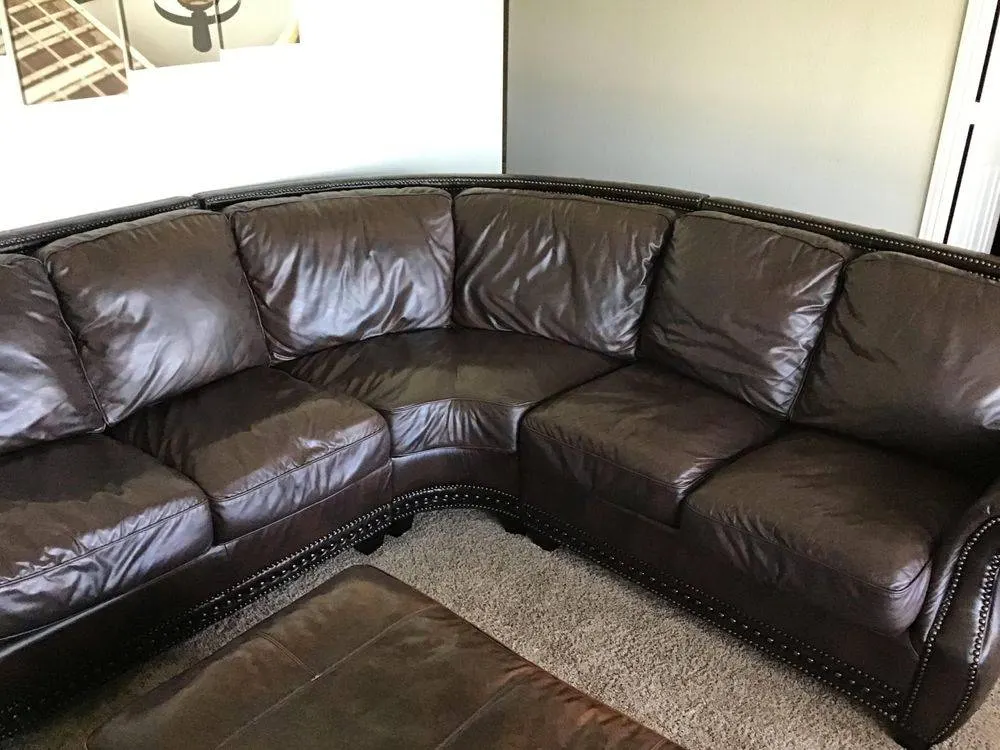
Match to the sectional as it is now rather than to the original color, and choose the scope deliberately. Color is mixed against the aged leather beside the repair, not against a factory reference. Then decide how far to extend the work: to the seam lines of that cushion, across the whole section, or across the piece. Whole-panel work to a seam gives the eye a break where it expects one, which is what stops a repair reading as a patch.
At a glance
| The real risk | A repaired panel that looks newer than everything around it |
|---|---|
| Match to now | Color is mixed against the aged leather, not the factory shade |
| Work to seams | Seam lines give the eye a natural break; blends do not |
| Sheen matters | A glossier panel stands out more than a color difference |
| Three scopes | One cushion, one section, or the whole piece |
Why sectionals wear unevenly
A sectional is one piece of furniture that gets used as several, and that is the whole source of the problem.
Households have a favorite seat. On a sectional it is usually the corner, or the end nearest the television, and it takes several times the use of the seat two places along.
The chaise, if there is one, takes a different kind of wear again — people lie on it rather than sit, so the whole surface is loaded rather than one cushion.
The end nearest a window fades while the end against an interior wall does not.
Arms nearest a walkway take knocks and hands; the inner arms take almost nothing.
And on a sectional with a pull-out or a reclining section, the mechanism sections flex where the static ones do not.
So after five years a sectional can have panels that are effectively different ages, on the same hide, bought on the same day.
The two things that make a repair visible
It is worth being precise about this, because owners usually worry about the wrong one.
The first is color. Not simply the shade, but the fact that the surrounding leather has aged. A repair colored to the original factory reference will be correct and it will look wrong, because nothing else on the piece is that color any more.
The second, and the one people underestimate, is sheen. A repaired panel finished slightly glossier than the leather around it catches the light differently from every angle in the room.
Sheen mismatches are more noticeable than color mismatches, because the eye reads them as a change in material rather than a change in tone.
Texture is the third factor and it is usually the easiest to get right, since grain can be matched accurately.
So the questions to ask a specialist are how the color will be matched, and how the sheen will be matched — in that order of importance and with sheen given real weight.
Matching to the sectional as it is now
This is the technique that determines whether the work disappears.
Color is mixed on site, against the actual leather beside the repair area, in the light of the room. A reference chip or a manufacturer's code is a starting point rather than an answer.
It is checked in daylight and again under the room's own lighting, since a match that works under one can be visibly off under the other.
Where the surrounding leather is itself uneven — faded at one end of the cushion and not the other — the match is made to the area immediately adjacent to the repair, and the transition is handled by extending the work to a seam rather than by feathering the color.
Sheen is matched by testing on a hidden area and adjusting the topcoat, not by using whatever finish the color came with.
And the match is confirmed before the full application, not discovered afterward.
This is slower than working from a code, and it is the difference between a repair you have to point out and one you have to look for.
Working to seam lines rather than blending
The single most useful principle in sectional work, and it is about how the eye reads a surface.
A seam is already a visual break. The eye expects a change there — a shadow line, a slight difference in how light falls — so a small difference in tone or sheen across a seam is absorbed rather than noticed.
In the middle of a panel there is no such break, so any transition has to be perfect to go unseen, and a feathered blend across an aged surface rarely is.
So the working unit is the panel, not the damaged area. A worn patch in the middle of a seat cushion means refinishing that cushion top, edge to edge.
This costs more than treating the patch and it is why the result is acceptable rather than obviously repaired.
It also ages better. A blend that looks acceptable on the day drifts apart as the surrounding leather continues to fade, while a panel treated to its seams stays consistent within itself.
Choosing the scope
Three levels, and the right one depends on how uneven the piece already is.
One cushion, to its seam lines. Right when the rest of the sectional is in similar condition and the difference is genuinely localized damage rather than years of extra use.
One section — the corner unit, the chaise, the loveseat portion — treated as a whole. Right when that section has clearly aged ahead of the others and refinishing one cushion within it would create a mismatch inside the section itself.
The whole sectional. Right when fading is uneven across the piece, when several sections need work, or when the owner wants the piece to look consistent rather than repaired.
The cost does not scale linearly. Cleaning, color mixing, setup and travel are largely shared, so the second and third section cost considerably less than the first.
That is worth knowing before deciding, because owners often assume doing the whole piece costs several times as much when it is closer to double.
When doing the whole piece is the honest recommendation
There are situations where a single-panel repair will disappoint no matter how well it is executed.
Heavy uneven fading, where the sun-facing end and the shaded end are visibly different colors. A repair anywhere on that piece sits between two different backgrounds.
Widespread finish wear, where several panels are dull and thin even without visible damage.
Leather that has yellowed or shifted in hue rather than simply lightened, which is common on older light-colored sectionals.
A piece where the owner's actual complaint is that it looks tired rather than that one seat is damaged — those are different requests, and only one of them is a repair.
And any case where two or more sections already need work, since doing them together is both cheaper per section and the only way to guarantee they match afterward.
A specialist should say which of these applies rather than quoting what was asked for.
The sections that get missed
A few parts of a sectional are easy to overlook when scoping, and they are what give a job away.
The inner faces where two sections meet, which are hidden when the piece is assembled and visible if it is ever moved or reconfigured.
The back panels of a floating sectional that is not against a wall.
The chaise sides, which take knocks and pet contact but are not in anyone's eyeline.
The seat backs, which fade at a different rate from the seats because they are more vertical and catch light differently.
The piping along cushion edges, which wears through before the panels do and which is what the eye actually follows around a piece of furniture.
And the underside edges of arms, which collect hands.
Worth photographing all of these when asking for a quote, since including them at the outset is far cheaper than adding them later.
Preventing the imbalance from returning
A sectional that wore unevenly once will do it again unless something changes.
Rotate the loose cushions between positions, not just end to end within a seat. Moving the corner cushion to a rarely used position and back evens out both compression and color.
Where cushions are not interchangeable, rotating and flipping within their position is still worth doing.
Consciously use different seats. This is harder than it sounds and it is the most effective thing available.
Address the light. If one end faces a window, window film or a treatment stops that end continuing to fade away from the rest.
Move the piece off an exterior wall and out of a vent path.
And condition the whole sectional on a schedule rather than only the seat that looks tired, since the panels nobody sits on are drying at the same rate as the ones they do.
Cushion covers and swapping
One option specific to sectionals that is worth raising, because it sometimes solves the problem cheaply.
Where cushion covers are removable and the cushions are the same size, swapping a worn cushion with one from a rarely used position redistributes the wear.
It does not fix damage, and it does even out fading and compression if it is done early enough — before the difference has become large.
Once the difference is obvious, swapping simply moves the problem to a more visible seat, so timing matters.
On some sectionals the covers can be removed and refinished off the piece, which gives better access and a more controlled environment for the work.
It is worth checking whether yours are removable, since it occasionally opens options that are not available on a fixed-cover piece.
And where a cushion is beyond refinishing, recovering that single cushion in matched leather is sometimes possible — which is the sectional equivalent of a panel replacement.
What to send for an assessment
Photograph the whole sectional from a distance, so the layout and the overall variation are visible in one frame.
Photograph the worn seat close up and at a raking angle.
Photograph a seat that has had little use, for comparison, and try to get both in a single frame somewhere.
Photograph the end nearest the window and the end furthest from it.
Photograph the piping along the cushion edges.
Say which seat gets used most, and where the light comes from and when.
Say whether the cushions are removable and interchangeable.
And say what you actually want — the damage fixed, or the piece to look consistent again — because those lead to different recommendations and it saves a conversation later.
Questions we get asked next
- Can just one section of a sectional be refinished?
- Yes, and whether it will look right depends on how much the rest has aged. Color is matched to the leather as it is now rather than to the factory shade, and the work runs to seam lines rather than blending mid-panel. Where fading is uneven across the piece, doing more of it is the honest answer.
- Will the repaired seat match the others?
- It should, provided the color is mixed on site against the adjacent leather and the sheen is matched by testing rather than assumed. Sheen mismatches are actually more noticeable than color ones, so it is worth asking specifically how that will be handled.
- Is doing the whole sectional much more expensive?
- Less than most people assume. Cleaning, color mixing, setup and travel are largely shared, so additional sections cost considerably less than the first. Doing two sections is closer to double than to triple, which often changes the decision.
- How do I stop one seat wearing out again?
- Rotate cushions between positions rather than only within a seat, consciously use different seats, and address any window that is fading one end. Condition the whole piece rather than only the tired-looking seat — the unused panels are drying at the same rate.
- sectional
- color matching
- restoration