How Can You Protect Leather Furniture from UV Fading Near Texas Windows?
The window is the reason one end of the sofa no longer matches the other. Glass filters less of the damaging light than most people assume.
Quick answer
Deal with the light before dealing with the leather. Ordinary window glass blocks most short-wave UV but passes long-wave UV and visible light, both of which fade pigment. The effective measures are a UV-filtering window film, cellular or blackout treatments on the worst-facing windows, and moving or rotating the furniture so no single panel takes the exposure. Once fading has happened, recoloring restores it — but only after the light is controlled, or it fades again.
At a glance
| Glass is not enough | It passes long-wave UV and visible light, which both fade pigment |
|---|---|
| Worst exposure | West and south-facing windows through summer afternoons |
| Most effective fix | UV-filtering window film — it treats the whole room at once |
| Free measure | Rotating cushions so no panel takes all the exposure |
| Fix the light first | Recoloring before controlling the sun means fading it again |
What window glass actually stops
This is the assumption that costs people a sofa, and it is a reasonable assumption to make.
Ultraviolet light is not one thing. The shorter-wave portion is the part associated with sunburn, and ordinary window glass blocks most of it — which is why you do not get burned sitting by a window.
The longer-wave portion passes through glass largely unimpeded. So does the entire visible spectrum.
Both of those degrade pigment. Fading is not exclusively a UV phenomenon — strong visible light fades dyes and pigments perfectly well on its own, which is why things fade behind glass that blocks UV entirely.
So the fact that you do not get sunburned through a window tells you nothing about whether your furniture is fading through it.
Modern low-emissivity glazing does better, and double glazing with a low-E coating cuts a meaningful share of the damaging light. Most homes have some windows like that and some that are not.
The practical conclusion is that any window with sun coming through it is fading whatever sits in the light, and the only question is how fast.
Which windows do the damage here
Orientation matters enormously, and it is worth knowing which of your windows are the problem.
West-facing windows are the worst in this region by a clear margin. They take the afternoon sun at its strongest, at a low angle that drives light deep into the room, during the hottest part of a Texas day.
South-facing windows take sun for the longest span of the day, and in winter the low sun angle reaches far into the room.
East-facing windows take morning sun, which is less intense and shorter in duration — real but slower.
North-facing windows are largely a non-issue for fading.
Skylights are their own case and they are severe, because the light comes straight down onto horizontal surfaces with nothing shading it at any hour.
A useful exercise is to watch where the light actually lands across a day. Most people are surprised by how far a west window reaches at five in the afternoon in July, and that patch of floor is where the furniture should not be.
How fading shows on leather
It is gradual and uneven, which is why it goes unnoticed until the contrast becomes obvious.
Color loses depth first. A rich brown goes flat, a deep red goes muted, a black goes charcoal.
Then it shifts. Different pigments break down at different rates, so the remaining color is not simply a lighter version of the original — browns tend to go orange or yellow, reds go pink, and blues go gray.
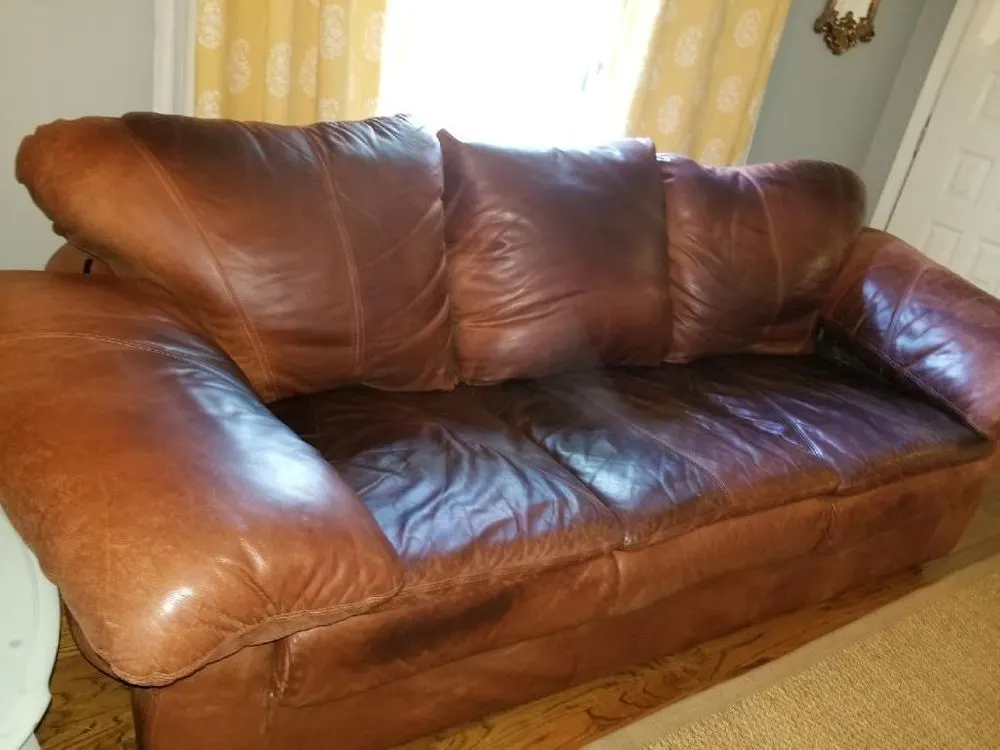
It is directional. The panels facing the window fade; the panels facing away do not. On a sectional this can produce a piece that is visibly two different colors.
It follows the light exactly, so you often see a hard line across a cushion where a piece of furniture or a curtain edge cast a shadow.
Aniline and semi-aniline leathers fade fastest, because the color is a dye in the hide with little pigment or topcoat protecting it.
Pigmented leathers hold up longer, since the color sits in a protective coating, and they still fade given a Texas west window and a few years.
Window film, and why it is the best answer
If one measure is going to be taken, this is the one, and it is worth explaining why.
A UV-filtering window film applied to the glass blocks the great majority of ultraviolet light, and the better films cut a significant portion of visible light and solar heat as well.
It works continuously without anyone remembering to do anything, which is its main advantage over blinds and curtains.
It protects everything in the room — leather, wood, textiles, artwork, flooring — rather than one piece.
It reduces solar heat gain, which lowers cooling costs and reduces the local heat load on furniture near the glass.
Clear films are available that change the appearance of the window very little, so it is not necessarily a visible modification.
The considerations are that some films are not suitable for certain glazing types, and a supplier should confirm compatibility rather than assuming. For a room with a serious west window and furniture worth protecting, it is the most cost-effective thing available.
Treatments, and how to use them properly
Blinds and curtains work, and only if they are closed at the right time, which is the practical weakness.
The hours that matter are the afternoon on a west window and the middle of the day on a south one. Closing them overnight achieves nothing.
Cellular and honeycomb shades do well because they block light and add insulation at the same time.
Sheer treatments diffuse light and reduce intensity without darkening the room, which is a reasonable compromise where a room needs to stay bright.
Exterior shading is the most effective of all — awnings, shutters, a pergola, or planting — because it stops the light before it reaches the glass and removes the heat as well.
Motorized or timed treatments solve the remembering problem, which is worth considering in a room nobody is in during the afternoon.
The honest note is that treatments only work as well as the habit behind them, which is why film is recommended first for rooms where the habit is unlikely.
The free measures worth doing anyway
Several of these cost nothing and they meaningfully slow the process.
Rotate loose cushions regularly — end to end and flipped where the construction allows. Fading still happens; it just happens evenly, which is far less noticeable than a hard line across one cushion.
Rotate or turn the whole piece a couple of times a year where the layout allows, so the same panel is not always facing the window.
Move furniture out of the direct light patch. Even a couple of feet makes a difference, since the intensity drops off with distance and angle.
Keep throws or covers over the exposed end when the room is not in use, which is unglamorous and effective.
Do not park a leather piece directly under a skylight, which is the hardest exposure in a house.
And keep in mind that the same window is heating that furniture as well as fading it, so moving it out of the light helps the drying problem at the same time.
What recoloring can put right
Faded leather restores well, and the outcome depends on the hide rather than on how far the color has gone.
The piece is cleaned thoroughly, and every trace of old conditioner, dressing and polish is removed, since nothing bonds through a silicone film.
Color is mixed to match — usually to the least faded area, or to whatever the owner wants the piece to be, since a full recolor is an opportunity to change it deliberately.
It is applied in thin coats that flex with the hide, then sealed with a topcoat.
The key decision is scope. Recoloring only the faded end of a sofa is possible and it rarely satisfies, because the unfaded end continues to fade and the match drifts apart again.
Doing the whole piece produces a uniform result and it costs less than twice as much, since preparation and color mixing are largely shared.
Where a room has several matching pieces at different exposures, doing them together is the only way to keep them matching afterward.
Fix the light before you fix the leather
This is the sequencing point that determines whether the money holds.
New color in the same light fades in the same way. A little slower, because a fresh topcoat offers some protection, and not by enough to change the outcome.
So the order is: control the light, then recolor.
Film, treatments or furniture placement first. Recoloring second, once the exposure is genuinely reduced.
That order also makes the color decision easier, because you are matching to a piece that is going to stay the color you choose.
If the light genuinely cannot be controlled — a wall of west-facing glass that is the reason the room exists — then it is worth choosing a more UV-tolerant material next time the furniture is replaced, and accepting a recoloring interval on what is there now.
Being told that plainly is more useful than a recoloring quote that does not mention the window.
Protectants and what they are worth
There are products marketed for UV protection on leather, and it is worth being realistic about them.
A conditioner with UV filtering offers some protection and it is genuinely better than one without, so if you are conditioning anyway, choosing one with UV filtering is free improvement.
It is not comparable to controlling the light. A surface treatment on furniture cannot approach what a film on the glass does, because the film addresses the whole exposure rather than adding a thin layer at the end of it.
Treat it as a supplement to the real measures rather than an alternative to them.
Reapplication matters, since these wear off with use and cleaning, and a product applied once a year is doing very little for most of that year.
Avoid heavy silicone-based dressings regardless. They build a film, attract dust, and complicate any future recoloring by leaving a surface nothing bonds to.
The short version: condition regularly with a product that includes UV filtering, and do not expect it to solve a window.
What to send for an assessment
Photograph the whole piece in daylight, and specifically capture both the faded and the unfaded areas in the same frame so the contrast is visible.
Photograph a hidden area — under a cushion, the back of a panel, beneath an arm — which shows the original color.
Photograph the room showing where the piece sits relative to the windows, which is what tells us whether the exposure has been controlled.
Say which direction the windows face and roughly when the sun reaches the furniture.
Say whether there is film, blinds or curtains, and whether they are actually used during those hours.
Press a thumb into the leather in the faded area and say whether it is still supple, since sun exposure dries as well as fades and the two often need addressing together.
And say whether other pieces in the room need to match, because that determines the scope more than the fading does.
Questions we get asked next
- Does window glass block the light that fades furniture?
- Only part of it. Ordinary glass blocks most short-wave UV but passes long-wave UV and the whole visible spectrum, and both of those fade pigment. That is why things fade behind windows that keep you from getting sunburned.
- Is window film worth the cost?
- For a room with west or south exposure and furniture worth protecting, it is the most cost-effective measure available. It works continuously with no habit required, protects everything in the room rather than one piece, and reduces solar heat gain at the same time.
- Can faded leather be restored to its original color?
- Yes, and it restores well provided the hide is still sound. The important decision is scope — recoloring only the faded end of a sofa rarely satisfies, because the rest keeps fading and the match drifts apart again. Doing the whole piece is the better spend.
- Should I recolor now or deal with the window first?
- The window first. New color in the same light fades the same way, only slightly slower, so recoloring before controlling the exposure means paying twice. Film or treatments first, recoloring second.
- UV fading
- windows
- recoloring