Why Do Leather Car Seats Crack in Texas Heat?
Car seats do not crack because the leather is poor quality. They crack because a closed vehicle in summer is the harshest place upholstery ever lives.
Quick answer
A closed car parked in summer sun reaches interior surface temperatures far above the outside air, every day for months. That heat drives plasticizers out of the finish and the hide, and leather that has lost plasticizer is stiff. Stiff leather cracks wherever it flexes — the seat cushion center, the bolster crown, the seam lines. UV through the glass degrades the finish at the same time. It is an environmental problem rather than a quality problem.
At a glance
| Mechanism | Heat drives plasticizers out; leather stiffens; stiff leather cracks where it flexes |
|---|---|
| Compounded by | UV through glass degrading the finish binder on the same panels |
| First to crack | Seat cushion center, bolster crown, seam lines, headrest fold |
| Timeline here | Years earlier than the same leather in a mild climate |
| Best prevention | Shade, a windshield screen, and conditioning three to four times a year |
What actually happens inside a parked car
A closed vehicle in direct sun works as a solar collector. Short-wavelength radiation passes through the glass, is absorbed by the interior surfaces, and is re-radiated at longer wavelengths that the glass does not let back out.
The result is that interior surfaces get considerably hotter than the outside air, and they stay hot for as long as the sun is on the car. Studies of vehicle interior heating consistently find substantial temperature rises within the first half hour of parking, with dark surfaces heating fastest.
In North Texas that happens on most days for much of the year, and it repeats: heat up through the afternoon, cool overnight, heat up again tomorrow.
So the seat is not experiencing one hot day. It is experiencing several hundred heating and cooling cycles a year, on top of being sat on.
Why heat makes leather crack
Leather stays flexible because of plasticizers in both the hide and the finish — compounds that let the material bend and recover instead of fracturing.
Heat drives those compounds out. They migrate to the surface and evaporate or are wiped away, and the higher the temperature the faster it happens.
Leather that has lost plasticizer is stiff. Stiff material does not crack on its own; it cracks when it is flexed. So the damage appears wherever the seat bends.
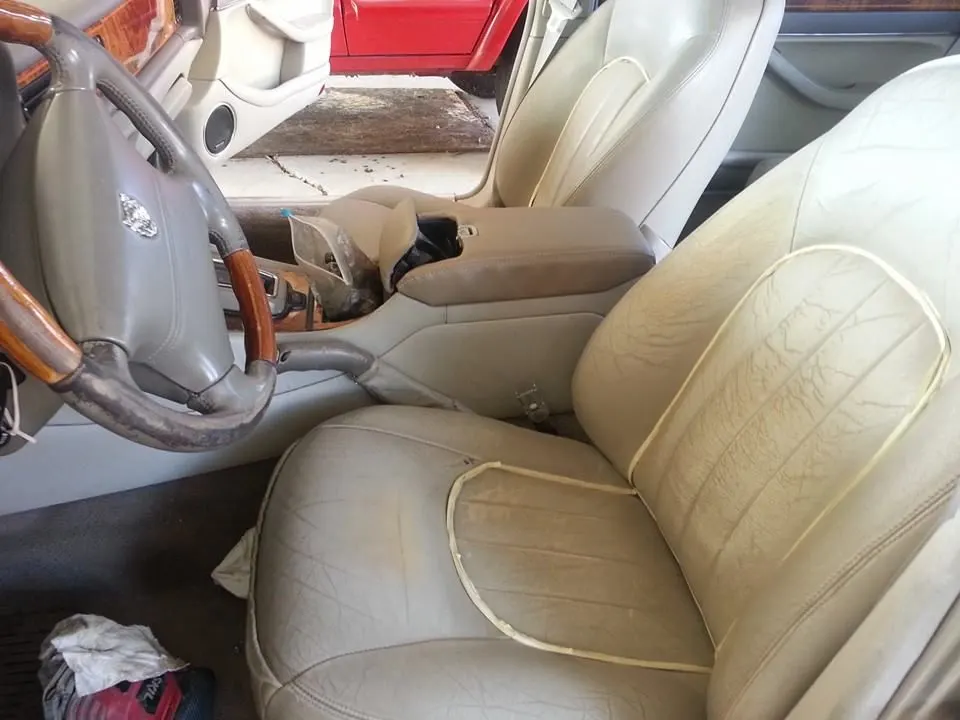
That is why cracking on a car seat is never random. It runs along the fold at the front of the cushion, along the crown of the bolster, beside the stitching lines, and across the crease behind a headrest — every one of them a place where the surface moves when someone sits down.
The hide also loses natural oils and fats through the same process, which is why old automotive leather feels papery rather than simply hard.
UV does the other half
Heat is not working alone, and the second mechanism is why the tops of surfaces fail before the sides.
Ultraviolet light breaks polymer chains. In a leather finish that means the binder holding the pigment and the clear topcoat both become less flexible and more brittle.
Ordinary automotive glass blocks most short-wavelength UVB but transmits a great deal of longer-wavelength UVA, which is entirely capable of doing this. The windshield in particular delivers a large dose to the tops of the front seats, the dash and the upper door panels.
So the panels that get the most sun are simultaneously the driest and the most brittle, which is why the top of a rear seat back or the shoulder of a front seat often shows fine cracking before the areas people actually sit on.
Fading is the visible early warning for this. A panel that has lost color has also lost binder flexibility, even though only the color change is obvious.
Where cracking shows up, in order
The sequence is consistent enough that you can inspect a car in two minutes and know where it stands.
Fine lines across the center of the seat cushion, running parallel to the front edge. This is the sharpest fold and the most-used surface.
The crown of the outer bolster, which combines a fold with the highest abrasion in the vehicle.
Beside seam lines, where stitching holes are stress concentrations and the material either side is held rigid.
The crease behind a headrest on seats where it adjusts.
The tops of rear seat backs and the shoulders of front seats — sun-driven rather than use-driven, which is how you tell them apart.
The pattern that means trouble is fine cracking appearing on a panel nobody touches. That is UV embrittlement rather than wear, and it indicates the finish across the whole interior is aging.
Why it is not a quality problem
Owners frequently conclude that their vehicle came with poor leather. Usually it did not.
Automotive leather is specified to a harder standard than furniture leather precisely because of this environment. The finishes are thicker, harder and more heat-resistant, and the hides are selected for consistency.
What defeats them is not a defect but a duty cycle no furniture ever faces. A sofa in a climate-controlled room lives at a fairly constant temperature. A car seat in this region cycles daily between comfortable and extreme.
The comparison worth making is between two identical vehicles: one garaged, one parked outside. The difference in interior condition at seven years is usually dramatic, and nothing about the leather differed.
That is also the encouraging part, because it means the variables that matter are ones an owner can influence.
What actually slows it down
In order of effect rather than convenience.
Shade. Parking in a garage, a carport or under cover removes most of the heating and most of the UV. It is by a wide margin the most effective thing available and it costs nothing.
A windshield sunshade. The windshield is the largest glass area and it points at the dash and the front seats. A reflective screen reduces the peak interior temperature noticeably and takes ten seconds to place.
Conditioning three to four times a year. This does not stop plasticizer loss, but it replenishes flexibility in leather that is still sound, which is what determines whether stiffness turns into cracking. In this climate it is not optional maintenance.
Cracking a window slightly where security allows, which reduces the peak temperature by venting the hottest air.
Window film within legal tint limits, which reduces both heat gain and UV transmission through the side and rear glass.
Cleaning on schedule, every four to six weeks, because soil is abrasive and abrasion thins the topcoat that is protecting everything underneath.
What does not help
A few common responses waste money or cause a second problem.
Silicone-heavy dressings. They produce a glossy look that owners associate with protection, they attract dust, they make seats slippery, and they contaminate the surface so any later repair needs extra preparation.
Kitchen oils. They do not absorb through a finished surface, they go rancid in a hot cabin faster than anywhere else, and they leave a smell that does not wash out.
Conditioning a surface that has already cracked, in the hope of closing the cracks. Conditioner cannot bridge a split. It is worth doing to protect the remaining sound material, but it will not undo what has happened.
Heavy seat covers left on permanently in summer, which trap heat against the leather rather than shielding it, and hold moisture after any spill.
And leaving the air conditioning to do the work on arrival. By the time the cabin cools, the surfaces have already had their several hours at temperature.
Catching it at the stage that is cheap to fix
There is a window where this is inexpensive, and it closes quietly.
Press a thumb firmly into the seat cushion at the fold line, hold for a second, release, and look closely with the door open in daylight.
Supple leather deforms with fine wrinkling and recovers. Nothing needed beyond normal conditioning.
Stiff but sound leather feels board-like with no cracks appearing. This is the point at which conditioning genuinely works and the whole problem can be deferred for years.
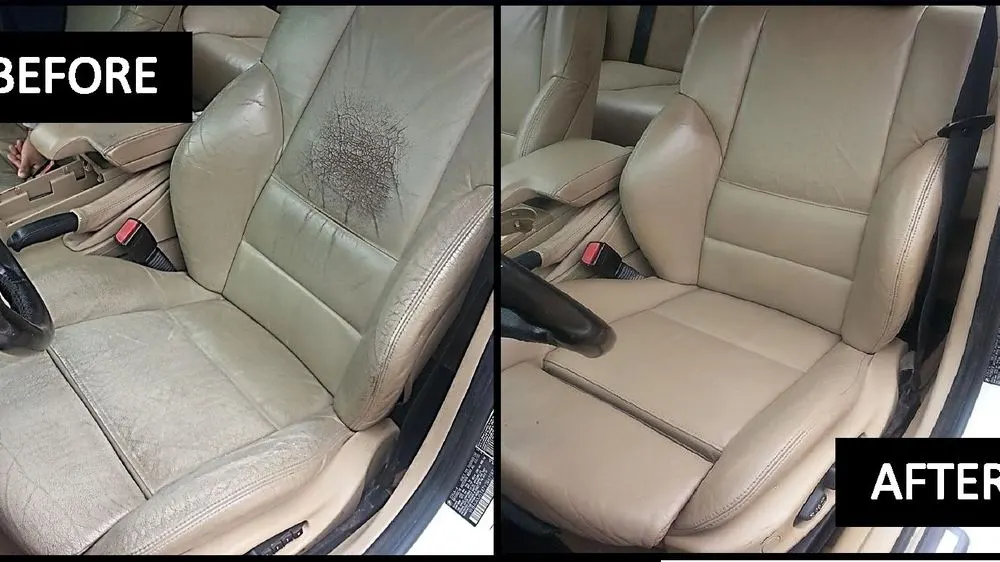
Fine cracks that stay after you release mean the finish has split. That panel now needs filling, texturing and refinishing rather than maintenance.
Flaking or powdering onto your thumb means the finish has aged out and the panel needs rebuilding.
Do this on the driver's seat, a rear seat, and the top of a seat back. The difference between them tells you how much is use and how much is sun.
How cracked automotive leather is repaired
Early cracking repairs well and the result is genuinely invisible on most vehicles.
The panel is cleaned and degreased. Car interiors accumulate sunscreen, hand lotion, sanitizer and protectant sprays, and none of those let a finish bond.
Any lifted edges are stabilized, and flexible filler is worked into the splits and built in thin layers until it is level with the surrounding surface.
Grain is pressed into the final layer to match the surrounding texture. Automotive leather is embossed, so the pattern repeats and matches convincingly.
Color is mixed against the actual leather, sprayed in thin coats and feathered well beyond the repair.
An automotive-grade topcoat seals it — formulated for the surface temperatures, UV load and abrasion that furniture finishes never face.
Where cracking is widespread across a panel rather than in a few lines, the whole panel is treated at once, which produces a far better result than chasing individual cracks.
Getting it assessed
Open the door and photograph in daylight without flash. Car interiors are dim, and flash flattens exactly the fine cracking that needs to be seen.
Take one shot of the whole seat, one square-on of the cracked area from about a foot away, and one from a low raking angle across the surface — that last one is what reveals whether the cracks are still within the finish or have opened into the hide.
Do the thumb press on an apparently sound area nearby and photograph the result, since that shows how much of the interior is close behind.
Photograph a rear seat or another panel for comparison.
Say what the vehicle is, roughly its age, whether it is parked outside or garaged, whether the seats are heated or ventilated, and whether there is an airbag tag on the outboard edge of the seat back — damage on or beside that seam belongs to a trim shop working to the manufacturer's specification rather than to a cosmetic repair.
Questions we get asked next
- My car is only five years old and the seats are already cracking. Is that normal here?
- Unfortunately yes, for a vehicle parked outside. Interior surfaces in a closed car in Texas summer sun cycle to temperatures no furniture experiences, several hundred times a year. Garaged vehicles of the same age and model routinely show none of it, which is the clearest evidence that it is the environment rather than the material.
- Will conditioning close cracks that are already there?
- No. A crack is a break in the finish and conditioner cannot bridge it. What conditioning does is keep the surrounding sound material flexible so the cracking spreads more slowly, which is worth doing — but the existing splits need filling, texturing and refinishing.
- Is a windshield sunshade actually worth using?
- Yes, and it is the highest-return item on the list after covered parking. The windshield is the largest glass area and it faces the dash and front seats directly. Reducing the peak surface temperature they reach every afternoon slows plasticizer loss measurably.
- Do ceramic coatings or leather sealants prevent this?
- A good protective topcoat applied during refinishing slows UV degradation of the finish and is worth specifying while the surface is being rebuilt anyway. Nothing applied to the surface changes the temperature the cabin reaches, which is the primary driver — so shade does more than any product.
Sources
- Heatstroke Prevention: Vehicle Interior Heating — U.S. National Highway Traffic Safety Administration, checked 2026-08-21
- cracking
- heat
- car seats