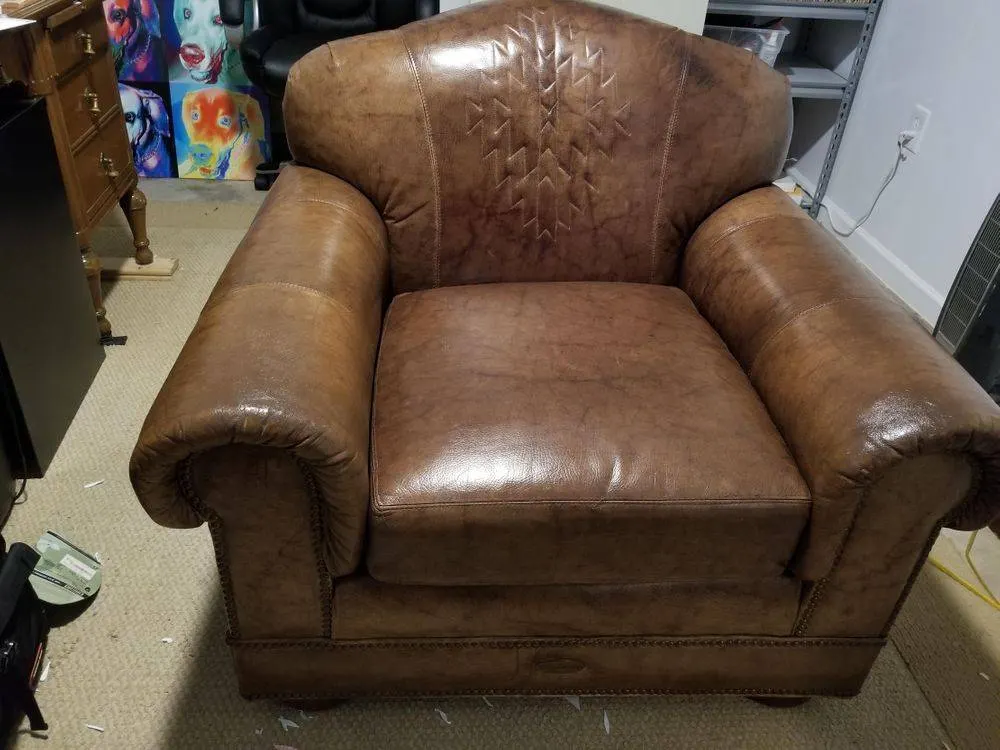
What Dallas Heat, Sun and UV Do to Leather Over Time
Fading and cracking are not two separate problems. They are the same process at two stages, and the panel that faded first is the panel that will crack first.
Quick answer
Ultraviolet light breaks down two things at once: the pigment that gives leather its color, and the binder that holds the finish together and keeps it flexible. Pigment loss shows first, as fading. Binder loss shows second, as stiffness and then cracking at fold lines. That is why the sun-facing end of a sofa is always both the palest and the first to crack — the same exposure caused both, and the fading was the early warning.
At a glance
| Stage 1 | Pigment breaks down — the panel fades and loses depth |
|---|---|
| Stage 2 | Binder breaks down — the finish stiffens and loses flexibility |
| Stage 3 | Cracking at fold lines, starting on the panel that faded first |
| Worst exposure | West and south-facing windows, long afternoon season |
| Cheapest fix | Acting at stage 1, when it is still a recoloring job |
Two kinds of damage from one source
Sunlight does two separate things to a leather finish, and understanding that they are linked explains almost every pattern of sun damage people describe.
The first is pigment degradation. The colorants in a finish absorb UV energy, and that energy breaks the molecules apart. Less intact pigment means less color reflected, so the panel looks lighter and flatter.
The second is binder degradation. The pigment is held in a polymer binder, and the topcoat over it is polymer too. UV breaks polymer chains, which makes both layers less flexible and more brittle.
Pigment loss is visible early because color is easy to see. Binder loss is invisible until it produces a symptom — stiffness you notice by touch, then cracking you notice by sight.
So a faded panel is not just a cosmetic problem. It is a panel whose finish has also lost flexibility, which is why it cracks before its neighbors do.
Why North Texas is harder on leather than most places
The relevant factors are exposure duration and intensity, and this region has both.
The sun season is long. Strong afternoon sun through west and south-facing glass runs for the majority of the year rather than a few months.
Modern homes here have a lot of glass, and open-plan layouts mean furniture is often positioned in the brightest part of a room rather than tucked away from it.
Ordinary window glass blocks most short-wavelength UVB but transmits a great deal of longer-wavelength UVA, which is entirely capable of degrading pigments and polymers. Being indoors is far less protective than people assume.
And ambient heat compounds it. Chemical degradation reactions run faster at higher temperatures, so the same UV dose does more damage on a hot surface than a cool one. A sun-facing panel in August is both irradiated and hot.
The pattern this produces
Sun damage is diagnostic because it follows light rather than use, and the geometry is usually obvious once you look for it.
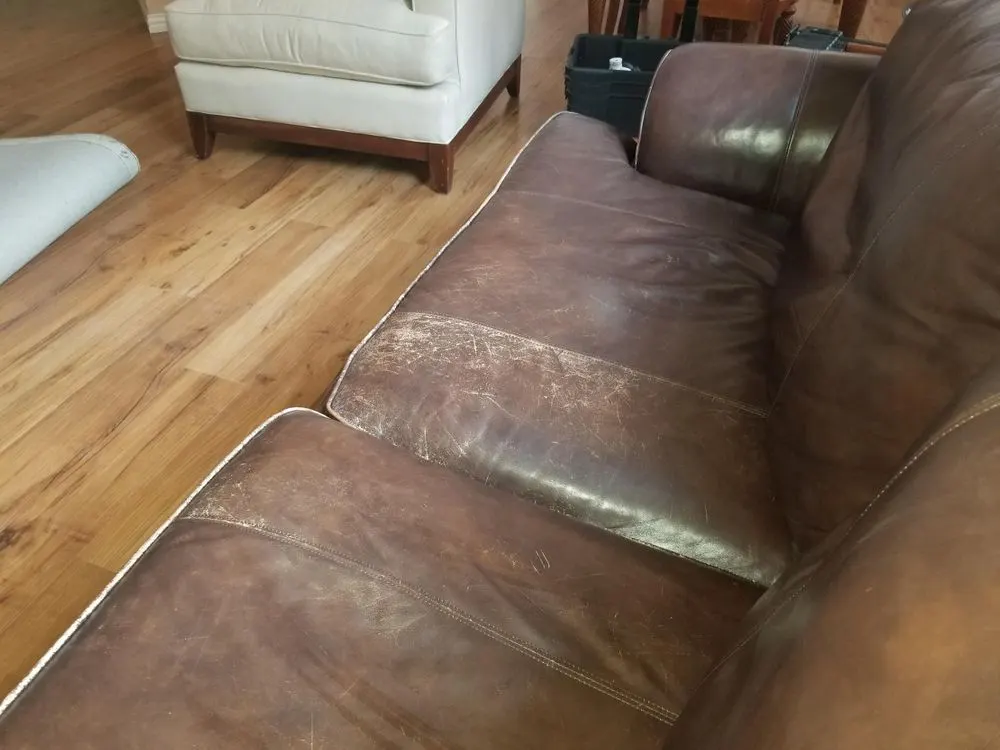
One end of a sofa noticeably lighter than the other, with a gradient in between, corresponding to a window off to one side.
The tops of seat backs and the upper surfaces of arms fading while the fronts and undersides stay closer to original, because the light comes from above.
A rectangle or a diagonal band of fading where the sun tracks across a piece at a particular hour.
In vehicles: the tops of rear seat backs, the tops of front seat shoulders, the top of the dash, and the upper part of the door cards — all the surfaces angled toward glass.
The distinguishing feature against wear is that sun damage appears on surfaces nobody touches. If the outside back of a sofa has faded, that is not use.
Why the color shifts rather than just lightening
People often describe faded leather as having changed color rather than gotten paler, and that observation is correct.
Finishes are rarely a single pigment. A black is usually built from several, a brown from several more, and they do not degrade at the same rate.
As the less stable components break down first, what remains is the more stable balance — which is a different color, not a diluted version of the original.
In practice: black tends toward gray or a brownish cast, dark brown tends toward orange or red, and navy tends toward a dusty purple.
This is why matching a repair to a faded panel is a mistake. You are not matching a lighter version of the original color; you are matching a different color that will keep shifting.
Vehicles: the extreme case
A car parked outside in this region is the harshest environment leather encounters short of being left outdoors.
Interior surfaces in a closed vehicle in direct summer sun reach temperatures far above the outside air, and they do it every day for months.
The glass area is enormous relative to the interior volume, and much of it is angled to catch the sun directly. The windshield alone delivers substantial UV to the dash, the tops of the front seats and the upper door panels.
The cycle repeats daily: heat up through the afternoon, cool overnight, repeat. Thermal cycling works the material mechanically as well as chemically.
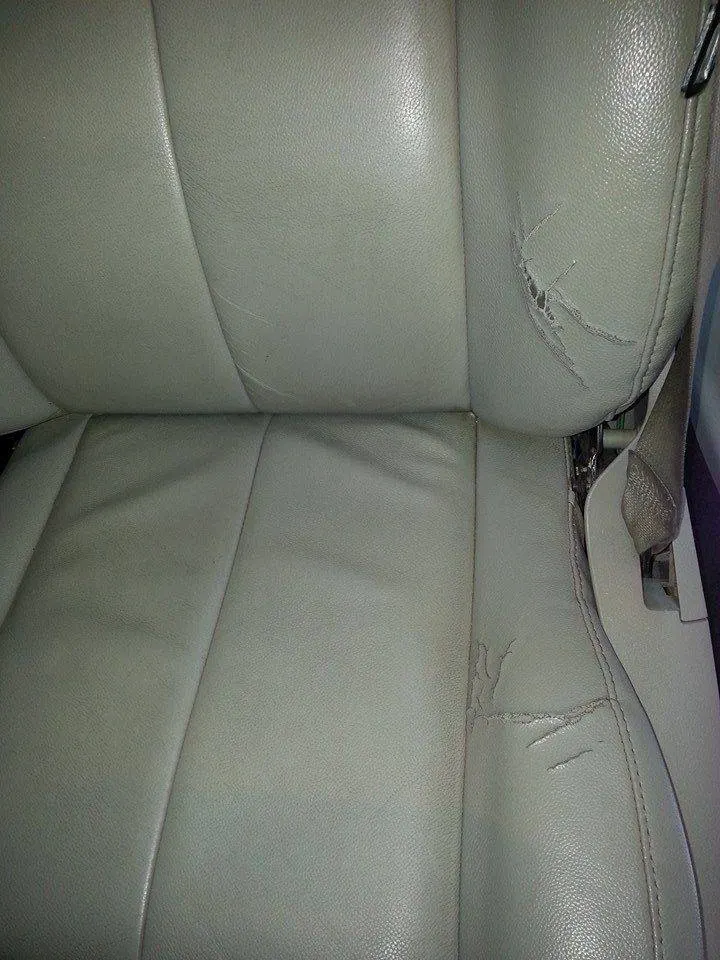
The result is that automotive leather reaches the cracking stage years earlier than equivalent furniture. A driver's seat bolster that is faded, stiff and abraded is the standard presentation, and it is three problems from one cause.
Catching it at the fading stage
This is where the money is, because the difference between the two stages is substantial.
At the fading stage, the finish is intact — it has lost color but not integrity. The work is cleaning, stabilizing and recoloring, and it is a straightforward job with a reliable result.
At the cracking stage, the same panel needs filling and texturing as well, because the coating has split and sometimes the hide beneath has too. More stages, more time, more cost.
The window between them is not long. On a heavily exposed panel in this climate it can be a single summer.
The practical check: once a panel has visibly faded, press a thumb firmly at a fold line and look under raking light. No cracks means you are still at stage one and should act. Fine cracks means the window has closed and the scope has grown.
What actually reduces the damage
In order of effectiveness rather than convenience.
Move the piece, or move the light. Repositioning furniture out of the direct afternoon path is free and it is the single most effective measure. Where that is not possible, sheer blinds or a shade during the strongest hours make a real difference.
Window film. UV-blocking film on residential glass reduces transmitted UV substantially and is one of the few interventions that addresses the cause rather than the symptom. It is worth considering in a room that has already cost you one refinish.
A UV-aware topcoat during any refinishing work. It does not stop the process, but it slows it, and it costs little to specify when the surface is being rebuilt anyway.
Conditioning on schedule. This does not affect pigment loss at all, but it keeps the finish supple, which is what determines whether binder loss turns into cracking. Two to three times a year for furniture, three to four for vehicles.
Rotating cushions so exposure spreads across panels rather than concentrating on the same two.
For vehicles: park in shade, use a windshield shade, and consider automotive window film within legal tint limits.
What does not help
A few common responses do nothing useful or cause a second problem.
Conditioner does not restore faded color. It darkens a panel temporarily while wet, then dries back. Judging it by the ten-minute result is why the myth persists.
Cleaning does not restore faded color either. If cleaning a hidden area brings the depth back, the problem was soil rather than fading — which is a good outcome and worth testing for, but it does not mean cleaning fixes fading.
Plastic covers trap heat and moisture against the surface, producing a tacky finish and sometimes mold. Breathable covers are fine; plastic is not.
Leaving a piece in the sun to even out the fading does exactly what it sounds like, plus accelerates the binder loss across the whole piece.
And matching a repair to the current faded shade locks the damage in permanently, which looks acceptable now and wrong the moment anything else changes.
Materials that suffer most
Not everything degrades at the same rate, and it is worth knowing where your piece sits.
Aniline and semi-aniline leather fades fastest, because the color is dye in the hide with little or no protective pigment layer above it. It also cannot be recolored without converting it to a pigmented finish, so the options after damage are narrower.
Dark pigmented colors show the largest visible change, because there is more pigment to lose and the components degrade unevenly.
Light pigmented colors fade less visibly but yellow over time as the binder degrades, which reads as a warm cast rather than a loss of depth.
Vinyl and PU degrade too, becoming chalky and brittle rather than simply fading. Marine and outdoor-adjacent vinyl is formulated for it; interior furniture vinyl is not.
Bonded leather in strong sun fails fastest of all, because heat accelerates the adhesive failure that was going to happen anyway.
Getting a sun-damaged piece assessed
Photograph the whole piece in flat daylight from a few feet back, positioned so both the faded and unfaded areas appear in the same frame. That single image communicates the gradient better than any description.
Take close-ups of the most faded area and the least faded area from the same distance in the same light.
Check the faded panel for fine cracking at fold lines and photograph that at a low raking angle if it is there.
Photograph the room showing the window relative to the furniture. It sounds unnecessary and it genuinely informs the recommendation about topcoat and about whether anything should change before the work is done.
And say how long the piece has been in that position, and whether anything about the room's light has changed — new windows, removed curtains, an added skylight. Owners usually date the damage from when they noticed it rather than from when the exposure started.
Questions we get asked next
- Does window glass protect furniture from UV?
- Only partly. Ordinary glass blocks most short-wavelength UVB but transmits a great deal of longer-wavelength UVA, which degrades pigments and polymers perfectly well. UV-blocking window film is what actually reduces the exposure meaningfully.
- Is fading covered by a furniture warranty?
- Rarely. Most manufacturers exclude damage from direct sunlight explicitly, on the reasonable grounds that placement is the owner's choice. It is worth reading the terms, but plan on it being an owner's cost.
- Can a faded panel be matched to the rest without recoloring everything?
- It can be matched to its current faded shade, and that is usually a mistake — it locks the fading in permanently. Matching to the original depth means bringing the faded panel back up, which typically means blending into neighbors and often recoloring the whole piece for an even result.
- How long before a recolored piece fades again?
- It depends entirely on what changed. Back in the same position with no shading, expect a similar timeline to the first time. Moved, shaded, or behind UV film, with a UV-aware topcoat and regular conditioning, it holds its color for many years.
Sources
- Ultraviolet Radiation and the Degradation of Polymeric Materials — National Institute of Standards and Technology, checked 2026-08-21
- UV damage
- heat
- Texas climate