Can Worn Piping and Rubbed Edges on Leather Cushions Be Rebuilt?
Piping is the first thing to go on most leather furniture and the last thing anyone thinks to ask about.
Quick answer
Yes, and there are two routes. Where the leather over the piping is thin or scuffed but intact, the edge is rebuilt with flexible filler, texture-matched and recolored — restoring the profile as well as the surface. Where the leather has worn through and the cord beneath is exposed, that run of piping is usually best replaced in matching leather, which is a defined upholstery job rather than a whole-cushion rebuild.
At a glance
| Why it goes first | Piping stands proud and takes contact before the panels do |
|---|---|
| Thin but intact | Rebuilt with filler, textured and recolored |
| Worn through | That run of piping is replaced in matching leather |
| It is a profile | The repair restores shape, not just color |
| Catch it early | Once the cord is exposed it deteriorates quickly |
Why piping wears first
On almost every piece of leather furniture, the piping is in worse condition than the panels it separates, and the reason is geometry.
Piping is a cord wrapped in leather and sewn into a seam. It stands proud of the surrounding surface.
That means it makes contact first with everything — hands, clothing, bags, vacuum cleaners, pets, the wall, the coffee table.
The leather over it is also stretched around a curve, so it is thinner there than it is on the flat.
And it is a seam, so the material is perforated by stitching along both sides of it.
Thin stretched leather over a raised profile, taking every contact, perforated on both edges. It is a wonder it lasts as long as it does.
The result is that a sofa can have perfectly good panels and piping that has gone silver, thin, or through to the cord.
Where it wears, in order
The pattern maps onto how people move around furniture.
The front edge of the seat cushion, which takes the backs of legs on every sit and every stand.
The front top edge of the arms, where hands push down to get up.
The outer corners of the seat cushions, which catch on everything.
The leading edge of a chaise or an ottoman.
The bottom rail piping, which meets vacuum cleaners, shoes and pets.
And the outside back piping on a floating piece, which takes wall contact.
Interior piping — between back cushions, on the inside of arms — usually stays perfect, which is why a comparison there shows exactly what the worn runs used to look like.
The three stages of wear
Knowing which stage you are at determines both the repair and the cost.
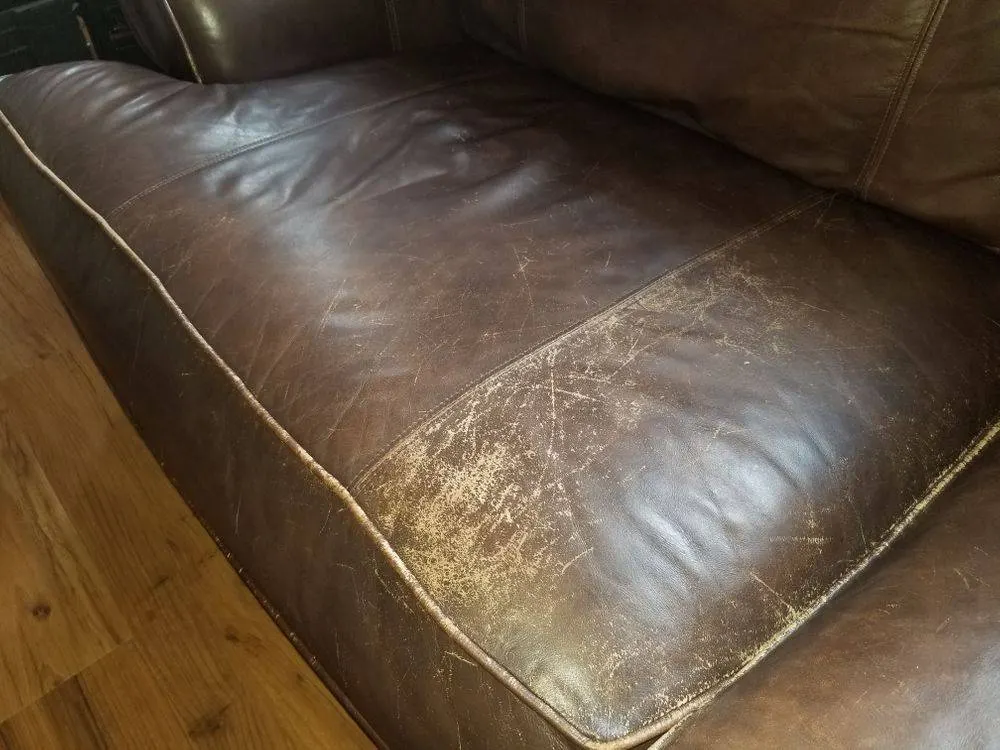
Stage one is finish wear. The color has rubbed thin along the crown of the piping, showing lighter or a different tone, and the leather is intact. This is the cheapest and most satisfying stage to address.
Stage two is leather thinning. The hide itself is worn down over the cord — often feeling smoother or slicker than the surrounding leather, sometimes with a slight sheen. Still repairable by rebuilding.
Stage three is breakthrough. The leather has worn through and the cord is visible, or the covering has split along the piping. At that point the material is gone and rebuilding with filler is bridging a hole.
Between two and three there is often a period where the leather is paper-thin and about to go, which is the moment to act.
The practical implication: piping caught at stage one or two is a modest job, and piping at stage three is a replacement.
Rebuilding a worn edge
This is the repair for stages one and two, and it differs from flat-panel work in one important way.
The area is cleaned and degreased, since piping collects hand oils along its whole length.
Any loose or lifting finish is removed back to a firmly attached edge.
Then the profile is rebuilt. This is the part that distinguishes piping work: filler is applied in thin layers not simply to level a surface but to restore the rounded shape of the cord beneath.
A rebuilt piping run that is flat rather than rounded reads as wrong even when the color is perfect, because the light no longer runs along it the way it does on the intact runs.
Texture is matched to the surrounding grain.
Color is mixed to the piece as it is now, applied in light coats, and sealed with a flexible topcoat.
And because piping flexes and takes contact, the thin-layer discipline matters as much here as on a recliner footrest.
Replacing a run of piping
For stage three, this is the durable answer and it is less drastic than it sounds.
The affected run is unpicked from the seam, the old covering is removed from the cord, and a new strip of matching leather is cut and wrapped.
The cord itself is usually reused unless it has been damaged.
The new piping is sewn back into the original seam line, following the existing stitch holes where the material allows.
The result on that run is new material with no repair in it.
The consideration is color match. New leather beside panels that have aged for years will differ, so the new piping is usually recolored to match the piece as it is now rather than left as it came.
On a cushion where several runs are worn, doing them together is considerably cheaper than one at a time, since the setup and the material are shared.
Rubbed edges without piping
Not every piece has piping, and unpiped edges wear in a related way that needs the same thinking.
A knife-edge or waterfall cushion has a folded edge that takes the same contact without a cord underneath.
Rolled arms wear along the crown of the roll.
Box-edge cushions wear at the corner where two planes meet.
In all of these the leather is stretched over a curve and takes contact first, so it thins and then breaks through exactly as piping does.
The repair is the same in principle: rebuild the profile with flexible filler in thin layers, match the texture, recolor.
Where it has worn through, a let-in piece of matching leather or a panel replacement is the route.
The key point is the same throughout: these are shape repairs, and a repair that restores color without restoring the profile still looks worn.
Why catching it early matters here
Piping has a sharper progression than most damage, which makes timing unusually worthwhile.
At stage one, the leather is intact and the repair is essentially refinishing along a line.
At stage two it is thinning, and the repair rebuilds material as well as color.
Once it breaks through, three things happen quickly. The exposed cord absorbs dirt and moisture. The leather either side of the opening is unsupported and begins to split along the stitch line. And the seam itself starts to fail because the covering is no longer holding the profile.
So a run that would have been a modest refinishing job becomes a piping replacement plus seam work within a season or two.
The useful habit is running a hand along the piping on the front of the seat cushions and the tops of the arms once or twice a year, feeling for thinning rather than looking for it.
Thin piping feels smoother and slicker than sound piping, and it feels that way well before it looks obviously worn.
Scope and matching across the piece
Piping runs are visually connected in a way that panels are not, and that affects the scope decision.
The eye follows piping around a piece of furniture. It is the line that defines the shape, which means an inconsistency along it is more noticeable than the same inconsistency on a flat panel.
So a single refinished run between two worn runs stands out more than you would expect.
The usual sensible scope is all the piping on a cushion, or all the piping along a continuous line — the front edges of all the seat cushions, for example — rather than the single worst run.
Where panels are also being recolored, doing the piping at the same time is far cheaper than separately and produces a consistent result.
And on a piece where the piping is worn but the panels are sound, piping-only work is a legitimate and modest job that transforms how the piece reads.
That last case is worth knowing about, because owners often assume a tired-looking sofa needs full recoloring when the piping is doing most of the damage to its appearance.
Slowing it down afterward
Piping wear is contact wear, so prevention is about reducing contact and keeping the leather supple.
Condition on a schedule, and work it into the piping specifically. Supple leather stretched over a cord resists abrasion far better than stiff leather does, and the piping is the part most likely to be missed when someone conditions a sofa quickly.
Vacuum along the piping rather than across it, and use a brush attachment rather than a hard nozzle. Vacuum damage to piping is more common than people realize.
Keep the piece a few inches off walls, so back and side piping is not rubbing.
Consider a throw over the front edge of the seat that gets the most use, which is where the worst run always is.
Move bags and hard objects off the arms.
And rotate cushions, since the front edge of a rotated cushion becomes the back edge for a while.
What to send for an assessment
Photograph the worn run along its length, and again close up at a raking angle so the profile and the thinning are visible.
Photograph an intact run on the same piece — inside an arm, between back cushions — for comparison.
Run a finger along the worn run and say whether it feels smoother or slicker than the sound piping.
Say whether the cord is visible anywhere, even a short section, since that changes the repair from rebuild to replacement.
Say whether the leather has split anywhere along the stitch line.
Photograph all the piping runs on the piece, since scope is usually decided by consistency rather than by the worst spot.
Say whether the panels also need attention, because doing both together is substantially cheaper.
And say how old the piece is and whether it has been conditioned, which predicts how the rest of the piping will behave.
Questions we get asked next
- Can worn piping be repaired, or does the cushion need recovering?
- Repaired, in most cases. Where the leather over the cord is thin or scuffed but intact, the profile is rebuilt with flexible filler, textured and recolored. Only where it has worn through to the cord does that run get replaced — and that is a defined job, not a whole-cushion rebuild.
- Why does my piping look worn when the panels look fine?
- Because it stands proud of the surface and makes contact first with everything, and the leather is stretched thinner over the cord. It is also perforated by stitching on both sides. Piping wearing out first is the normal pattern rather than a fault.
- Is it worth doing just the piping?
- Often, yes. The eye follows piping around a piece, so worn runs make a sofa look far more tired than the panels justify. Piping-only work is a modest job that can transform how a piece reads, and owners frequently assume they need full recoloring when they do not.
- How do I tell if my piping is about to go?
- Feel it rather than look at it. Run a finger along the front edge of the seat cushions and the tops of the arms — thinning piping feels smoother and slicker than sound piping, and it feels that way well before it looks obviously worn.
- piping
- edges
- upholstery repair