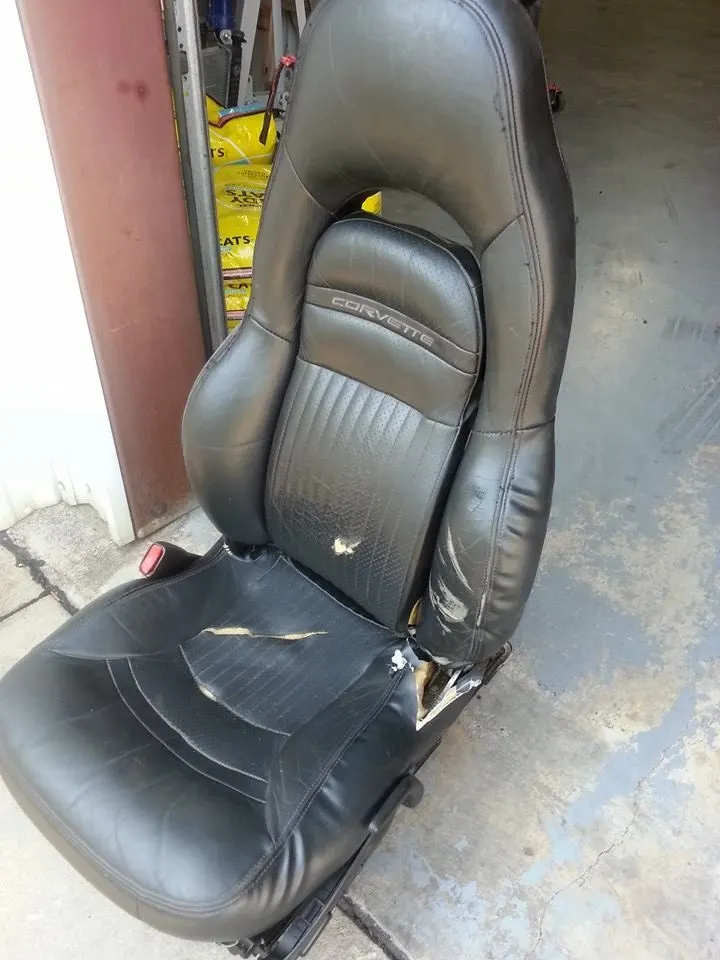
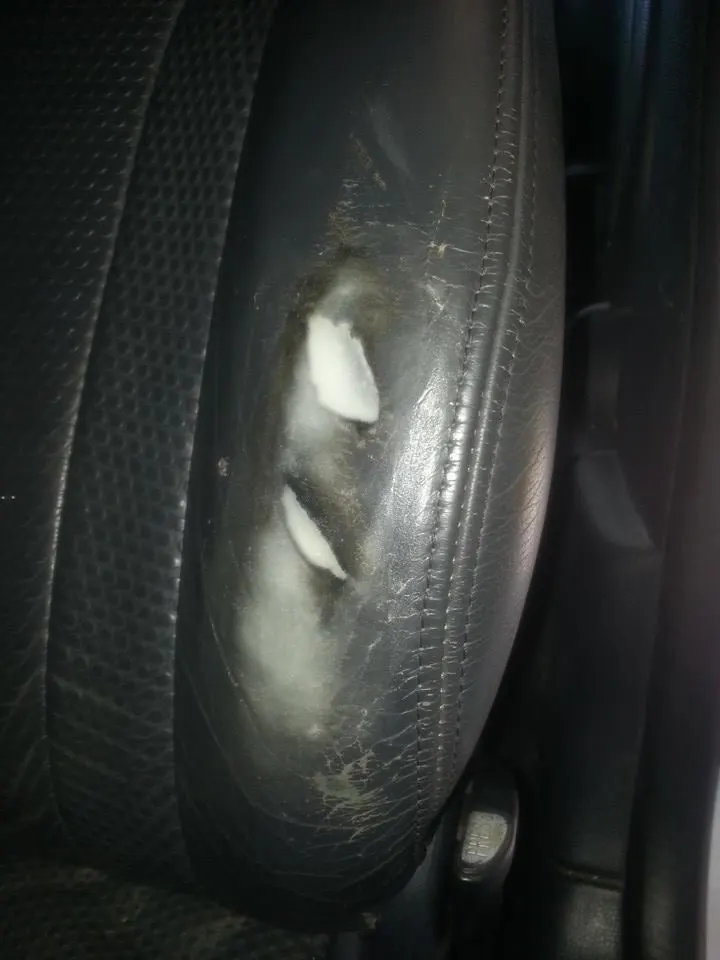
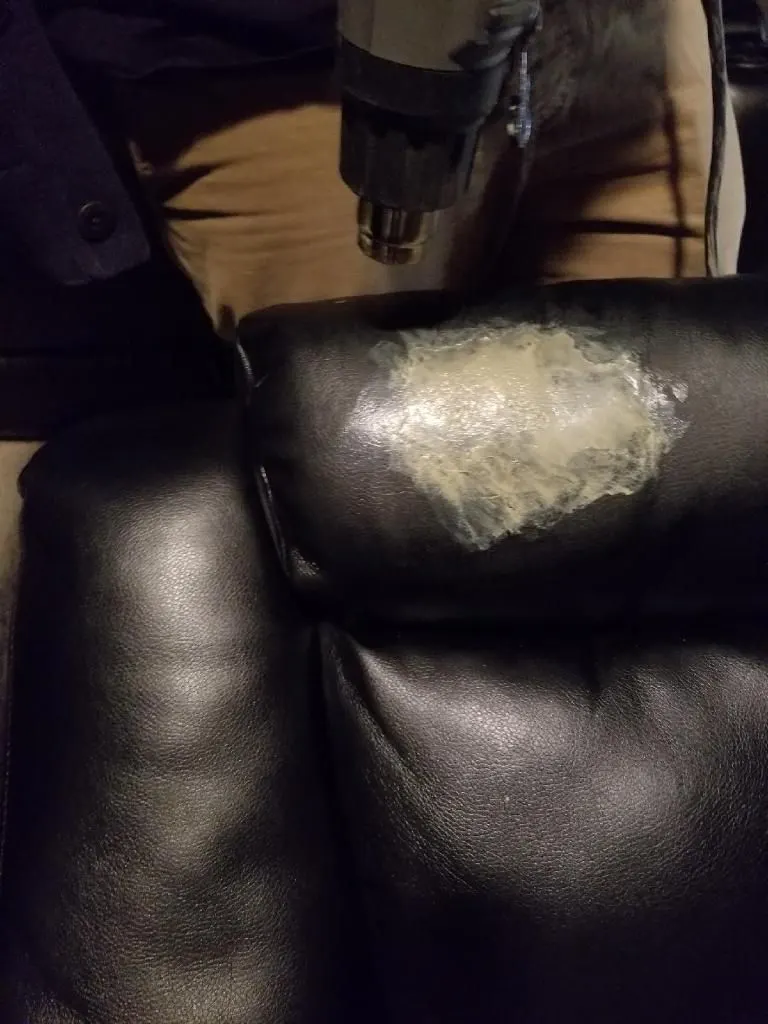
Can a Cigarette Burn or Small Hole in a Leather Couch Be Repaired Invisibly?
A burn the size of a pea needs a repair the size of a coin. That surprises people, and it is the reason burn repairs last.
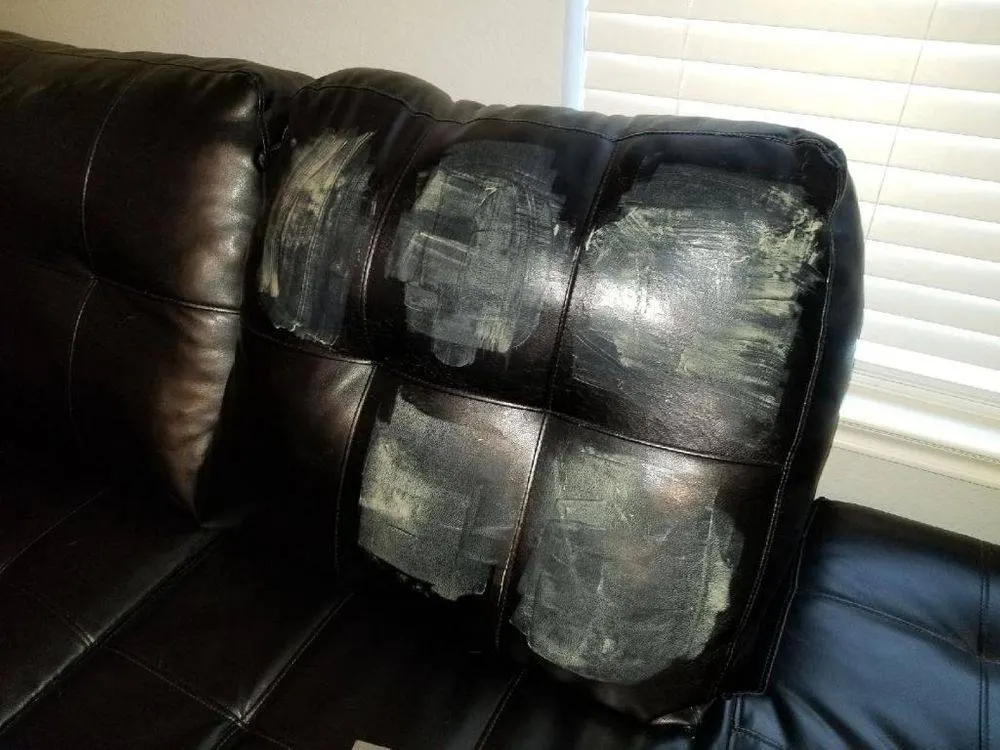
Quick answer
Usually, on sound leather. The charred rim has to be cut back to healthy material first, because burnt leather has no strength and nothing bonds to it — which is why the finished repair area is always bigger than the burn was. A backing goes in behind the hole, the void is filled in thin flexible layers, the grain is matched and the area is recolored and sealed. Done properly on a flat panel, most burn repairs cannot be found afterward.
At a glance
| Repair area | Always larger than the burn — char must be removed |
|---|---|
| Best outcome | Flat panel, sound leather, isolated burn |
| Harder | Burns on edges, piping, seams or shaped areas |
| Also affected | Heat discolors the leather in a ring around the burn |
| Check underneath | Deep burns melt into the foam as well |
What a burn does to leather
It helps to know what has actually happened, because it explains every part of the repair.
Leather is a protein structure. Heat denatures it — the collagen fibers shrink, harden and eventually char.
The center of a burn is carbonized material with no strength. It is not damaged leather, it is a different substance.
Around that is a ring of heat-affected leather that looks intact and has been stiffened and weakened.
Around that is a wider ring of discoloration, where the finish has been scorched or the color has changed without the hide being structurally harmed.
The finish itself may have melted or bubbled, which is why burns often have a raised, glazed rim.
And on a cushion, the heat frequently goes further than the visible mark — into the foam beneath, which is worth checking before anything is quoted.
Why the repair is bigger than the burn
This is the part that surprises owners and it is not padding in the estimate.
Nothing bonds to char. Filler applied over carbonized leather adheres to a crumbly layer that is itself not attached to anything, so the repair lifts at its edges within weeks.
So the charred material is cut away entirely, back to leather that is sound.
The heat-affected ring usually has to go too, since stiffened weakened leather at the edge of a repair is where the next failure starts.
That means a burn the size of a pea commonly becomes a working area the size of a coin, and a larger burn scales accordingly.
It is the same principle as any structural repair: you build on sound material or you build twice.
A quote that promises to fill a burn without removing anything is quoting a repair that will fail, and it is worth asking specifically how the char will be dealt with.
The discoloration ring
Often overlooked at the quoting stage and it is what makes a technically good repair still look wrong.
Heat changes leather color well beyond where it chars. On a tan sofa a burn often has a darkened halo; on a dark sofa the halo can be lighter.
That ring is not removable by cleaning, because the color change is in the finish and sometimes in the hide.
So a repair that rebuilds the hole perfectly can sit in the middle of a discolored patch, which reads as damage even though the hole is gone.
The answer is to recolor out to the seam lines rather than only over the repair, so the discoloration is covered along with the fill.
That is why burn repairs are usually quoted as panel work rather than as spot work.
On a light-colored piece the ring is more visible and the case for whole-panel recoloring is stronger.
The repair, step by step
The sequence is standard, and each stage has a reason.
The area is cleaned and degreased. A seat or arm carries body oils, and nothing bonds through them.
The char and the heat-affected material are cut back to sound leather, with the edges cleaned so filler has something to key into rather than a crumbly rim.
A backing material is inserted through the opening and bonded beneath it, spanning well past the hole on all sides. This is what gives the repair its strength — filler alone is a surface, not a structure.
Filler is built in thin flexible layers, each allowed to set, until it is level with the surrounding leather. A single thick fill shrinks against its own skin and cracks.
The grain is matched to the surrounding texture using an embossing, so the area does not read as a smooth patch.
Color is mixed to the piece as it is now, applied in light coats, and sealed with a flexible topcoat at a matched sheen.
Then it cures before the panel takes weight or friction.
Check the foam before you quote
Deep burns are not only a surface problem, and finding this out afterward is expensive.
A cigarette resting on a cushion can burn through the leather and into the foam beneath, leaving a cavity.
Filling the leather over a void means the repair is bridging a hole with nothing supporting it, and it will dish or crack under the first weight.
So the foam is checked through the opening, and any damaged foam is removed and the void built up before the surface is rebuilt.
There is also a smell consideration. Burnt foam retains an odor that surface work does not address, and on a larger burn the affected foam should come out rather than be covered.
Press around the burn and feel for softness or a dip that does not match the rest of the cushion.
On a cushion with a removable cover this is easy to inspect; on a fixed panel it is assessed through the opening.
Where burn repairs go well and where they do not
Location matters more than size, which is not obvious.
A burn in the middle of a flat panel is the best case. There is sound leather all around it, the surface is flat, and the repair has room to be built and blended within the panel.
A burn on a seat cushion top is nearly as good, with the caveat that it flexes, so the thin-layer discipline matters.
A burn on an edge or a rolled arm is harder, because the repair has to rebuild a curve as well as a surface.
A burn on piping or welting is harder still — piping is a defined profile and rebuilding it convincingly is skilled work, sometimes better solved by replacing that run of piping.
A burn on or across a seam usually needs the seam addressed as well as the material.
And several burns clustered together are often better treated as one larger repair or a panel replacement than as separate fills.
The other burn sources
Cigarettes are the classic and they are not the only cause we see.
Candles, particularly on a piece near a table, which drop wax as well as heat.
Fireplace and grill sparks, which produce small scattered burns rather than one.
Hair straighteners and curling irons set down on a sofa, which leave a distinctive elongated burn.
Laptops and chargers, which produce a broad low-temperature heat mark rather than a hole — usually a discolored stiff patch.
Irons, which mark and glaze rather than burn through.
And hot dishes set down on a leather ottoman, which is a common and avoidable one.
The treatment differs by depth rather than by cause: anything that has charred needs cutting back, while a heat mark that has only discolored and stiffened may need refinishing rather than filling.
What to do before the repair
The interim handling affects the outcome more than people expect.
Do not pick at the charred material or try to clean it out. What looks like loose debris is often still attached to leather the repair will use, and pulling it enlarges the hole unevenly.
Do not trim the edges yourself for the same reason.
Do not apply a self-adhesive patch on a visible surface. It lifts at the edges and leaves adhesive that must be removed first.
Do not use a colored wax or a marker to disguise it, which contaminates the area.
Do vacuum gently around the area to remove loose ash, and do cover the opening if the foam is exposed, simply to keep it clean.
Do photograph it before anything is done.
And if there is any chance the burn is still smoldering — which happens more often than people think with a cushion — soak the area thoroughly. A slow smolder inside foam is a genuine hazard, not a cosmetic problem.
How invisible is invisible
Worth setting expectations honestly, because it varies with the material.
On pigmented leather with a consistent grain, a burn repair on a flat panel is typically undetectable once the panel is recolored to its seams.
On leather with a strong natural grain variation, the texture match is harder and the result is very good rather than perfect.
On aniline leather there is no coating to rebuild into, so any repair is more visible and recoloring changes the character of that area — a decision the owner should make rather than discover.
On smooth or patent-style finishes, any repair shows more, because there is no grain to disguise the transition.
On bonded or coated synthetic furniture, a burn can be filled and the material is delaminating throughout regardless, so it is a temporary fix.
The single biggest variable is whether the panel is recolored to its seam lines afterward. A perfect fill left sitting in a discolored ring on faded leather is what people describe as a visible repair.
What to send for an assessment
Photograph the burn close up with something for scale beside it — a coin works well.
Photograph it again at a low raking angle, which shows whether the rim is raised and how far the discoloration extends.
Photograph the whole panel, so the position relative to seams and edges is clear.
Say whether it has gone all the way through the leather.
Press around it and say whether the foam beneath feels normal or soft and dipped.
Say what caused it and roughly when.
Say whether there are other burns elsewhere on the piece, since several in one visit cost far less than separately.
And do a thumb test on the leather beside the burn, saying whether it is supple or board-like, since that determines how well anything will hold.
Questions we get asked next
- Why is the repair area bigger than the burn?
- Because charred leather has no strength and nothing bonds to it, so it has to be cut back to sound material — along with the ring of heat-weakened leather around it. Filling over char produces a repair that lifts at its edges within weeks.
- Will the burn repair be invisible?
- On pigmented leather with a consistent grain, on a flat panel, usually yes — provided the panel is recolored to its seam lines. What gives repairs away is a perfect fill sitting in the middle of the heat discoloration ring, which cleaning cannot remove.
- Does the foam need replacing too?
- If the burn went through, often yes. Filling leather over a cavity means the repair bridges a void and will dish or crack under weight. Burnt foam also retains an odor that surface work does not address, so it is checked through the opening before anything is quoted.
- Can I fill a burn hole myself with a repair kit?
- The kits can close a hole and they rarely match grain or color, and they do not remove the char — which is the step that determines whether it holds. The residue usually has to be cleaned off before a proper repair, so treat them as temporary at best.
- burns
- holes
- couch repair