Can Dog Chews, Claw Tears or Punctures in Leather Furniture Be Fixed?
Claw marks and punctures repair cleanly. A chewed corner is a different problem, because the leather is not damaged — it is gone.
Quick answer
Claw scratches and punctures repair reliably — backed, filled in thin layers, texture-matched and recolored, and they disappear on sound leather. Chewed damage is harder because material has been removed rather than split, so the repair has to rebuild volume as well as surface, and on a corner or an edge there is often no flat area to build on. Where a chewed corner has lost a large area, replacing that panel usually gives a better result than filling.
At a glance
| Claw scratches | Repair reliably and disappear on sound leather |
|---|---|
| Punctures and tears | Backed, filled and refinished — routine work |
| Chewed areas | Harder — material is missing, not just split |
| Chewed corners | Often better replaced than filled |
| Timing | With a young dog, consider protection before repair |
Three kinds of damage, three different jobs
Owners describe all of it as pet damage and the repairs are genuinely different, which is why quotes vary so much.
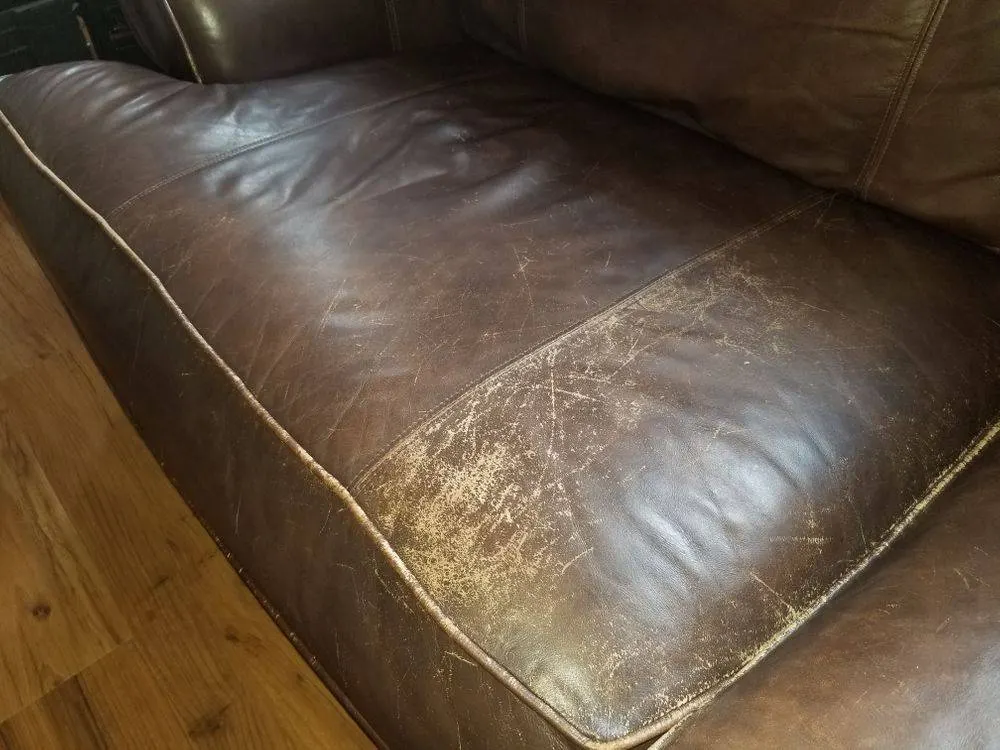
Claw scratches are surface damage. The finish has been scored, and sometimes the hide beneath, but nothing is missing and nothing has separated.
Punctures and tears are openings. A claw has gone through, or caught and pulled, leaving a hole or a split with the material still present around it.
Chewing removes material. Teeth take pieces away, so there is a void rather than a split, and the edges are ragged and often stretched.
That distinction drives everything. The first two are rebuilt from the material that is still there; the third has to replace material that is not.
It also explains why a small chewed area can cost more than a much larger scratch, which surprises people until they see it explained.
Claw scratches, and how deep they go
The most common and the most reliably fixed, and the treatment depends on depth.
Light scratches sit in the finish only. They often lift considerably with a proper clean, and a light touch-in and reseal handles the rest.
Medium scratches have cut through the finish into the top of the hide. They catch a fingernail and may show a lighter color in the base of the score. These are filled, texture-matched and recolored, and they disappear.
Deep gouges have removed some thickness of hide. Same approach, more building up, and still a good result on sound material.
The key variable is not depth but the state of the leather around it. On a supple hide, all three repair well. On leather that has stiffened, a repair holds and new damage appears easily.
Doing a whole panel rather than individual scratches usually gives a better result, since a cat or dog rarely leaves one mark in isolation and a panel treated to its seams reads as consistent.
Punctures and tears
Openings need support before anything else, and that is the difference between a repair that lasts and one that reopens.
The edges are cleaned and trimmed back to sound material, removing anything ragged or stretched that would not sit flat.
A backing material is inserted through the opening and bonded beneath it, spanning well past the damage on all sides. This is what gives the repair strength — the filler on its own is a surface, not a structure.
The void is then filled in thin flexible layers, each allowed to set, until it is level.
Texture is matched to the grain around it, then color, then a flexible topcoat.
On a seat or a cushion the repair also has to flex, so the same thin-layer discipline that matters on a recliner footrest matters here.
Larger tears, particularly those that run along a seam line, sometimes combine a backed repair with restitching, since the seam and the material both need addressing.
Why chewed damage is harder
This is the case worth explaining properly, because owners are often quoted a surprise.
Chewing removes material. There is no flap to lay back down and no split to close — there is a hole with nothing to fill it.
The edges are usually stretched and thinned, not cleanly cut, so the material immediately around the void is weaker than it looks.
Saliva has typically softened and swollen the leather, which changes its texture locally and sometimes permanently.
And dogs chew corners, arm fronts and cushion edges — the parts of a piece that are curved, that take load, and that have the least flat surface to build on.
A filled chew repair on a flat panel can be excellent. The same repair on a rounded arm corner has to rebuild a three-dimensional shape as well as a surface, which is considerably more work and more visible if it is not right.
Where a large area of a corner is gone, letting in a piece of matching leather or replacing the panel usually produces a better outcome than building the whole thing from filler.
Repair, let in, or replace the panel
Three approaches, in increasing order of cost and of how much damage they can absorb.
Fill and refinish. Right for scratches, punctures, tears, and chewed areas up to roughly the size of a coin on a flat surface.
Letting in a piece. A section of matching leather is cut and bonded or stitched into the void, then blended. Right for larger chewed areas where filler alone would be a thick mass, and for damage on shaped areas where volume has to be rebuilt.
Panel replacement. The whole panel is remade in matching leather and stitched back in along the original seam lines. Right for extensive damage, for corners that have lost their shape, and for cases where the surrounding material is also compromised.
Panel replacement produces a panel with no repair in it at all, which is its advantage. Its consideration is color match, since new leather beside panels that have aged for years will differ — which is why recoloring the adjacent panels is often part of it.
A good assessment says which of the three applies and why, rather than defaulting to the cheapest.
The timing question with a young dog
This comes up constantly and it deserves a straight answer rather than a sales one.
If the dog is a puppy still chewing, or an adult dog with a chewing habit that has not been addressed, repairing now means repairing again.
That is not a reason to leave severe damage indefinitely — an open tear collects dirt, grows, and lets the foam out — but it is a reason to sequence sensibly.
The practical approach is usually to stabilize anything that will get worse, protect the piece properly, and do the cosmetic work once the behavior has settled.
Stabilizing means closing openings so they do not spread, without the full refinishing that makes it invisible.
For an older dog with an established habit that is not going to change, protection is the answer and the repair is scheduled around it — or accepted as recurring.
A specialist who asks about the dog's age before quoting is doing the right thing.
Protecting the specific places
Dogs damage furniture in predictable places, which makes targeted protection practical.
The arm fronts and corners, which are at head height for a standing dog and are the classic chew targets.
The seat cushion front edge, which takes claws from jumping up and pushing off.
The spot the dog actually lies in, which takes claws, weight and oils.
The base rail and the outside back, from a dog that scratches at the piece.
A throw on the lying spot and a cover on the arm nearest the dog handle most of it, and both look deliberate rather than defensive.
Trimmed claws prevent more damage than anything else on this list and cost nothing.
And giving the dog an acceptable alternative — a bed positioned where they actually want to be rather than where it suits the room — does more than any deterrent.
What not to do to fresh damage
The improvised responses make the repair harder, and they are all common.
Do not glue a flap down with household adhesive. It will not hold on a flexing panel, and the residue has to be removed before a proper repair, sometimes damaging the finish.
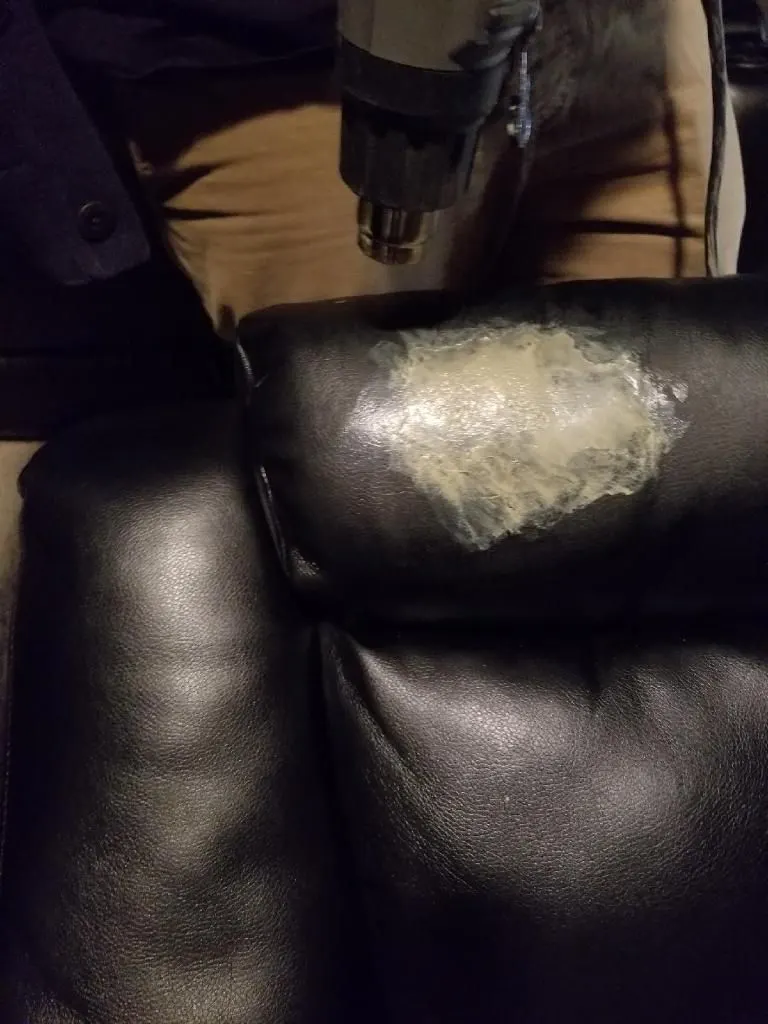
Do not apply a self-adhesive patch on a visible surface. It lifts at the edges, collects dirt around the perimeter, and leaves adhesive that has to be cleaned off.
Do not trim the edges yourself. What looks like a ragged flap is often material the repair will use, and cutting it away can turn a fill into a let-in.
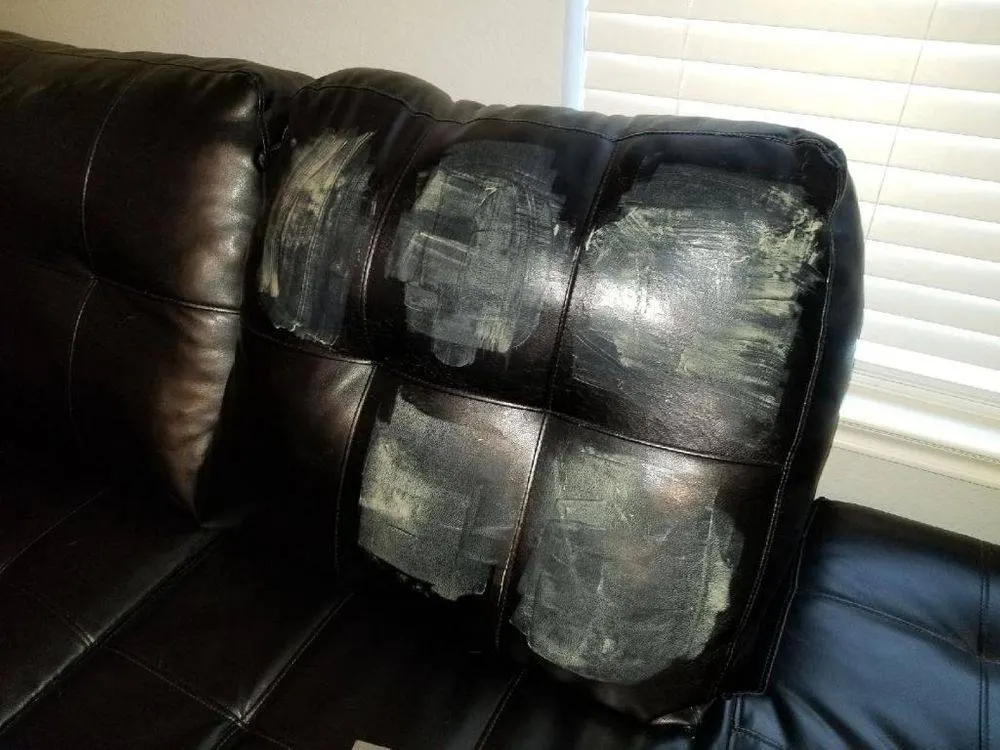
Do not use a colored wax or shoe polish to disguise it, which leaves a contaminant that has to be removed.
Do keep any piece of leather that came away, since it can sometimes be used.
Do cover the area if the foam is exposed, simply to keep it clean, and do photograph it before doing anything.
How well it comes out
Worth setting expectations honestly, because they vary by damage type.
Scratches on sound leather: usually invisible afterward. This is among the most satisfying work in the trade.
Punctures and small tears: usually invisible, provided the backing is done properly and the panel is treated to its seams.
Chewed areas on flat panels: very good, and the result depends on how much material is missing.
Chewed corners and shaped areas: acceptable to very good with a let-in, and best with a panel replacement.
Damage on leather that has already stiffened: the repair holds and new damage nearby is likely, so the honest framing is that it fixes this problem rather than the piece.
Damage on bonded or coated synthetic furniture: temporary at best, because the material is delaminating throughout regardless.
The single biggest variable in all of it is whether the surrounding leather is supple, which a thumb test answers before anyone quotes.
What to send for an assessment
Photograph each damaged area close up with something for scale beside it — a coin or a hand works.
Photograph the same area at a low raking angle, which shows depth and whether material is missing.
Photograph the whole piece so the position and the construction are clear.
Say whether it is scratched, torn, punctured or chewed, in those terms, since they lead to different repairs.
Say whether any material is missing or whether it is all still there.
Press a thumb into the leather beside the damage and say whether it is supple or board-like.
Say how old the dog is and whether the behavior is ongoing, because that genuinely changes the recommendation.
And say whether there are other marks elsewhere on the piece, since doing them together is considerably cheaper.
Questions we get asked next
- Can a chewed sofa corner be repaired invisibly?
- On a flat panel with a small area missing, usually yes. On a rounded corner where a large piece is gone, filling has to rebuild a three-dimensional shape and the result is rarely as good as letting in matching leather or replacing the panel — which is why chewed corners are quoted differently from tears.
- Should I repair the sofa while my puppy is still chewing?
- Usually stabilize now and refinish later. Anything that will grow — open tears, exposed foam — should be closed so it does not spread, but full cosmetic work is better scheduled once the chewing has settled, along with proper protection in the meantime.
- Do claw scratches always need filling?
- No. Light scratches that sit in the finish often lift considerably with a proper clean and need only a touch-in and reseal. Filling is for scratches that catch a fingernail, meaning they have cut through into the hide.
- Is pet damage worth repairing on a bonded leather couch?
- Rarely as a lasting fix. Bonded material delaminates throughout regardless of the damage, so a repaired area holds while new patches fail nearby. A cover is usually the more sensible spend on that material, with reupholstery or replacement as the real answer.
- pet damage
- dogs
- tears