How Should You Prepare Leather Furniture for Parties, Guests and Holiday Spills?
Hosting is the one predictable event that puts a room's worth of risk on your furniture in a single evening. It is also the easiest to prepare for.
Quick answer
Clean and condition about a week before, not the day before — a well-maintained finish is what resists a spill, and conditioner needs time to be absorbed and buffed rather than sitting on the surface when guests arrive. On the night, keep a clean dry microfiber cloth within reach and blot anything immediately without rubbing and without household cleaners. Then check the whole piece the next morning in daylight, because the marks nobody mentioned are the ones that set.
At a glance
| A week ahead | Clean and condition, so the finish is at its best |
|---|---|
| The day before | Vacuum seams, move fragile pieces, position coasters and trays |
| On the night | A dry microfiber cloth within reach — blot, never rub |
| Never reach for | Wipes, all-purpose spray, club soda, salt or hairspray |
| Next morning | Inspect in daylight — unreported marks are the ones that set |
Why hosting is worth preparing for specifically
Most damage to furniture accumulates slowly, which is why it is hard to act on. Hosting is the exception.
An evening with guests concentrates risk: more people than usual, drinks in hands rather than on tables, food away from the dining room, and everyone slightly less careful than they would be at home.
It is also the one situation you know about in advance, which makes it the easiest to manage.
The holidays add specifics — candles, richer food, red wine, more guests in a smaller space, and often children and pets in an unfamiliar arrangement.
And in this region the season runs from Thanksgiving through New Year with several events in it, so the preparation is worth doing once for the whole run rather than repeatedly.
None of this requires covering the furniture or policing anybody. It requires about an hour of work spread over a week and one habit on the night.
A week before: clean and condition
The timing here is the part that matters, and it is the opposite of what most people do.
A well-maintained finish is what resists a spill. Liquid sits on top of a sound coating long enough to be wiped away; on a dry, worn or contaminated surface it finds its way in faster.
So the useful preparation is the ordinary maintenance, done in advance rather than skipped.
Clean the piece with a leather-specific cleaner, panel by panel rather than spot by spot, and let it dry fully.
Then condition lightly and buff off with a clean cloth.
Doing this a week ahead rather than the day before gives the conditioner time to be absorbed and the surface time to settle. Conditioner applied the afternoon of a party is still on the surface that evening, where it will transfer onto clothing and hold whatever lands on it.
If the piece has not been conditioned in a long time, a week ahead also leaves room for a second light application if the first is absorbed quickly.
The day before: the practical pass
Short, and it is the part that changes how the evening goes.
Vacuum the seams, the cushion channels and underneath the cushions. Crumbs and grit that are already there get ground in when the room is busy.
Move anything genuinely vulnerable out of the room — an aniline chair, a light ottoman that will be used as a seat, anything you would be upset about.
Put coasters where people will actually put drinks rather than where they should. A tray on the ottoman is more effective than a rule about the ottoman.
Add side tables or a bar cart, since most drink spills happen because there was nowhere to put a glass down.
Put a throw on the seat that will take the most use, and on any spot a pet uses, which looks deliberate rather than defensive.
And keep candles off leather surfaces entirely — a candle on a leather-topped table or close to an arm is a wax and heat risk that is entirely avoidable.
The one habit for the evening
This is the whole of the response plan and it is deliberately simple, because complicated plans do not survive a busy room.
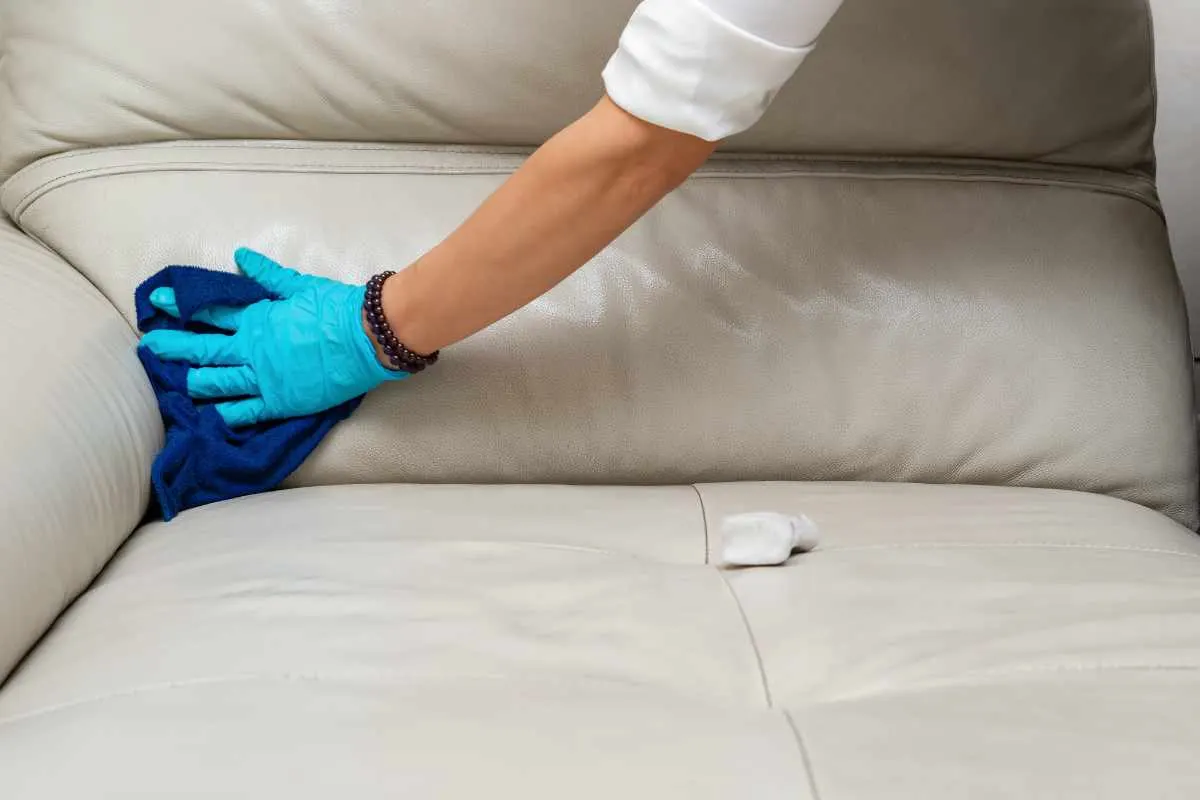
Keep a clean dry microfiber cloth somewhere accessible — a drawer in the room, not the kitchen at the other end of the house.
When something spills, blot it immediately. Nearly everything comes off pigmented leather if it is dealt with in the first minute.
Blot, never rub. Rubbing spreads a spill outward and works it into the grain, turning a coaster-sized mark into a plate-sized one.
Work from the outside inward for the same reason.
Lift solids off with the edge of the cloth rather than pressing them in.
Then leave it. Do not chase a faint remaining mark at eleven at night with whatever is under the sink — that is how a small mark becomes a refinishing job.
Tell guests it is fine, mean it, and deal with it properly the next day.
What not to reach for
The folk remedies are worth naming, because every one of them turns up in the aftermath of a party.
Household wipes and all-purpose sprays strip the finish. They are the most common cause of damage on party-night spills, precisely because they are within reach.
Club soda does nothing useful on leather. It is fabric advice, and on leather it just adds liquid.
Salt on a red wine spill is fabric advice too, and on leather it is abrasive and pointless.
Hairspray and rubbing alcohol on ink dissolve the finish along with the ink, leaving a bare patch instead of a mark.
Nail polish remover removes the coating on contact.
Baby wipes are gentler than most of the above and they still contain surfactants and sometimes alcohol, and they leave residue.
A dry cloth first, a barely damp one if needed, and nothing else until daylight.
The specific holiday spills
A few that come up every year, with what actually helps.
Red wine: blot immediately and thoroughly. On sound pigmented leather it usually comes off entirely if caught quickly; on aniline it may stain and that is a specialist job.
Chocolate and rich sauces: lift the solid off first with the edge of a cloth rather than wiping, which spreads the oil.
Grease and oily food: blot, do not add water, and expect that a shadow may remain — oil marks need a degreasing product rather than a cleaner.
Candle wax: let it harden completely, then lift it off gently rather than picking at it warm. Do not use heat to melt it out, which drives it into the grain.
Cranberry and beet: strongly pigmented, and speed matters more than with anything else on this list.
Ink from a signed card or a pen left on a cushion: blot nothing, add nothing, and get it assessed.
And dye transfer from clothing — dark denim, a new dress — which often appears the next morning rather than at the time.
The morning after
This is the step that catches what the evening missed, and it takes ten minutes.
Inspect the whole piece in daylight, not in lamplight. Marks that are invisible under a lamp are obvious in the morning.
Check the seat cushions, the arm tops, the front edges and the backs of the seats.
Lift the cushions and look underneath and in the channels, where food ends up.
Look for the marks nobody mentioned, which is most of them. Guests generally do not report a spill they cleaned up themselves, and a cleaned-up spill with a household wipe is worth knowing about.
Deal with anything fresh with a leather cleaner, panel by panel.
Photograph anything that has not come off, before trying anything further, so a specialist can see it as it was.
And vacuum the whole piece again, since crumbs left in the seams for a week grind into the finish.
Guests, pets and the honest conversation
The social side is real and it is worth handling deliberately rather than anxiously.
Trays and coasters placed well do more than any request, because they give people somewhere obvious to put a glass.
A throw on the seat that a pet uses reads as a pet's spot rather than as a restriction, and guests will use the other seats without being asked.
If there is a genuinely vulnerable piece, move it rather than defending it. Nobody enjoys an evening spent watching the furniture.
With children in the house, a designated snack area with a hard surface removes most of the risk without anybody being told not to move.
And if something happens, the tone that keeps the evening pleasant is that it is fine and it can be dealt with — which happens to be true for almost everything that lands on pigmented leather.
Furniture is for using. The point of the preparation is that you can relax during the evening rather than during the week after.
Between events during the season
For a household hosting several times through the holidays, a short routine between events keeps things from accumulating.
Vacuum the seams after each gathering rather than at the end of the season.
Wipe the high-contact areas — arm tops, headrests, cushion fronts — with a barely damp cloth, since skin oils build up quickly with more people using the room.
Deal with any mark before the next event, because a second spill on top of an unaddressed first is harder than either alone.
Reposition the throws, since the ones that were in the right place last time may not be for a different group.
Do not condition between every event. Once before the season and once after is right, and more than that produces surface residue.
Then a full clean and condition at the end of the season, which is also the natural time to look at anything that needs a specialist.
When to call rather than continue
A short list of what is worth stopping for, because escalating at home is how most party marks become repairs.
Anything that has already been treated with a household product and looks worse or duller than the mark did.
Ink, marker and dye transfer, all of which respond badly to solvents in untrained hands.
Oil and grease shadows that remain after blotting.
Any mark on aniline or lightly finished leather, which absorbs rather than resisting and where home treatment usually spreads the problem.
Heat damage or wax that has been driven into the grain.
And any area where the finish now looks different — duller, shinier, or lighter — than what surrounds it, which means the coating has been affected rather than the surface soiled.
In every one of those cases, photographing it and leaving it alone is the cheapest thing you can do.
Questions we get asked next
- Should I condition my sofa the day before guests arrive?
- No — do it about a week ahead. Conditioner applied the day before is still on the surface during the party, where it transfers onto clothing and holds whatever lands on it. A week gives it time to be absorbed and properly buffed, which is when it actually protects.
- What do I do about red wine on a leather sofa?
- Blot immediately with a dry cloth, working from the outside inward, and do not rub. On sound pigmented leather it usually comes off completely if you get to it in the first minute. Do not add salt, club soda or any household cleaner.
- Are baby wipes safe on leather in an emergency?
- Better than an all-purpose spray and still not good. They contain surfactants, sometimes alcohol, and they leave residue that builds up. A dry microfiber cloth is genuinely more effective on a fresh spill, and it is what should be within reach.
- How soon should I deal with a mark I find the next morning?
- That day. Most things that are still on the surface come off with a leather cleaner; the same mark left for a week has had time to set and to be ground in by use. Photograph anything that does not come off rather than escalating through products.
- hosting
- spills
- holidays