Can Torn or Worn RV Dinette Seats Be Repaired Without Removing Them?
The dinette is the hardest-used seating in most coaches and the most awkward to take out. Fortunately it rarely needs to come out.
Quick answer
Yes. Cosmetic repair, recoloring and most seam work happen with the benches in place, which matters because dinette seating is usually bolted to the floor and doubles as storage. Loose cushions can be worked on either in the coach or taken away. What decides the outcome is not access but material: if the covering is a coated synthetic that is peeling widely, repair is a holding measure rather than a fix, and recovering the cushions is the durable answer.
At a glance
| Stays in place | Benches are bolted down and usually hold storage underneath |
|---|---|
| Highest wear | Front edges, corners and the seat closest to the door |
| Material decides | Sound vinyl or leather repairs; widely peeling synthetic does not |
| Cheap to recover | Flat cushions are simple shapes and cost less to recover than a sofa |
| Check the base | Soft plywood under a cushion is a separate repair |
Why the dinette wears faster than the rest of the coach
In most coaches the dinette takes more use than any other seating, and the wear pattern shows it.
It is the eating area, the work area, the card table and often the extra bed. People sit there for hours rather than minutes.
Getting in and out means sliding across the seat rather than sitting straight down, because the table is in the way. That sliding is abrasion, concentrated on the front edge and the outer corner.
It is close to the door in most layouts, so it takes the dirt, the wet coats and the bags.
Food and drink land there more than anywhere else in the coach.
And in a coach with a slide-out dinette, the whole assembly moves and flexes every time the slide operates.
So a dinette can look years older than the recliners ten feet away, on the same material and the same age of coach.
Why the benches stay put
Dinette seating is not furniture that has been placed in the coach. It is built into it.
The bases are bolted or screwed to the floor, and often to the wall as well.
They almost always contain storage, so there are hinged lids, gas struts, latches and sometimes the water heater or wiring routed inside.
In a slide-out, the whole assembly is part of the slide mechanism.
Taking that apart to do cosmetic work would cost more in labor than the repair itself and would risk the seals and the mechanism.
So the work happens in place, which for cosmetic repair is entirely practical — the surfaces that need attention are the ones facing you.
The exception is a loose cushion, which can simply be lifted out if working on it elsewhere is easier.
Establish the material first
This decides whether the repair is a fix or a holding measure, and it takes two minutes.
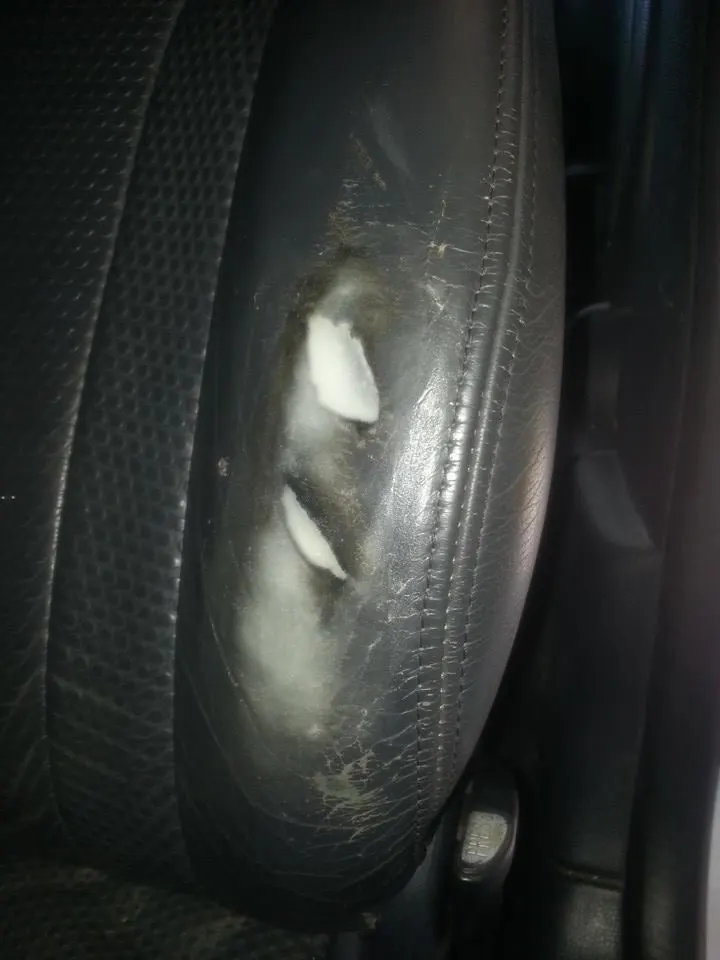
Peeling that lifts in flakes or sheets, showing a fabric-looking layer underneath, is a coated synthetic or bonded material. Leather does not shed a surface layer.
Cracking or wearing without shedding points at leather or at a solid vinyl.
Check a hidden edge — the underside of a cushion, the back of a bench — for a woven backing behind a thin coating.
Look at the grain across a large flat area. A pattern that repeats exactly is embossed on a manufactured material.
Most RV dinettes are vinyl or a coated synthetic rather than hide, which is sensible given the weight limits and the cleaning demands of an eating area.
Solid marine-type or contract-grade vinyl repairs very well. Bonded material that is peeling across the cushion does not, because the whole material is delaminating rather than only the visible part.
Where dinettes fail, in order
The pattern is consistent across layouts and it tells you what to look at.
The front edge of the seat cushion, from sliding in and out, which is nearly always the worst area.
The outer corner nearest the aisle, which takes the same sliding plus knocks from bags and legs.
The top edge of the backrest, where people rest an arm and where the light hits.
Seams along the front edge and around the corners, where stress and stiffened material meet.
The area beside the window, which fades from direct sun without necessarily wearing.
And the underside edges of a hinged lid, which take a knock every time the storage is opened.
Damage from spills and food is usually staining and finish damage rather than structural, and it responds to different work.
What in-place repair involves
Standard technique, done in a small space, and the small space is the main practical constraint.
The area is cleaned and degreased thoroughly. A dinette carries food residue, skin oil and cleaning-product film, and nothing bonds through any of that.
Tears are backed from beneath, then filled in thin flexible layers, each allowed to set.
Worn areas are rebuilt the same way, level with the surrounding surface.
Texture is matched to the grain around it, which on vinyl reproduces accurately because the embossed pattern repeats.
Color is mixed to the material as it is now rather than to a factory reference, then built in light coats and sealed with a flexible topcoat.
Ventilation matters more than in a house — a coach is a small enclosed space, so windows, the door and the roof vents should be open while the work is done.
When recovering the cushions is the better spend
Dinette cushions are the cheapest seating in a coach to recover, and that changes the calculation.
They are simple shapes — flat or lightly boxed rectangles, straight seams, no contours, no mechanisms.
So where the covering has failed broadly, recovering costs far less than the equivalent work on a sofa or a recliner and it solves the problem rather than deferring it.
That is the right answer when the material is peeling across the cushion, when several areas have failed, or when the vinyl has gone stiff and crazes under thumb pressure.
It is also the moment to change material. A contract-grade or marine-type vinyl handles the heat, the sun through the window and the food far better than what most coaches leave the factory with.
And the base and foam can be dealt with at the same time, which is efficient since the cushion is already apart.
The foam and the base underneath
Two things under the surface that decide how the seating actually feels.
Dinette foam is often thin and low-density from new, because it is a cost-sensitive area of the build. It compresses and takes a set faster than seating foam elsewhere in the coach.
A cushion that has gone flat and hard is a foam problem, and no surface work changes it. Replacing the foam in a dinette cushion is inexpensive and transforms how the area is to sit in, and it is often the better first spend on an otherwise sound cushion.
The base is the other issue. Many dinette cushions sit on plywood, and where water has reached it — a window leak, a spill through a seam, condensation in storage — the plywood softens.
A soft or flexing base is a repair in its own right and it has to be dealt with before new material goes over it.
Press firmly across the seat and feel for give, softness or a spongy area, and look underneath if the lid opens.
Why RV interiors age faster than household ones
The same cushion in a kitchen would last considerably longer, and the reasons are environmental.
A parked coach in a Texas summer reaches interior temperatures well above ambient, and that heat drives plasticizers out of vinyl and degrades the adhesives in bonded material.
Dinette windows are large and the seating sits right against them, so it takes direct sun for hours.
Long storage combines heat with trapped humidity, which is what breaks down polyurethane coatings regardless of use.
Travel adds constant vibration and flexing.
And slide-out assemblies work the material mechanically every time they operate.
The practical response is shade and ventilation: reflective covers or blinds on the dinette windows, and airflow during storage. Both make a measurable difference and neither costs much.
Keeping a repaired dinette longer
The measures that matter are unglamorous and they work.
Blinds or reflective covers on the dinette windows whenever the coach is parked.
Ventilation during storage rather than a sealed coach through a Texas summer.
A neutral cleaner rather than household wipes and all-purpose sprays, which strip finishes — and this is an eating area, so it gets wiped constantly.
Wipe spills promptly rather than letting them sit, since food acids and oils damage finishes given time.
Consider a throw or a fitted cover on the seat that takes the most traffic, which absorbs the sliding abrasion that causes most of the wear.
And deal with any seam split quickly, because an open seam in a dinette collects crumbs and liquid straight into the foam.
The slide-out complication
Where the dinette is on a slide, a few things change and they are worth knowing before booking.
The whole assembly moves, which works the material at the seams and at the corners every time the slide operates. That is why slide-out dinettes often show seam failures earlier than fixed ones.
Access differs depending on slide position. Work is generally easier with the slide extended, which means the coach needs to be somewhere it can be run out — not a tight storage stall.
That is worth confirming before a visit, because a coach parked where the slide cannot open turns into a rescheduled appointment.
Clearance around the seating is also tighter when the slide is in, and some surfaces are simply unreachable in that position.
The slide seals are worth a look at the same time. A seal that has failed is a water route straight into the dinette area, and a foam problem that keeps returning on a slide-out dinette usually traces back there rather than to anything on the surface.
None of this makes the work harder. It just means the coach needs to be somewhere with room, and that a repeat problem deserves a look at the seals before more money goes into the cushions.
What to send for an assessment
Photograph each damaged area close up, in daylight without flash, with something for scale.
Photograph the whole dinette so the layout and the positions are clear.
Photograph the edge of any peeling so what is underneath is visible, since that identifies the material.
Say whether the damage flakes and sheds or cracks without shedding.
Press the cushion and say whether it feels flat and hard, and whether the base underneath gives or feels soft.
Say whether the cushions lift out or are fixed, and whether the dinette is on a slide-out.
And say the coach's age, how it is stored, and whether the rest of the furniture is the same material — it often is, and doing everything in one visit is far more efficient.
Questions we get asked next
- Do the benches have to be unbolted?
- No. Cosmetic repair, recoloring and most seam work happen in place, which is important because dinette bases are fixed to the floor and usually contain storage or run services. Only full recovering needs the cushions off, and those generally lift out.
- My dinette cushions are flat and hard. Is that a covering problem?
- No, that is the foam. RV dinette foam is often thin and low-density from new and it takes a set with use. Replacing it is inexpensive, it transforms how the area sits, and on otherwise sound cushions it is frequently the better first spend.
- Is recovering the cushions expensive?
- Less than most owners expect. Dinette cushions are simple flat shapes with straight seams and no mechanisms, which makes them the cheapest seating in a coach to recover — and it is the moment to move to a tougher vinyl than the one the coach was built with.
- Why is the front edge always the worst part?
- Because the table forces you to slide in and out rather than sitting straight down, so that edge takes abrasion on every use. It is also where crumbs and liquid collect. A throw or fitted cover on the busiest seat removes most of that wear.
- RV
- dinette
- repair