Is It Better to Repair a Whole Set of Leather Dining Chairs at Once?
Dining chairs are the one case where fixing only the damaged ones reliably makes the room look worse.
Quick answer
Almost always yes, for two reasons. Chairs in a set are viewed together around one table, so any difference between them is directly compared rather than noticed in isolation — and the chairs that get used most have aged furthest, so repairing only those creates a visible split. The cost also favors it: cleaning, color mixing, setup and travel are shared across the set, so each additional chair costs considerably less than the first.
At a glance
| Why together | Chairs are compared side by side at one table |
|---|---|
| Uneven wear | Two or three chairs take most of the use in every household |
| Cost structure | Setup and color mixing shared — later chairs cost much less |
| Common failures | Seat fronts, arm tops, back tops and the rear of the backrest |
| Rotate afterward | Moving chairs around the table keeps them aging together |
Why sets are different from single pieces
A sofa is judged against itself and against memory. A set of dining chairs is judged against the chair next to it, in the same light, at the same moment.
That is a much harsher comparison. Differences in color, sheen and texture that would go unnoticed on a single piece are obvious when two chairs sit side by side.
It also means the standard is set by the best chair in the set rather than by what the owner expects. A restored chair that looks excellent against a worn one still reads as different.
And dining chairs are usually seen all at once, from a doorway or across a room, so the eye takes in the whole group rather than individual pieces.
The practical consequence is that partial work on a set is the one situation where a technically good repair can leave the room looking worse than before.
Which is why the scope conversation matters more here than almost anywhere else.
Why some chairs wear far faster
Every household has favorite chairs, and the pattern is remarkably consistent.
The chairs at the ends of the table, which are often larger, often have arms, and are usually taken by the same people.
The two or three seats nearest the kitchen, which get used for coffee, homework and everything that is not a meal.
The chair someone works from, which takes hours rather than minutes.
Meanwhile two or three chairs at the far end may only be used when there are guests, which in most homes is a handful of times a year.
Add uneven light — the chair nearest the window fading while its opposite number does not — and a set that was identical five years ago can have chairs at genuinely different stages.
So the damaged chairs are not unlucky. They are the ones doing the work, and repairing only them restores the two extremes of a set while leaving the middle untouched.
Where dining chairs fail
The pattern is specific to how people use a dining chair, and it differs from a sofa.
The front edge of the seat, which takes the backs of legs on every sit and stand, and which is the most common failure by a wide margin.
The top edge of the backrest, which is where everyone grabs to pull the chair out. That single habit accounts for an enormous amount of wear.
The rear face of the backrest, which is what the eye sees first when the chairs are pushed in — and which owners routinely forget to include.
Arm tops on carver chairs.
The outer sides of the seat, which knock against the table and against other chairs.
The corners of the seat, which catch on the table edge.
And the seat surface itself, which takes spills, food and cleaning products more than any other furniture in a house.
The economics of doing the set
This is the argument that usually settles it, and owners are consistently surprised by the numbers.
Several costs are effectively fixed per visit rather than per chair: travel, setup, cleaning products, and the time spent mixing and confirming a color match.
Color mixing in particular is a significant part of any recoloring job, and it is done once for a set of matching chairs.
So the second chair does not cost what the first did, and the sixth costs less again.
Doing six chairs is nowhere near six times the cost of doing one, and doing six over three separate visits across two years costs substantially more than doing six at once.
There is also a matching cost to staging the work: chairs repaired eighteen months apart are matched to a set that moved on in between, so the later ones may need the earlier ones revisited.
It is worth asking for both quotes — the damaged chairs alone and the full set — because the gap is usually smaller than expected.
When partial work is genuinely fine
Doing the whole set is not always necessary, and there are real cases where it is not.
Isolated damage on an otherwise consistent set — one puncture, one burn, one scratch — where the chairs are all at the same stage. A repair that disappears into a panel does not create a mismatch.
Structural work such as a restitched seam, which is invisible when done properly and does not change color.
A set where the chairs are deliberately not matched, which some households have.
Chairs that live in different rooms and are never seen together.
And a set where the budget genuinely only stretches to the worst chairs now, in which case doing them in matched pairs rather than singly at least keeps the set balanced.
The distinction is whether the work changes the color or the sheen of a panel. Repairs that do not are safe to do individually; recoloring is what creates the split.
Matching across a set
Where the whole set is being done, matching is easier than it is for a single chair, and there are two approaches.
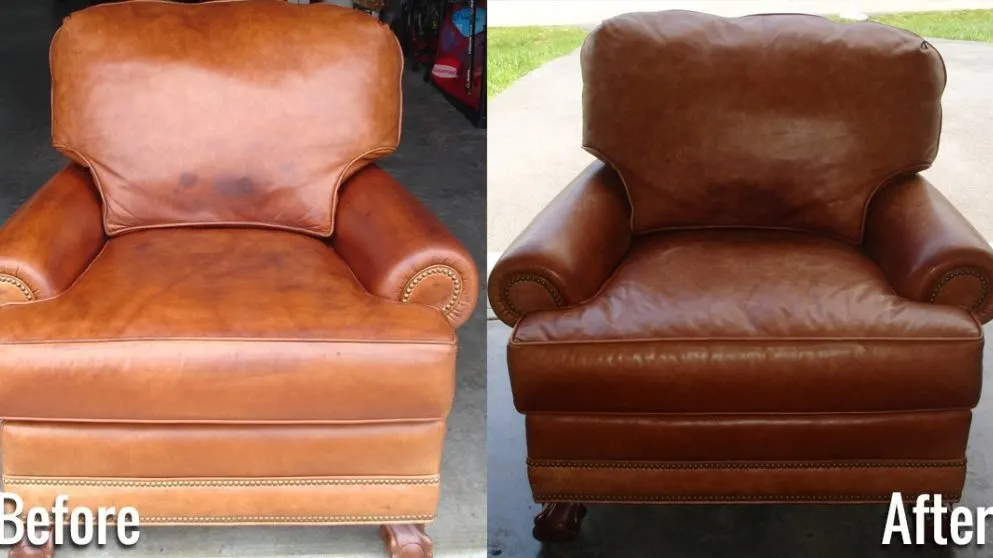
The first is to match all chairs to the current condition of the least-worn ones, which keeps the set looking as it does now and simply removes the damage and the unevenness.
The second is to take the whole set back toward its original color, which is effectively a refresh and produces a more dramatic result.
Either is legitimate; what matters is that it is a deliberate decision made in advance rather than discovered afterward.
Sheen is chosen once and applied across every chair, which removes the single most common source of visible mismatch.
And because all the chairs are being worked on together, the color is confirmed against several of them rather than against one, which produces a better average match.
This is the practical reason set work usually looks better than the sum of individual repairs.
Where the chairs get worked on
A practical point that affects scheduling more than people expect.
Dining chairs are small and movable, which opens options that fixed furniture does not have.
Work can happen in place, at home, with the chairs in the dining room or a garage.
Or the chairs can be collected and worked on elsewhere, which suits a full set well and removes the disruption from the house.
Doing a set at home means the dining room is out of use for the working period plus the cure time, which is worth planning around rather than discovering.
A garage or a covered outdoor space is often the best compromise, giving ventilation and keeping the house clear.
In this climate the working environment matters: a hot garage in August affects how coatings flow and cure, so an early start or a cooler space gives a better result.
And the cure period before the chairs are sat on is confirmed at the end rather than promised up front.
Foam, webbing and the parts under the leather
Worth checking while a set is being assessed, because it is cheap to address then and expensive later.
Dining chair seats are often thinly padded, and the foam compresses faster than sofa foam because the load is concentrated on a small area.
A seat that feels hard, or where you can feel the frame through it, is a foam problem and no surface work changes it.
Webbing and springs under a drop-in seat can sag or fail, which shows as a seat that dips in the middle.
Joints loosen on dining chairs more than on any other furniture, because of how they are moved and leaned back in. A chair that creaks or racks needs the frame attending to, and that is furniture repair rather than leather work.
Drop-in seat pads are usually easy to remove, which makes both foam replacement and recovering straightforward on this kind of chair.
It is worth sitting on every chair in the set during the assessment rather than only looking at them.
Keeping the set even afterward
The uneven wear will return unless something changes, and the fix costs nothing.
Rotate the chairs around the table every few months. The end chairs become side chairs, the guest chairs get used, and the set ages together.
Rotate the drop-in seat pads too where they are interchangeable.
Move the set relative to the window if one end is fading, or address the light.
Discourage the habit of pulling chairs out by the top edge of the backrest, or accept it and expect that edge to need attention first.
Clean the seats promptly, since dining chairs take more food and drink than any other furniture.
And condition all of them on the same schedule, including the ones nobody sits in — those are drying at the same rate as the rest and stiffen quietly.
What to send for an assessment
Photograph the whole set together, which is how it will be judged.
Photograph the worst chair close up, and photograph the best chair for comparison.
Photograph the rear faces of the backrests, since that is what shows when the chairs are pushed in and it is the most commonly forgotten area.
Say how many chairs there are and how many are noticeably worn.
Say which chairs get used and which do not, since that predicts what the others will need soon.
Sit on each one and say whether any feel hard, dipped or loose in the frame.
Say whether the seat pads lift out.
And ask for two quotes — the worst chairs alone and the full set — because the difference is usually the deciding information.
Questions we get asked next
- Can I repair just the two worst dining chairs?
- You can, and it usually creates a visible split. Chairs are compared side by side at one table, so two freshly recolored chairs among six worn ones read as a mismatch. Structural repairs that do not change color are safe to do individually; recoloring is what causes the problem.
- How much more does doing the whole set cost?
- Considerably less than proportionally. Travel, setup, cleaning and color mixing are shared across the set, so each additional chair costs much less than the first. Six chairs is nowhere near six times one, and doing them in stages over years costs more overall.
- Why does the top of the backrest wear out?
- Because that is where everyone grabs to pull the chair out. That single repeated habit accounts for a large share of dining chair wear, along with the front edge of the seat. Both are contact points rather than sitting surfaces.
- Do the chairs have to leave the house?
- No. Work can happen in place or in a garage, though a full set at home means the dining room is out of use for the working period plus the cure time. Collection is a practical option for a set and removes the disruption, so it is worth discussing either way.
- dining chairs
- sets
- color matching