How Do Sunscreen, Lotion and Blue Jeans Stain Light-Colored Car Seats?
The three things most likely to mark a light interior in this climate are all applied to skin, and two of them do chemical damage rather than sitting on top.
Quick answer
All three transfer from skin or clothing onto the seat, and cabin heat drives them into the finish rather than leaving them on it. Denim dye is the most recoverable and usually cleans off a sealed surface. Body lotion leaves an oily mark that needs degreasing. Sunscreen is the difficult one, because some formulations interact with the finish and can leave a permanent yellow or orange discoloration that cleaning cannot lift — at which point the panel needs refinishing.
At a glance
| Denim dye | Sits on the topcoat. Usually cleans off if the finish is intact |
|---|---|
| Body lotion | Oily mark that migrates into the finish. Needs degreasing, sometimes repeatedly |
| Sunscreen | Can react with the finish and discolor it permanently. Refinishing, not cleaning |
| Why here | Cabin heat drives all three into the surface far faster than a cool interior would |
| Prevention | Let products dry on skin before getting in; protector on light interiors |
Why light interiors are so common here, and so vulnerable
Cream, beige and light gray interiors are specified far more often in this region than in cooler places, for a sensible reason: light surfaces absorb less solar energy and a light interior is meaningfully cooler to sit in after a car has been parked in the sun.
The trade-off is that everything shows. A mark that is invisible on a black seat is obvious on a cream one.
That is not a durability problem — the same finish is on both — but it does mean light interiors reward prompt cleaning far more than dark ones, and it means owners here encounter these three problems constantly.
The heat that made a light interior desirable is also the thing that turns a surface deposit into a bonded one, which is where most of the difficulty comes from.
Denim: the most recoverable of the three
Indigo dye in denim is not fully fixed to the fabric, which is why jeans fade attractively and why the dye migrates onto anything it rubs against under warmth and pressure.
A car seat provides all three: prolonged contact, body weight, and in this climate a warm surface.
The result is a blue-gray haze on the seat cushion and the lower part of the backrest, exactly where the wearer sits.
On a sealed pigmented finish, fresh transfer sits on top of the topcoat and lifts with an appropriate cleaner, worked over the whole panel rather than scrubbed at the darkest point.
Left for months it starts to bond into the finish, at which point cleaning removes most of it and a residual tint remains, which is a refinishing job.
Where the topcoat has already worn through, the dye reaches the pigment layer directly and cleaning it means removing the seat's own color along with it.
Body lotion and hand cream
These leave an oily deposit rather than a colored one, and they behave differently from dye.
Lotion transfers from arms, legs and hands onto the seat and the door armrest, and because oil is mobile it migrates into the finish rather than sitting on it.
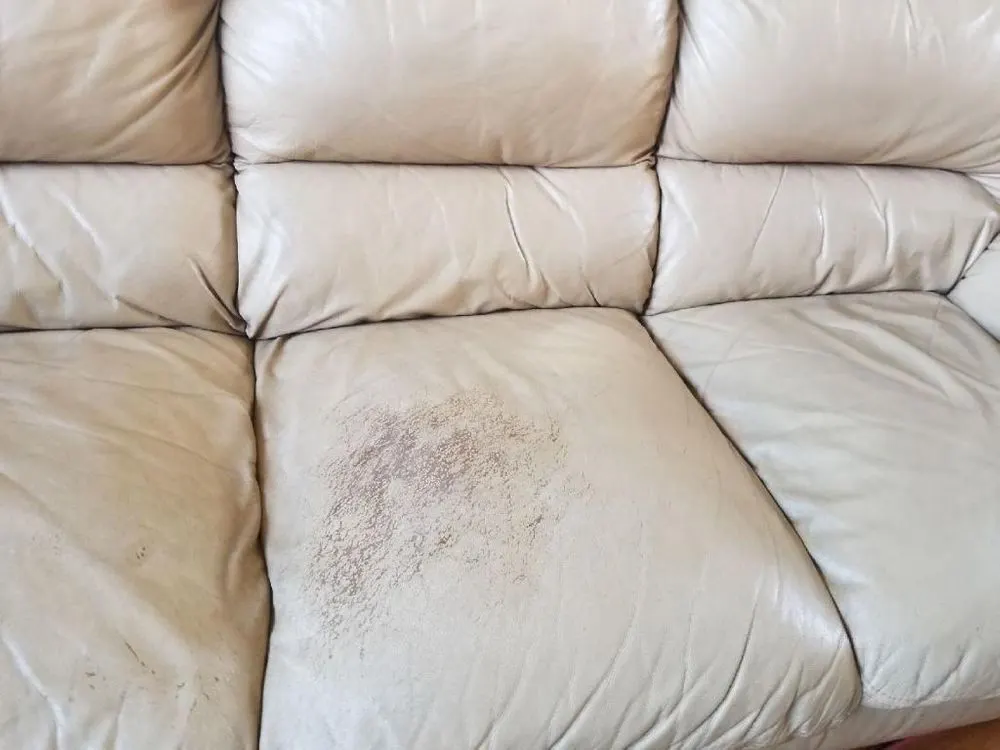
The visible result is a darkened patch, often slightly shiny, in the contact areas. On light leather it reads as grubbiness that will not wipe off.
Cleaning removes what is on the surface; the oil that has migrated into the finish needs degreasing, and often more than one pass, because oil wicks back to the surface after each treatment.
Many lotions also contain silicones and emollients that soften a topcoat over time, so a favorite seat that has taken years of lotion can have a finish that is both darkened and slightly tacky.
The important instruction: a tacky, darkened contact area needs degreasing, not conditioner. Conditioner on a softening finish makes it worse and is one of the most common mistakes on this specific problem.
Sunscreen is the difficult one
This deserves its own treatment because it is the only one of the three that can cause damage cleaning cannot reverse.
Sunscreens contain UV filters, oils, emulsifiers and often silicones. Some of those ingredients — avobenzone is the one most frequently implicated — can interact with coated surfaces, and the interaction is accelerated by heat.
On a light-colored interior the visible result is a yellow, orange or brownish discoloration in the contact areas, and it looks like a stain even though the finish itself has changed.
The distinguishing test is straightforward: a stain sitting on the surface gets lighter with proper cleaning. A discoloration in the finish does not change at all however carefully it is cleaned.
Where cleaning makes no difference, the panel needs refinishing — cleaning and degreasing, stabilizing, then rebuilding the color and topcoat.
There is no product an owner can apply that reverses it, and repeated aggressive cleaning attempts only thin the topcoat and make the underlying discoloration more visible.
Why cabin heat changes everything
The same three products in a cool climate cause a fraction of the trouble they cause here, and the reason is temperature.
A vehicle parked in summer sun reaches interior surface temperatures far above the outside air, and it does so every day for months.
Warm surfaces absorb oils and mobilize dyes far more readily than cool ones. Indigo migrates faster, lotion penetrates deeper, and any chemical interaction between sunscreen ingredients and a finish proceeds faster.
Heat also softens the topcoat temporarily, which makes it more receptive to everything landing on it.
And the products themselves are used far more here — sunscreen daily for much of the year, lotion in a climate that runs air conditioning constantly.
So this is not a general leather-care topic with a local mention appended. It is a specifically regional problem, and the timeline for dealing with a mark is much shorter here than the general advice suggests.
What to do when it happens
The response differs by cause, so identify which one you have first.
For anything fresh and visible: blot with a dry cloth, no rubbing, and get the vehicle out of the sun if you can. Heat is what sets these marks.
For denim haze: clean the whole panel with a cleaner made for automotive leather, applied to a cloth, in light passes rather than one aggressive session. Repeat over a few days rather than scrubbing.
For lotion marks: the same approach, expecting to need several passes. If the area stays darkened, it needs professional degreasing rather than more effort at home.
For suspected sunscreen discoloration: clean once, gently, and see whether it changes at all. If it does not, stop. Further cleaning removes topcoat and makes the discoloration more visible, and the answer is refinishing.
In all cases: no alcohol, no disinfectant wipes, no all-purpose spray, no melamine sponge. Every one of those removes finish along with the mark, and on a light interior a thinned topcoat shows immediately.
Prevention that actually works
For sunscreen and lotion, the single most effective habit is letting the product dry on skin before getting into the vehicle. A few minutes is enough, and it removes most of the transfer entirely.
Applying sunscreen after you arrive rather than before you drive achieves the same thing.
A leather protector on a light interior genuinely earns its cost here. It makes the surface less receptive to dye and oil and buys real time before anything bonds. It needs reapplying after cleaning, since cleaning removes it too.
Wipe the seat cushion, the backrest lower and the door armrest weekly with a barely damp microfiber cloth. That takes deposits off before heat can drive them in, and it is the highest-return minute of maintenance on a light interior.
Clean properly every four to six weeks rather than every few months. On a light interior in this climate that is a realistic interval.
And park in shade wherever possible, which reduces the heat that turns a deposit into a bonded mark.
What refinishing involves when it comes to that
Where a mark has bonded or the finish has discolored, the work is a panel refinish and it produces a reliable result.
The area is cleaned and degreased thoroughly, which on a lotion- or sunscreen-affected panel is the longest stage and often needs repeating.
The remaining finish is assessed and stabilized, and any thinned or damaged coating is taken back to something sound.
Color is mixed against the actual leather and tested on a hidden area, checked in daylight and again under artificial light.
It is sprayed in thin coats and feathered well beyond the affected area. On a light interior the blend goes wider than it would on a dark one, because the eye detects small tonal differences far more readily in pale surfaces.
An automotive-grade topcoat seals it, restoring the barrier that was protecting the pigment.
Applying a protector afterward is worth discussing at that point, since the panel has just been rebuilt and keeping it that way is cheaper than doing it again.
Children, beach trips and the seasonal pattern
The heaviest damage tends to arrive in bursts rather than steadily, which is useful to know because it is predictable.
Summer weekends: sunscreen applied liberally, often to children, then everyone gets straight into a hot car. This is the single biggest contributor in most family vehicles here.
Lake and pool trips, where sunscreen is combined with damp swimwear and prolonged contact.
Gym and sports use, where lotion, sweat and friction combine on the driver's seat.
Everyday commuting in denim, which produces the slow haze rather than a specific incident.
Knowing the pattern makes the prevention practical: a towel over the seat on a beach or pool day costs nothing and prevents the worst single category of damage on a light interior.
What to send for an assessment
Photograph the affected area square-on with the door open in daylight, no flash — flash on a light interior blows out exactly the tonal differences that need assessing.
Photograph an unaffected area of the same seat for comparison.
Say what you think caused it and roughly when it started. Sunscreen, lotion and denim each lead to a different first step.
Say what has already been used to clean it, and how many times. Repeated aggressive cleaning changes the condition of the finish as well as the mark.
Say whether proper cleaning made any difference at all. A mark that lightens is a cleaning problem; one that does not move is a finish problem, and that single answer usually determines the recommendation.
And do the white-cloth rub on an inconspicuous part of the area — color on the cloth means the topcoat has worn through, which changes the approach again.
Questions we get asked next
- Can sunscreen stains be cleaned off leather?
- Sometimes. If the sunscreen is sitting on the surface, proper cleaning and degreasing lifts it. If ingredients have interacted with the finish and discolored it — which heat accelerates — cleaning makes no difference at all, and the panel needs refinishing. The test is whether one careful clean changes anything.
- Why is my passenger seat marked but not the driver's?
- Usually because of who sits where and what they have applied. Sunscreen and lotion transfer follows the person rather than the vehicle, so a family car often shows marks on the seats used by whoever applies the most. It is worth checking the rear seats too if children ride there.
- Would a protector have prevented it?
- It would have helped considerably with denim dye and lotion, by making the surface less receptive and buying time before anything bonded. Against sunscreen ingredients that interact with the finish it offers less, though a protective layer still means less direct contact with the topcoat.
- Should I just choose a dark interior next time?
- A dark interior hides all three marks far better, and it runs considerably hotter in a Texas summer. Most people here decide that a light interior plus a cleaning routine is the better trade, and the routine is what makes that work rather than the color choice itself.
- sunscreen
- stains
- light interiors