Can Clothing Dye, Newspaper Ink and Fabric Transfer Be Removed from Leather?
Dye transfer is the most common complaint on light-colored furniture and one of the most recoverable — provided nobody scrubbed at it first.
Quick answer
Usually yes. Indigo from denim, newsprint and dye from throws or clothing transfers onto the surface, and on sealed pigmented leather most of it sits on the topcoat where a proper cleaner lifts it. Transfer that has been left for months can bond into the finish, in which case cleaning removes part of it and the panel is refinished for the rest. Where the topcoat has already worn through, the dye reaches the pigment layer and refinishing is the only route.
At a glance
| Fresh transfer, intact finish | Cleans off completely in most cases |
|---|---|
| Months-old transfer | Partial cleaning, then refinish the panel for the remainder |
| Worn topcoat | Dye reaches the pigment. Refinishing rather than cleaning |
| Aniline leather | Absorbs the dye. Specialist work, and not always fully reversible |
| Prevention | A leather protector plus prompt cleaning — the two together do most of it |
What dye transfer actually is
Indigo dye in denim is not fully fixed to the fabric. It never has been — that is the reason jeans fade attractively, and the same property means the dye migrates onto anything it rubs against under pressure and warmth.
Leather is a receptive surface for it. Warm, slightly textured, and in contact with a person's body weight for hours at a time.
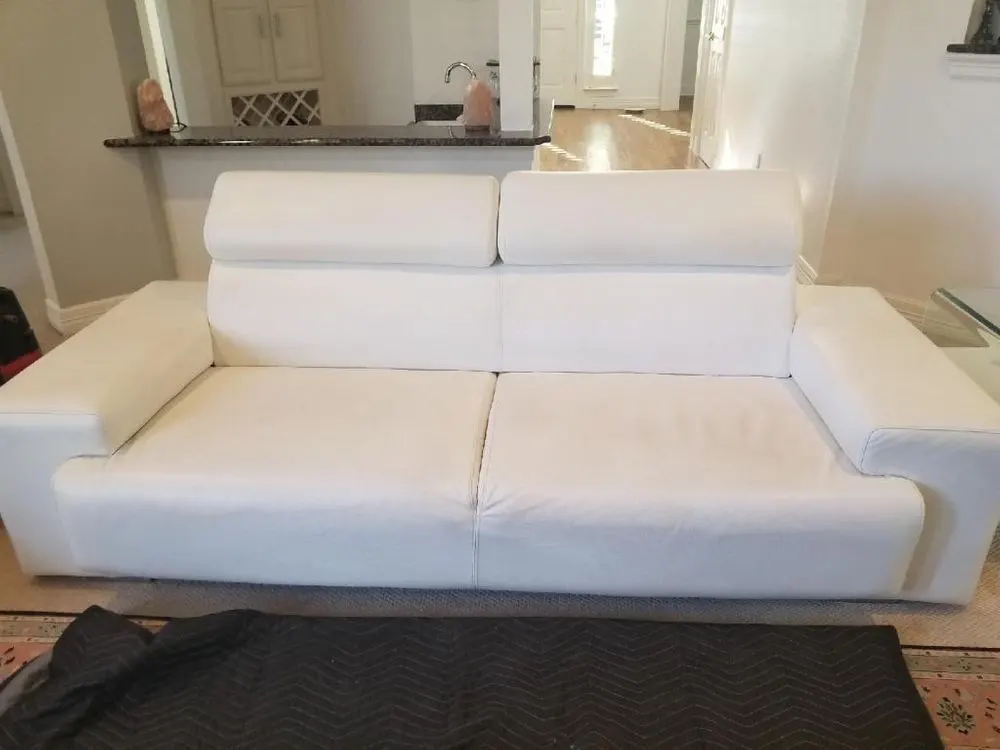
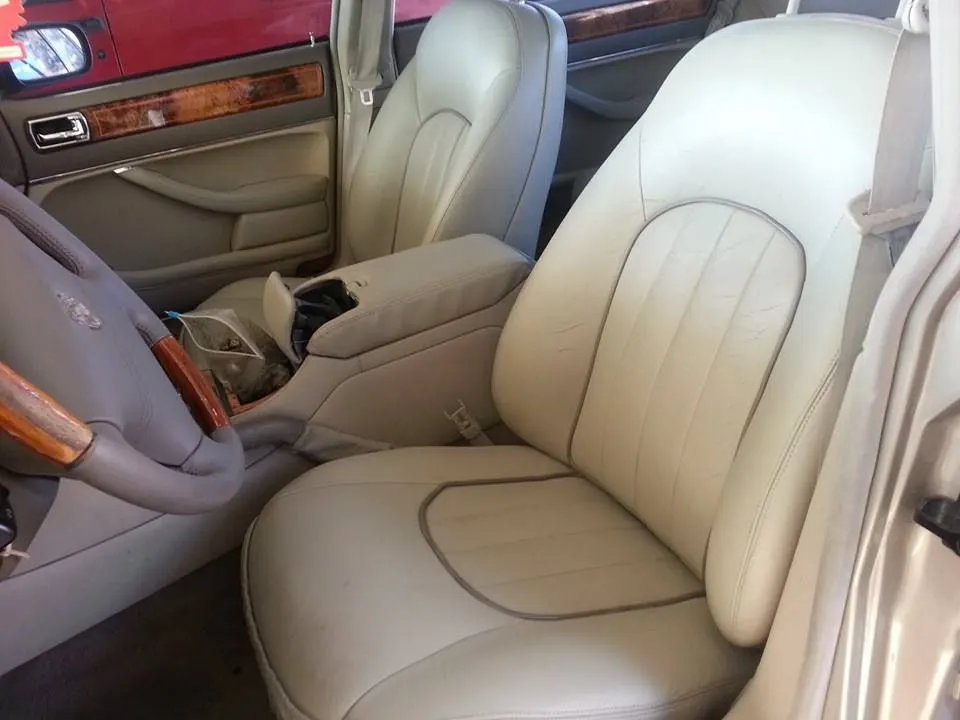
The result on light furniture is a blue or gray haze on the seat and the front of the back cushions, exactly matching where jeans sit. On vehicle seats it appears on the seat cushion and the lower part of the backrest.
Newsprint does the same thing with black pigment, usually onto arms where a paper rests. Colored throws, cheap upholstered chairs pushed against a sofa, and new clothing of any strong color all contribute.
It is not dirt in the ordinary sense — nothing has been spilled. It is pigment that has migrated from one material to another, which is why it responds to a different approach than a spill would.
Why light leather shows it and dark leather does not
Dark furniture takes the same transfer. It simply conceals it, because blue-gray haze against dark brown is close in tone and the eye passes over it.
On cream, white, pale gray and tan leather there is maximum contrast, so the same quantity of transferred dye reads as obvious discoloration.
That has one genuine advantage: the problem gets noticed early, while it is still on the surface and easy to remove. Dark furniture accumulates the same transfer for years and it is only discovered when a specialist cleans a panel and the cloth comes away gray.
It also means light furniture rewards a shorter cleaning interval. Every six to eight weeks on a well-used light sofa in this climate is a realistic schedule, and it prevents transfer from ever getting the chance to bond.
How long you have before it stops being easy
Fresh transfer sits on top of the topcoat. It is mechanically held rather than chemically bonded, and a leather cleaner lifts it readily.
Over weeks and months, two things happen. Repeated contact adds more dye and works it into the surface texture, and the dye begins to interact with the finish rather than resting on it.
Warmth accelerates both. A sofa in a sunny room, or a car seat in a Dallas summer, bonds transfer faster than the same piece in a cool room.
Past that point, cleaning lifts a proportion — often most of it — and leaves a residual tint that will not come out. That residual is a refinishing job rather than a cleaning one.
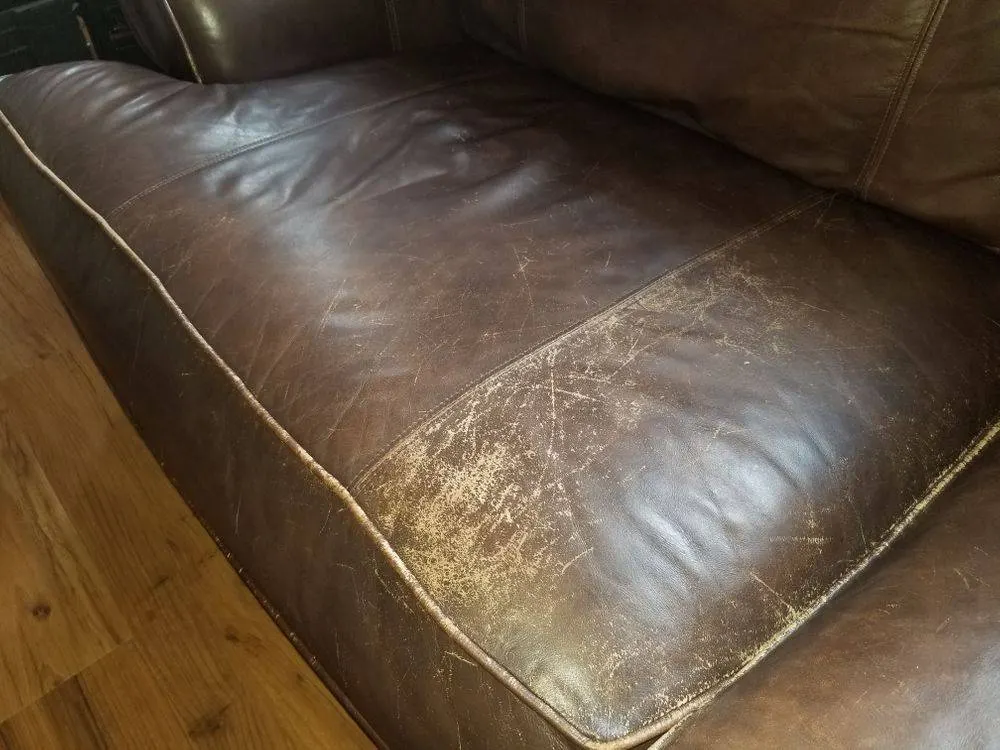
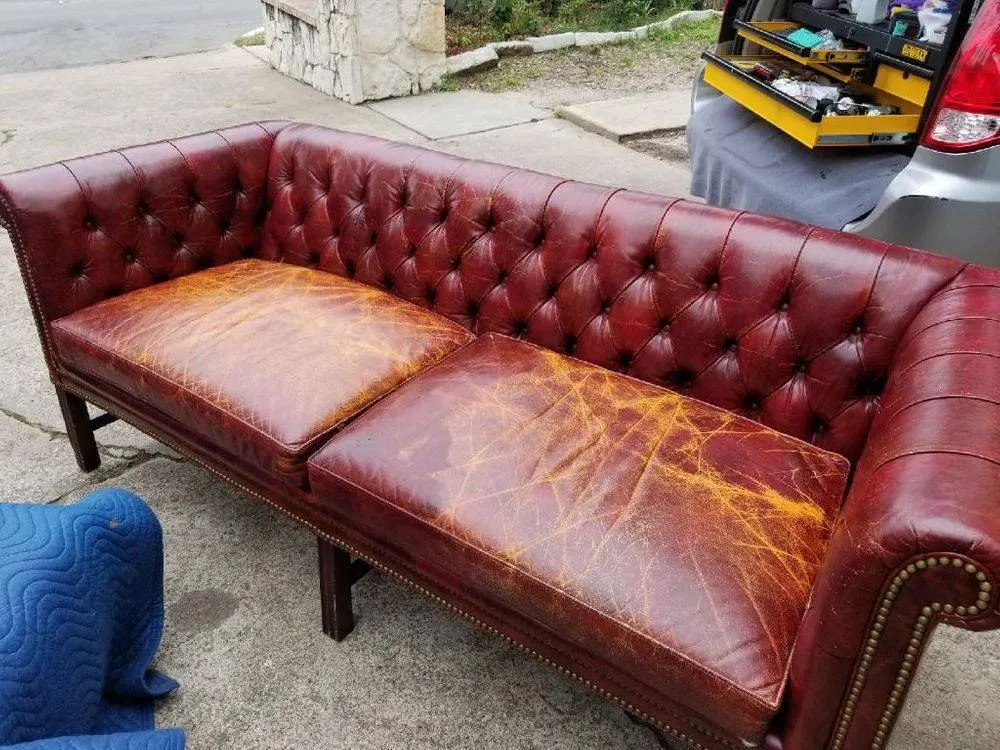
Where the topcoat has already worn through, the dye reaches the pigment layer directly and nothing lifts it, because you would be removing the color of the sofa along with it.
Cleaning it properly
The method matters more than the product on this particular problem.
Vacuum first with a soft brush attachment, especially the seams, so you are not dragging grit across the finish.
Test the cleaner on a hidden area and let it dry fully before judging.
Apply cleaner to a cloth rather than the leather, and work the whole panel in overlapping circles with light pressure. Do not concentrate on the worst area — transfer is spread across the contact zone even where you cannot see it, and cleaning a patch leaves a boundary.
Change to a clean part of the cloth constantly. You are lifting dye off and transferring it to the cloth; a saturated cloth just moves it around.
Expect to repeat. Two or three light passes over a few days remove more than one aggressive session, and they do so without abrading the topcoat.
Wipe with a barely damp cloth, dry with a third, and let the panel dry naturally.
What not to do
Dye transfer produces more avoidable damage than almost any other complaint, because it looks like something that should scrub off.
Do not scrub. Pressure and abrasion wear the topcoat, and once that is gone the dye reaches the pigment and the problem becomes permanent.
Do not use alcohol, hand sanitizer, disinfectant wipes or all-purpose spray. They lift dye, and they lift the finish with it. This is the single most common way a cleanable haze becomes a pale patch that needs refinishing.
Do not use a melamine sponge. It is an abrasive, and it takes the finish off with the mark.
Do not use bleach or any whitening product on light leather. It damages the finish and can leave a permanent yellow cast.
And do not condition to hide it. Conditioner temporarily darkens and blends the haze, then dries back, and now there is product sitting over the dye.
Aniline and unfinished leather
This is where the answer changes substantially, so it is worth confirming what you have.
Put a drop of water on a hidden area. If it beads, the leather is pigmented and sealed, and everything above applies.
If it soaks in within a few seconds, the leather is aniline or lightly semi-aniline. There is no protective coating, so transferred dye goes into the hide rather than sitting on a topcoat.
On those materials, home cleaning frequently makes things worse: the cleaner spreads the dye, lifts some of the leather's own color, and leaves a lighter halo around a darker center.
Specialist treatment can reduce it considerably, and complete removal is not guaranteed. Where the transfer is severe, converting to a pigmented finish is sometimes the pragmatic option — but that changes the character of the leather permanently and should be a considered decision.
If your leather absorbs a water drop, the useful move is to photograph the problem and ask before attempting anything.
Vehicles get it worse
Car seats concentrate every factor that drives dye transfer.
Contact is prolonged and under body weight. Cabin temperatures in a parked car in a Dallas summer are far above room temperature, and heat is what mobilizes indigo.
Light-colored interiors — cream, beige, light gray — are common in this region precisely because they stay cooler, which means the vehicles most likely to show transfer are also the ones most exposed to the heat that causes it.
The classic pattern is a blue-gray cast on the seat cushion and the lower backrest of the driver's and front passenger seats, worst in the areas that take the most weight.
The same rules apply: clean the whole panel promptly, do not scrub, keep solvents away. And a protective treatment on a light interior is genuinely worth the cost here in a way it is not everywhere.
Prevention that actually works
Three measures, in order of effectiveness.
A leather protector made for finished upholstery. It makes the surface less receptive to dye migration and buys real time before anything bonds. It needs reapplying after cleaning, because cleaning removes it too — a protector applied once at delivery and never renewed is doing nothing three years later.
A shorter cleaning interval on light pieces. Every six to eight weeks, whole panels, gentle. Transfer that never gets more than a few weeks old never becomes a problem.
A throw over the most-used seat during heavy-wear periods. Unglamorous and completely effective, and it costs nothing.
Beyond that: wash new dark denim before wearing it around light furniture, keep newspapers off arms, and be wary of cheap colored cushions and throws resting permanently on a pale sofa.
When to hand it over
Some situations are better assessed than attempted.
Any transfer on aniline or unfinished leather.
Transfer that has been present for months, where the realistic outcome is partial cleaning plus refinishing.
Any area where the topcoat has already worn through — check by rubbing gently with a white cloth in an inconspicuous spot; color on the cloth means the seal has gone.
Anything that has already been treated with a solvent, alcohol or an abrasive, because the finish may now be damaged as well as discolored.
And any case where two or three gentle cleaning passes have not made a clear difference. At that point more effort is more risk, and a specialist has products that reach further without abrading.
What to send for an assessment
Photograph the whole piece in flat daylight, so the pattern of discoloration is visible. Dye transfer follows contact areas, which is what distinguishes it from fading or soil.
Photograph the worst area square-on, and again from a low raking angle.
Photograph an unaffected area — the back of the piece, or under a cushion — as a reference for the original color.
Do the water-drop test on a hidden area and report the result, since finished and unfinished leather need different answers.
Do the white-cloth rub in an inconspicuous spot and photograph the cloth. That tells a specialist whether the topcoat is intact, which is the single most important variable.
And say how long it has been there and what has been used on it so far. Both change what is realistically achievable.
One more detail worth including: whether the discoloration is even across the contact area or heavier in patches. Even coverage points to ordinary clothing transfer and cleans predictably. Heavier patches with defined edges usually mean a specific item sat there repeatedly — a colored throw, a bag, a newspaper — and those areas have taken more dye and may need refinishing while the rest of the panel cleans.
Questions we get asked next
- Why does my dark sofa not show any denim transfer?
- It almost certainly has the same transfer — dark leather simply hides it, because blue-gray against dark brown is close in tone. It usually becomes visible only when a panel is professionally cleaned and the cloth comes away gray.
- Will the haze come back after cleaning?
- Yes, if nothing else changes, because the source is ordinary clothing. That is why a protector plus a regular cleaning interval is the answer rather than a single deep clean — you are managing an ongoing process rather than removing a one-time stain.
- Can newsprint on a light armrest be removed?
- Usually, and it responds to the same approach as denim: whole-panel cleaning, light pressure, repeat passes rather than one aggressive one. Newsprint sits well on the surface, so fresh transfer often lifts completely.
- Is dye transfer covered by a furniture warranty?
- Rarely, since it comes from the owner's clothing rather than a defect in the piece. Some retailers sell protection plans that cover it explicitly, which is worth checking if you have one — but the practical protection is a leather protector and a cleaning routine.
- dye transfer
- denim
- light leather