Can Tufted or Chesterfield Leather Sofas Be Repaired Without Losing the Detail?
On a Chesterfield the detail is the point. The risk in any repair is filling in the very thing that makes it a Chesterfield.
Quick answer
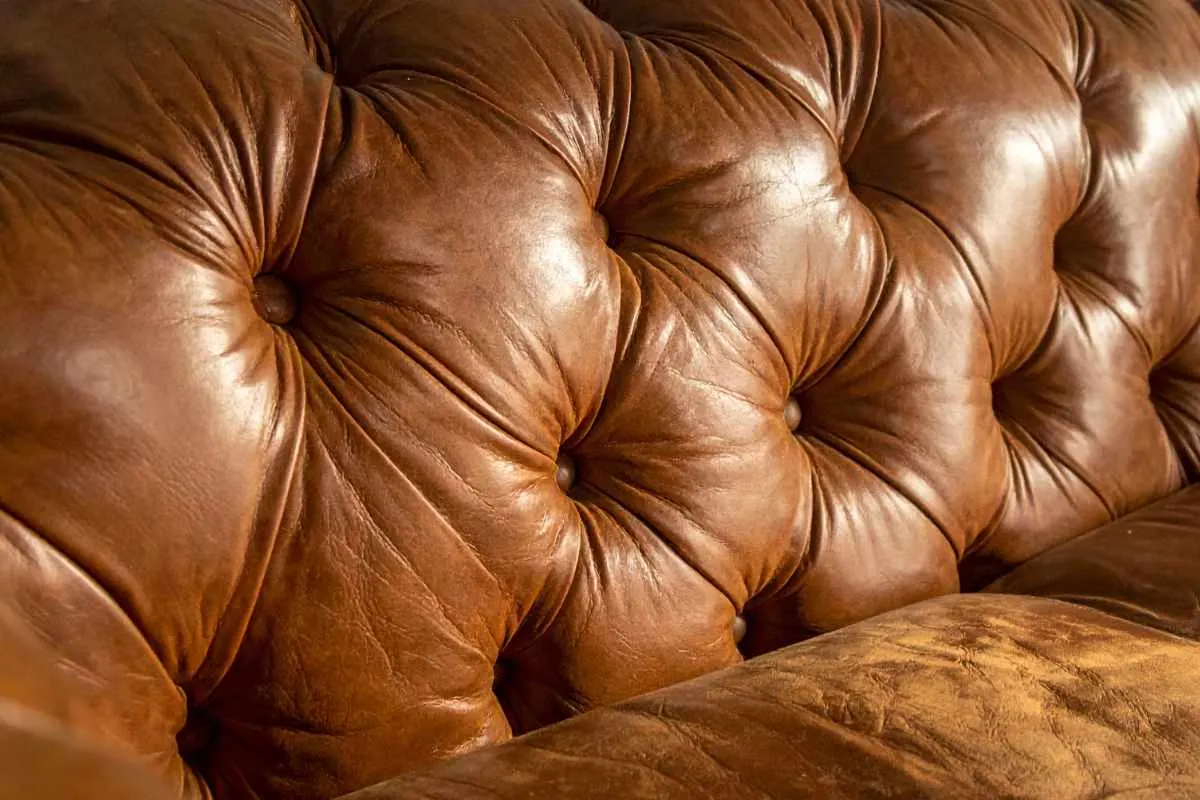
Yes, and the discipline is different from flat-panel work. Deep buttoning creates folds, valleys and buttons that define the piece, so color has to be applied thinly and worked into the detail rather than built up over it — heavy application softens the crispness of the folds and drowns the buttons. Repairs concentrate in the fold crowns and around buttons, where the leather is stressed and where cleaning never reaches.
At a glance
| Main risk | Product build-up filling the folds and drowning the buttons |
|---|---|
| Wear points | Fold crowns, button surrounds, arm rolls and the front edge |
| Cleaning | Soil accumulates in the valleys and around every button |
| Buttons | Pulled or missing buttons are a defined, separate repair |
| Time | Tufted work takes considerably longer than flat panels |
Where tufted sofas fail
Predictable, once you know the geometry.
The crowns of the folds on the seat and back, which take contact and abrade first — usually showing as color loss along the ridges while the valleys stay original.
Around the buttons, where the leather is under most tension. Cracking radiating from a button is the classic tufted failure.
The button surrounds themselves, where the leather can split and release the button.
The rolled arms, which on a Chesterfield are a defining feature and take contact along their whole length.
The front edge of the seat, as on any sofa.
And the valleys, which do not wear but darken with accumulated soil until the contrast between ridge and valley is the wrong way round — pale crowns and dark valleys, when it should be even.
That last one is a cleaning problem rather than damage, and it accounts for a lot of tired-looking Chesterfields.
Cleaning a tufted piece properly
This is where most of the improvement comes from, and it takes far longer than cleaning a flat sofa.
Soil collects in the valleys and around every button, and a cloth passed over the surface only touches the crowns.
So cleaning is done with a soft brush worked into the valleys and around each button, then lifted with a cloth.
It is slow. A tufted back can have dozens of buttons and hundreds of feet of fold, and each one needs attention.
Vacuuming first with a brush attachment removes the loose material and makes the wet stage far more effective.
The buttons themselves collect a surprising amount and are worth individual attention.
Done thoroughly, a clean alone frequently transforms a Chesterfield, because the loss of definition people read as wear is often just soil filling the detail.
And it should always be the first step, since it also reveals what the actual condition underneath is.
Why product build-up is the main risk
This is the specific danger in refinishing a tufted piece and it is worth understanding before commissioning work.
On a flat panel, a slightly heavy application of color or conditioner is a cosmetic issue at worst.
On a tufted piece, product runs into the valleys and pools around the buttons. It builds up there, dries thicker, and softens the crisp line of the fold.
Repeated over several treatments, the valleys shallow out and the buttons appear to sink into a filled surround. The piece loses its definition, which is the thing that made it a Chesterfield.
It also collects and darkens over time, so the valleys end up looking dirty even when they are not.
The correct approach is thin coats, worked with a brush into the detail and immediately worked out of the pooling points, rather than sprayed or wiped on heavily.
It is more labor and it is the difference between a refreshed Chesterfield and a slightly melted-looking one.
The same applies to conditioner, which owners frequently over-apply on tufted furniture precisely because it seems to disappear into the folds.
Recoloring a tufted sofa
Entirely possible, and it is a different job from recoloring a flat piece.
Preparation takes longer, because degreasing and removing old dressings has to reach into every valley and around every button, and residue left there will show as unbonded patches.
Color is applied by brush into the detail and then blended across the crowns, rather than the other way round.
Several very thin coats replace the two or three normal ones, precisely to avoid build-up.
The buttons are colored individually.
Sheen is critical on a tufted piece, because the folds catch light along their length. A finish that is too glossy makes every ridge into a highlight and the piece looks plastic; too matte and the definition disappears.
Cure time is longer, since the material in the valleys is thicker and dries more slowly.
Expect the whole job to take substantially more time than the same size of flat sofa, which is reflected in the quote rather than being a markup.
The padding underneath
On a deep-buttoned piece the padding is doing structural work, and its condition shows on the surface.
Buttoning depends on padding of the right depth and density to form the folds. As it compresses, the folds flatten and the piece loses its shape.
A Chesterfield with shallow, soft-looking tufting usually has compressed padding rather than a leather problem, and no surface work restores it.
Seat cushions on these pieces are often feather, feather-and-down, or a foam core with a wrap, and they need regular plumping to keep their shape.
Traditional pieces may have sprung seats with webbing, coir and horsehair, which is specialist upholstery work when it fails.
Buttons pulling through repeatedly in one area frequently means the padding there has broken down and no longer holds them.
So a piece that has lost its definition should be assessed for padding before anyone quotes on the leather.
Aniline, distressed and antiqued finishes
Chesterfields are frequently finished in ways that complicate matching, and this is worth checking early.
Many are aniline or semi-aniline, which absorb readily, mark from water, and need low-moisture products.
Many have an antiqued or two-tone finish, where a darker tone sits in the recesses and a lighter one on the crowns. That effect is applied deliberately and reproducing it in a repair is genuinely skilled work.
Distressed and hand-rubbed finishes have deliberate variation, which is helpful for hiding repairs and hard to match consistently.
Some are wax-finished or pull-up leathers, which lighten when stretched and darken when relaxed. These behave unlike anything else and need a specialist familiar with them.
So the question to ask before any work is what finish type it is and whether the specialist has worked with it.
A repair matched to the wrong finish type on a two-tone Chesterfield looks obviously wrong even when the base color is perfect.
Caring for a tufted piece
Slightly different from a flat sofa, and mostly about the detail.
Vacuum the valleys and around the buttons regularly with a brush attachment. Grit sitting in a valley abrades the fold above it.
Condition lightly and work it out of the valleys rather than letting it pool. Less product than you think, more often.
Plump and reshape the cushions, particularly on feather-filled pieces, which need it after every use to keep their form.
Keep it out of direct afternoon sun, since fold crowns fade before valleys and produce a striped effect that is difficult to correct.
Deal with a pulled button promptly, because the tension redistributes to the neighboring buttons and they follow.
And keep the piece off exterior walls so air circulates behind it, since a Chesterfield's deep back panel holds moisture against a cold wall.
What to send for an assessment
Photograph the whole piece, and then a close section of the tufting showing several buttons and the folds between them.
Photograph each damaged area close up and at a raking angle, which shows the fold profile.
Photograph any button that has pulled, split or gone missing.
Say whether the valleys look dark from soil or whether the crowns have lost color, since those are different problems.
Press the padding and say whether the tufting feels shallow or soft compared with how it was.
Do a water-drop test on a hidden area, since aniline and pigmented pieces need very different handling.
Say whether the finish is a single color or has a darker tone in the recesses.
And say the age and, if you know it, the maker, because construction varies enormously across Chesterfields.
Questions we get asked next
- Can a Chesterfield be recolored without losing the tufting detail?
- Yes, with the right technique. Color is brushed into the detail in several very thin coats rather than applied heavily, and worked out of the pooling points around buttons and in the valleys. Heavy application is what shallows the folds and drowns the buttons.
- My buttons keep pulling through. Why?
- Usually the padding beneath has degraded and no longer holds them, so the tension redistributes to the neighboring buttons and they follow. Re-setting the buttons alone will not last — the padding in that area needs addressing at the same time.
- Why does my tufted sofa look dirty in the folds?
- Because soil collects in the valleys where a cloth never reaches, while the crowns get wiped. Proper cleaning uses a soft brush worked into every valley and around each button. It is slow, and it frequently transforms a piece on its own.
- Does tufted work cost more than a flat sofa?
- Yes, and it reflects real additional time rather than a markup. Preparation, cleaning, color application and curing all take substantially longer on a deep-buttoned piece, because everything has to be worked into the detail by hand rather than across a flat surface.
- chesterfield
- tufting
- buttons