Why Do Boat Seats Crack and Fade in North Texas Sun?
A boat seat gets the sun twice — once from above and again reflected off the lake — and unlike a car interior there is no glass in between.
Quick answer
Marine vinyl takes unfiltered UV from above and reflected UV off the water, with no glass in between, which is a considerably harder exposure than a car interior. UV degrades the plasticizers and the surface coating; the vinyl stiffens, goes chalky, then cracks where it flexes. Heat accelerates it and the daily wet-dry cycle works the material mechanically. Good marine vinyl is built for this, which is why the failures are usually about age, neglect or the wrong cleaner rather than the material.
At a glance
| Exposure | Direct UV plus reflection off the water, unfiltered by any glass |
|---|---|
| Sequence | Fading, then chalking, then stiffening, then cracking at the flex points |
| First to fail | Horizontal surfaces — seat cushions, sun pads, engine covers |
| Accelerators | Heat, harsh cleaners, and long storage without cover or airflow |
| Good news | Vinyl repairs and recolors reliably while the material is still sound |
Why a boat seat has a harder life than a car seat
Car interiors take a beating in this climate, and boat seats take more.
A vehicle's glass filters a portion of the ultraviolet reaching the interior. A boat seat has nothing between it and the sun.
Water reflects a significant share of the light that hits it, so the same seat also takes UV from below and the side. In effect it is being lit twice.
Boats are used at the times of day and year when the sun is strongest, and they are frequently stored uncovered on a trailer or in an open slip between trips.
And the surface temperature of a dark marine vinyl cushion in direct summer sun is high enough to be genuinely uncomfortable to sit on — which is a useful indicator of what the material is enduring.
So the fair comparison is not with a sofa or even a car seat. It is with outdoor furniture, and marine vinyl is engineered accordingly.
What UV actually does to marine vinyl
Marine vinyl is a PVC layer over a knit or woven backing, with plasticizers mixed in to keep it flexible and a surface coating to protect it.
Ultraviolet light breaks polymer chains in both the coating and the vinyl itself, and it degrades the pigment that gives the material its color.
The first visible result is fading — the color loses depth and shifts, exactly as it does on any pigmented surface.
Next comes chalking, where the degraded surface layer breaks down into a fine powder. Run a finger across a chalky seat and it comes away with residue on it. That is the coating disintegrating rather than dirt.
Meanwhile heat drives plasticizers out of the material. Vinyl that has lost its plasticizers is stiff.
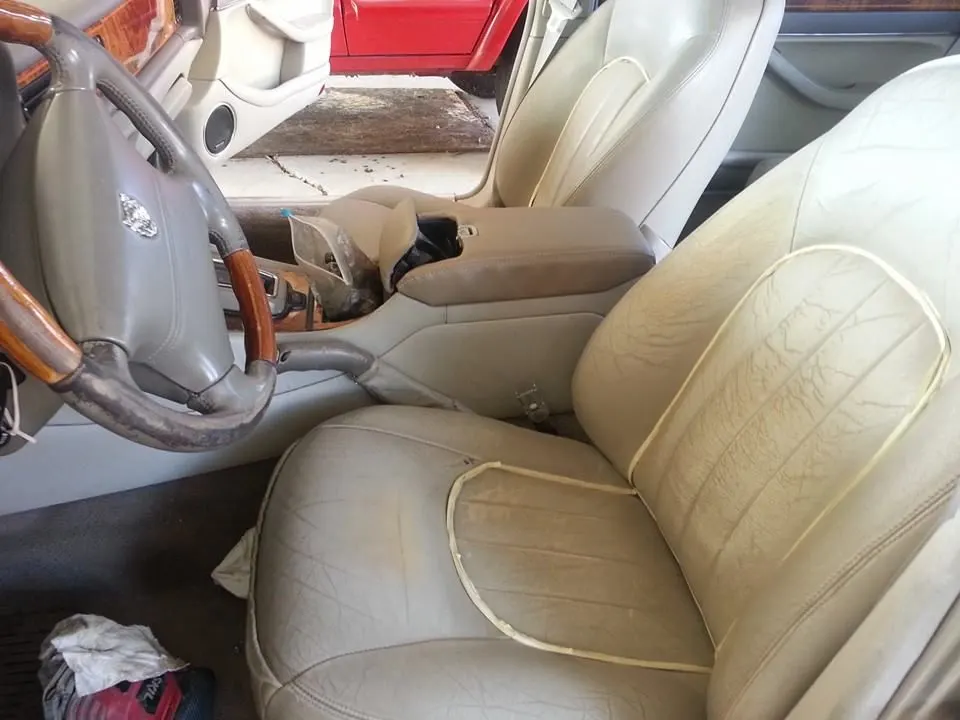
Stiff vinyl cracks where it flexes — the fold at the front of a cushion, the crown of a bolster, beside every seam.
The sequence is consistent enough that you can date a seat's condition by which stage it is at.
Where boat seats fail first
Damage follows exposure and flex, and the pattern is predictable.
Horizontal surfaces take the most UV: seat cushions, sun pads, engine cover cushions, and the tops of backrests. These fade and chalk first.
Seams are next. Stitching holes are stress concentrations, the thread itself degrades in UV, and the material either side is held rigid.
The front fold of a seat cushion, which flexes every time someone sits.
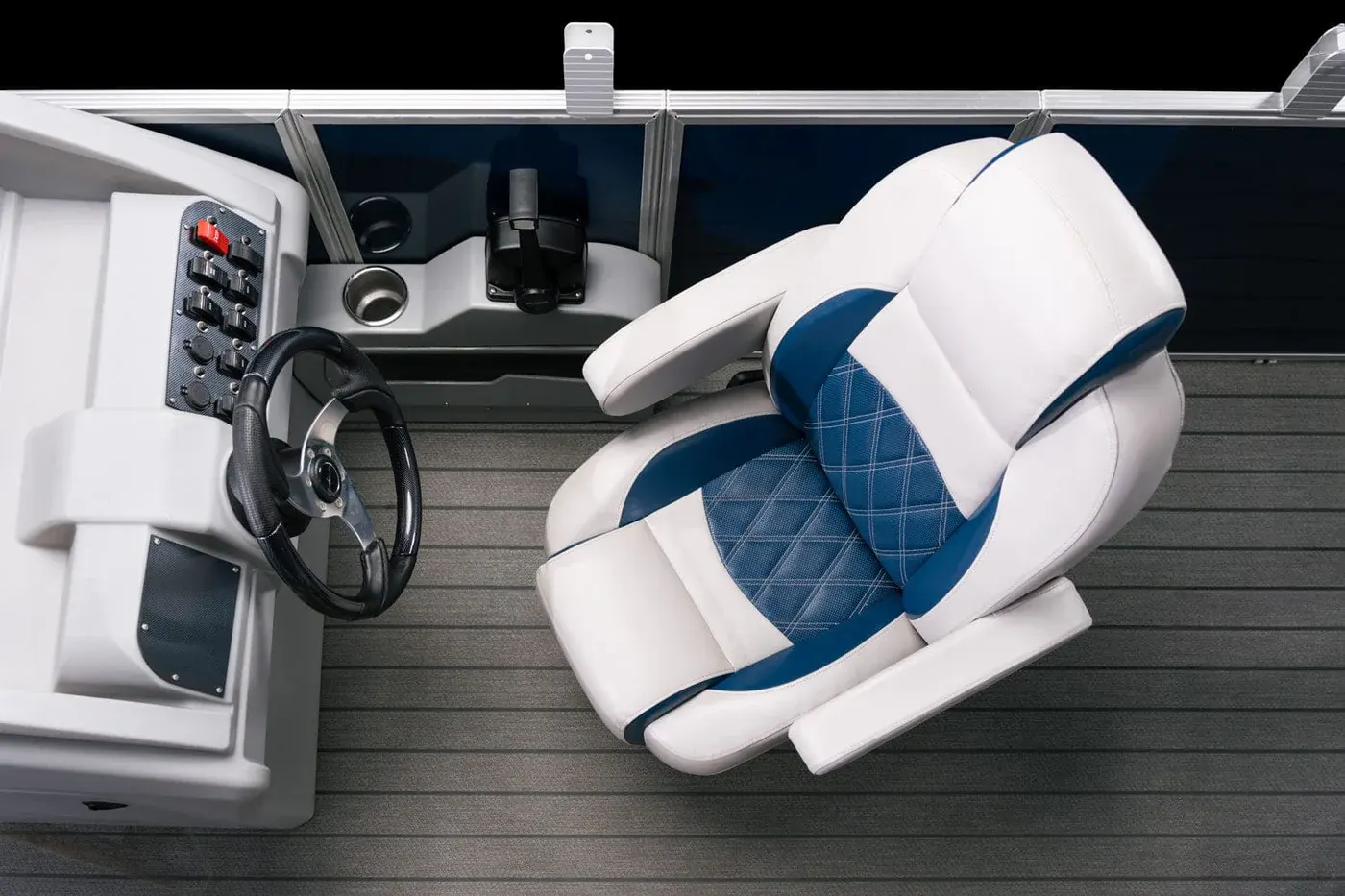
The bolsters of a helm seat, which take sliding entry in the same way a car's driver bolster does.
Vertical surfaces and anything under a console or a T-top last considerably longer, which is why the shaded parts of a boat often look years newer than the exposed parts.
That contrast is diagnostic. If shaded areas look sound and exposed ones are chalky, the material is fine and the problem is exposure — which means recoloring is likely to work well.
The wet-dry cycle adds a second mechanism
Boats get wet and dry repeatedly, which does something a car interior never experiences.
Water sits in seams and in the low points of cushions. It works into stitching holes and into any opening in the surface.
Then the sun dries it, often quickly and at high temperature.
That cycle stresses the material and the thread mechanically, and it drives moisture into the foam beneath through any gap.
It is also what makes mildew a constant issue on boat upholstery, because damp foam in a warm covered boat is close to ideal growing conditions.
So a boat seat is dealing with UV, heat, mechanical flex and repeated wetting at the same time. The material is designed for it, and it is still the hardest environment upholstery faces.
What the marine environment adds locally
North Texas boating has its own specifics beyond the general marine picture.
Lake use here is heavily concentrated in the hottest months, so boats get their exposure in the worst conditions rather than spread through the year.
Boats stored on trailers at home frequently sit uncovered on a driveway between trips, taking full sun without even being used.
Covered storage and dry stack are common and they make an enormous difference to how long upholstery lasts.
Freshwater lakes mean no salt exposure, which removes one degradation factor that coastal boats face — a genuine advantage.
But summer humidity plus a covered boat produces the mildew conditions that dominate the other half of marine upholstery problems.
The practical upshot: the two things that determine how long a boat's seats last here are whether it is covered and whether it gets airflow.
What repairs, and what does not
The material's condition determines the answer more than the damage does.
Vinyl that is faded but still flexible recolors extremely well. It is manufactured to a consistent thickness with an embossed grain that repeats, so the color is rebuilt and the texture matches accurately. This is one of the most satisfying jobs in the trade because a faded boat transforms.
Isolated damage on sound vinyl — a tear, a puncture, a burn, a worn bolster — repairs reliably: backed, filled in thin layers, textured and recolored.
Split seams restitch, and they are the most common single failure on boat seating.
What does not repair durably is vinyl that has gone chalky and crazed throughout. Once the material itself is breaking down, a new coating sits on a failing substrate and the cracking continues around it.
The test is simple: press a thumb firmly on the vinyl beside the damage. If fine cracks appear or the surface powders onto your thumb, the material is at the end of its life and reupholstery is the honest recommendation.
The cleaners that finish seats off early
A large share of premature marine vinyl failure is chemical, and most of it is avoidable.
Bleach-based cleaners are the main offender. They are reached for constantly on mildew, and they strip plasticizers and degrade both the coating and the stitching. A boat cleaned with bleach every season ages visibly faster.
Strong alkaline hull cleaners and degreasers do the same.
Alcohol-based products dissolve the surface coating.
Melamine sponges are abrasive and remove the grain along with the mark.
Pressure washing forces water into seams and behind panels, and it can lift stitching.
The correct approach is a cleaner made for marine vinyl, applied to a cloth or a soft brush, rinsed and dried — and mildew treated with a product intended for the material rather than with household bleach.
What actually extends the life
In order of effect.
Cover the boat. A properly fitted cover or a covered slip removes the majority of the UV, and it is by a wide margin the most effective thing available.
Ensure airflow under any cover. A cover that traps moisture swaps a UV problem for a mildew problem, so vents matter as much as the cover itself.
Rinse and dry the upholstery after each outing. Fresh water removes whatever has landed on it, and drying prevents water sitting in seams.
Apply a UV protectant made for marine vinyl a few times a season, buffed off rather than left glossy. This is one of the few products that genuinely earns its cost in this application.
Deal with seam splits immediately, since they grow fast in a marine environment.
And keep the wrong cleaners off the boat entirely, which costs nothing and is the change most owners have not made.
Timing the work around the season
There is a practical scheduling point that saves money and gets a better result.
The end of the season is the ideal time. The boat is coming out of use, there is no pressure to have it back on the water, and the cure period costs nothing.
It also means the boat goes into storage with sound upholstery rather than with damage that will worsen over months of sitting.
Spring, before the season starts, is the second best option and it is when most people call — which means it is the busiest period.
Mid-season work is entirely possible and it costs the owner use of the boat during the cure period, which in July is the expensive time to lose.
For the work itself, a shaded or covered location is far better than an open trailer in the sun, for the same reasons that apply to vehicles.
Why color choice matters more on a boat
If upholstery is being replaced or recolored, the color decision has consequences beyond appearance in this climate.
Dark vinyl absorbs far more solar energy than light vinyl. On a boat in open sun, a dark seat runs considerably hotter than a white one beside it, and that surface temperature is what drives plasticizers out of the material.
So dark seats stiffen and crack sooner than light seats on the same boat, of the same age, in the same conditions.
They are also uncomfortable to sit on after the boat has been in the sun, which on a Texas lake is a practical issue rather than a minor one.
The counterpoint is that light vinyl shows everything — soil, dye transfer from clothing, sunscreen marks, and pink staining in particular, which is dramatic on white and easy to miss on dark blue.
The usual sensible compromise is light or mid-tone on horizontal surfaces that take sun and get sat on, with darker material reserved for vertical faces, trim and areas that stay shaded.
That is also how many manufacturers specify it, and it is worth keeping rather than overriding for the sake of a uniform look.
What to send for an assessment
Photograph the affected seating in daylight but not in direct glare, and avoid flash.
Take close-ups of the worst area square-on and from a low raking angle, which shows whether the surface is merely faded or has started to craze.
Photograph a shaded area of the same material — under a console, on the underside of a cushion, behind a backrest — which shows the original color and the material's condition without exposure.
Press a thumb firmly on the vinyl beside the damage and say what happened: nothing, fine cracks, or powder on your thumb. That single answer usually determines whether the recommendation is repair, recolor or reupholster.
Say how the boat is stored, whether it is covered, and what has been used to clean it.
And say whether there is any smell from the cushions, because mildew in the foam is a separate problem from anything visible on the surface.
Questions we get asked next
- Can faded boat seats be recolored rather than replaced?
- Yes, and it is one of the best-value jobs in marine upholstery provided the vinyl is still flexible. The material is manufactured to a consistent thickness with a repeating embossed grain, so color rebuilds and texture matches reliably. The limit is chalky, crazed vinyl, where a new coating sits on a failing substrate.
- My seats are chalky. Is that dirt?
- No. Chalking is the surface coating breaking down into powder under UV. Cleaning removes the loose residue and more appears, because the source is the material rather than something on it. Light chalking on otherwise sound vinyl recolors well; heavy chalking with crazing means the vinyl has aged out.
- Is a cover really worth it?
- It is the single most effective thing you can do for boat upholstery. UV is the primary degradation mechanism and a cover removes most of it. The one condition is airflow — a cover that traps moisture against warm upholstery in a Texas summer produces mildew, so vents matter as much as coverage.
- Why do my seams fail before the vinyl does?
- Thread degrades in UV too, and seams are stress concentrations that take load every time someone sits or the boat moves through chop. Water sitting in stitching holes accelerates it. Seams are worth checking at the start and end of every season, because they are fast to fix early and expensive once they have run.
- boat seats
- marine vinyl
- UV damage