Can a Torn Work-Truck Vinyl Seat Be Repaired for Daily Heavy Use?
Work vehicles get vinyl for a reason, and the same reason makes their seats among the most reliable things to repair.
Quick answer
Yes. Vinyl is manufactured to a consistent thickness with an embossed grain that repeats, so filler bonds predictably and texture matches accurately — which makes it the most reliable seating material to repair. A properly built repair on a work-truck seat takes the same daily abuse the original surface did. The repairs that fail are the ones done thick and fast; thin layers and a proper cure are what make it hold.
At a glance
| Why vinyl repairs well | Uniform thickness, repeating embossed grain, predictable bonding |
|---|---|
| Typical damage | Tears from tools and belts, seam splits, burns, worn bolsters, cracking |
| Durability | A correctly built repair wears at the same rate as the surface around it |
| What fails | Thick filler, rushed cure, or work over an uncleaned surface |
| Downtime | Usually a couple of hours on site — no need to take the truck off the road |
Why work vehicles get vinyl in the first place
It is worth starting here, because it explains why the repair outlook is so good.
Vinyl is specified for work trucks, fleet vehicles and base-trim models because it takes punishment. It resists abrasion, tolerates aggressive cleaning, does not absorb spills, and does not need conditioning to stay serviceable.
It is also manufactured rather than grown. A hide varies in thickness and density across a panel; vinyl is a consistent sheet with a consistent backing.
That consistency is exactly what makes it repairable. Filler bonds the same way everywhere, color behaves predictably, and the embossed grain repeats at a fixed interval so a texture plate reproduces it accurately.
The practical result is that vinyl seat repairs come out invisible more reliably than leather repairs do, which is the opposite of what most owners assume.
How work-truck seats actually fail
The damage pattern is specific and it is worth recognizing, because it points at prevention as well as repair.
Tears from tools. A utility knife, a screwdriver or a tape measure on a belt catches the seat on entry, and vinyl cuts cleanly rather than resisting.
Punctures and gouges from anything carried in a back pocket or hooked on a tool belt.
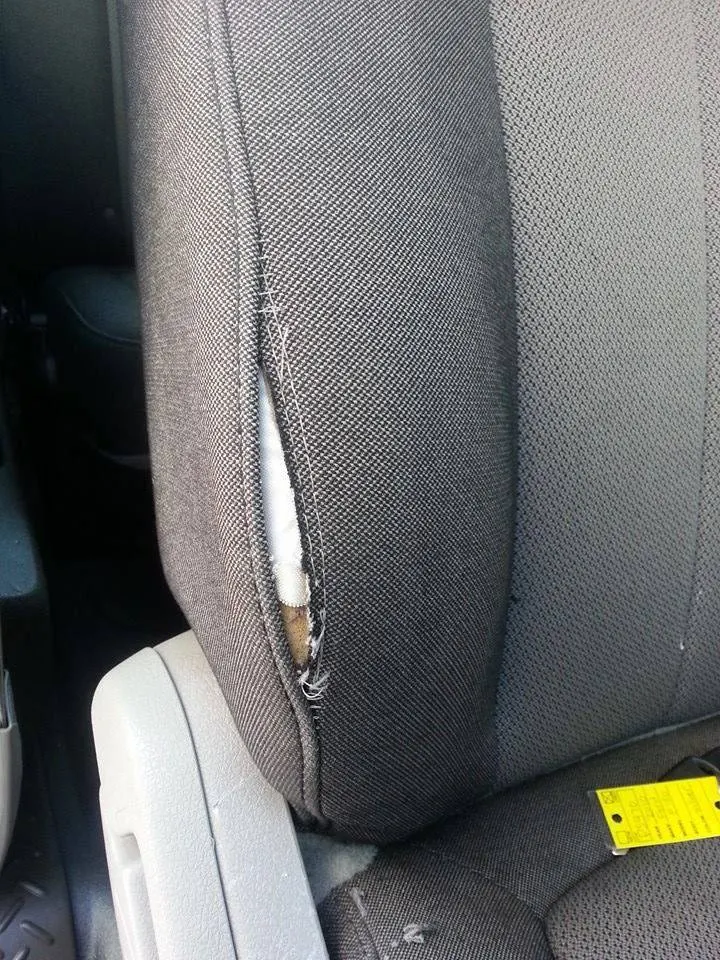
Seam splits, which are the most common single failure. Seams take the load every time someone slides in and out, and on a vehicle with several drivers that happens many times a day.
Bolster abrasion, from the same sliding entry that wears a leather bolster, accelerated by workwear fabric which is coarser than ordinary clothing.
Cracking across the seat cushion, from heat and UV drying the plasticizers out — the same mechanism as leather, on a material that also stiffens.
And burns, from cigarettes, sparks and hot tools set down on a seat.
How a vinyl seat repair is built
The sequence is the same as any surface repair, with vinyl-specific materials at each stage.
The area is cleaned and degreased. Work vehicle interiors accumulate more than most — hand cleaner, oil, grease, dust and whatever the job involves — and none of it lets a finish bond.
Any lifted or torn edges are trimmed back to sound material and stabilized.
A backing material is bonded behind the opening so filler has a floor rather than dropping into the foam.
Vinyl-grade flexible filler is built up in thin layers, each allowed to cure. This is where good and bad repairs separate: thin layers flex with the panel, and a thick fill cracks at its border the first time someone drops into the seat.
Grain is pressed into the final layer with a plate matched to the vinyl's pattern.
Color is sprayed in thin coats and feathered well past the repair, then sealed with an automotive-grade topcoat chosen for abrasion and heat.
Will it hold up to daily use
This is the question that matters for a work vehicle, and the honest answer is yes with a condition attached.
A repair built correctly — clean surface, thin flexible layers, proper cure, correct topcoat — wears at the same rate as the vinyl around it. There is no reason for it to fail before the surrounding material does.
What fails is rushed work. Filler applied thick to save time cracks at its edge. A cure cut short means the topcoat takes friction before it has hardened. Work over a surface that was not properly degreased lifts.
So the practical guidance for a fleet manager is to judge on method rather than on speed. A repair done in two careful hours outlasts one done in forty minutes by a wide margin, and on a vehicle in daily service that difference shows within months.
The other variable is what caused the damage. If the tool that cut the seat is still on the same belt, the seat will be cut again — and no repair addresses that.
Seam splits deserve their own answer
They are the most common failure on multi-driver vehicles and the one most often handled badly.
A split seam is thread failure, not material failure. The vinyl either side is usually sound.
The correct repair is restitching, using thread suited to the material and the load.
The common mistake is gluing. Adhesive in a seam holds the two edges in a slightly wrong alignment, it prevents proper restitching later, and it usually opens again beside the glue line within weeks.
Caught early, a seam split is a fast repair. Left running, the stitching continues to fail along its length and the material either side tears, at which point the panel needs rebuilding as well as sewing.
For a fleet, seams are the thing worth inspecting on a schedule. A minute per vehicle catches them while they are still quick.
Heat, UV and the Texas work vehicle
Work trucks live outside, which makes them the hardest case in this region.
Cabin temperatures in a vehicle parked on a job site through a Texas afternoon run far above ambient, every day, for months.
That heat drives plasticizers out of vinyl. Vinyl that has lost plasticizer is stiff, and stiff vinyl cracks where it flexes — the seat cushion fold, the bolster crown, beside the seams.
UV through the glass degrades the surface at the same time, which is why work-truck seats often go chalky and faded before they crack.
So the damage a fleet sees is usually two problems together: mechanical damage from tools and wear, and material degradation from the environment.
The second is what determines whether a repair is worth doing. A tear in sound vinyl repairs and lasts. A tear in vinyl that is already chalky and crazed sits in material that is failing generally, and the honest recommendation there is often to plan for seat covers or replacement.
What actually extends the life of these seats
For a work vehicle, prevention is cheaper than repair and most of it costs nothing.
Seat covers, fitted properly, on vehicles where tools and workwear are the main threat. This is the highest-return measure by a wide margin, and it is the standard answer for genuine trade use.
A habit of sitting down before swinging legs in, which removes most of the sliding abrasion on the bolster.
Tools off belts before getting in, which removes most of the tears.
Cleaning with a neutral cleaner rather than the degreasers and solvents that are already in the vehicle. Shop degreasers strip plasticizers out of vinyl and are a leading cause of premature cracking.
A vinyl dressing with UV protection a few times a year, buffed off rather than left glossy — a slippery driver's seat is a genuine nuisance.
And shade where the vehicle is parked, which is often not available on a job site but is worth taking when it is. A truck that spends its lunch hours under a tree rather than in an open lot accumulates measurably less heat damage over a season.
The fleet arithmetic
For a business running several vehicles, the calculation is about downtime as much as cost.
Interior repair is mobile, so vehicles do not leave the yard or the job site. A seat repaired in the parking lot at the depot is a vehicle that has lost no working time.
Repairs across several vehicles at one location share setup, color mixing and travel, so per-vehicle cost drops substantially with volume.
Scheduling around a cure period matters more here than for a private car. Work done in the morning gives the whole day; work done at five in humid weather means an overnight before the seat should take friction.
It is worth triaging the fleet before booking: which seats have sound vinyl with specific damage, which have material that is generally degraded, and which are better served by covers. Money spread evenly across all three is money partly wasted.
And the driver-habit conversation is worth having at the same time. A fleet that adopts tools-off-belt and covers on the worst-used vehicles sees the repair interval lengthen noticeably.
What to send for an assessment
Photograph the damage square-on with the door open in daylight, no flash, with something for scale beside it.
Take a second shot from a low raking angle so depth and any lifted edges show.
Photograph an undamaged part of the same seat for color and texture reference.
Press a thumb firmly on the vinyl a few inches from the damage and say what happens. If fine cracks appear or the surface feels chalky, the material is degrading generally and that changes the recommendation.
Say how many vehicles are involved and whether they are the same model and color, because a fleet is quoted differently from a single seat.
Say where the vehicles are and what access window works — depot, job site, overnight — since that shapes the plan more than the damage does.
Include a photograph of the seam areas even where nothing has split yet. Seams are the earliest warning on a multi-driver vehicle, and stitching that has started to loosen is a five-minute job now and a panel rebuild in three months.
And say honestly what the vehicles are used for. A plumber's van, a landscaping truck and a service vehicle carrying nothing sharper than a laptop have completely different damage profiles, and the right recommendation — repair, covers, or both — depends on which one you are running.
Questions we get asked next
- Is a repaired vinyl seat as strong as it was?
- In the repaired area, effectively yes — a backing bonded behind the opening carries the load and the filler flexes with the panel. It is not armored, so the same tool that cut it can cut it again, but under normal use it wears at the same rate as the vinyl around it.
- Is it cheaper to just fit seat covers?
- Covers are cheaper up front and they are the right answer for genuine trade use where tools and workwear will keep causing damage. They do not repair what is underneath, though, and a torn seat under a cover keeps tearing. The usual sensible order is repair once, then cover to protect it.
- Can several trucks be done in one visit?
- Yes, and it is the efficient way to do it. Setup, color mixing and travel are shared across vehicles at one location, so per-vehicle cost drops with volume. It is worth booking the whole group rather than dealing with each seat as it becomes annoying.
- My vinyl is cracked everywhere, not just torn. Worth repairing?
- Probably not as a spot repair. Widespread crazing means the vinyl has lost its plasticizers and is failing generally, so a repair sits in material that keeps cracking around it. Covers or seat replacement are the honest recommendations at that point.
- work trucks
- vinyl
- fleet