Why Is Color Rubbing Off My Leather When I Clean or Sit on It?
Pigment on a cleaning cloth is not dirt coming off. It is the finish coming off, and every pass removes more of it.
Quick answer
The clear topcoat that seals the pigment has worn through, so bare pigment is exposed and comes away on anything that rubs it. It is not dirt and it is not the leather bleeding — it is the finish failing. Stop cleaning that area immediately, because each pass takes more pigment off. The fix is refinishing: clean, stabilize, rebuild the color layer, and seal it. Cleaning and conditioning cannot restore a coating that has gone.
At a glance
| What it means | The clear topcoat is worn through; bare pigment is exposed |
|---|---|
| Not | Dirt, dye bleeding, or a manufacturing fault in most cases |
| Stop | Cleaning that area — every pass removes more color |
| Where it starts | Seat fronts, arm crowns, headrests, driver's bolster |
| The fix | Refinishing — rebuild the color layer and seal it |
What is actually coming off on the cloth
A finished leather surface is built in layers: the hide, a pigment layer that provides the color, and a clear flexible topcoat over it that protects the pigment from abrasion and moisture.
The topcoat is the sacrificial layer. It takes the friction of daily use, and over years it wears thin and then through, particularly where contact is heaviest.
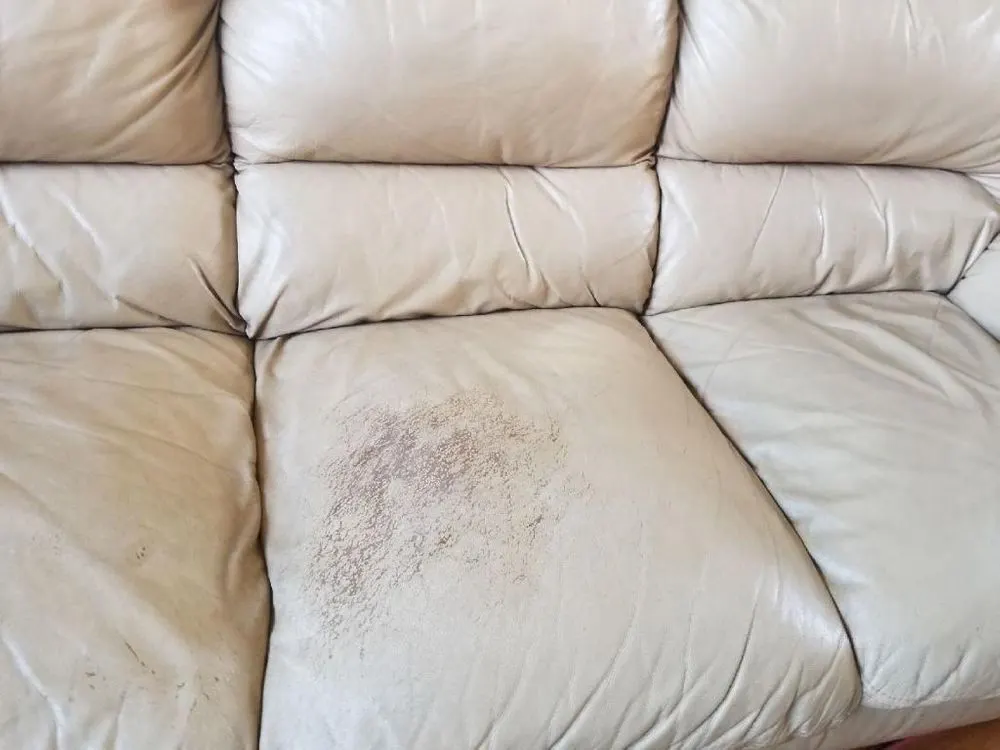
Once it has gone, the pigment layer is exposed directly. Pigment is designed to be protected, not to be rubbed, so it comes away on a cloth, on clothing, on hands.
So when you see color on a cleaning rag, you are not removing dirt to reveal clean leather. You are removing the color layer itself, and what is underneath is the natural shade of the hide — usually a pale, undyed tone that looks nothing like the sofa.
That is why the area gets lighter rather than cleaner as you keep going.
Why cleaning makes it worse
This is the part worth acting on immediately, because the instinct is to clean harder.
A cleaner is designed to lift soil from a sealed surface. On an area where the seal has gone, the same product acts directly on exposed pigment, and the mechanical action of the cloth removes it.
Each pass takes a little more. A patch that was slightly pale on Monday can be visibly lighter by the weekend if someone has been working at it.
The most common story a specialist hears is that a customer noticed a dull patch, cleaned it thoroughly, saw color on the cloth, assumed it was ingrained dirt, and cleaned it again more firmly. By the time it reaches an assessment, the area has been taken back further than the original wear.
The correct response the moment color appears on a cloth is to stop cleaning that area entirely and leave it alone until it can be assessed.
Where it always starts
Topcoat wear is not random. It maps onto friction, and knowing the pattern means catching it before pigment is exposed.
The front edge of a seat cushion, where people slide across on every sit and stand.
The crown of an armrest, which takes forearms, sleeves, watches and bag straps.
Headrests, which take the combination of friction and hair products — and hair products contain compounds that soften a topcoat as well as abrading it.
In vehicles, the driver's outer bolster, which is the single highest-abrasion surface in most cars.
On office chairs, the arm caps and the seat front, in that order.
If you check those specific places every few months and catch a dulling patch before it turns pale, you are looking at a small refinish rather than a whole-panel one.
Distinguishing this from the other causes of color loss
Three different problems produce a paler area, and they need different work.
Topcoat wear with exposed pigment — the subject here — follows contact. The pale areas are exactly where people touch, and color transfers onto a cloth. This needs refinishing.
UV fading follows light rather than contact. The pale areas correspond to a window, and they usually cover a whole panel including places nobody touches. Nothing transfers onto a cloth. This needs recoloring, which is similar work driven by a different cause.
Chemical damage from solvents has a boundary. The affected area often has a visible edge where someone wiped, and the surface may also be dull or tacky. This also needs refinishing, and the exposure has to stop first.
A quick test that separates the first from the second: rub an inconspicuous part of the pale area gently with a white cloth. Color on the cloth means the topcoat is gone. No color means the pigment is intact and the problem is fading or soil.
The case where it is not wear
There is one situation where color transfer is not a worn topcoat, and it is worth ruling out.
On aniline and some semi-aniline leathers, the dye is in the hide rather than in a pigment layer, and there may be little or no topcoat by design. Some of these leathers will transfer a small amount of color when new, particularly in deep or saturated shades, and manufacturers sometimes note this as a characteristic rather than a fault.
The distinguishing features: it happens across the whole piece rather than only where people touch, it is present from early in the piece's life rather than appearing after years, and the leather shows the natural grain and absorbs a water drop readily.
If that describes your piece, the transfer is a property of the material. It can be reduced with a specialist protective treatment, and it cannot be fixed by refinishing without converting the leather to a pigmented finish — which changes its character permanently.
If the transfer appeared after several years of use and only in the places you sit and lean, it is worn topcoat.
What refinishing involves
Rebuilding the color layer is standard work with a reliable outcome, provided the hide underneath is sound.
The area is cleaned and degreased. On a headrest or an arm this stage matters more than usual, because body oil that has reached exposed pigment has to come out or new color will not bond.
The remaining finish is assessed and stabilized: keyed where it is still intact, taken back where it has broken down, so there is a sound edge to blend into.
Where the surface has become uneven — worn areas often dish slightly — flexible filler levels it and grain is pressed to match the surrounding texture.
Color is mixed against the actual leather, not from a chart, tested on a hidden area and checked in both daylight and evening light, then sprayed in thin coats and feathered well past the worn area.
A flexible topcoat seals it, restoring the sacrificial layer that wore away in the first place. Sheen is matched to the rest of the piece.
On a seat or an arm, the blend usually covers the whole panel, because a perfectly matched patch on a slightly aged panel is still visible as a patch.
Why it happens faster here
Two North Texas conditions accelerate topcoat wear specifically.
Dry conditioned air runs for most of the year and stiffens finishes. A stiff topcoat abrades rather than flexing under friction, so the same amount of use wears it away faster than it would in a humid climate.
Strong UV through west and south-facing windows degrades the binder holding the topcoat together, which has the same effect from a different direction — a brittle coating gives up its surface more readily.
Vehicles compound both. Cabin temperatures in a car parked outside through summer are far above anything indoors, and the driver's bolster takes friction on every entry while in that state.
The practical implication: conditioning on schedule is not just about preventing cracks. A supple topcoat resists abrasion, so conditioning directly extends the life of the color layer beneath it.
What to do right now
If color is coming off, five things help and none of them cost anything.
Stop cleaning that area. Not reduce, stop. Every pass removes more pigment.
Stop conditioning it too. Conditioner on exposed pigment can lift it, and it will not restore a coating that is gone.
Cover the area if it is somewhere that keeps getting rubbed, so the exposed pigment is protected until it can be refinished.
Reduce use of that specific seat if you can. Swapping cushions on a sofa spreads the load and stops the worst area getting worse.
Photograph it now, in daylight, before anything else changes. A specialist wants to see how much pigment is left, and that changes week to week once the topcoat is gone.
Preventing it on the rest of the piece
If one area has worn through, the others are behind it on the same curve. There is a real opportunity to keep them there.
Clean the whole piece on a schedule with a product made for finished leather — every two to three months for everyday furniture in this climate. Soil is abrasive, and cleaning removes the grit that grinds a topcoat away.
Condition two to three times a year. A flexible topcoat wears more slowly than a stiff one.
Keep the specific chemistry away: no all-purpose sprays, no disinfectant wipes, no alcohol, no hand sanitizer transferred from hands onto headrests.
Wipe headrests and arm caps with a barely damp cloth weekly, which removes body oil before it can soften the coating.
And move the piece out of direct afternoon sun if that is at all possible, or break the light with blinds.
Getting it assessed
Photograph the pale area square-on in daylight and again from a low raking angle, no flash.
Photograph the cloth with color on it, if you have one. That single image tells a specialist immediately that this is topcoat wear rather than fading, and it saves a diagnostic step.
Photograph an unworn area of the same piece — the back, or under a cushion — for color reference. That is what the new color is matched against.
Say which areas are affected and whether they correspond to contact points or to a window. Contact means wear; window means fading; both means both, which is common on older furniture.
And say honestly how much cleaning has been done since you noticed it. That determines how much pigment is left and therefore how much has to be rebuilt.
Questions we get asked next
- Is this a manufacturing defect I can claim on?
- Usually not — on a piece several years old, a worn topcoat in the places people sit and lean is normal wear rather than a fault. If it appeared within the first year or two, or across areas nobody touches, it is worth raising with the retailer before spending anything on repair.
- Can I just apply a leather color product from a kit?
- On a small, flat, low-flex area of a dark uniform piece it can work. On a seat front or an arm — which is where this problem lives — the flex is high and the blend has to be wide, and color applied without stabilizing the worn edge and sealing afterward tends to lift within months.
- Will the color transfer onto my clothes?
- It can, especially on light clothing against a dark sofa, and especially when the surface is warm or slightly damp. That is a practical reason to cover the area rather than wait, quite apart from the leather itself.
- How much of the sofa needs doing?
- At minimum the affected panel, blended into its neighbors so no boundary shows. If several panels have worn through, refinishing the whole piece usually costs less than treating them one at a time and produces an even result rather than three different ages of finish.
- color transfer
- finish failure
- recoloring