Headlight Restoration or New Headlights in Dallas: Which Do Cloudy Lenses Need?
Most yellow, cloudy headlights only need restoration: the haze sits on the outside of the lens, and it can be sanded away, polished clear and sealed with a UV coating in your driveway in under an hour. New headlight assemblies are for damage inside the lens, such as internal crazing or moisture. Here is how to tell which one you have.
Quick answer
If your headlights in Dallas are yellow or cloudy on the outside of the lens, restoration usually fixes them. We machine-sand the oxidation away in stages, polish the lens clear and seal it with a UV coating, in your driveway, both lights in under an hour. With that UV sealant the clarity lasts years, not months. You need new headlight assemblies only when the crazing or moisture is inside the lens, where polishing cannot reach. That is a parts or body-shop job, not ours.
At a glance
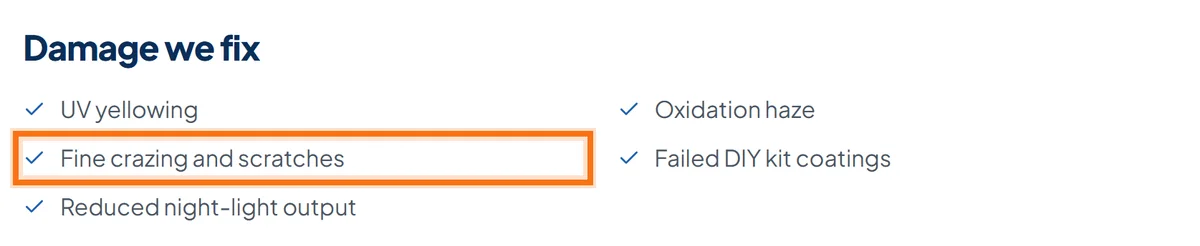
| Restoration fixes | UV yellowing, oxidation haze, fine surface crazing and scratches, failed DIY kit coatings |
|---|---|
| Restoration cannot fix | Crazing or moisture inside the lens |
| Time | Both lights, under an hour, where the car is parked |
| How long it stays clear | Years with the UV sealant; shade or a garage helps |
| New headlight assemblies | A parts or body-shop job; we tell you from photos if you need them |
| Estimate | Free, from phone photos texted to (972) 522-9763 |
Why Headlights Turn Yellow and Cloudy in Texas
Headlight lenses are made of polycarbonate, a clear plastic protected by a factory clearcoat. In Texas, UV from the sun burns that clearcoat off. Once the bare plastic is exposed, it oxidizes and turns yellow, and the surface goes hazy.
Two things happen as a result. The first is light: a hazy lens lets less light through, and the drop is sharp. You notice it most on an unlit road at night, which is exactly when you need the light. The second is looks: cloudy lenses age the front of a car more than any other single feature, even when the paint and interior are in good shape.
The important point for your decision is where the damage sits. Yellowing and haze from the sun are on the outside surface of the lens. That is the layer restoration works on. Damage inside the lens is a different problem, and the next section shows how to tell them apart.
Restore or Replace: Match Your Lens to This Table
Look at your headlights in daylight, then at night with the lights on. Hazy headlights are close to a certainty under the Texas sun, and that damage is what the first four rows of the table below describe. The last two rows are where restoration stops and new headlight assemblies start.
At night, the sign to watch for is reduced light output: the road ahead looks dimmer than it used to, even though both bulbs work. Haze on the lens cuts the light that gets through, and the photos tell us whether that haze is on the surface.
If you are not sure which row you are in, that is normal. A few clear phone photos are enough for us to tell you, and the answer costs you nothing.
| What you see | Where the damage is | Does restoration fix it? | What to do |
|---|---|---|---|
| Yellow tint across the lens | Outside surface (UV yellowing) | Yes | Restore both lights and seal them with a UV coating |
| Milky, hazy or dull lens | Outside surface (oxidation haze) | Yes | Restore both lights and seal them |
| Fine crazing or light scratches on the surface | Outside surface | Yes | Restore; the scratches are sanded out in stages |
| Lens cleared with a store kit, now hazy or peeling again | Outside surface (failed DIY kit coating) | Yes | The old coating comes off, then the lens is restored and properly sealed |
| Fine cracks you can see inside the lens | Inside the lens (internal crazing) | No, polishing cannot reach it | New headlight assemblies from a parts supplier or body shop |
| Water droplets or fog inside the lens | Inside the lens (moisture) | No, polishing cannot reach it | New headlight assemblies from a parts supplier or body shop |
How to read this table: find the row that matches what you see, then read the second column. If the damage is on the outside surface, restoration is the fix. If it is inside the lens, no amount of polishing will clear it, and we will tell you so from your photos before you book anything.
What Headlight Restoration in Your Dallas Driveway Involves
Restoration is done where the car is parked: your driveway at home, your office parking lot, or wherever the vehicle sits. You do not drive anywhere. Both headlights take under an hour.
The work follows three steps:
Machine sanding in stages: the yellow, oxidized layer is sanded away in stages, so the haze and fine surface scratches come out with it.
Polishing: the lens is polished until it is optically clear again, so light passes through it properly.
UV sealing: a UV coating goes on last. This is the step drive-through kits skip, and it is the reason the haze does not come back within months.
We always do both lights as a pair. Restoring one lens and leaving the other leaves the car with an odd-eye look, one bright and one dull. The same method works on fog light lenses and on tail light lenses where they have hazed.
Because the visit is short, you can be at work while it happens. If you want to know what a car visit looks like from start to finish, our guide to how mobile car repair works at your home or workplace walks through it, including why some shade or cover helps.
How Long Does a Restored Headlight Stay Clear?
This is the question that separates a real restoration from a quick polish. Polishing alone makes a lens clear for a while. But polished polycarbonate with no protection left on it re-yellows within months, because the factory clearcoat that kept the sun off is gone.
If your lenses were polished before and turned yellow again within months, the missing piece was most likely the UV coating. That is why the UV sealant matters. With it, restored clarity lasts years, typically comparable to the coating on a new lamp. Sun exposure still matters after the work is done.
Where you park makes a difference. A car that lives in a garage or under shade keeps its clarity longer than one parked in an open lot all day. If your car sits outside at work in Dallas, Plano or Fort Worth, a covered spot or the shaded side of a building is the simplest thing you can do to protect the result.
Why We Don't Recommend Store-Bought Headlight Kits
Parts-store kits are tempting because the job looks simple. The difference is the finish: without a proper UV coating, the clear plastic you just exposed starts yellowing again, and within months the lens can look as bad as before.
Kits also add a step to the real repair. Failed DIY kit coatings are one of the problems we list on our headlight page. A coating that has gone hazy or started peeling has to be taken off before the lens can be restored and sealed properly.
Our advice is the same as for leather and trim: do not tape, trim or glue the damage, and skip the DIY kit. Send us photos first. If the lens is a good candidate, the restoration is short. If it is not, you have saved yourself the kit and the afternoon.
The same sun that clouds your lenses also fades dashboards, door panels and other interior plastics. Our guide to restoring faded interior plastic trim explains what can be done about that side of the car.
When You Need New Headlight Assemblies Instead
Restoration works on the outside surface of the lens. Two kinds of damage sit where polishing cannot reach:
Internal crazing: a web of fine cracks inside the lens. Polishing the outside does nothing to it.
Moisture: droplets or fog inside the headlight. The outside can be perfectly clear and the light still looks dull.
If either one is the main problem, the honest answer is new headlight assemblies. We do not sell or fit headlight assemblies. That is a job for a parts supplier or a body shop, and we will tell you so plainly rather than restore a lens that will still look poor.
We make that call from your photos, before anyone books a visit. If the damage is on the surface, we restore. If it is inside, we say so, and you have not paid anything to find out.
If a lens shows both, surface yellowing plus crazing inside, we explain what restoration will change and what it will not, so you can decide with the full picture.
Clear Headlights Before You Sell or Trade In
Headlight restoration is one of the most useful items in resale prep. Clear lenses transform the front of the car, while cloudy ones make a buyer mentally mark the car down.
If you are getting a car ready to sell, look at the cabin with the same eye. Worn bolsters, stains, scuffed trim and a faded dash are the other things worth a look before a sale. Our article on whether interior repair is worth doing before a lease return or trade-in covers that decision in detail.
When the headlights and the interior both need work, send photos of everything in one message. We quote it all together and plan the visit around everything that needs doing. Our car interior restoration and automotive plastic and trim repair pages list what we repair inside the car.
How to Get a Free Headlight Estimate From Photos
You do not need an estimate visit. A few phone photos are enough for us to see whether your lenses need restoration or replacement.
Take these photos:
The front of the car: one photo straight on, in daylight, so we can see both lenses together.
Each lens up close: hold the phone close enough to see the surface. If there is a peeling kit coating or fine scratches, they should be visible.
Anything inside the lens: if you see fine cracks or water droplets behind the surface, take a close photo of that too. This is the detail that decides between restoring and replacing.
Fog lights and tail lights: if they are hazed as well, include them.
Text the photos to (972) 522-9763 with the city where the car is parked, or upload them through our free estimate form. We reply with a firm price and an honest recommendation. Then you pick a time, and we come to the car anywhere in Dallas–Fort Worth.
Why Dallas Drivers Call Leather Repair Dallas for Headlight Restoration
Leather Repair Dallas (legal name Dallas Leather Reconditioning Specialist) is owned and run by Francisco Avila, who is also the technician. The service is fully mobile: we work in your driveway, at your office lot, or wherever the vehicle is parked, across Dallas, Plano, Frisco, Richardson, Irving, Garland, Fort Worth, Arlington, McKinney and the rest of the metroplex.
The process is the same four steps as every job we do: you send photos, we reply with a firm estimate and an honest recommendation, you pick a time, and the technician comes to your home or business. Most repairs finish in a single visit.
For headlights, that means a short visit with no drop-off. Both lenses are sanded, polished and UV-sealed as a pair, in under an hour, and the car is ready to drive when we leave.
It also means a straight answer. If your lenses have moisture or crazing inside, we tell you from the photos that new assemblies are the right call, before you book a visit.
Because we also repair car seats, dashboards, consoles, door panels, trim and carpet, one visit can cover the outside lenses and the cabin together. You can read more on our headlight restoration service page.
Ready to find out which one your car needs? Text photos of both headlights to (972) 522-9763 or request your free photo estimate. We will tell you whether restoration will clear them, and what it costs, before you commit to anything.
Questions we get asked next
- Will headlight restoration fix yellow, cloudy headlights?
- Yes, when the yellowing and haze are on the outside surface of the lens, which is the usual case. We sand the oxidation away in stages, polish the lens clear and seal it with a UV coating, both lights in under an hour.
- How long does headlight restoration last?
- With the UV sealant, restored clarity lasts years, typically comparable to the coating on a new lamp. Parking in a garage or shade extends it. Without a UV coating, polished polycarbonate re-yellows within months.
- When do I need new headlights instead of restoration?
- When the crazing or moisture is inside the lens. Polishing works on the outside surface and cannot reach either one. We tell you honestly from your photos if your lamps need replacement instead.
- Do you sell or install new headlight assemblies?
- No. New headlight assemblies are a job for a parts supplier or a body shop. We restore and seal the lenses you have, and we tell you from photos when replacement is the better call.
- Can you restore just one headlight?
- We always do both lights as a pair. Restoring one and leaving the other gives the car an odd-eye look, with one lens bright and one dull.
- I already used a store kit and the haze came back. Can you fix it?
- Usually, yes. Failed DIY kit coatings are one of the problems we fix. The old coating comes off, then the lens is restored and sealed with a proper UV coating.
- Do you restore fog lights and tail lights too?
- Yes. We restore fog light lenses, and tail light lenses where they have hazed, with the same sanding, polishing and UV sealing steps.
- Do I have to bring the car to a shop?
- No. The work is done where the car is parked, at home, at work or wherever it sits in Dallas–Fort Worth. Send photos first for a free estimate.
- headlight restoration
- cloudy headlights
- yellow headlights
- mobile car repair
- dallas