Are Household Wipes and All-Purpose Cleaners Safe for Leather and Vinyl?
The products people reach for most often are the ones that do the most cumulative damage, and nothing about a single use looks harmful.
Quick answer
No. All-purpose sprays are formulated to dissolve grease, and the binder holding a leather finish together is chemically similar to what they target. Disinfectant and baby wipes add surfactants, alcohol and fragrance that soften a topcoat. A single use rarely shows. Weekly use on the same headrest or arm strips the coating within months. Use a cleaner made for finished leather or vinyl, applied to a cloth rather than sprayed.
At a glance
| All-purpose spray | Cuts grease — and the binder in a leather finish. Cumulative damage |
|---|---|
| Disinfectant wipes | Alcohol and quaternary compounds dissolve topcoat. Worst in commercial use |
| Baby wipes | Surfactants and fragrance not intended for a coated surface |
| Melamine sponges | Abrasive. Removes the finish along with the mark |
| Use instead | A cleaner made for finished leather or vinyl, on a cloth, never sprayed |
Why household cleaners and leather finishes are chemically opposed
A finished leather surface is a coating: pigment suspended in a flexible polymer binder, sealed with a clear topcoat. Both layers are organic polymers.
An all-purpose household cleaner is designed to break down and lift greasy soil from hard surfaces. It does that with surfactants and solvents, and the chemistry it targets is not very different from the chemistry of the binder holding your sofa's color in place.
So the cleaner does exactly what it says on the bottle. It cuts grease. It simply does not distinguish between the grease you want gone and the polymer you want to keep.
That is the whole mechanism, and it explains why the damage is cumulative rather than dramatic. Each use removes a very small amount of coating. Fifty uses on the same spot removes a lot.
Why nobody notices until it is too late
The failure is invisible at every individual step, which is why this is such a common problem.
The first several uses leave nothing detectable. The surface looks clean and behaves normally.
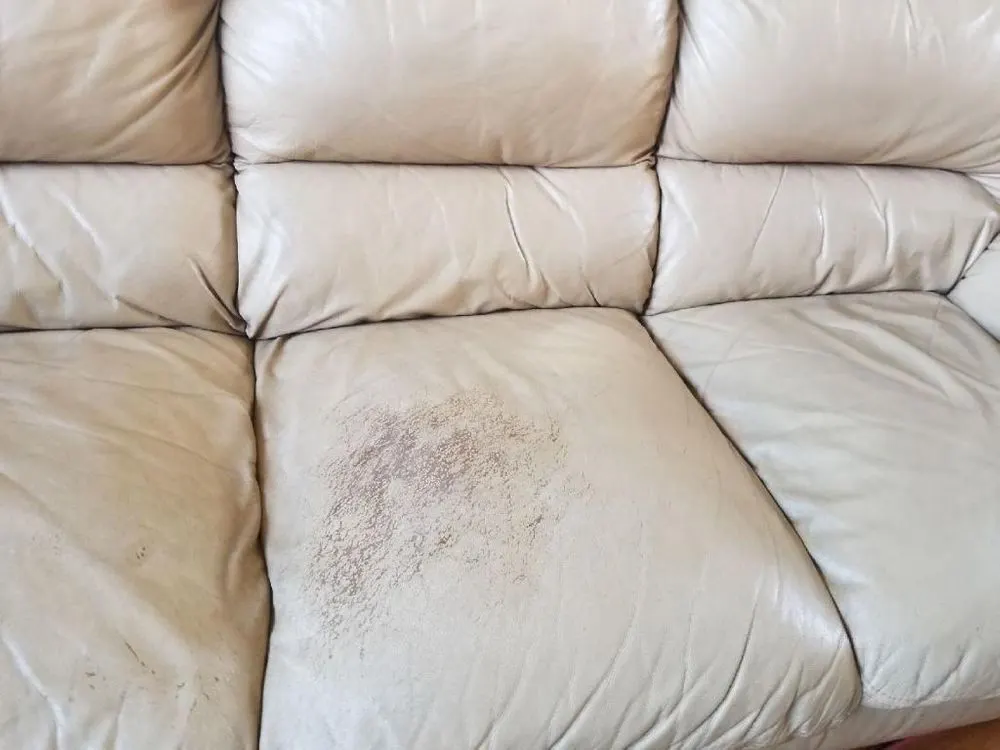
Somewhere around the twentieth or thirtieth use on the same area, the sheen changes slightly — the spot is a little duller or a little shinier than the leather beside it, depending on the original finish. Almost nobody notices this stage.
Then the color goes. The topcoat has thinned enough that pigment is exposed, so the area looks pale and starts transferring color onto the cloth.
Then the surface goes tacky, because what remains of the coating has broken down.
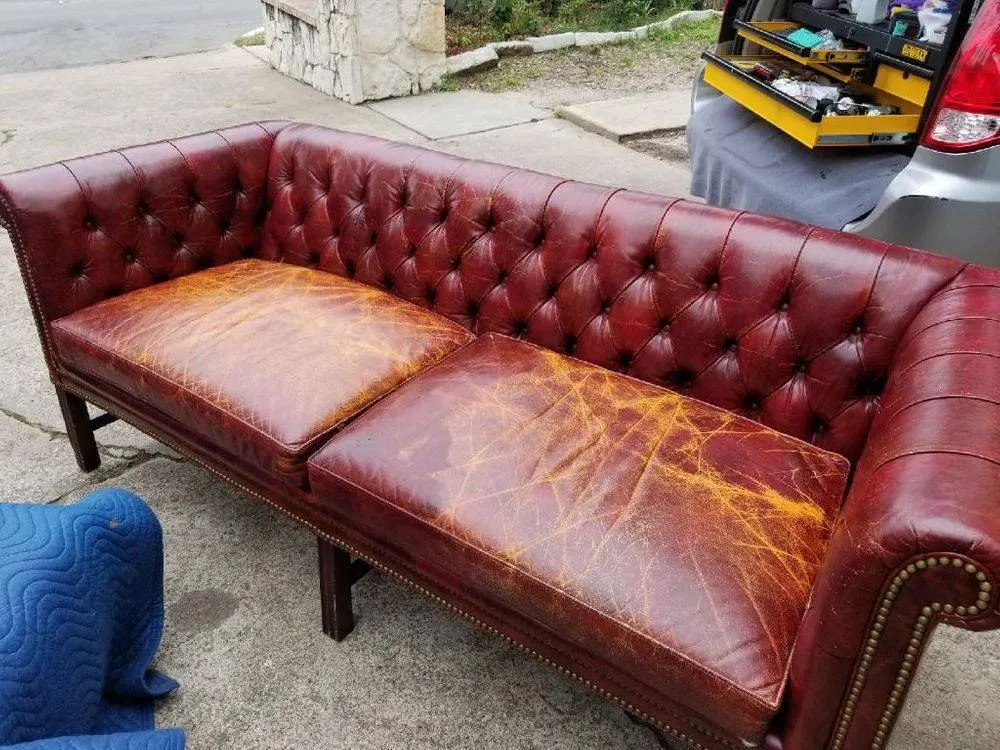
Then it cracks, because there is nothing flexible left to protect the hide.
By the time someone asks about it, the answer is refinishing rather than a change of product — although the change of product still has to happen, or the refinished panel goes the same way.
The specific products, and what each one does
All-purpose sprays: surfactants plus solvents, formulated for hard surfaces. Dulls and thins a finish with repeated use. The most commonly used and the most quietly destructive.
Disinfectant wipes: usually alcohol, quaternary ammonium compounds, or both. Alcohol dissolves the topcoat directly. In offices and clinics where they are used on a schedule, they are the leading cause of premature seating failure.
Baby wipes: mild by design for skin, but they contain surfactants, preservatives and fragrance, and they leave residue on a coated surface. Used occasionally, minor. Used daily on a headrest, they degrade the finish and build a film.
Glass cleaner: contains ammonia or alcohol in most formulations. Both attack a leather finish.
Melamine foam sponges: not a chemical problem at all. They are a fine abrasive, and they remove the mark by removing the surface it is on.
Dish soap: often suggested as a gentle option. It is a degreaser, and diluted heavily it is survivable, but it strips the finish's natural flexibility and leaves surfactant residue that has to be rinsed — which means more water on the leather.
Furniture polish with silicone: does not strip anything, but leaves a barrier that repels the products used in any future repair and migrates onto clothing.
Vinyl is not immune
People often assume vinyl can take anything because it is plastic. It cannot.
Vinyl stays flexible because of plasticizers mixed into the material. Solvents and strong degreasers extract them, and vinyl that has lost plasticizer becomes hard, then brittle, then crazed with fine cracks.
This is the standard failure in restaurant seating: booths wiped nightly with a kitchen degreaser stiffen and crack years before they should, and the material is blamed rather than the routine.
Alcohol-based products do the same thing to the PU coating on faux leather.
The practical result is identical to leather: use a neutral-pH cleaner intended for the material, keep kitchen and clinical chemistry away from seating, and the surface lasts many times longer.
What to use instead
The list is short and the products are inexpensive relative to a refinish.
For finished leather: a cleaner made for leather upholstery. Applied to a cloth, never sprayed at the surface, worked over a whole panel with light pressure, wiped with a barely damp cloth, dried with a third.
For vinyl and PU: a cleaner formulated for vinyl or a neutral-pH upholstery cleaner. The same application method.
For sanitizing in a commercial setting, where the requirement is real: ask the chemical supplier directly for a product rated safe on coated upholstery, and supply it to the cleaning team rather than assuming they will choose correctly.
For everyday maintenance between cleanings: a barely damp microfiber cloth on headrests and arms, weekly. This removes body oil before it can soften anything and it involves no chemistry at all.
And test anything new on a hidden area, letting it dry fully before judging.
The commercial version of this problem
In offices, restaurants and clinics this is not an occasional mistake but a scheduled process, and it destroys upholstery predictably.
A floor of executive chairs wiped daily with disinfectant wipes shows pale arm caps within a year. The chairs are not low quality; they are being chemically stripped on a rota.
Restaurant booths wiped with kitchen degreaser crack at the seat fronts within two or three years, well short of the material's design life.
Medical and dental settings have a genuine, non-negotiable requirement to disinfect between patients, so the answer is never to clean less — it is to choose a product compatible with the surface.
For a facilities manager, this is the highest-return conversation available: one compatible product, clearly labeled for seating, extends the life of every refinish and every new chair by years. It costs almost nothing and it is routinely overlooked.
Why it happens faster in this climate
Two North Texas factors amplify chemical damage.
Heat. Warm surfaces absorb solvents more readily and reactions run faster, so the same wipe does more on a car seat in August than on a sofa in a cool room. Vehicle interiors show this damage sooner than furniture for exactly that reason.
Dry conditioned air. A finish that has already stiffened from months of low humidity is more brittle, and a brittle coating gives up its surface more easily under both chemical and mechanical action.
Combined, they mean the wipe that would have taken three years to cause visible damage somewhere milder takes considerably less here.
The counterweight is the same as always: clean on a schedule with the right product, condition two to three times a year, and keep the wrong chemistry away entirely.
If the damage has already been done
The first step is stopping, which sounds obvious and often is not, because the damaged area looks dirty and the instinct is to clean it more.
If the area is merely duller than its surroundings, stopping the exposure may be enough. Clean it gently once with an appropriate leather cleaner and leave it alone for a few weeks.
If the color is transferring onto a cloth, the topcoat is gone and the area needs refinishing. Stop cleaning it entirely, because every pass removes pigment.
If it is tacky, the coating is breaking down. Do not apply conditioner — that makes a softening finish softer. It needs cleaning and assessment.
In all cases, the second step matters as much as the first: replace the product in the cupboard. A refinished panel cleaned with the same wipes returns to the same state, and nobody wants to pay for that twice.
A simple household rule
If it is not sold for leather or vinyl upholstery, it does not go on leather or vinyl upholstery.
That single rule eliminates every product listed above and costs nothing to follow.
It is worth communicating to everyone in the household, and in a commercial setting to whoever cleans, because the damage is caused by routine rather than by a decision. Nobody chooses to strip a sofa; someone just grabs the nearest bottle.
Keeping one appropriate cleaner where the household cleaners live, clearly labeled, is more effective than any amount of explanation.
And for the genuinely urgent cases — a spill that needs dealing with right now and no leather cleaner in the house — a barely damp cloth and blotting will hold the situation until the right product is available. Doing less is almost always better than doing it with the wrong thing.
Getting damaged areas assessed
Photograph the affected area square-on in daylight and again from a low raking angle, no flash.
Photograph an unaffected area of the same piece for comparison.
Do the white-cloth rub in an inconspicuous part of the affected area and photograph the cloth. Color on the cloth means the topcoat has gone.
It also helps to note whether the surface feels different from the leather around it. A duller patch that still feels the same is early damage. One that feels rougher, or slightly tacky, has gone further, and the difference decides whether stopping is enough or whether the panel needs rebuilding.
Say exactly what was used and how often — weekly, daily, occasionally — because frequency determines how deep the damage goes.
And say whether the affected areas correspond to where people touch, where a cleaner wipes, or where the sun falls. Those three patterns lead to three different diagnoses, and the first two are the ones this article covers.
For a commercial enquiry, include who does the cleaning and what is on their cart. That single answer usually explains the whole pattern of damage across a floor of chairs or a dining room of booths, and changing it is the cheapest part of any recommendation that follows.
Questions we get asked next
- I have used all-purpose spray on my sofa for years. Is it ruined?
- Probably not ruined, but likely thinner than it should be in the areas you cleaned most. Check by rubbing an inconspicuous spot with a white cloth. No color on the cloth means the topcoat is still doing its job and stopping now is enough. Color means that area needs refinishing.
- Is dish soap and water safe as a budget option?
- It is a degreaser, so it strips a little finish each time and leaves surfactant residue that needs rinsing — which means more water on the leather. A dedicated leather cleaner is inexpensive and does not force that trade-off. Use dish soap only if there is genuinely no alternative, heavily diluted, on a cloth.
- What about wipes sold specifically as leather wipes?
- Those are formulated for the surface and are a reasonable convenience option for quick maintenance. They are not a substitute for periodic proper cleaning, since they do not remove much and they leave a light residue, but they are safe in a way household wipes are not.
- How do I disinfect leather safely in a clinic or restaurant?
- Ask the chemical supplier for a product explicitly rated safe on coated upholstery and finished leather, and supply that to the cleaning team. Most standard disinfectants are formulated for hard surfaces, and using them on a flexible polymer coating is what causes the failures described here.
- cleaning products
- wipes
- chemical damage