How Much Does Leather Car Seat Repair Cost in Dallas–Fort Worth?
Small, single-area leather repairs start around $75, and every car seat gets a firm price from your phone photos before anyone drives anywhere. What moves the number is the damage, the material, how much of the panel needs color, and how many seats are done in one visit. Fort Worth pays the same as Dallas, with no distance surcharge.
Quick answer
Small, single-area leather repairs start around $75, and every leather car seat in Dallas–Fort Worth is quoted per job from your phone photos, with a firm price that is free. A scuffed or faded spot is the smallest job. A cracked or torn bolster, a burn, a split seam or a whole faded seat costs more, and several seats or surfaces done in one visit share the setup. Fort Worth pays the same as Dallas: the photo price is the full price, with no distance surcharge.
At a glance
| Starting point | Small single-area repairs start around $75 |
|---|---|
| Your real number | A firm price from your photos, free, before any visit |
| What raises it | Tears, burns and split seams, full-panel color, perforated or vinyl sections, more seats |
| What lowers it per seat | Doing several seats or surfaces in one visit (shared setup) |
| Fort Worth and suburbs | Same pricing as Dallas: no distance surcharge |
What leather car seat repair costs in Dallas–Fort Worth
Small, single-area leather repairs start around $75. That is the starting point on our leather repair page, and it covers the smallest jobs: a scuff, a worn spot, a small area of lost color on otherwise healthy leather. Everything bigger is priced per job from your photos, and the estimate you get back is a firm number, not a range.
We do not publish a price list for car seats because two seats with the same-looking damage can be very different jobs. The table below shows the jobs we quote most often in Dallas, Fort Worth and the suburbs, from smallest to largest, and what each one involves. The work itself is described on our leather car seat repair page.
| The damage | What the repair involves | How it is priced |
|---|---|---|
| A scuff, a worn spot or a small area of lost color | Cleaned, touched in, color matched and sealed | The smallest job: small single-area repairs start around $75 |
| Driver's bolster worn or cracked, still intact | Cracks filled with flexible compound, re-grained, recolored to factory shade, sealed with an abrasion topcoat | Per job from photos; the most common car seat quote we give |
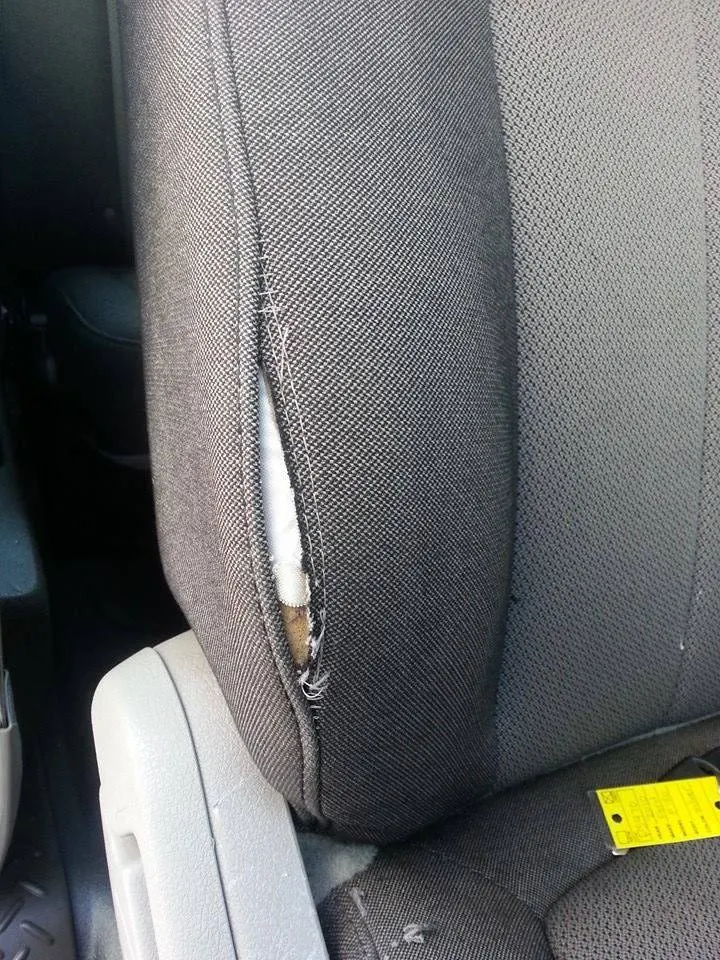
| Tear, split or a burn or hole | Backed from beneath, filled in layers, grain-matched and color-blended into the panel | Per job from photos; more work than a crack of the same size |
| Split seam or stitching | Seam work on the panel, then the area refinished | Per job from photos |
| A whole seat faded or color worn through | Refinishing by area, blended so the seat reads uniform | Per job from photos; priced by area rather than by severity |
| Several seats, or seats plus wheel, console and doors | Assessed and repaired together in one visit | One quote, itemized, with pricing that reflects the shared setup |
How to read this table: only the first row has a published number, because every other row depends on the size of the damage and the leather around it. Find the row that looks like your seat, then send photos; the reply is a firm price for exactly that job.
Why a car seat is priced from photos, not a list
A price list would have to guess. Two driver's seats with a crack of the same length can need very different work: on one the leather around the crack is supple and the repair is contained; on the other the leather has dried and stiffened across the whole bolster, so the honest job is a wider refinish, or a trim shop.
Photos settle that in minutes. You send the whole seat and close-ups of the damage, we identify the material and the stage of the damage, and the reply is a firm price and a plain recommendation. No visit is needed to get a number, and the estimate is free.
The price from photos is the price, unless the damage turns out to be materially different in person from what the photos could show. That is rare, and it is discussed before any work starts. Our general guide to what changes a leather repair quote explains the same logic for furniture and cars together.
What changes the price of a leather car seat repair
Six things decide the size of a car seat job. None of them is the make of the car on its own; a worn bolster on an older truck and one on a new SUV are repaired the same way.
| Factor | Why it changes the quote | What to send or tell us |
|---|---|---|
| Type and stage of damage | A worn finish is touched in; a crack is filled in layers; a tear or burn is backed, filled and grained first | A close-up of each damaged spot |
| Condition of the leather around it | Supple leather holds a contained repair; leather brittle across the seat needs a wider refinish or a trim shop | Say whether the leather beside the damage feels soft or stiff |
| Material: leather, vinyl or perforated | Many seats mix leather centers with vinyl sides, and each takes its own fillers, colors and topcoat; perforated panels need their holes kept open | A photo of the seat center and the side together |
| How much of the panel needs color | Color is blended so the repaired panel reads uniform, so the area colored is often larger than the damage | A photo of the whole seat, not only the close-up |
| How many seats or surfaces | Setup and color mixing are shared across everything done in one visit | A list of every seat, the wheel, console or doors you want looked at |
| Access to the seat | Seats are repaired in place almost always; removal is needed only when access requires it, and then it happens in the same visit | The year, make and model |
How to read this table: the first three rows decide how much work one seat takes; the last three decide how the job is organized. The fastest way to an accurate price is to send everything in the right-hand column with your first message.
The driver's bolster: the repair most people are pricing
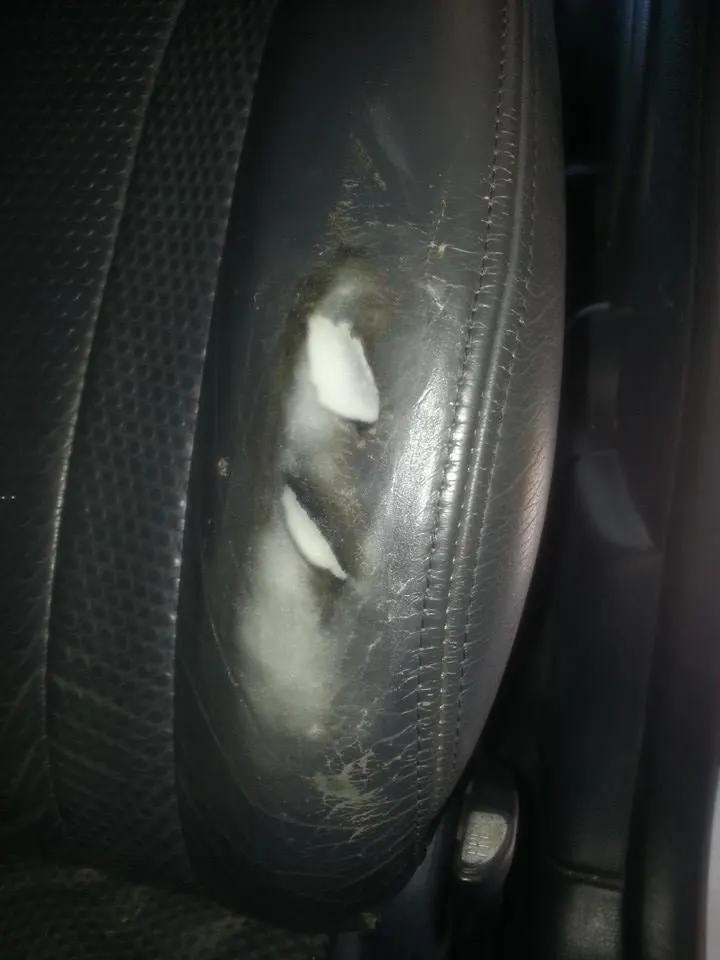
If you are reading this because of one seat, it is almost always the outer bolster of the driver's seat. You slide across it under your full weight every time you get in and out, so the finish wears first, then the leather dries, then the crease lines crack, and finally the seam beside them lets go.
The stage decides the price. A bolster that is only worn or losing color is the easiest and least expensive to fix. Once it has cracked, it is filled, re-grained, recolored and sealed in stages. Once it has split or worn through to the padding, the estimate tells you whether a repair will hold or whether a sewn-in new panel from an auto trim shop is the better answer, because new panels and covers are trim shop work, not ours.
That is why it pays to send photos early. A bolster caught while it is still worn rather than torn is a smaller job, and in Dallas heat a bolster moves from one stage to the next sooner. Why the driver-side bolster wears first walks through the three stages in detail.
Leather, vinyl or perforated: does the material change the price?
It changes the work, so it can change the price. Many cars that are sold as having leather seats use genuine leather on the seating surfaces and vinyl on the bolsters, backs and sides. Both repair well, but they take different fillers, colors and topcoats, so each surface is identified from your photos before it is priced. Leather or vinyl car seats shows how to tell them apart.
Perforated seats take extra care. The holes are kept open through the fill and the finish, and very little liquid is used near them, because anything that runs into the perforations reaches the foam and, on ventilated seats, the ducting. That is routine work for us, and heated and ventilated seats keep working after the repair.
Cloth and vinyl seats are repaired too: vinyl is welded and re-grained to its pattern, and burns and small tears in cloth are patched with matched material. Our car seat repair page covers all three materials.
Why the color work is part of the price
On a car seat, the color is what makes a repair disappear or stand out. We match to your actual seat, and factory color references by seat code help confirm the mix. The color is applied in thin layers and sealed with a topcoat matched to the original sheen.
Then the repaired area is blended into the panel, so the seat reads as one piece instead of a seat with a patch. That blending is why a quote can cover more area than the crack itself: the edge of the color has to fall where the eye expects a break, such as a seam.
A cheap repair usually skips exactly this step. A generic color from a kit, one thick pass of filler and no topcoat give a near-match that looks wrong in daylight and cracks along its own edge. Fixing a failed kit repair means removing it first, which adds to the job, so leave the seat as it is until we see it.
One seat or the whole interior: how to get more for the visit
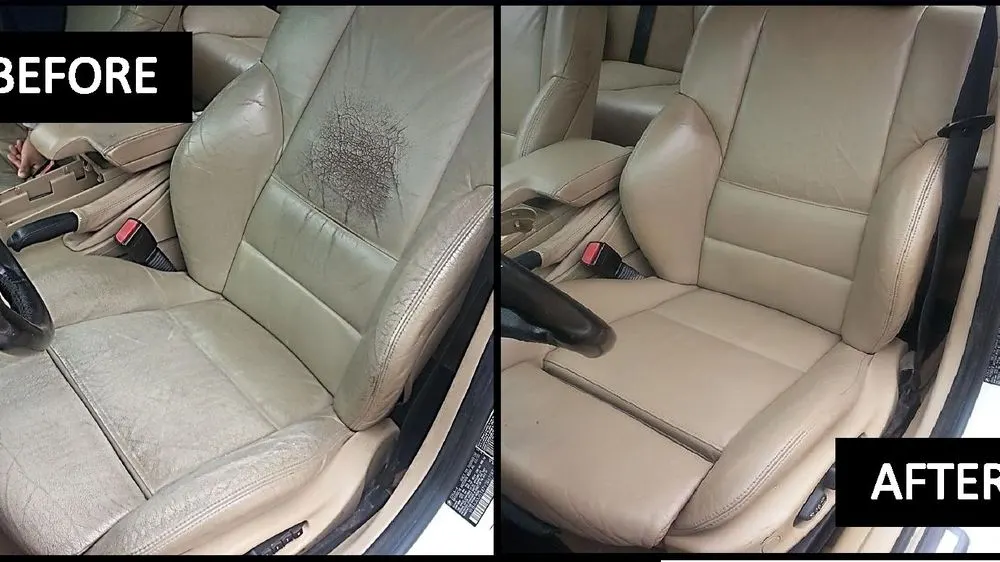
Travel, setup and color mixing are largely fixed per visit, so a second seat in the same appointment adds less work than the first. That is the one cost factor you control.
Our auto leather repair service is built around it: seats, steering wheel, console and doors are assessed and repaired together, with pricing that reflects the shared setup. Door panels done together are quoted as a package, and a full interior quote is itemized surface by surface so you can phase the work if you prefer.
Two situations make this especially worth doing. Before a sale or a lease return, worn leather is one of the first things an appraiser or buyer sees, and the repair cost is typically far below the value or fee impact. And for business vehicles, fleets get multi-vehicle scheduling and per-seat pricing, with visits to your yard or lot.
Fort Worth, Dallas and the suburbs: does your location change the price?
No. This is a fully mobile service, and the work happens where the car is parked: your driveway, your office lot, a parking garage or a dealership. Nothing is towed to a shop and there is no drop-off to arrange.
Fort Worth is core territory with regular routes, not an occasional trip, and the photo estimate there is the full price, with no distance surcharge. Our Frisco, Mesquite and Mansfield pages say the same thing: the photo estimate is the whole price, no trip fees. A seat in Tanglewood or Ridglea, an office lot in the Cultural District, a driveway in West Plano or a garage in Uptown Dallas is quoted the same way.
All we need on the day is access to the vehicle and some shade or cover. Our Fort Worth car seat repair and Plano car seat repair pages describe how a local visit works.
When paying for a repair is not the right call
Repair is the answer while the leather around the damage is still sound. When the leather is brittle across the whole seat and splitting in several places, or a bonded material is peeling everywhere, the honest recommendation is to recover the seat at an auto trim shop, and the estimate says so before you spend anything.
Damage on or right next to a side airbag seam is the one case we send to a trim shop that works to the manufacturer's specification. Seat motors, frames, springs, wiring and airbag modules belong to the dealer or a trim shop as well.
Seat covers are a different question. A repair removes the damage; a cover hides it, shifts around under you and, on seats with side airbags, must be one the vehicle maker allows. For single-area damage, a repair usually costs about the same as quality covers or less. Car seat covers or repair compares the two in detail.
Why Dallas–Fort Worth drivers call Leather Repair Dallas
Leather Repair Dallas, legally Dallas Leather Reconditioning Specialist, is owned by technician Francisco Avila, and the service is mobile across the whole metroplex. Seats are repaired in place, most repairs take one visit of one to three hours, and you drive the car the same day, with a specific light-touch window given at the visit.
The price is settled before the visit: free, from photos, and firm. Hours are Monday to Friday 9 to 5 and Saturday 10 to 4, and most appointments are scheduled within days of estimate approval. If the right answer is a trim shop, a dealer or no repair at all, you hear that from the photos rather than after a wasted trip.
How to get a firm price for your car seat
Ordinary phone photos in normal light are enough. Send the whole seat from the open door, a close-up of each damaged spot, a low-angle shot along any crack, the seat center and side together so we can see whether they are leather or vinyl, and any other seat or surface you want quoted at the same time.
Add the year, make and model, say whether the seat is heated, ventilated or perforated, and mention anything already used on it, such as a repair kit, glue or wipes. Do not tape, glue or trim the damage before we see it.
Text the photos to (972) 522-9763 or send them through the free photo estimate form. You get a firm price and an honest recommendation back, for Fort Worth, Dallas or anywhere in between.
Questions we get asked next
- How much does it cost to repair a leather car seat in Fort Worth?
- Small single-area leather repairs start around $75, and larger jobs such as a cracked or torn bolster, a burn or a whole faded seat are priced per job from your photos. Fort Worth pays the same as Dallas: the photo estimate is the full price, with no distance surcharge.
- Is the photo estimate really free, and is it the final price?
- Yes. The photo estimate is free with no obligation. The price quoted from photos is the price, unless the damage turns out to be materially different in person from what the photos could show, which is rare and is discussed before any work starts.
- Is a cracked driver's bolster expensive to fix?
- It depends on the stage. A bolster that is only worn or losing color is the easiest and least expensive to fix. A cracked bolster is filled, re-grained, recolored and sealed in stages. Once it has split through to the padding, the estimate tells you whether a repair will hold or a trim shop panel is the better answer.
- Do perforated, heated or ventilated seats cost more to repair?
- They take more care: the holes are kept open through the fill and the finish, and very little liquid is used near them. Heated and ventilated seats keep working after the repair. Send a close-up of the perforated area so the estimate covers it.
- Is it cheaper to repair several seats at once?
- Per seat, yes. Setup, travel and color mixing are shared across everything done in one visit, so seats, the steering wheel, the console and the doors are quoted together with pricing that reflects the shared setup.
- Do the seats have to come out of the car?
- Almost never. Repairs happen in place, in your driveway or office lot. If access genuinely requires removing a seat, removal and reinstallation happen in the same visit.
- Is repairing a seat cheaper than buying seat covers?
- For single-area damage, a repair usually costs about the same as quality covers or less, and it removes the damage instead of hiding it. On seats with side airbags, a cover must be one the vehicle maker allows.
- When is a leather car seat not worth repairing?
- When the leather is brittle across the whole seat and splitting in several places, or a bonded material is peeling everywhere. Then the honest recommendation is to recover the seat at an auto trim shop, and the estimate says so. Damage on a side airbag seam also goes to a trim shop.
- leather car seat repair
- cost
- estimates
- fort worth
- dallas