Can a Cracked or Scratched Leather Ottoman Be Repaired at Home?
An ottoman is the one piece of leather furniture where a careful owner can genuinely do some of the work themselves.
Quick answer
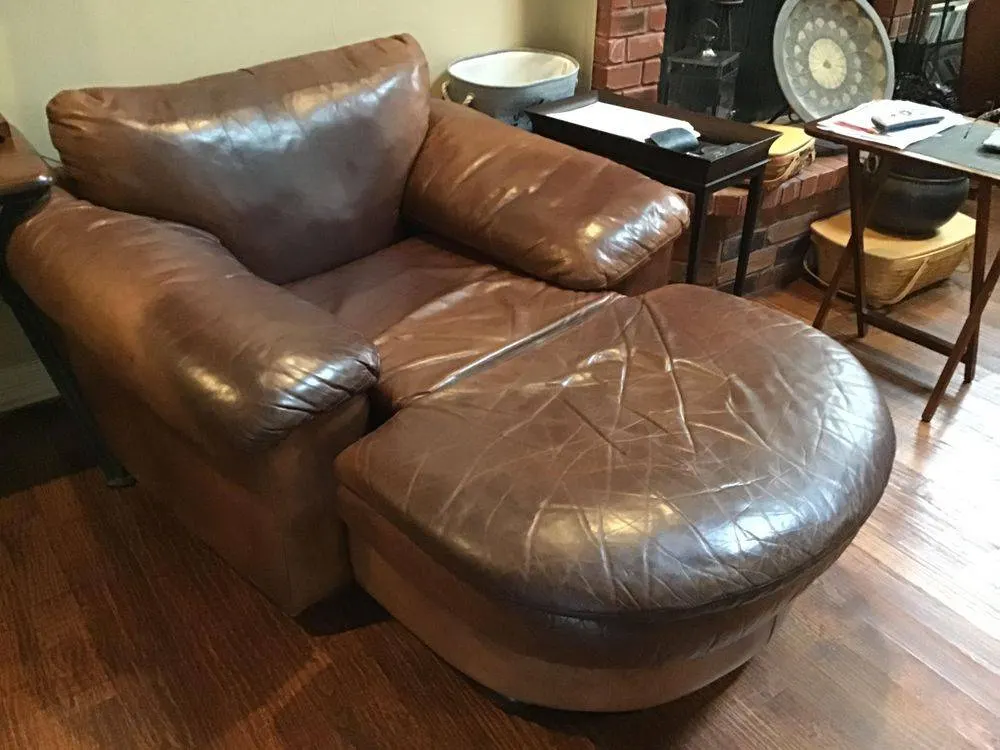
Cleaning, conditioning and light surface scratches — yes, genuinely, and an ottoman is the best piece in the house to try on. It is small, mostly flat, and usually not the focal point of the room. What is not worth attempting at home is color matching across a whole top, cracks that have gone through into the hide, and anything on aniline leather. Those three account for most of the failed DIY repairs we are called to correct.
At a glance
| Reasonable at home | Cleaning, conditioning, light surface scratches |
|---|---|
| Not worth attempting | Whole-top color matching, deep cracks, anything aniline |
| Why ottomans wear | They are used as tables, footrests and seats at once |
| Check underneath | Feet and the frame take more abuse than the top |
| A tray helps | The single most effective preventive measure |
Why ottomans take so much damage
An ottoman leads a harder life than almost anything else in a living room, because it does several jobs at once.
It is a footrest, so it takes shoes, heels and the constant abrasion of feet being repositioned.
It is a table, so it takes drinks, plates, laptops, remote controls and anything with a hard edge or a wet base.
It is extra seating when the room is full, and it takes that load on a surface not designed for it.
It is a play surface for children and a jumping-off point for pets.
And it is at shin height in the middle of a room, so it gets knocked, kicked and pushed against furniture.
All of that lands on one mostly flat panel, which is why an ottoman frequently looks worse than the sofa it belongs to.
What is genuinely reasonable to do yourself
An ottoman is the right place to try, because the stakes are lower than on a sofa and the geometry is simple.
Cleaning is entirely a home job. A leather-appropriate cleaner, applied to a cloth, worked across the whole panel rather than in patches, then dried. This alone lifts a surprising amount of what people take for damage.
Conditioning likewise — a small amount, worked in, buffed off with a clean cloth. On an ottoman that has never been conditioned, this often improves the appearance considerably.
Light surface scratches that do not catch a fingernail frequently improve with cleaning and conditioning alone, because much of what you are seeing is displaced finish rather than removed finish.
Gently warming a light scratch with your hand or a hairdryer at a low setting and held well back, then working conditioner in, can help further on some finishes. Test on a hidden area first.
And routine care — wiping spills promptly, vacuuming the seams, keeping it out of direct sun — is entirely yours to do and is worth more than any repair.
The three things not to attempt
These account for most of the repairs we are called in to correct, and the correction usually costs more than the original job would have.
Color matching across a whole top. Consumer color kits are supplied in generic shades, and matching an aged leather requires mixing against the actual piece. A top recolored in a near-match reads as wrong across its whole area, and the product then has to be removed before a proper job.
Cracks that catch a fingernail. Those have gone through the finish into the hide, and filling them requires flexible compounds applied in thin layers with the grain matched. Consumer fillers cure hard, crack along their edges, and leave a shiny smooth patch that is more visible than the crack.
Anything on aniline leather. It has no protective coating, absorbs everything, and marks from water alone. Home products commonly leave a ring or a patch that is worse than the original mark and is difficult to correct.
The unifying point is that all three are irreversible in a way that cleaning is not. A bad clean can be redone; a bad recolor has to be stripped.
Why repair kits disappoint
They are inexpensive and widely sold and the failure mode is consistent, so it is worth explaining.
The colors are generic. Leather is rarely a standard shade, and it has aged away from whatever it was, so a kit color is an approximation.
The fillers are firmer than professional compounds and they cure hard. On a surface that flexes — and an ottoman top flexes under feet — they crack along their own edges.
The grain papers supplied are generic patterns that rarely match the actual grain of the piece.
There is no topcoat in most kits, so the repair has a different sheen from its surroundings and it soils faster.
And the instructions do not include degreasing, which on an ottoman that has had feet on it for years is the step that determines whether anything bonds.
Used on a small hidden area by a careful person, a kit can be adequate. Used on a visible top panel, the usual outcome is a patch that draws the eye more than the damage did.
Assessing what you actually have
Three checks that tell you which category you are in, and they take two minutes.
Run a fingernail across the damage. If it does not catch, the damage is in the finish and home care may improve it. If it catches, it has gone into the hide.
Put a drop of water on a hidden area. If it beads, the surface is sealed and is pigmented leather or a synthetic. If it darkens and soaks in, it is aniline and should be left to a specialist.
Press a thumb into the leather beside the damage. If it yields and springs back, the hide is supple. If it feels board-like, it has stiffened and any repair will be chasing new cracks.
Also look at whether the damage is one area or spread across the top. Isolated damage on a sound panel is one thing; a top that is generally worn and faded is a refinishing job.
And check whether it flakes. Peeling means bonded or coated synthetic rather than hide, and no home treatment addresses delamination.
When to call someone
The threshold is clearer on an ottoman than on most pieces because the damage is usually concentrated on one panel.
Cracks that catch a fingernail, or that are spreading.
Color loss across a significant part of the top.
Tears, punctures, burns or anything where material is missing.
Any damage on aniline leather.
Peeling or flaking, which means the material is failing rather than the finish.
A top that dips, feels soft or has lost its shape, which is padding rather than covering.
And anything where a home attempt has already been made and looks worse — that is worth stopping immediately rather than escalating, and photographing before anything else is tried.
What professional repair involves
For an ottoman, the work is straightforward and the flat geometry helps.
The panel is cleaned and thoroughly degreased. Feet deposit oils, and an ottoman used as a footrest for years is heavily contaminated even when it looks clean.
Cracks and worn areas are filled with flexible compound in thin layers, each allowed to set.
The texture is matched to the surrounding grain, which on a flat panel with consistent grain is straightforward.
Color is mixed on site against the piece as it is now, applied in light coats, and sealed with a flexible topcoat at a matched sheen.
Because an ottoman top is a single flat panel bounded by seams, it is one of the easier pieces to make look genuinely uniform — the whole panel is done to its seam lines and there is no blending problem.
And it is small, so the whole job is usually quick compared with sofa work.
The parts underneath
Worth checking while anything is being assessed, since ottomans take structural abuse.
The feet, which are knocked, dragged and kicked more than on any other piece. Loose feet are common and they are a simple fix.
The frame, which takes people sitting on a piece designed for feet. A frame that creaks or gives needs attention.
The padding, which compresses under both feet and occasional seating. A top that dips or feels hard is a foam issue, and on an ottoman with a removable top panel it is usually straightforward to replace.
Storage ottomans have hinges, gas struts and a lid that takes load, all of which can fail independently of the leather.
And the deck or webbing beneath the padding, which sags over time.
Sitting on it and pressing it firmly tells you most of this in a few seconds, and it is worth doing before deciding that the problem is the leather.
Preventing the next round
An ottoman responds better to prevention than almost anything, because most of its damage comes from a few specific uses.
A tray. This is the single most effective measure — it gives drinks and plates somewhere to go, it stops rings and spills, and it takes the hard edges.
A throw over the section used as a footrest, particularly in a household where shoes stay on.
Discourage sitting on it if the frame is not built for it, or accept that it will need structural attention.
Trim pet claws and give the pet an alternative, since ottomans are a favorite jumping-off point.
Wipe spills immediately, since the top is horizontal and liquid pools rather than running off.
Condition on the same schedule as the rest of the room's leather, and do not forget it — ottomans are the piece most often left out of a care routine.
And rotate it if it is square, so one edge does not take everything.
What to send for an assessment
Photograph the whole top square-on in daylight, then close up on the damage, then at a low raking angle.
Photograph the sides and the feet, since those often need attention too.
Run a fingernail across the damage and say whether it catches.
Do a water-drop test on a hidden area — usually the underside of an edge — and say whether it beads or soaks in.
Press a thumb beside the damage and say whether the leather is supple or board-like.
Press the top and say whether it feels firm, soft or dipped.
Say what you have already tried on it, particularly any repair kit or household product.
And say whether the ottoman needs to match a chair or sofa, since that determines whether the work should extend beyond the ottoman.
Questions we get asked next
- Can I fix leather scratches on an ottoman myself?
- Light scratches that do not catch a fingernail, yes — cleaning and conditioning often improve them considerably, because much of what you see is displaced finish rather than removed finish. Scratches that catch a nail have gone into the hide and need filling and texture matching.
- Are leather repair kits any good?
- For a small hidden area, sometimes. On a visible top panel they usually disappoint: generic colors, fillers that cure hard and crack, grain papers that do not match, and no topcoat. The result often draws the eye more than the damage did, and it has to be removed before a proper repair.
- My ottoman top dips in the middle. Is that a leather problem?
- No, that is padding or the deck beneath it. No amount of surface work changes how a top sits. On an ottoman with a removable top panel, replacing the foam is usually straightforward and it is often the better first spend.
- Why does my ottoman look worse than the sofa it matches?
- Because it does several jobs at once — footrest, table, extra seat, pet launchpad — and all of that lands on one flat panel. It is also the piece most often left out of a care routine. A tray and a throw on the footrest section prevent most of it.
- ottoman
- DIY
- scratches