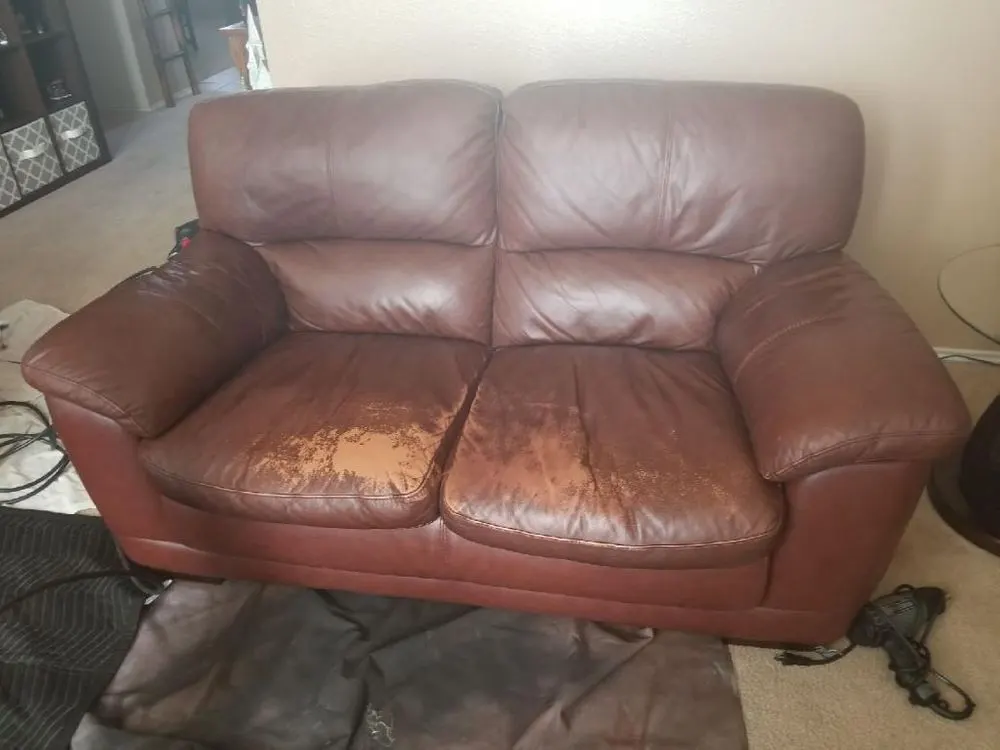
Can Pet Urine Stains and Odor Be Removed from Leather and Cushion Foam?
Pet urine is the one accident where cleaning the leather perfectly can leave you exactly where you started.
Quick answer
The stain usually can; the odor depends entirely on how far the urine traveled. Urine passes through seams and stitch holes into the foam, and foam holds it. Cleaning the leather removes the visible mark and leaves the source, which is why the smell returns in warm humid weather. Real resolution means treating or replacing the foam as well — and on leather, urine is chemically damaging as well as staining, so speed matters more than with any other spill.
At a glance
| Two problems | Staining on the leather, odor in the foam beneath |
|---|---|
| Why it returns | Warmth and humidity reactivate salts left in the foam |
| Chemically damaging | Urine degrades leather, not just discolors it |
| Act immediately | Blot before it reaches the seams — that is the whole window |
| Often needed | Foam replacement, not just cleaning |
Why urine is different from other spills
Most spills are a surface problem. Urine is three problems at once, which is why it is treated differently.
It stains. The pigments and concentrated compounds discolor leather, particularly light-colored leather.
It damages. Urine is not chemically neutral — it contains ammonia and uric acid compounds, and it changes pH as it breaks down. That attacks the protein structure of leather, degrades the finish, and can stiffen or discolor the hide permanently.
And it soaks. Unlike a drink spilled on a flat surface, urine typically arrives in quantity and finds seams, stitch holes and cushion gaps, which puts it into the foam.
That third point is the one that matters most, because it is where the odor lives and it is invisible.
So an owner can clean the leather thoroughly, see no mark, and still have a sofa that smells every August.
Why the smell keeps coming back
This is the most common complaint and the mechanism is worth understanding.
As urine dries, it leaves behind uric acid salts. Those crystals are not water-soluble in the way the rest of the liquid is, so ordinary cleaning does not remove them — it removes the parts around them.
The crystals sit in the foam, dormant and largely odorless while dry.
When humidity rises, they take up moisture and become active again, releasing the odor.
In North Texas that means a sofa that seems fine through a dry spell and smells noticeably in warm humid weather, or whenever someone sits on it and compresses warm damp air out of the cushion.
It also means every summer, indefinitely, until the source is addressed.
Enzyme-based treatments work by breaking down those compounds rather than washing them away, which is why they are the right category of product — and why they need to reach the foam to do anything.
What to do in the first minutes
The window here is genuinely short and it determines almost everything that follows.
Blot immediately and heavily with dry towels, pressing to absorb. The objective is to remove liquid before it reaches the seams.
Do not rub, which spreads it and works it into the grain and the stitching.
Work from the outside inward to keep the affected area small.
Change to dry towels repeatedly — a saturated towel returns liquid to the leather.
If the cushion cover is removable and the liquid has clearly gone through, take it off now rather than later, so the foam can be dealt with while it is still wet rather than after it has dried in.
Then clean the leather with a product made for it, across the whole panel.
Do not use ammonia-based cleaners on urine. Ammonia is a component of urine, and to a pet it smells like a marked spot, which encourages a repeat.
Treating the leather
Once the liquid is out, the leather needs both cleaning and assessment.
Clean the whole panel with a leather-appropriate cleaner rather than spot-cleaning, which leaves a visibly cleaner patch.
Then look at what remains. A faint tide line is a drying artifact and often evens out. A distinct discoloration means the leather itself has been affected.
Urine damage to a finish is common: a dull patch, a tacky area, or a section where the color has lifted. That is refinishing work rather than cleaning.
On aniline leather, urine reaches the hide immediately and staining is often permanent, with recoloring as the route back.
Check the stiffness. Leather that has been wet with urine and dried can be noticeably harder than the material around it, and that does not soften back with conditioning.
And condition afterward, since both the urine and the cleaning will have stripped oils.
The foam is the real question
This is where the decision is actually made, and it is worth being blunt about it.
If the urine reached the foam, no amount of work on the leather resolves the odor.
Check by removing the cushion cover if it comes off. Look for staining on the foam and on the inside of the leather, and smell the foam directly.
Press the cushion firmly and smell what comes out, which is more revealing than smelling the surface.
Compare the weight against a cushion you know is clean.
Lightly affected foam can sometimes be treated with an enzyme product applied thoroughly enough to reach the whole affected depth, then dried completely with airflow. Partial treatment does not work, because untreated crystals remain.
Heavily affected foam, repeated accidents in the same place, or foam that still smells after treatment and drying should be replaced. It is not expensive relative to the rest of the piece, and it is the only reliable answer.
And the deck fabric under the cushion, plus the frame beneath it, should be checked too, since liquid does not stop at the foam.
Enzyme treatments and how to use them
The right product category, frequently used in a way that cannot work.
Enzyme cleaners break down uric acid compounds biologically rather than washing them away, which is what makes them appropriate here.
They need contact with the affected material. Spraying the surface of a leather cushion does almost nothing, because the problem is inside the foam and the leather is a barrier.
They need time. Most require the area to stay damp for a period while the enzymes work, which means covering it rather than letting it dry immediately.
They need to be applied to the full depth of the affected area, which usually means removing the cover and treating the foam directly.
They are deactivated by other cleaning chemicals, so an area that has had bleach, vinegar or a general cleaner on it may not respond until that residue is gone.
And they are not for the leather surface itself in most cases — the leather is cleaned with a leather product and the foam is treated with the enzyme.
Used correctly on accessible foam they work well. Used as a spray on an intact cushion they are close to useless, which is why so many owners conclude they do not work.
What to keep away from it
Urine accidents attract aggressive treatment and several common choices make things worse.
Ammonia-based cleaners, for the reason above — they smell like urine to a pet and invite a repeat in the same spot.
Bleach, which damages leather permanently and reacts badly with urine compounds.
Vinegar, which is widely recommended and is acidic enough to damage leather finishes, and which does not address uric acid crystals.
Baking soda, which absorbs some odor from surfaces and does nothing about crystals in foam, and which leaves residue in seams.
Steam cleaning, which drives moisture further into the foam and can set proteins.
Masking sprays and deodorizers, which cover the smell temporarily while the source continues.
And saturating the cushion with any liquid, which spreads the affected area rather than treating it.
Repeat accidents and what they mean
Worth addressing directly, because the repair is pointless if this continues.
Pets return to the same spot because they can smell it, even after it seems clean to a person. Residual odor is a marker.
So thorough treatment is part of preventing repetition, not just of fixing damage.
Repeated accidents in the same place also mean the foam has been saturated more than once, which moves the answer decisively toward replacement.
A sudden change in an otherwise house-trained pet is worth a veterinary conversation, since urinary problems and several other conditions present this way. That is genuinely the first call rather than an afterthought.
In the meantime, a waterproof cover on the affected cushion protects both the repair and the foam underneath it.
And giving the pet an acceptable alternative resting place, positioned where they actually want to be, does more than any deterrent.
When replacement beats repair
There is a point at which the honest recommendation is not restoration.
Multiple cushions affected, with odor throughout the piece.
Liquid that has reached the deck fabric, the webbing and the frame, where treatment is impractical.
Foam that still smells after proper enzyme treatment and complete drying.
Leather that has been chemically damaged over a wide area — stiffened, discolored, or with the finish destroyed.
A bonded or coated synthetic piece, where the material is failing anyway and the covering cannot be separated from the problem.
In those cases replacing the cushion inserts and refinishing may still work; replacing the piece may be the better spend.
A specialist should look at the foam and the deck before quoting, because a quote based only on the visible stain is quoting half the job.
What to send for an assessment
Photograph the stain in daylight without flash, close up and with the whole panel visible.
Say how long ago it happened, and whether it has happened more than once in that spot.
Say whether the cushion cover is removable, and if you have removed it, photograph the foam and the inside of the leather.
Say whether there is an odor, whether it is constant or comes and goes with the weather, and whether it is stronger when the cushion is pressed.
Press the cushion and say whether it feels damp or heavier than its neighbors.
Say what has already been used on it, particularly vinegar, bleach or any ammonia-based product.
Press the leather beside the stain and say whether it feels stiffer than elsewhere.
And do a water-drop test on a hidden area, since aniline and pigmented leather have very different outlooks here.
Questions we get asked next
- Why does the smell come back every summer?
- Because uric acid crystals left in the foam are dormant while dry and reactivate when humidity rises. Ordinary cleaning removes the liquid around them and not the crystals themselves, so the source stays in the cushion and announces itself in warm humid weather.
- Will an enzyme spray fix it?
- Only if it reaches the foam. Sprayed on the surface of an intact leather cushion it does almost nothing, because the leather is a barrier and the problem is inside. It needs to be applied to the foam directly, kept damp while it works, and dried thoroughly.
- Does the foam always need replacing?
- No. Lightly affected foam can be treated with an enzyme product applied through its full depth and dried completely. Foam that has been soaked repeatedly, or that still smells after proper treatment, should be replaced — it is inexpensive relative to the rest of the piece.
- Can I use vinegar on pet urine on leather?
- No. It is acidic enough to damage leather finishes, and it does nothing about the uric acid crystals that cause the recurring odor. Ammonia-based cleaners are worse still, because to a pet they smell like a marked spot and invite a repeat.
- pet urine
- odor
- foam